
Nutrition research · Research briefing
Protein Intake and Gut Bacteria: New Review Finds Mixed Effects in Active Adults
The review reports changes in gut bacteria, but microbial measurements alone cannot establish a health benefit or identify a better protein source.
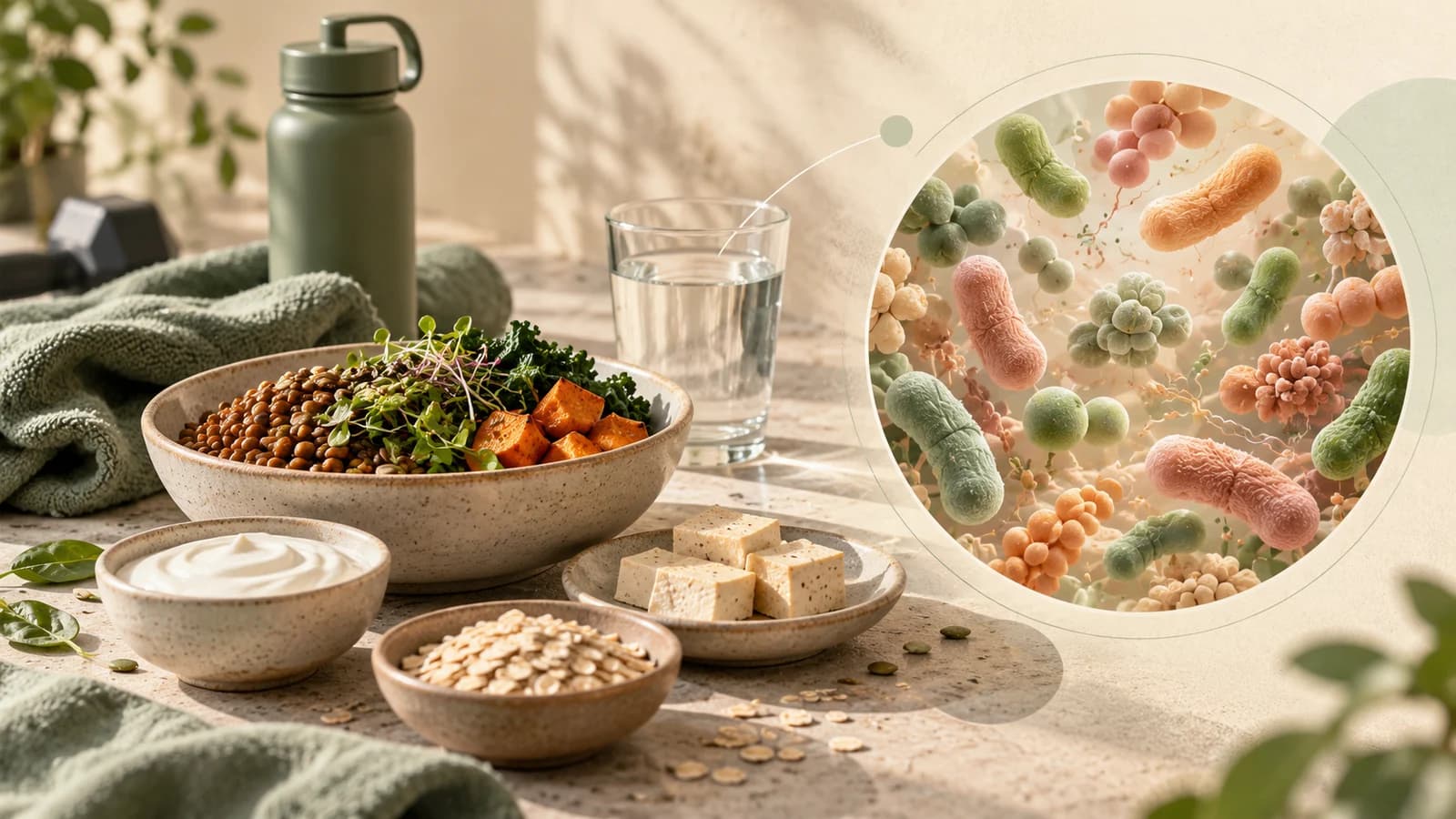
A review of 18 studies involving 819 physically active participants reports a mixed response of gut bacteria to protein intake. Two measures of microbial diversity increased, two others showed no statistically significant change, and the abundance of some bacterial groups fell. Those findings do not, by themselves, show that digestion or long-term health improved or worsened.[1]
The review, published in Nutrition Reviews on October 20, addresses a question that matters to people eating around a training routine. Its findings leave an important question open: what do these microbial changes mean for the health of the people eating the protein?
Evidence access
This briefing is based on the publisher’s abstract and public supplementary files. The subscription-only main paper was not available for full-text verification.
What the researchers examined
Zihan Bao and colleagues searched PubMed, EBSCOhost, the Cochrane Library and Web of Science through June 2026. Two reviewers independently screened records and extracted data. Eligible studies quantified protein intake, included exercise or physical activity, and reported gut microbiota outcomes. Results were combined using random-effects meta-analysis.[1]
The abstract reports increases in the Shannon and Chao1 diversity indices, but no statistically significant change in the Simpson index or observed operational taxonomic units. It also reports reduced Bifidobacterium abundance. This is a synthesis of separate studies, rather than one trial that assigned 819 people to the same diet.[1]
What a diversity score can tell us
Microbial diversity describes aspects of a community, including how many different microbial groups are detected and how evenly they are represented. Chao1 estimates richness; Shannon incorporates richness and evenness. Other indices place different weight on the community’s composition, so agreement between measures cannot be assumed.[3]
A methodological analysis in Scientific Reports describes the challenges of attaching a biological meaning to these scores. A statistically detectable shift in an index does not tell a reader how much better they will feel, whether a disease risk changed, or whether a training routine will become more effective.[3]
Reading the result
The health question needs health outcomes. Microbial diversity and bacterial abundance are not substitutes for evidence about symptoms, disease or performance.
Earlier research shows why diet context matters
A separate 2020 randomized trial provides useful context. Its analysis included 28 healthy older men who completed a 10-week intervention comparing two different levels of protein intake. Investigators supplied whole-food meals and snacks, with similar fiber intake between groups.[5]
After correction for multiple comparisons, that trial found no significant between-group differences in the bacterial abundances or volatile metabolites examined. It was small, unblinded and restricted to older men. It cannot settle the question for athletes, other ages or protein powders, and it does not overturn the new review.[5]
Its value here is narrower: the food pattern, population and measurement method are part of the experiment. A headline about “protein and the gut” can conceal those details.
Where confidence remains limited
Study quality is uneven
The review’s Supplementary Figure S1 includes studies rated at high overall risk of bias as well as studies with some concerns. Supplementary Table S1 lists English-language search restrictions. Both are relevant when judging how representative and dependable a pooled result may be.[2]
Subgroup findings need care
Results within separate subgroups do not establish that protein sources or participant groups differ from one another. Cochrane’s methods guidance calls for direct statistical comparisons and cautions that multiple subgroup analyses create more opportunities for chance findings. Such exploratory results need careful checking before they inform dietary advice.[4]
Some checks remain outstanding
Full-text access is needed to check the overall effect estimates, outcome-specific certainty ratings and complete intervention details. The review’s funding and competing-interest statements also remain unverified for this briefing. That does not mean they are absent: the authors’ PRISMA checklist points to those disclosures in the main manuscript.[2]
What readers can conclude now
The review adds evidence about microbial measurements. A decision to change a protein source, alter a daily target or buy a supplement needs a closer match between the evidence and the intended outcome.
In particular, a drop in a bacterial group does not identify a probiotic product that will help. NCCIH notes that probiotic effects can differ between organisms and products; evidence for one strain or condition cannot simply be transferred to another.[6]
The next useful research will connect these microbial findings to clinical or performance outcomes over longer follow-up. Until then, the results are best read as a reason to investigate further, rather than a new rule for the protein on your plate.
Our protein-safety guide provides broader background. This report examines a specific review and its accessible supplementary evidence.
Check the evidence
Sources & reporting notes
- Effects of Protein Intake on Gut Microbiota in Physically Active Individuals: A Systematic Review and Meta-Analysis
Bao Z, Jiao M, Zhao M, et al. · Nutrition Reviews · Published October 20, 2026
Primary news source. Publication details and headline findings checked against the publisher’s abstract and publisher-deposited metadata. Main text requires subscription access.
- Public supplementary data and PRISMA 2020 checklist for the Bao et al. review
Nutrition Reviews · Supplementary Tables S1–S3 and Figure S1 · October 2026
Public files checked for search restrictions, study risk of bias and reporting details. Figure S1 informs the bias discussion; the PRISMA checklist identifies disclosures in the subscription article.
- Key features and guidelines for the application of microbial alpha diversity metrics
Scientific Reports · 2025 · doi:10.1038/s41598-024-77864-y
Background on the differences between diversity measures and the difficulty of interpreting them biologically.
- Cochrane Handbook Chapter 10: Analysing data and undertaking meta-analyses
Cochrane · Sections 10.11.3 and 10.11.6
Independent methodological context on subgroup comparisons, statistical interaction and the risk of overinterpreting exploratory analyses. This is published guidance, not an interview about the new paper.
- A period of 10 weeks of increased protein consumption does not alter faecal microbiota or volatile metabolites in healthy older men: a randomised controlled trial
Journal of Nutritional Science · 2020 · doi:10.1017/jns.2020.15
Full open-access text checked for background context. This trial concerns older men and is not a direct replication of the active-population review. We did not establish whether it was included in that review.
- Probiotics: What You Need To Know
National Center for Complementary and Integrative Health · NIH
Background on why evidence for probiotics depends on the organism, product and condition being studied.
How this briefing was prepared
Headline findings and publication details were checked against the publisher’s abstract and bibliographic records. Public supplementary files informed the discussion of search restrictions, bias and reporting. The earlier trial was read in full; it is included as background, not a replication of the new review. We did not independently recalculate the meta-analysis or interview the researchers. The evidence-access limits described above apply throughout this briefing.
AI assisted with drafting and illustration. No independent medical review is claimed. See our editorial policy or request a correction.
This article provides general research information, not individual medical advice. Discuss personal dietary changes with an appropriately qualified health professional.