
Food prices · Food price analysis
What Does a $23.68 Thanksgiving Turkey Put on the Plate?
The 2026 Farm Bureau survey puts a 16-pound frozen bird at $23.68. USDA yield and nutrition data help put that grocery bill in terms of servings, leftovers and the price of the protein you actually eat.
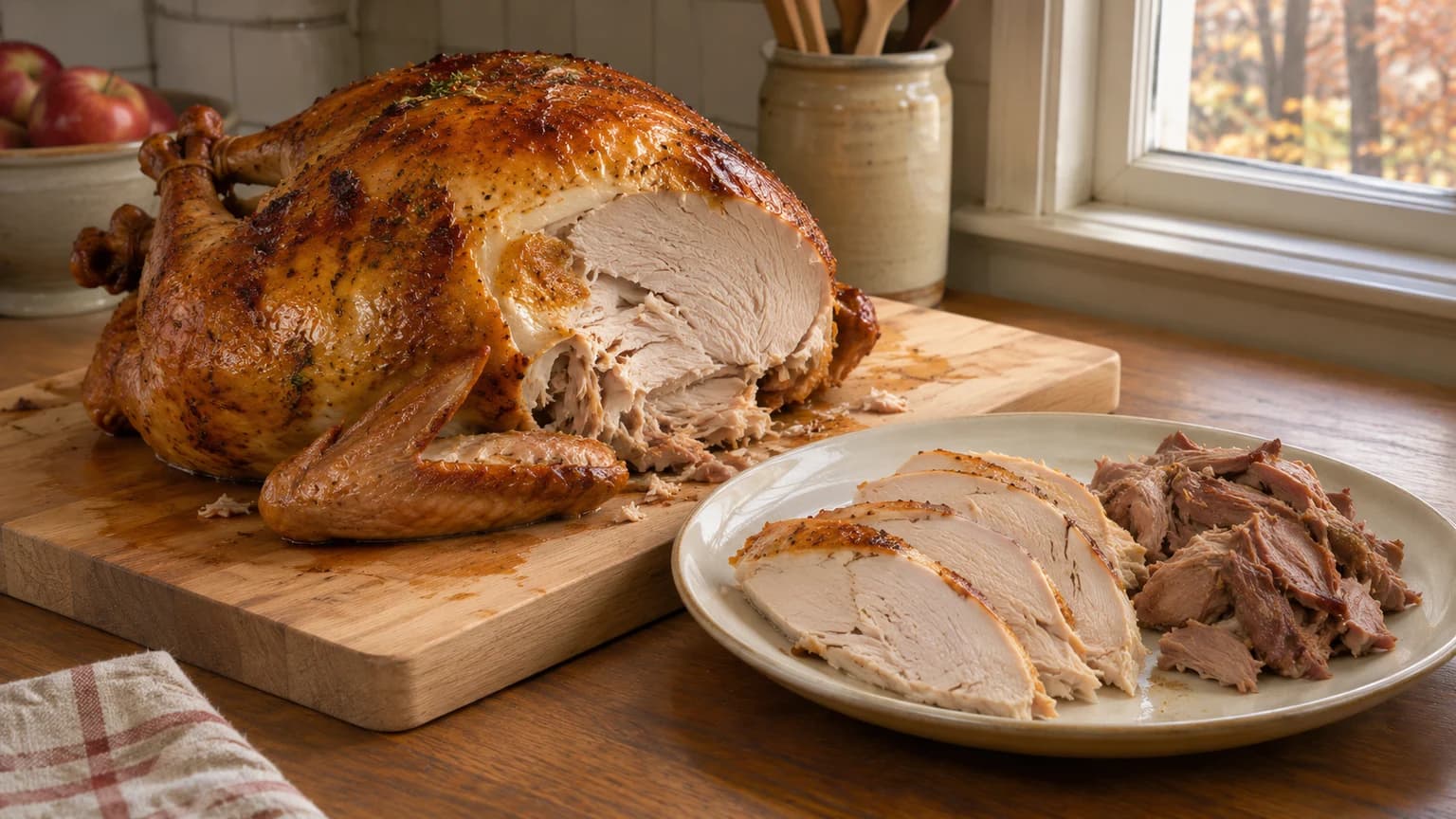
The weight on a Thanksgiving turkey does double duty. At the grocery store it determines the bill. At home it helps you decide whether there will be enough for dinner and whether you should clear a shelf for leftovers. One number has to answer both questions, even though a good share of the weight on the label will never reach the carving platter. That gap matters more when the turkey is the biggest line on the holiday receipt.[1][2]
In its Thanksgiving survey released November 18, the American Farm Bureau Federation put the U.S. average price of a 16-pound frozen turkey at $23.68. Its full basket for ten came to $58.63, up from $55.18 in 2025. The turkey itself cost about ten percent more in the survey than it did a year earlier. For shoppers picking up a bird ahead of November 26, those figures offer a way to tell whether a price on the shelf is unusually good or simply familiar.[1][4][10]
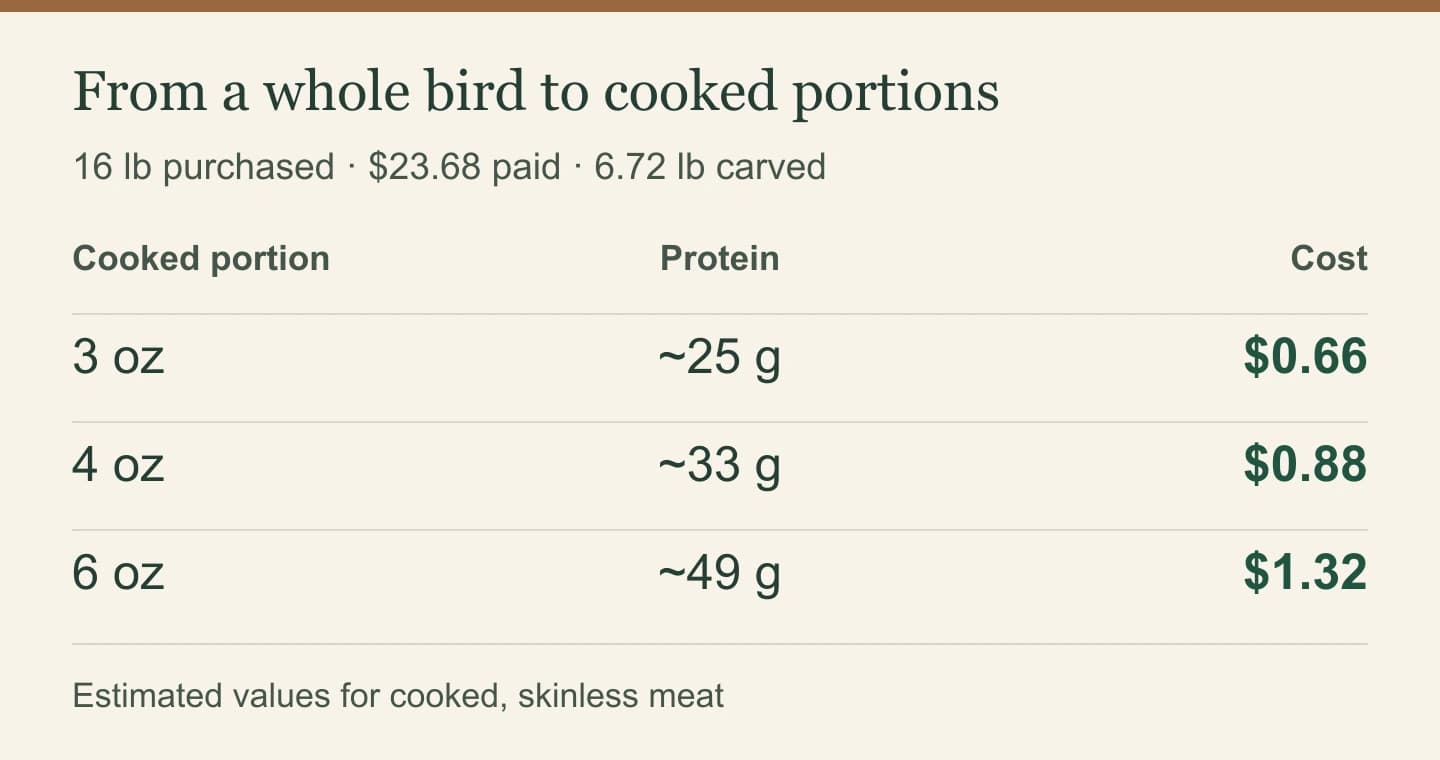
There is another comparison shoppers can make at the same time. A USDA food-buying table puts the cooked, skinless meat from a whole turkey bought with its neck and giblets at roughly 42 percent of the purchased weight. At the survey's size, that leaves about 6.7 pounds of edible meat. A three-ounce portion works out to about 66 cents and roughly 25 grams of protein using USDA's nutrient reference for roasted whole turkey meat.[1][2][3]
That is enough to make sense of the shelf tag, compare a smaller bird and work out how much meat has to fit in the refrigerator after dinner. The arithmetic gets more useful when the guest list and the advertised deal are real. A coupon may change the checkout total. Bone, skin and carving change the yield. Your plans for the extra meat determine how much of that yield you get value from.
Evidence access
The Farm Bureau price survey, the USDA Food Buying Guide and the USDA nutrient record are public. The serving counts and costs below are ProteinCalc calculations based on those inputs. The estimates describe a specified whole-bird scenario and can be recalculated with your receipt and carved weight.
The price and portions in brief
- The 2026 survey put the turkey at $1.48 per pound as sold and the full basket for ten at $58.63.
- The USDA yield factor implies roughly 6.7 pounds of cooked, skinless meat from a 16-pound whole bird purchased with the neck and giblets.
- At the survey price and modeled yield, three cooked ounces cost about 66 cents and provide roughly 25 grams of protein.
- Compare offers using the whole checkout price and the amount your household expects to serve or save.
What the $23.68 price measures
Farm Bureau's volunteers gathered prices in the first week of November. They checked in stores and online across all 50 states and Puerto Rico. The survey asked shoppers to find good prices, with special promotional coupons and deals tied to other purchases outside the calculation. That gives the national number a useful timestamp and a defined set of shopping conditions. A member-only offer this week, or a market with a different selection of frozen birds, can produce a very different total for the same weight.[1]
The turkey was $21.50 in the 2025 survey. The difference between that price and this year's $23.68 is $2.18, or just over ten percent. The full basket rose $3.45, about six percent. Looked at as differences between those two published baskets, the turkey contributed nearly two-thirds of the increase. A host who already has the pantry ingredients for sides may feel the higher price of the bird more acutely than the headline figure for the meal suggests.[1][4]
Forty percent of the 2026 basket price was for the turkey. The remaining dollars were for the particular sides, drinks and dessert ingredients in Farm Bureau's long-running comparison. The group's $5.86 per person describes that whole basket split ten ways. A host who serves two mains, buys prepared sides or pays for delivery has a different bill. The $2.37 you get by dividing the bird's price ten ways describes how you split its purchase cost among ten guests, with whatever meat is left still part of that same purchase.[1]
Farm Bureau also reported regional basket averages from $54.33 in the South to $61.57 in the Northeast. Those figures combine all the items on the list. A store changing the price of rolls or pie ingredients can move a grocery basket differently from a store changing the price of frozen poultry. For a household decision, the weight, final package price and any conditions printed under the local offer are the better starting point.[1]
How 16 pounds becomes 6.7 pounds of meat
USDA's Food Buying Guide was built for kitchens that need to order ingredients in bulk and forecast how many cooked servings they can deliver. Its whole-turkey entries separate the weight as purchased from the edible portion. We selected the row for a fresh or frozen whole turkey sold with the neck and giblets, then selected the yield for cooked meat with the skin, giblets and meat from the neck excluded. That row supplies 0.42 pounds of cooked meat for each pound purchased.[2]
Multiplying 16 by 0.42 gives 6.72 pounds, or a little more than 107 ounces, of carved meat. A turkey can lose moisture in the oven, leave drippings in the pan and still have bones, skin and pockets of meat on the carcass after carving. All those differences are swept into the conversion from purchased weight to the particular portion being counted. Calling the rest of the weight waste would overlook skin people eat, juices used for gravy and the carcass a cook may save for stock.[2]
The guide gives the same purchased bird a higher yield if the skin goes on the plate. Its estimate in that case is 0.48 pounds of cooked turkey with skin per pound bought, with neck meat and giblets still outside the serving weight. A package sold without its neck and giblets has a different entry again. The guide estimates 0.47 pounds of cooked skinless meat per pound purchased for that category. Checking the package description can matter more than carrying the yield to another decimal place.[2]
For the protein estimate we use a skinless yield and the skinless nutrient entry together. A serving of meat with skin has its own nutrition profile, just as a slice of breast alone has its own profile. At home, the cleanest way to replace the benchmark is to weigh the meat you have actually carved for serving or storage. Tare an empty container, add the pieces people will eat and record the cooked weight. If you count more meat the next morning, add that to the total before comparing the price with the benchmark.[2][3]
The survey supplied the price and package size, while the federal guide supplied the yield for a specified class of bird. Our calculation pairs the two sources under one package assumption. The figure works as a shopping estimate. Your own weight after carving is the better guide if the turkey is a different size, comes with added solution or is carved and served in a different way.[1][2]
What a serving costs after roasting
Divide $23.68 by the estimated 6.72 cooked pounds and the price becomes $3.52 per cooked pound of skinless meat. A three-ounce portion costs about 66 cents, a four-ounce portion about 88 cents, and a six-ounce portion about $1.32. These dollar amounts allocate the entire purchase price to the cooked meat. The estimate gives no credit for the neck or a pan of drippings used elsewhere in the meal. It also leaves outside the budget whatever you spend roasting, seasoning and serving the turkey.[1][2]
USDA FoodData Central lists 29.06 grams of protein per 100 grams of roasted whole turkey meat with the skin removed. Three cooked ounces weigh about 85 grams and contain about 24.7 grams of protein using that entry. Four ounces contain about 33 grams and six ounces about 49 grams. These figures describe the mixed meat from a whole roasted bird. If your portion is exclusively breast or dark meat, the corresponding food entry is a better match for a personal food log.[3]
Here is the budget calculation in a form you can reuse. Multiply the cooked pounds by about 454 to get cooked grams. Multiply those grams by 0.2906 to estimate the protein in the batch. At the modeled yield, the bird holds about 886 grams of protein. Divide that figure by 25, then divide the price you paid by the resulting number of 25-gram equivalents. The survey price divided by about 35.4 protein equivalents comes to roughly 67 cents per equivalent.[1][2][3]
The 25-gram unit is a convenient way to compare food costs. It comes close to the protein in a three-ounce portion of this particular turkey. With a different food, the amount of food that contains 25 grams of protein changes. A count of equivalents is also a different question from how many people the bird feeds. At dinner the pieces are uneven, the portions depend on appetite and the menu includes other food. The calculation's job is to put two grocery prices on comparable terms.[3]
How to size the bird for your table
The modeled 107.5 cooked ounces add up to about 36 three-ounce portion equivalents, 27 four-ounce equivalents or 18 six-ounce equivalents. Rounded equivalents can include a fraction of a final serving. For ten guests eating six ounces of turkey each, the model leaves about 47.5 ounces, close to three pounds, for seconds and later meals. Six ounces is an assumption for the example. On a table with another main dish, substantial sides or guests who prefer smaller servings, the amount eaten at dinner could be lower.[2]
For a second example, imagine eight people, five ounces of carved meat each and just enough interest in leftovers to save another 20 ounces. That kitchen wants 60 cooked ounces, or 3.75 pounds. Dividing by the 0.42 yield factor translates to almost nine pounds as purchased under the same assumptions. The smallest package at the store might weigh more, and the exact yield can vary, so this is a way to decide between two sizes or two forms of turkey. It gives you a clearer basis for the choice than a national survey that happens to use a 16-pound bird.[2][1]
The same math can identify a tight fit. Sixteen guests at six ounces each would take 96 of the estimated 107.5 ounces. That leaves under 12 ounces for seconds. A host who wants both six-ounce portions for everyone and enough meat for several lunches could increase the amount bought or add another dish. Put expected seconds and take-home portions on the list before sizing the bird. They change how many pounds you need just as much as another name on the guest list.[2]
Breast and dark meat also have their own guest lists. The whole-bird yield pools pieces that may go at different speeds. If a few people all ask for breast, the total may look generous even as the slices they want run out. If several prefer dark meat, a second small cut could solve a problem the overall pound count misses. Before paying for a larger turkey, it helps to start with what each person is likely to take and what you would be glad to use later.
Why this week's advertised price can look different
The Farm Bureau survey compares an early-November basket. USDA's Agricultural Marketing Service gathers advertised retail promotions on a different schedule, using circulars and digital ads from major grocery retailers. A featured price reflects an advertised offer. Availability, eligible sizes and whether customers use it depend on the store and the terms. Farm Bureau's own release noted that USDA's average featured price for whole frozen turkeys had already fallen during the second week of November.[1][5]
In the November 20 retail bulletin, the weighted advertised average for conventional frozen whole turkeys was $1.15 per pound in the category under 16 pounds and $1.11 in the category over 16 pounds. USDA noted that many of the lowest-priced whole frozen birds required an additional purchase, often of $20 to $50. That puts the two surveys' numbers in perspective. One captured a 16-pound bird in an early shopping trip outside special combined deals. The other recorded advertised offers close to the holiday, including offers with strings attached.[1][5]
Even the definition of a pound matters when comparing prices in the news. A retail figure prices a package for the shopper. A wholesale quote prices a specified product at a point in the supply chain. An advertised feature price has a promotional window, and an annual wholesale outlook covers a longer period. A higher quoted wholesale figure and a deeply discounted supermarket offer can coexist. The buyer can use the exact offer they qualify for and the seller's price label without trying to reconcile those markets at the checkout.[5][6]
Take two hypothetical prices for otherwise identical 16-pound birds. At 99 cents per pound the whole turkey would cost $15.84. At $1.99 per pound it would cost $31.84. With the same 6.72-pound yield, the cost per cooked pound would be about $2.36 or $4.74. Expressed as cost per 25 grams of protein it would be about 45 cents or 90 cents. Those are illustrations of the same calculation, with no assumption that either offer is available at your grocery store.[2][3]
Look at what you have to buy to qualify for the advertised number. If a discount takes $8 off the turkey and requires you to add $12 of groceries you had no plans to buy, the combined bill goes up by $4. If those same groceries are things you would have bought anyway at comparable prices, the lower turkey price can lower the bill. In both cases the turkey itself has the same yield. Comparing the whole shop will tell you more about the budget than correcting the yield figure ever could.
Check the total package price even when no coupon is involved. An eight-pound whole bird at a hypothetical $1.90 per pound would add $15.20 to the bill. The bigger bird at the survey's $1.48 per pound adds $23.68. If the smaller package covers the entire guest list, you keep $8.48 available for the rest of the meal. If you expect to use the additional meat, the bigger bird buys more meat for each dollar under matched yield assumptions. The better deal depends on which of those benefits you need.[1][2]
When a smaller cut is worth comparing
Two packages can tell very different stories per pound as purchased. USDA's guide lists about 0.57 pounds of cooked skinless meat per purchased pound for a bone-in turkey breast, compared with about 0.42 for the whole bird modeled here. At a hypothetical $2 per pound as purchased, that breast would cost about $3.51 per cooked pound of meat. That is close to the $3.52 calculated for the whole bird at $1.48 per purchased pound. The apparent price difference narrows after you account for what reaches the plate.[2][1]
The breast comparison uses dollars per cooked pound. To compare cost per gram of protein for the two options, each would need its own matched nutrient entry. That distinction also matters for an already-cooked or pre-sliced product. Some of its price is paying for work someone else did. The useful questions are how much cooked meat it supplies, how much you can count on serving and whether the convenience justifies the difference for the day you have planned.[2][3]
You can also start with a maximum budget and work back to the shelf tag. If you are willing to spend up to $4 per pound of cooked meat, multiply $4 by the yield factor for each cut. That gives a maximum shelf price of $1.68 per pound for the whole bird and $2.28 for the bone-in breast. The higher shelf-price ceiling for the breast comes from the greater share of its weight that becomes a skinless serving in the guide. You can do this comparison even if the packages are different sizes.[2]
There are also households for which the lower price per edible pound is only half the decision. A 16-pound bird takes space before it goes in the oven and more space afterward if nobody is taking leftovers home. A smaller cut may be a closer fit for a crowded refrigerator or a meal that has other mains. Someone who wants a carcass for stock and expects to eat sliced turkey through the weekend could find more uses for a whole bird on the same budget.
You can estimate the effect of carved yield before you buy. Suppose the $23.68 bird supplies 5.5 cooked skinless pounds in one kitchen and 7.5 in another. At the same USDA protein concentration, the estimated cost per 25 grams is about 82 cents in the first case and 60 cents in the second. Those are sensitivity examples. They show how the economics move when yield changes, without treating those weights as a measured range for Thanksgiving turkeys.[1][3]
The leftover plan changes the value you get
Imagine a family spends $23.68 and carves the modeled 6.72 pounds. The nominal cost per cooked pound is $3.52. If the family eats or shares 4.5 pounds before discarding the rest, the same purchase price divided by the meat that was used comes to $5.26 per pound. This is a second way to count the cost. Yield measures what is available after cooking. Consumption measures what the purchase actually supplies when the meal, the weekend and the freezer are all taken into account.[1][2]
A simple way to make use of the purchase is to decide where the leftovers are going before you sit down. A container for the next day's lunch can go in the refrigerator and meat for later can go in freezer portions. Ask whether guests want take-home food before assuming every leftover ounce will stay in your kitchen. If you plan on broth too, budget for stock and meat separately so the carcass has a use without counting its weight a second time as carved servings.
FoodSafety.gov recommends refrigerating perishable leftovers within two hours, or within one hour if they have been exposed to temperatures above 90°F. Shallow containers help the food cool quickly. The CDC advises using refrigerated turkey leftovers within three to four days or freezing them for longer storage. It recommends reheating leftovers to 165°F. A plan to use a large quantity of turkey later in the week is easier to keep if you portion and freeze what you will need beyond the refrigerator window.[7][8]
Time before the meal counts too. FoodSafety.gov gives several days of refrigerator thawing time for a frozen bird of this size and offers a cold-water method for situations where the schedule is shorter. The official chart is a better place to check timing than the sticker weight alone. For safe cooking it calls for 165°F in the thickest breast and the innermost parts of the thigh and wing. Work backward from when you want to eat before choosing between a large frozen bird and an option you can use sooner.[7][9]
Three numbers to take to the store
Start with how many ounces of cooked meat your table needs. Ten people at six ounces means 60 ounces. Increase that number for the extra helpings, packed lunches and take-home portions you genuinely want. Next, choose the yield factor for the package in front of you. A whole bird with the neck and giblets included serves a different amount of skinless meat per pound from a package of bone-in breast. Finally, work from the price you will pay after the conditions of the offer are accounted for.[1][2]
For this week's 16-pound reference bird, the grocery price works out to $1.48 per purchased pound and about $3.52 per cooked skinless pound. If you only remember one relationship, divide the price per purchased pound by the edible yield factor expressed as a decimal. The result estimates dollars per cooked pound. Once you have your actual carved weight, use that in place of the benchmark and keep any use of neck meat, skin or broth consistent across the alternatives you are comparing.[1][2]
Farm Bureau's shopping basket answers what a conventional Thanksgiving dinner cost in an early-November snapshot. The yield figures answer a question that stays open until the bird is on the cutting board. With a reasonable estimate for what gets carved, the $23.68 figure becomes something a host can use. It can help you choose between packages, see how many portions you are paying for and decide whether those last few pounds will be welcome on Friday.[1][2]
Check the evidence
Sources & reporting notes
- 2026 Thanksgiving dinner cost survey and release
American Farm Bureau Federation
November 18 release for the 16-pound turkey price, shopping dates and methods, basket total and regional comparisons.
- Food Buying Guide, Meats and Meat Alternates yield table
USDA Food and Nutrition Service
The whole-turkey rows on printed page 1-59 and the turkey-breast row on 1-60 give purchased-to-edible yields.
- Turkey, whole, meat only, cooked, roasted (NDB 05168, FDC 171481)
USDA Agricultural Research Service · Standard Reference
The USDA poultry table lists 29.06 g of protein per 100 g of edible roasted meat, the value in FoodData Central record 171481.
- 2025 Thanksgiving dinner cost survey
American Farm Bureau Federation
Source for the prior-year turkey price of $21.50 and the $55.18 meal basket.
- Weekly Grocery Store Turkey Feature Activity, November 20, 2026
USDA Agricultural Marketing Service
The week's advertised price averages for whole birds, promotion conditions and active offer dates.
- Livestock, Dairy, and Poultry Outlook for November 2026
USDA Economic Research Service
Monthly market outlook that covers turkey wholesale pricing and production.
- Thanksgiving food safety steps
FoodSafety.gov
Federal guidance on cooking temperature and prompt refrigeration of leftovers.
- Preparing Your Holiday Turkey Safely
Centers for Disease Control and Prevention
Covers refrigerator storage, freezing and safe reheating of cooked turkey leftovers.
- Meat and poultry roasting charts
FoodSafety.gov
Official thawing and cooking tables for whole turkeys by purchased weight.
- Thanksgiving Day holiday notice
USDA National Finance Center
Lists Thursday, November 26 as the 2026 U.S. Thanksgiving holiday.
How this article was reported
We paired the Farm Bureau's $23.68 price for a 16-pound frozen turkey with USDA's 0.42 cooked skinless yield for a whole turkey purchased with neck and giblets. Figures for alternative package types are taken from the corresponding rows of the Food Buying Guide.
Protein costs use 16 × 0.42 × 453.59237 × 0.2906, giving about 886 g of protein in the modeled bird. We divide the bird price by estimated edible pounds, serving equivalents or 25-gram protein equivalents and round at the end. Side dishes, energy, seasoning and the value of stock are outside the estimate.
The prices for hypothetical grocery offers, the guest counts and the 5.5- and 7.5-pound yield examples are illustrations. The price comparisons between years come directly from each year's Farm Bureau release.
Our corrections policy explains how to report an error.