
Chicken Breast Protein: 100g, 150g & 200g (Raw vs Cooked)
150 g cooked chicken breast provides about 45.8 g protein, while 150 g raw provides about 33.8 g. Select how you weighed it and calculate protein and calories for 100 g, 200 g, ounces, or any custom serving using the matched USDA records.
Quick answer
Chicken breast protein calculator
100 g cooked chicken breast has about 30.5 g protein and 151 calories. The same cooked USDA record gives about 45.8 g protein for 150 g, 61.1 g for 200 g, 76.4 g for 250 g, and 91.6 g for 300 g. Choose raw or cooked to match how you weighed the chicken; the two records are not interchangeable.
USDA FoodData Central record: FDC 171534Raw and cooked weights are not interchangeable. Cooking removes water, so protein looks higher per 100 g even though cooking does not create extra protein.
Your result
100 grams cooked chicken breast has 30.5 grams of protein and 151 calories.
100 g cooked chicken breast
USDA source record
Chicken, broiler or fryers, breast, skinless, boneless, meat only, cooked, grilled
Per 100 g: 30.5 g protein and 151 kcal. Choose this record when the portion was weighed after cooking.
View FDC 171534 on USDA FoodData Central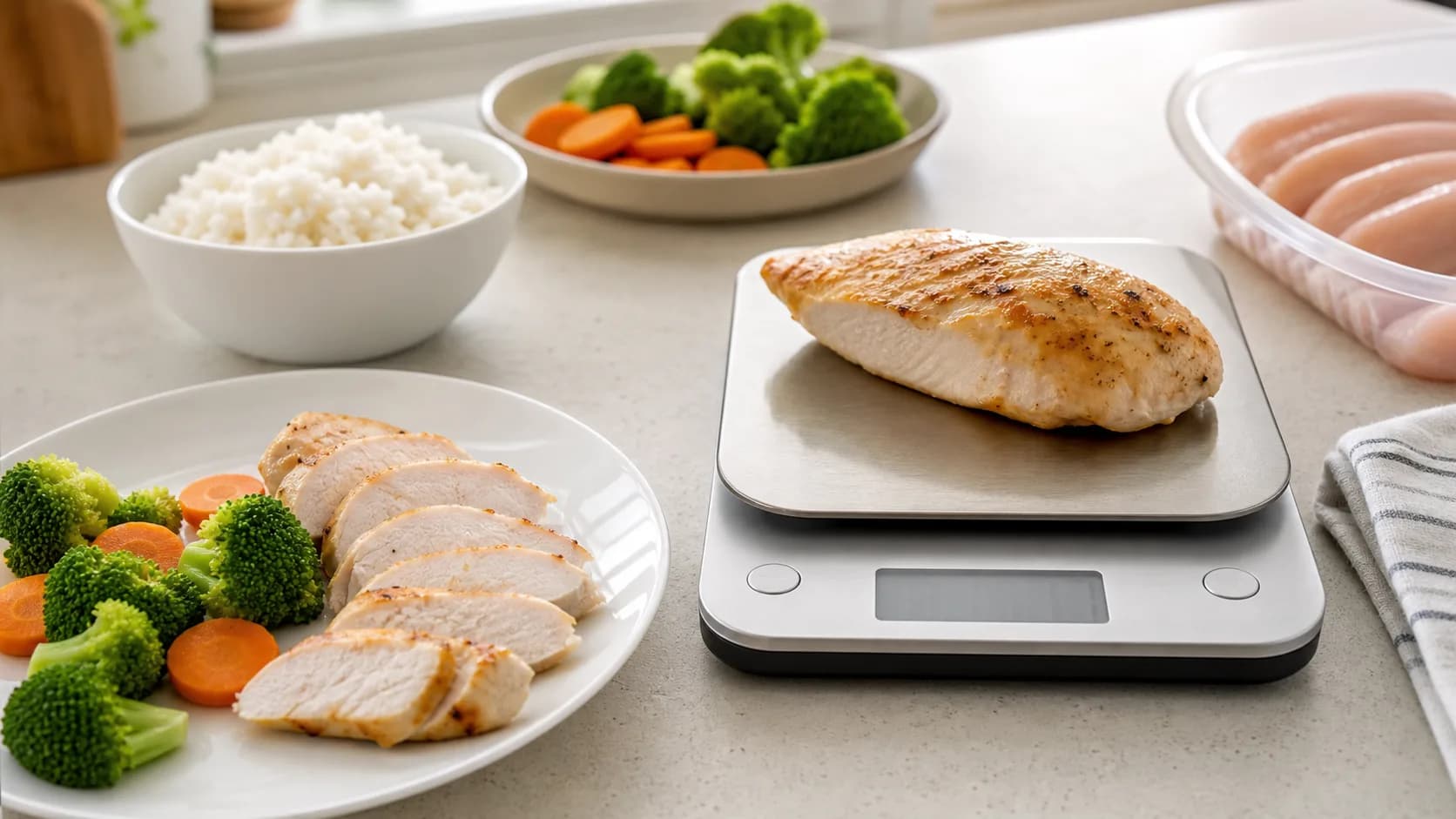
Cooked grilled chicken breast — nutrition per 100 g
How Much Protein and How Many Calories Are in Common Chicken Breast Servings?
Cooked grilled chicken breast provides about 30.5 g protein and 151 calories per 100 g. That equals about 61.1 g protein in 200 g, 76.4 g in 250 g, and 91.6 g in 300 g. The table also answers common 3 oz, 4 oz, 6 oz, and 8 oz searches using the same USDA records.
| Serving | Equivalent weight | Cooked, grilled | Raw, boneless skinless |
|---|---|---|---|
| 100 g | 100 g | 30.5 g protein · 151 kcal | 22.5 g protein · 112 kcal |
| 150 g | 150 g | 45.8 g protein · 227 kcal | 33.8 g protein · 168 kcal |
| 200 g | 200 g | 61.1 g protein · 302 kcal | 45.1 g protein · 224 kcal |
| 250 g | 250 g | 76.4 g protein · 378 kcal | 56.3 g protein · 281 kcal |
| 300 g | 300 g | 91.6 g protein · 453 kcal | 67.6 g protein · 337 kcal |
| 3 oz | 85.0 g | 26 g protein · 128 kcal | 19.2 g protein · 95 kcal |
| 4 oz | 113.4 g | 34.6 g protein · 171 kcal | 25.5 g protein · 127 kcal |
| 6 oz | 170.1 g | 51.9 g protein · 257 kcal | 38.3 g protein · 191 kcal |
| 8 oz | 226.8 g | 69.3 g protein · 342 kcal | 51.1 g protein · 254 kcal |
Calculated as serving weight ÷ 100 × the selected USDA per-100-g value. Cooked values use FDC 171534; raw values use FDC 2646170. These are alternative tracking records, not a cooking-yield conversion: 200 g raw chicken will not remain 200 g after cooking.
How Much Cooked Chicken Breast for 20-40g Protein?
These targets use the cooked grilled record, scaled from USDA FDC 171534.
| Protein target | Approx. amount | Approx. calories |
|---|---|---|
| 20 g protein | 65.6 g | 99.0 kcal |
| 25 g protein | 82.0 g | 123.8 kcal |
| 30 g protein | 98.4 g | 148.5 kcal |
| 40 g protein | 131.1 g | 198.0 kcal |
Protein and Nutrition Data Table
Serving estimates are rounded from the cited source record.
| Food / serving | Amount | Protein | Calories |
|---|---|---|---|
| Cooked grilled chicken breast | 100 g | 30.5 g | 151 kcal |
| Standard cooked portion | 3 oz / 85 g | 26.0 g | 128 kcal |
| High-protein meal portion | 150 g | 45.8 g | 227 kcal |
| One large cooked breast | 196 g | 59.9 g | 296 kcal |
| Half cooked chicken breast | 98 g | 29.9 g | 148 kcal |
| Raw boneless skinless breast | 100 g raw | 22.5 g | 112 kcal |
Sources: cooked rows — USDA FDC 171534; raw row — USDA FDC 2646170.
Best Product and Buying Options
| Product / format | Best for | Protein fit | Check before buying |
|---|---|---|---|
| Fresh boneless skinless breast | Highest control over seasoning, sodium, and cooked weight | Best all-purpose option | Weigh cooked portions if you track macros closely. |
| Frozen plain chicken breast | Budget meal prep and bulk cooking | Usually similar to fresh | Check for added solution or high sodium. |
| Pre-cooked grilled strips | Fast lunches, wraps, salads, and bowls | Convenient but label-dependent | Can be high in sodium and marinades. |
| Canned chicken breast | Pantry backup for sandwiches and quick meals | Good convenience protein | Choose low-sodium when possible. |
Protein Comparison Table
| Food | Protein | Calories | Best use |
|---|---|---|---|
| Chicken breast, cooked grilled | 30.5 g / 100 g | 151 kcal | Leanest everyday meat protein. |
| Chicken thigh, cooked skinless | About 23 g / 100 g | Higher fat | Better flavor and texture, less lean. |
| Turkey breast, cooked | About 29 g / 100 g | Lean | Closest poultry alternative. |
| Whey protein powder | About 20-25 g / scoop | Label-dependent | Convenient protein when a full meal is not practical. |
| Firm tofu | About 17 g / 100 g | Moderate | Plant-based alternative with more fat and fiber. |
High-Protein Recipe Ideas
Chicken rice protein bowl
150 g cooked chicken breast, rice, Greek yogurt sauce, cucumber, herbs
A reliable post-workout meal with lean protein and easy carbohydrates.
Low-calorie chicken salad
120 g chicken breast, lettuce, tomatoes, pickles, light yogurt dressing
High protein density with a large food volume for weight loss.
Chicken egg breakfast wrap
100 g chicken breast, one egg, egg whites, high-fiber wrap, salsa
Combines complete proteins while keeping prep simple.
Chicken breast meal prep plate
120-150 g cooked chicken breast, potatoes or rice, roasted vegetables, measured sauce
Keeps the protein anchor consistent while calories change through sides and sauces.
Proper Guide and Practical Notes
How much protein is in chicken breast?
Use about 30.5 g protein per 100 g cooked skinless chicken breast as the source-matched planning answer. A 3 oz cooked serving gives about 26 g protein, 4 oz gives 34.6 g, 6 oz gives 52 g, and 8 oz gives 69.3 g. By gram weight, 150 g gives 45.8 g protein, 200 g gives 61.1 g, 250 g gives 76.4 g, and 300 g gives 91.6 g.
Raw vs cooked chicken breast protein
Protein does not disappear during normal cooking, but water loss makes cooked chicken more protein-dense per 100 g. USDA FDC 2646170 lists 22.5 g protein per 100 g raw boneless skinless breast, while FDC 171534 lists 30.54 g per 100 g cooked grilled breast. Match the database entry to whether you weighed raw or cooked chicken.
How many calories are in chicken breast?
Plain cooked grilled skinless chicken breast has 151 kcal per 100 g in USDA FDC 171534. That scales to about 227 kcal for 150 g, 302 kcal for 200 g, 378 kcal for 250 g, and 453 kcal for 300 g. Raw boneless skinless breast is about 112 kcal per 100 g in the selected Foundation record. Oil, skin, breading, marinades, and sauce must be counted separately.
How much protein is in one chicken breast or chicken fillet?
A breast or fillet is not a fixed serving size. The USDA cooked record includes a large 196 g breast, which scales to about 59.9 g protein and 296 kcal, but actual pieces can be much smaller or larger. For an accurate one-breast answer, weigh the edible portion and use the calculator with the matching raw or cooked state.
Grilled, baked, boiled, fried, canned, and packaged chicken are different entries
This page uses plain cooked grilled skinless breast as its cooked benchmark. Plain baked or boiled breast may be close, but fried chicken, skin-on breast, canned chicken, deli slices, pre-cooked strips, and products with retained water or added solution can differ in calories, fat, sodium, and protein per 100 g. Prefer the exact package label or a preparation-matched database record.
Is chicken breast a complete protein?
Yes. Chicken breast is an animal protein and provides all essential amino acids, so it is considered a complete protein. That makes it a reliable anchor for muscle gain, weight loss, and simple meal prep when the rest of the plate supplies fiber, carbohydrates, fats, and micronutrients.
Use the right chicken breast page
Use this page when you need detailed answers for 100 g, 3 oz, 150 g, one cooked breast, raw-vs-cooked tracking, and USDA source context. Use the chicken breast chart page when you want a shorter comparison card inside the full meat protein chart.
Best way to use it for weight loss
Use cooked chicken breast as a 30-50 g protein anchor, then add vegetables, potatoes, rice, or beans depending on your calorie target. Avoid counting breading, sauces, and frying oil as if they were plain chicken.
Best way to use it for muscle gain
For muscle gain, pair 120-200 g cooked chicken breast with enough carbohydrates and calories to support training. Chicken breast is very lean, so rice, potatoes, pasta, olive oil, avocado, or dairy may be needed when the goal is gaining weight rather than simply increasing protein.
Food safety note
USDA FSIS lists poultry at 165 F as the safe minimum internal temperature. Use a food thermometer for thick breasts, stuffed chicken, leftovers, and meal prep batches.
Best For
Sources, Credit and Method
Cooked values use USDA FDC 171534 per 100 g edible grilled skinless chicken breast. Raw values use USDA Foundation FDC 2646170 per 100 g boneless skinless breast, with energy from Atwater specific factors. Serving values are scaled from the selected record and rounded for practical meal planning.
Frequently Asked Questions
How much protein is in 100g chicken breast?
USDA FDC 171534 lists 30.54 g protein per 100 g cooked grilled skinless chicken breast, commonly rounded to 30.5-31 g. USDA FDC 2646170 lists 22.5 g per 100 g raw boneless skinless breast. Use the record matching the state you weighed.
How much protein is in 3 oz and 150g chicken breast?
A 3 oz cooked chicken breast serving has about 26 g protein. A 150 g cooked serving has about 45.8 g protein when scaled from USDA FDC 171534.
How much protein is in 200g, 250g, and 300g chicken breast?
Using the cooked grilled USDA record, 200 g chicken breast has about 61.1 g protein and 302 kcal, 250 g has 76.4 g protein and 378 kcal, and 300 g has 91.6 g protein and 453 kcal. These are cooked edible weights.
How much protein and how many calories are in 4 oz, 6 oz, and 8 oz chicken breast?
Four ounces of cooked grilled chicken breast has about 34.6 g protein and 171 kcal; 6 oz has about 52 g protein and 257 kcal; and 8 oz has about 69.3 g protein and 342 kcal. Ounce-to-gram conversions and nutrition are rounded.
How many calories are in 100g raw versus cooked chicken breast?
The selected USDA cooked grilled record has 151 kcal per 100 g, while the selected raw boneless skinless record has about 112 kcal per 100 g. Water loss during cooking changes the concentration, so use the entry matching when the chicken was weighed.
How much protein is in one chicken breast?
A large cooked chicken breast listed at 196 g provides about 59.9 g protein when scaled from USDA FDC 171534. Smaller grocery-store pieces can be much lower, so weighing the cooked portion is more accurate.
Can I calculate 500g, 1 lb, or 1 kg of chicken breast?
Yes. Enter the edible weight in the calculator. From the cooked grilled record, 500 g calculates to about 152.7 g protein and 755 kcal, 1 lb cooked to about 138.5 g protein and 685 kcal, and 1 kg cooked to about 305.4 g protein and 1,510 kcal. These are mathematical totals, not serving recommendations, and raw package weight is not the same as cooked edible weight.
Is cooked chicken breast good for weight loss?
Yes, plain cooked skinless chicken breast is useful for weight loss because it gives high protein for relatively few calories. The final meal still depends on added oil, breading, sauces, rice, wraps, and side dishes.
Is chicken breast better than protein powder?
Chicken breast is usually better as a whole-food meal anchor because it provides complete protein and satiety. Protein powder is more convenient when you need protein quickly or cannot eat another full meal.
Supporting Charts and Tools
Related Food Protein Guides
Know Your Daily Protein Target
Use the calculator first, then use these food pages to build meals that match your goal.
Calculate My Daily Protein