
Nutrition research · Research news analysis
Plant vs Animal Protein: Finnish Study Finds Different Testosterone Links
A new analysis links protein-source patterns with total testosterone and SHBG. Its observational design and less consistent free-testosterone findings limit dietary conclusions.
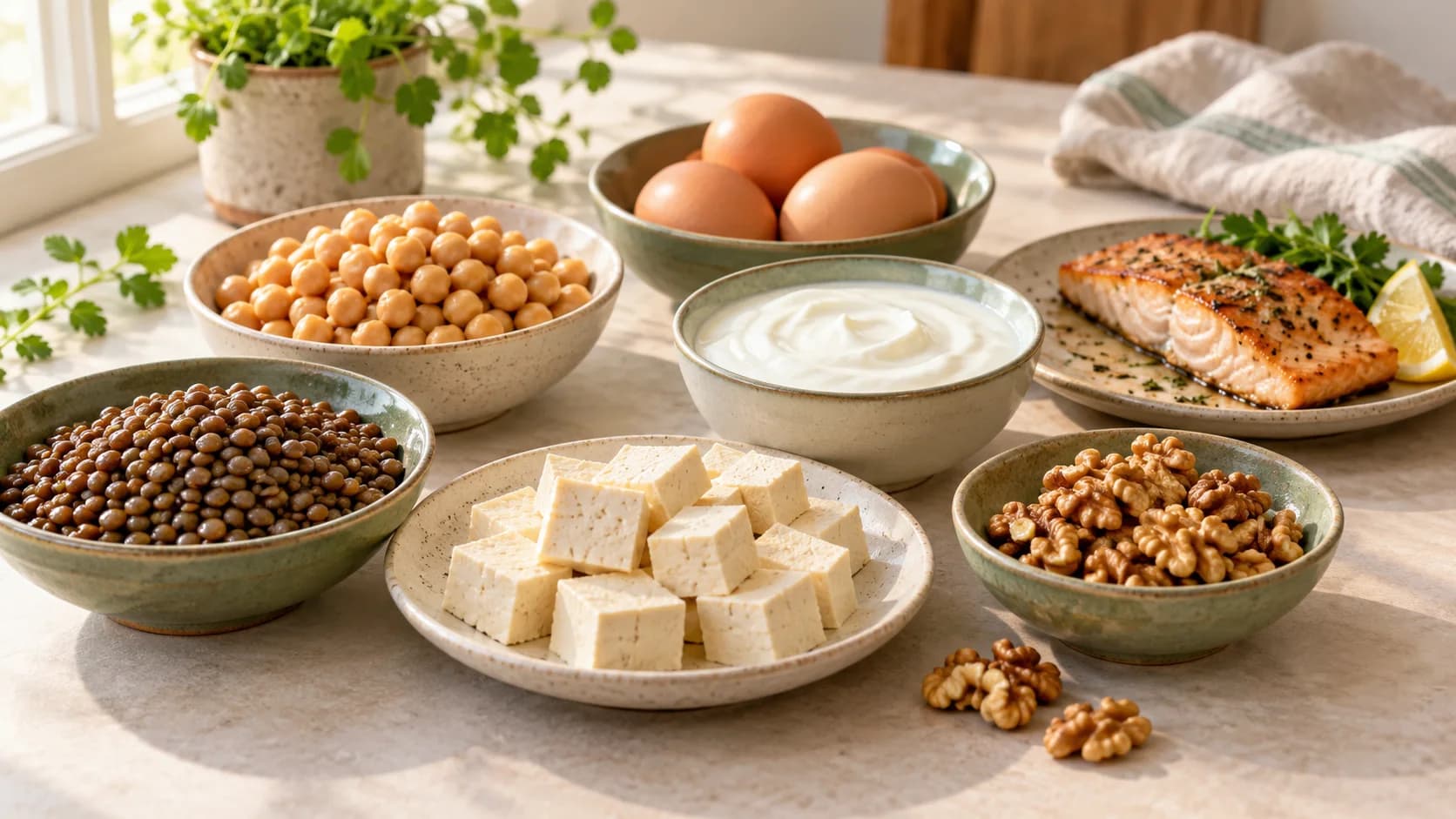
A Finnish study has found different associations between plant and animal protein intake and blood testosterone measurements in middle-aged men. The result is attention-grabbing, but it does not show that switching protein sources will raise or lower an individual's testosterone. The researchers examined dietary records and hormone measurements collected at the same stage of an observational study, rather than assigning men to different diets.[1]
The University of Eastern Finland highlighted the findings on October 27, bringing renewed attention to a paper published online on September 9 in the International Journal of Food Sciences and Nutrition. Its analysis included 2,546 men aged 42 to 60. Higher plant protein intake was associated with higher total testosterone and sex hormone-binding globulin, or SHBG; animal protein showed associations in the opposite direction.[3][2]
The paper's fuller results make the story more interesting than a contest between foods. Findings for calculated free testosterone were less consistent, most modeled animal-to-plant substitutions were not statistically significant, and the study did not establish a clinical improvement. For anyone wondering whether a familiar meal or protein shake is helping or harming their hormones, those details are essential. They separate a useful research question from a dietary promise the evidence cannot yet deliver.[1]
Evidence access
The publisher’s open-access full text was available and checked, including the main results, discussion, limitations, funding and conflict disclosures. Supplementary tables are not reproduced. The September paper date and October university-release date are shown separately.
The findings in brief
- Associations with total testosterone and SHBG do not establish that a food changed testosterone production or health.
- Animal protein is a broad category: the meat-protein result did not show the same total-testosterone association.
- Calculated free-testosterone findings were less consistent, and most modeled animal-to-plant substitutions were not statistically significant.
A recent paper using an older set of observations
The analysis used baseline data from the Kuopio Ischaemic Heart Disease Risk Factor Study in eastern Finland. The relevant examinations took place between 1984 and 1989. Participants recorded their food intake over four days and provided blood samples. This means the news date, the paper's publication date and the period in which the underlying observations were collected are three different dates, each answering a different question about the research.[1]
A long-running cohort can generate valuable new analyses from carefully collected historical information. Older data are not automatically unusable. They can, however, limit how directly a result describes current eating patterns, foods and supplement habits. The task for a reader is to understand which features are being examined and which features have changed, rather than assuming that a recently published paper must have measured a contemporary population.
It would also be misleading to describe this as a decades-long test of whether protein altered the men's hormones. The parent study is longitudinal, but this particular dietary-hormone analysis was cross-sectional. The duration of a research program cannot be transferred to every analysis conducted within it. Following people for other outcomes does not turn a snapshot comparison of diet and hormones into a trial or a demonstrated sequence of cause and effect.
What the reported differences mean
In the published abstract, men in the highest animal-protein intake quartile had adjusted total testosterone concentrations about 1.2 nanomoles per liter lower than those in the lowest quartile. For plant protein, the corresponding comparison ran in the other direction, with a difference of about 1.1 nanomoles per liter. These were group-level associations within the data, not changes caused by a prescribed food substitution.[2]
The two numbers cannot be added together to predict what a person would gain by replacing an animal food with a plant food. They compare different exposure groups against their respective reference groups. They do not describe one person moving from one diet to another while everything else remains fixed. Adding them would create a new estimate that the study did not establish and that its design cannot directly verify.
Nor does a group average tell us how a particular participant would respond. People with the same reported intake can have different hormone concentrations, and people with similar concentrations can have different health histories. A news report should make the average comparison understandable without presenting it as a personalized forecast. The most useful question is what pattern was observed, under which assumptions, and how much additional evidence would be needed before acting on it.
Total testosterone is only one part of the measurement
A total testosterone test includes hormone circulating freely and hormone attached to proteins. MedlinePlus explains that different testosterone measurements can provide different information, and that results are interpreted alongside a person's clinical context. This is why a headline about total testosterone should not automatically be read as a direct measurement of every aspect of androgen activity or a complete assessment of hormone health.[4]
The distinction has practical consequences for interpreting nutrition research. If the amount of a binding protein differs between groups, measured total hormone and the freely circulating fraction may not tell identical stories. A study can therefore report an association with total testosterone without establishing a corresponding change in tissue exposure, symptoms or physiological function. Those further steps require their own measurements and an appropriate design.
For a reader, this is a reason to be precise rather than a reason to ignore hormone research. Asking whether the study measured total testosterone, free testosterone or a calculated estimate is a small but powerful check. It prevents a familiar hormone name from creating an impression of certainty that the actual laboratory assessment does not support. It also helps explain why two apparently conflicting headlines may be describing different endpoints.
The binding protein belongs in the story
SHBG is a protein that binds sex hormones in the bloodstream. MedlinePlus describes its test as useful for helping clinicians interpret hormone availability in conjunction with other information, often including total testosterone. A measurement of SHBG therefore adds context; it is not simply another version of a testosterone score, and a higher value is not automatically a universal health target.[5]
In this study, associations for total testosterone and SHBG often moved together. That makes a straightforward claim about increased testosterone production particularly difficult to justify. The measurements concern circulating concentrations and binding context. They do not directly reveal whether a food changed hormone production, clearance or biological action. The paper discusses these possible distinctions and calls for more direct physiological investigation.[1]
An everyday analogy can help without pretending to reproduce endocrine physiology. Measuring the total number of passengers on a transport system does not tell you how many are available at a particular destination at a particular time. Additional information is needed. Likewise, one overall hormone concentration cannot carry every interpretation readers attach to it. The analogy explains the measurement problem; it is not a model for calculating hormone activity from a meal.
The free-testosterone analysis was supplementary
The investigators calculated free testosterone from measured total testosterone and SHBG rather than directly measuring it. Because the estimate used those other biomarkers as inputs, it was not an independent third laboratory observation. The authors treated these analyses as supplementary and reported a less consistent pattern than for total testosterone and SHBG. That is a material qualification to the broad headline about protein sources.[1]
Calculated quantities are common in medicine and research, and calculation alone does not make a result uninformative. Its usefulness depends on the underlying measurements, the formula and the setting in which it is applied. The important reporting point is to identify an estimate as an estimate. A reader should not be left assuming that several correlated results amount to several entirely separate confirmations of the same biological explanation.
This also changes how much weight to place on a food-based conclusion. Before claiming that one protein source improves the body's effective androgen exposure, research would need a convincing connection between the dietary change and relevant physiological outcomes. A supplementary calculation from a cross-sectional dataset is a much narrower piece of evidence. Treating it carefully preserves its value while leaving the larger causal question genuinely open.
Animal protein is not synonymous with meat
The official university release notes an important distinction within the broad animal-protein category. Dairy protein was associated with lower total testosterone and SHBG, while meat protein was associated with lower SHBG but not with total testosterone. That makes a headline asserting that meat lowers testosterone an inaccurate shortcut from a broad category to a specific food claim.[3]
Food categories are useful for organizing data, but they can obscure substantial differences in what people eat. A category may combine foods consumed in different amounts, with different accompanying nutrients, and in different social or dietary settings. A finding attached to a category is therefore a starting point for more detailed investigation, not permission to assume that every member of it has the same relationship with every outcome.
Readers can apply this distinction when deciding what a headline says about their own breakfast or dinner. Does the paper actually examine the food named in the headline? Is the reported association present for that food, for a larger grouping, or only for a ratio between categories? These are different claims. Keeping them separate is especially important when nutrition coverage risks turning a familiar staple into an unnecessary source of anxiety.
A model of replacement is not an experiment in replacement
Dietary questions often involve replacement. If someone eats more of one food while keeping their overall intake similar, something else may become a smaller part of the diet. Ibsen and colleagues' methodological paper on food-substitution models explains why the modeled comparison, its unit and the adjustment for energy and confounding all matter. This is independent methodological background, not a new test of the Finnish hormone findings.[6]
The Finnish researchers examined modeled substitutions as well as associations with individual protein categories. Most animal-to-plant substitutions were not statistically significantly associated with the hormone outcomes. An isolated association involving SHBG should not be promoted into proof of a general hormone benefit from replacing animal protein. These models used observational information; participants did not perform the substitutions as an assigned intervention.[1]
For an actual dietary decision, the distinction is substantial. Replacing a food on a plate changes a bundle of nutrients and habits. A mathematical comparison estimates an association under specified assumptions. It can help define a better question for a future trial, but it cannot show that the hypothetical replacement happened, was followed consistently, or produced the predicted change in a particular person's blood measurements.
Statistical adjustment is useful and incomplete
The paper adjusted its analyses for a range of measured characteristics, including age, body mass index, lifestyle factors and aspects of diet. That is a strength compared with simply comparing unadjusted averages. It attempts to account for other features that may travel with protein intake and hormone concentrations. It does not reproduce random assignment or guarantee that every relevant difference between participants has been removed.[1]
To see the problem, imagine two hypothetical dietary groups that also differ in work schedules, health history or their usual activity. Some differences may be measured well, others imperfectly and others not at all. Even an extensive model cannot adjust for information it does not contain with sufficient accuracy. This is an explanation of residual confounding, not an allegation that a particular unmeasured factor explains away the result.
The useful position is neither automatic acceptance nor automatic dismissal. Adjustment can make an observational finding more informative while still leaving a causal question unresolved. A report should explain both contributions. Claiming that researchers controlled for everything overstates the method; declaring that observational research tells us nothing understates it. Such studies can reveal patterns worth testing, especially when the same question is examined through several complementary designs.
Four days of eating provide detail, with limits
Food records can capture the foods, amounts and preparation details a person reports during a defined recording period. The National Cancer Institute's dietary-assessment primer explains that records have strengths and limitations, including the possibility that recording changes behavior and that short periods may not represent usual intake. This methodological context is relevant whenever a study uses a few days of eating to describe a longer-term dietary pattern.[7]
The Finnish paper reports that nutritionists checked participants' records, an important effort to improve their quality. It also acknowledges that a four-day window may not fully describe foods consumed only occasionally. That matters when trying to interpret separate categories such as fish, eggs or individual meat types. An apparently precise average can still depend on how well the observation period represents the behavior of interest.[1]
A simple hypothetical example illustrates the issue. Two people may usually eat the same amount of fish over a month, but only one happens to eat it during the recording days. Their short records could place them in different apparent intake groups. This does not mean the study's records were useless; it explains why measurement error and representativeness belong beside the result when reporting what a food category might mean.
A statistical association is not a diagnosis
A difference between groups can be statistically detectable without establishing a meaningful improvement in symptoms or health. The study did not test whether changing protein sources treated testosterone deficiency, improved fertility, increased muscle gain or altered sexual function. Those are different outcomes, and none should be implied simply because a familiar hormone was measured in blood.[1]
The Endocrine Society's guideline resources recommend diagnosing hypogonadism in men only when compatible symptoms and signs accompany unequivocally and consistently low testosterone concentrations. They recommend confirming an appropriate diagnosis with repeat morning fasting measurement and further evaluation where indicated. This clinical guidance is separate from the nutrition study and helps explain why a dietary association cannot be used as an individual diagnostic rule.[8]
Someone who is worried about persistent symptoms deserves an assessment that considers their actual situation, rather than a prediction drawn from a group average in a food study. The article cannot interpret an individual's test result or identify the cause of a concern. Its job is to show what the research contributes, what remains unanswered and why a clinical question requires more than choosing a side in a protein debate.
How the finding relates to soy research
Plant protein is a broad category, and this study should not be presented as a trial of tofu, soy milk or isolated soy protein. A separate 2021 meta-analysis of 41 clinical studies assessed soy or isoflavone intake and male reproductive hormones. It found no significant effects on the testosterone and estrogen outcomes examined. That evidence addresses a different intervention-focused question from the new observational analysis.[9]
It would be equally wrong to turn the Finnish association into a claim that soy is a testosterone booster or to assume that the soy review means every possible plant-based dietary pattern has identical endocrine effects. Different exposures, populations and endpoints require careful comparison. The value of bringing these sources together is to identify the questions they actually answer, rather than recruit either paper into a simplistic food-versus-food argument.
For readers who already eat plant foods, the new result does not create a requirement to consume a special product. For readers who eat animal foods, it does not establish that removing a whole category will improve hormone health. Ordinary decisions about dietary preference, adequacy and affordability can remain grounded in their wider context while research continues to investigate the specific associations reported here.
Who is represented, and who still needs study?
The participants were middle-aged men from eastern Finland. The paper acknowledges that this population limits generalization. Its findings cannot automatically be applied to women, teenagers, populations with substantially different diets, people receiving hormone treatment, or patients with a diagnosed endocrine disorder. A large sample from one setting can provide a useful estimate within that setting while still leaving substantial questions about other groups.[1]
The age and setting of the data also matter for modern supplement discussions. A comparison of dietary patterns in the 1980s is not a direct test of contemporary whey powders, high-protein packaged snacks or a particular plant blend. A claim about one of those products would need evidence involving that exposure. The presence of the word protein in both a dataset and a product label does not make their research questions interchangeable.
Future work could investigate whether the pattern appears in other populations, whether repeated dietary and hormone measurements support a time sequence, and whether a controlled change in protein source alters relevant outcomes. These possibilities explain why the findings can be interesting without becoming immediately prescriptive. The next steps should be driven by the uncertainty in the evidence rather than by whichever dietary interpretation attracts the strongest reaction.
What readers can check in the reporting
The paper states that the authors reported no potential conflict of interest and that the research received no specific support from a public, commercial or nonprofit funding agency. It also explains that participant data cannot be openly released because sensitive personal information cannot be fully anonymized. These are the study's disclosures; they are not a guarantee that every interpretation is correct or a reason to infer hidden misconduct.[1]
STROBE provides reporting checklists for observational research, including cross-sectional studies. Such guidance helps readers look for clear accounts of participants, measurements, analysis and limitations. A checklist is a transparency aid, not a quality score that automatically validates a paper. Here, the distinction is useful because a well-reported observational association can still remain uncertain about causality, and transparent limitations make that uncertainty easier to evaluate.[10]
Our reporting separates the study's measurements from clinical background and from explanatory examples. No interviews, participant-level analyses or new hormone measurements were conducted for this article. That is why the source notes identify both the primary paper and independent context. A long article should earn its length by making those boundaries understandable, rather than implying that detail alone turns a limited research design into a more definitive one.
One blood sample cannot describe an individual's usual pattern
The study collected fasting morning blood samples, which provides a more standardized setting than sampling participants at arbitrary times. It nevertheless assessed total testosterone and SHBG at one time point. The authors acknowledge that this could not capture variation within the same individual. Standardizing a measurement improves comparability; it does not make a single observation a permanent description of a person's hormone status.[1]
MedlinePlus explains that testosterone levels change over the course of a day and that interpretation can require additional testing. This is useful context for understanding why a population study and an individual assessment have different needs. A research group may detect an average association across many people while still lacking the repeated information needed to characterize a particular person's usual concentration or explain their symptoms.[4]
The same principle affects how a reader should imagine the result. The analysis is not a recording of each participant's hormone response to each meal. It links a limited window of recorded eating with a standardized blood assessment. A future study with repeated observations could examine whether dietary patterns and hormone measurements move together over time. Even that stronger time sequence would need careful interpretation before establishing the effect of a deliberate intervention.
A research lead, with no new hormone diet prescribed
The study adds a specific observation to a difficult nutrition question: protein-source patterns were associated with circulating hormone measurements in this group of men. The most useful parts of the story are the distinctions inside it—total versus calculated free testosterone, animal protein versus individual foods, and observed associations versus modeled substitutions. They help explain why a dramatic dietary promise would outrun the evidence.
For now, the finding supports further research rather than a food-based testosterone prescription. Readers can remain interested without becoming alarmed about a familiar meal or buying a product marketed around the headline. A convincing next step would connect a clearly defined dietary change with relevant physiological and clinical outcomes. Until then, the different links observed in Finland are a question worth investigating, with the limits of the answer kept in view.
Check the evidence
Sources & reporting notes
- Associations of dietary proteins with serum total testosterone and sex hormone-binding globulin concentrations in middle-aged men
Wynne-Ellis MM et al. · International Journal of Food Sciences and Nutrition · September 9, 2026 · doi:10.1080/09637486.2026.2731397
Primary open-access full paper. Methods, principal findings, substitution-model discussion, limitations and disclosures checked through the publisher’s full article. Individual supplementary tables are not reproduced.
- Primary study indexed abstract and publication record
PubMed · U.S. National Library of Medicine · PMID:42714417
Cross-check for publication date, sample, headline comparisons and study design. This is the same study, not independent replication.
- Animal and plant proteins show different associations with testosterone levels in men
University of Eastern Finland · October 27, 2026
Official institutional news release and the recent news hook. Its distinction between meat and the wider animal-protein category was checked against the paper.
- Testosterone Levels Test
MedlinePlus · U.S. National Library of Medicine
Clinical background on types of testosterone measurement, timing and contextual interpretation.
- SHBG Blood Test
MedlinePlus · U.S. National Library of Medicine
Background on binding proteins and why total testosterone alone may not tell the entire clinical story.
- Food substitution models for nutritional epidemiology
Ibsen DB et al. · American Journal of Clinical Nutrition · 2021 · PMID:33300036
Independent methodological context. Modeled substitutions are distinguished from assigned dietary interventions.
- Food Record at a Glance
National Cancer Institute · Dietary Assessment Primer
Background on the strengths and limitations of food records and their ability to represent habitual diet.
- Testosterone Therapy for Hypogonadism Guideline Resources
Endocrine Society · 2018 clinical practice guideline resources
Clinical context for diagnosis and confirmation. Not a dietary guideline or an interview about the new study.
- Neither soy nor isoflavone intake affects male reproductive hormones: an expanded and updated meta-analysis of clinical studies
Reed KE et al. · Reproductive Toxicology · 2021 · PMID:33383165
Separate intervention-focused context on soy and isoflavones. The Finnish study is not presented as a soy-supplement trial.
- STROBE reporting checklists
Strengthening the Reporting of Observational Studies in Epidemiology
Reporting guidance for observational designs; a checklist is not a quality score or a causal-inference guarantee.
How this article was reported
This article distinguishes the September 9 paper publication, the October 27 university release and the November 1 publication of this analysis. The dietary and blood observations date to 1984–1989.
No author interviews, participant-level reanalysis or new laboratory tests were conducted. Hypothetical explanations are not study data; no dietary intervention effect is inferred from a cross-sectional association.
The funding and competing-interest descriptions reflect the authors’ published statements. No food, brand or hormone treatment is endorsed.
Educational research reporting. This article does not diagnose a condition, prescribe a supplement or replace advice from a qualified healthcare professional. Our corrections policy explains how to report an error.