
Nutrition research · Research analysis
Vegan vs. Mediterranean for Weight Loss: What a New Protein Analysis Found
The low-fat vegan diet led to more weight loss in the original trial. A new analysis links that difference to changes in what participants ate, including where they got their protein.
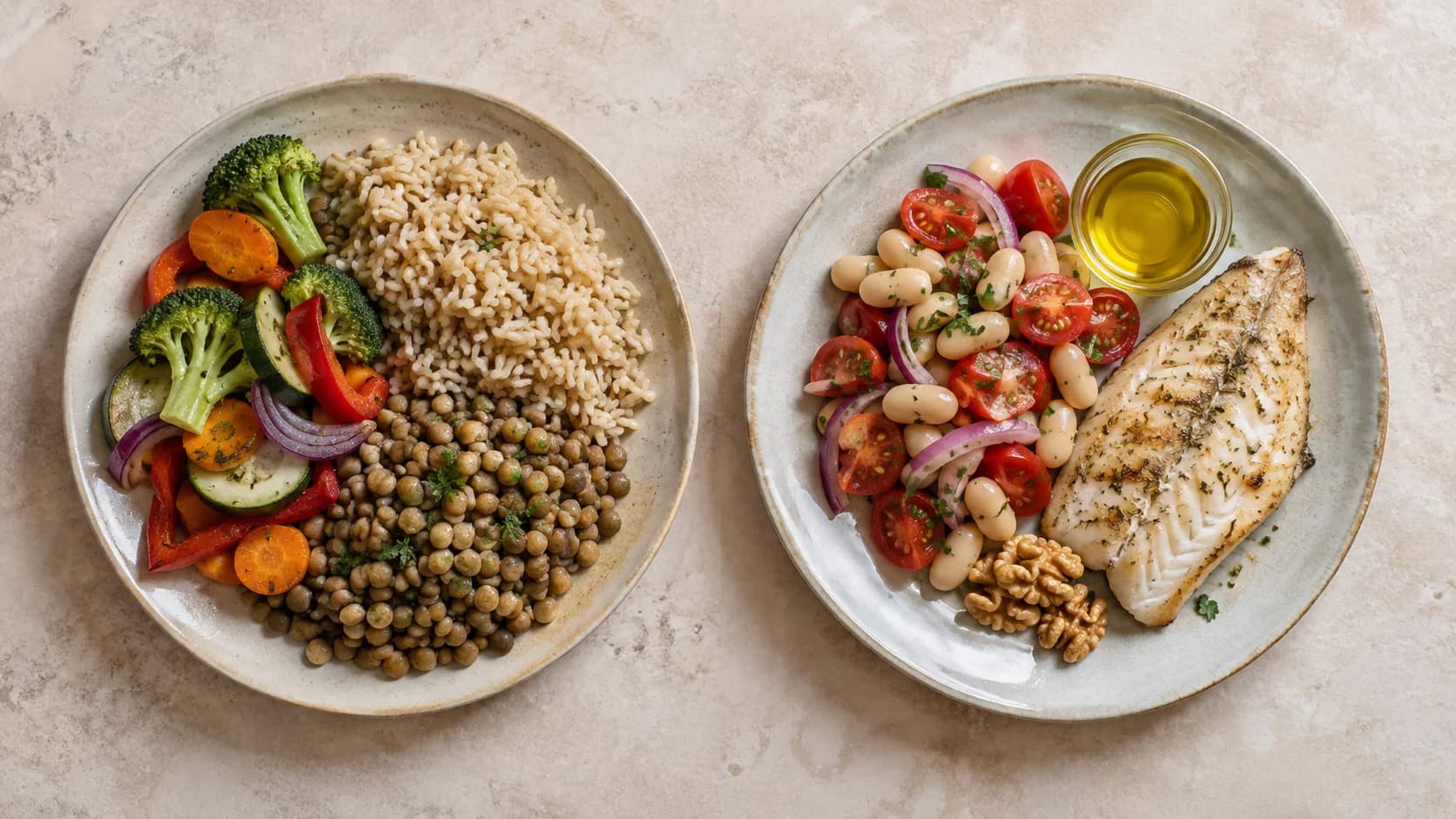
The same volunteer could spend one season cooking with olive oil and eating fish, then spend another eating beans, grains and vegetables without added fats. That was the logic of a small Washington, D.C., trial comparing two ways of eating. Years after the original weight results appeared, researchers went back to the volunteers’ food records to ask a narrower question. Did the people who changed where they got their protein also tend to lose more weight?[1][2][3]
They did. In the new analysis, participants who increased plant protein or decreased animal protein tended to lose more weight. But total protein intake also fell during the low-fat vegan phase, and protein sources were only one of several things that changed. The experiment answers a question about two diets as they were taught and followed. A different experiment would be needed to tell how much of the weight change came from replacing animal protein alone.[1][5]
The distinction matters at the grocery shelf. A person can trade chicken for beans at dinner without adopting either of the trial diets. That ordinary swap changes the ingredients and often the fiber, starch, fat and total energy on the plate. The study is useful precisely because it shows how those changes can travel together, even inside a randomized trial.[1][6]
Evidence access
This analysis uses the published BMJ abstract, the original trial report and registry, and an open paper from the same trial that describes its methods. The full October 2026 paper could not be retrieved for this article. Findings that require its full methods or tables are outside the scope of this report.
The findings in brief
- The original randomized trial compared two complete diets and reported greater average weight loss on the low-fat vegan diet.
- In the new analysis, eating more plant protein and less animal protein was associated with greater weight loss. Total protein intake also fell on the vegan diet.
- The trial randomized diet order. It did not hold calories or the rest of the diet constant while changing protein source.
What the October paper added
The 2026 paper in BMJ Nutrition, Prevention & Health is a secondary analysis. That means the investigators asked a new question of data that had already been collected. The 62 adults were randomized in the original trial, whose main report appeared online in 2021 and in a 2022 journal issue. The 2026 paper, published on October 20 and announced by the study organization on October 29, looks back at that same experiment. The new report adds information about what participants ate. It adds no second group of 62 people.[1][2][5]
The weight result people are likely to remember comes from the earlier report. Average body weight fell by about 6 kilograms, or 13 pounds, on the low-fat vegan phase, with essentially no average change on the Mediterranean phase. The estimated difference between diets was 6 kilograms, with a 95% confidence interval of 4.5 to 7.5 kilograms in favor of the low-fat vegan phase. Those figures describe the comparison between the two diet programs. They are separate from the later correlations involving protein.[2][3]
It is common to see several papers emerge from a trial that collected food logs, body measurements and laboratory samples. An earlier analysis of these same participants looked at compounds called dietary advanced glycation end products. Other investigators could ask still more questions about fiber, energy density or meal patterns using overlapping records. Each question can be worthwhile. The papers should be counted as analyses of one experiment when deciding how many times the finding has been tested in a new population.[3][4]
The right starting point is therefore two dates and two outcomes. The original report supplied the diet comparison for body weight. The October paper supplied the correlations between changes in reported intake and changes on the scale. Keeping those results separate makes the new contribution easier to see. It also preserves the value of the first trial, which compared choices people can actually make without pretending that those choices differ in a single nutrient.
What the two diets actually asked people to do
The trial recruited adults with body mass indexes from 28 to 40 in the Washington, D.C., area. Participants were assigned to one of two sequences. One group started with the Mediterranean diet and the other with the low-fat vegan diet. After 16 weeks on the first diet and a four-week interval, the groups switched for another 16 weeks. Fifty-two people completed the full trial. Those details matter because 62 is the number randomized, while 52 is the number known to have completed both periods.[2][4][5]
The vegan program emphasized grains, legumes, fruit and vegetables. It excluded animal foods and added fats, and the researchers provided a vitamin B12 supplement. The Mediterranean program was modeled on the PREDIMED approach. It encouraged produce, legumes, nuts and fish, favored lean white meat over red meat, and provided extra-virgin olive oil as the main culinary fat. Both phases included weekly classes with meal ideas and support. Participants otherwise chose and prepared their meals.[3][2]
People were allowed to eat according to appetite rather than follow an assigned calorie quota. The study was therefore closer to comparing two sets of eating instructions than to serving two equally caloric menus in a laboratory. That is a strength if the question is what can happen when people follow a diet in daily life with support. It creates a different kind of uncertainty when the question is what happens at exactly the same energy intake.[3][1]
The crossover design lets the researchers compare periods within the same person. Many fixed differences, including height or early-life history, are then less likely to explain the comparison. Weight and habits acquired during the first phase can still carry into the second phase. A four-week washout gives some time between diets. It cannot guarantee that everyone returned to the same starting weight, appetite or meal routine, which is why the order and the analysis of periods matter when reading a crossover result.[4][2][3]
What changed in the food records
The research team used three-day food records to estimate daily intake. On the low-fat vegan phase, recorded animal protein fell by about 48 grams a day and plant protein rose by about 14 grams a day. Total protein fell by about 33 grams a day. On the Mediterranean phase, the abstract reports no statistically significant shift in these measures. These are averages from recorded diets, rather than amounts investigators assigned people to take or a daily target for readers.[1][5]
The arithmetic is central to the story. In this group, people did not replace each gram of animal protein with a gram of plant protein. On average the increase in plant protein covered only part of the decrease in animal protein. That leaves a source question and a quantity question tied together. It also leaves room for changes in the overall amount of food or calories, depending on what filled the space left by the foods that were removed.[1][6]
Across the recorded dietary changes, the researchers found that greater increases in plant protein went with greater weight loss, while higher changes in animal protein went with smaller losses or gains. The abstract also reports an association between total protein change and weight change. It says the three protein correlations met the stricter significance threshold used for that group of comparisons. The correction helps address multiple testing within that group. A significance threshold cannot separate protein from the other aspects of diet that moved with it.[1]
A correlation describes a tendency across people. It gives neither the number of pounds an individual should expect to lose nor the grams of protein needed to produce that result. Two people could make a similar recorded change in animal protein and still have quite different results on the scale. They may eat different replacement foods, make different changes to the rest of their day, or record their eating with different accuracy. Those are plausible reasons for variation, not an explanation established for any individual volunteer.[1][7]
Why a randomized trial can still leave a causal question
Think about where the coin toss would sit in the study. It determined whether someone tried the Mediterranean program or the vegan program first. It did not separately assign that person to eat, for example, 30 grams less animal protein while keeping the rest of the diet fixed. A person who followed the vegan instructions more closely might remove more meat and dairy, use less oil and eat more legumes at the same time. In the records, the protein change can serve as a marker of how much of the broader program they followed.[1][4]
That is why the comparison of diet assignments and the comparison of logged protein changes carry different evidentiary weight. One uses the randomized sequence of whole diets. The other examines how changes recorded after assignment relate to another change recorded during the trial. Once people are grouped by what they actually ate, randomization no longer guarantees that those groups had comparable calorie intakes, food preferences, adherence or other relevant behaviors.[1][6]
Consider a dinner of fish, vegetables and olive oil replaced by a bowl of lentils, rice and vegetables. The protein moves from fish toward plants, but so do the mix of fats, the amount of fiber and the amount of energy per bite. The comparison changes again if someone keeps the fish and swaps out butter for lentils on the side, or chooses a plant protein product with nearly the same calories and protein as the original meal. All three examples can be described loosely as eating more plant protein. Their nutritional changes are quite different.[6]
Calories and food choices moved together
An instruction to eat without counting calories still allows calorie intake to change. When a diet takes out added fats or favors foods with more water and fiber, a familiar bowlful can contain a different amount of energy. A participant might change how often they eat, how much oil they use or how much they leave on the plate. The October abstract specifically flags lower fat intake, lower energy density and higher carbohydrate intake as changes that accompanied the protein shift. The correlation alone cannot sort out their contributions.[1][3]
Energy density is the amount of energy in a given weight of food. Water makes food heavier without providing energy. Fat supplies more energy per gram than protein or carbohydrate. A bowl can therefore become larger or heavier without supplying more calories. This gives readers a concrete reason to question the idea that two diets eaten freely must also have supplied the same energy. A trial that wanted to hold energy intake steady would have to design and check for that condition.[1][8]
One controlled feeding experiment at the US National Institutes of Health illustrates the difference between what is offered and what is eaten. Adults lived at a research center and received an ultra-processed diet and an unprocessed diet in randomized order. They could eat as much or as little as they wanted. The group ate more energy on the ultra-processed diet. The foods and participants differed from the Washington diet study. The experiment is relevant here because it measured intake under controlled conditions and shows why permission to eat freely tells us little about the calories people will actually consume.[8]
The Washington study measured a real outcome, body weight, under two sets of instructions. Its October analysis then asked which logged dietary changes tracked that outcome. People were free to change many details inside each diet. That makes it reasonable to explore energy density, food selection and protein source as explanations. It makes a clean percentage breakdown of the weight result much harder. The new analysis gives an estimate of association, with several possible explanations still in play.[1][2]
What a three-day food record can capture
A short food record provides more detail than asking someone whether they generally eat plant foods. It can capture what they ate, the amounts they remember or recorded, and ingredients reported in a mixed dish. Analysts can turn those entries into estimated grams of animal and plant protein. A record is still a sample of meals. Someone who eats fish twice a week may record both fish meals, one or none, depending on which days are included.[1][7]
A mixed dish creates a second problem. The protein in a bowl of soup might come from lentils, stock, pasta and a cheese topping, each in different amounts. A nutrition database has to represent the item with the information available. Missing portions, changed recipes and restaurant meals add uncertainty. That does not invalidate the records. It means that the difference between two people’s estimated intake is less direct than the difference between two scale readings collected in the study.[7][3]
Food recording can also change behavior. Someone might cook a simpler dinner because it is easier to log, or forget ingredients added in small quantities. The National Cancer Institute’s dietary assessment primer discusses these features of food records and distinguishes short-term intake from a person’s usual intake. The key issue here is how well several recorded days represent the change across a 16-week period. Neither complete agreement nor a specific direction of error can be assumed for this group.[7]
There is also a gap between enrolling and finishing. The researchers’ announcement reports 52 people completing the 36 weeks out of 62 randomized. Completion is useful context about the demands of trying both diets. The complete-case count for each correlation and the treatment of missing entries would require the full secondary paper. The public abstract supports reporting the overall trial size and the direction of the associations. It does not justify assigning every estimate a denominator of 62.[1][5]
Why the amino acid result deserves a separate reading
Proteins are made of amino acids, and foods contain them in different proportions. The October abstract reports that reductions in estimated isoleucine, lysine, methionine and tyrosine intake went along with greater weight loss. These are estimates from the same food records used to calculate protein intake. They describe changes in foods and nutrients together. The investigators did not assign four separate diets that lowered each amino acid in turn.[1]
Imagine that someone cuts several foods at once. The estimated intake of many amino acids could fall together because those foods supply more than one of them. Their overall protein and calories might fall as well. A correlation between each amino acid and weight could then reflect shared changes in the diet. To tell whether an amino acid contributed independently, researchers would need a design or analysis capable of separating those changes, with clear information on the assumptions and comparisons.[1][6]
This is also why the correction reported for the three protein correlations should be described at the level the abstract supports. It identifies one group of comparisons and gives a threshold for that group. The publicly accessible evidence does not support extending that statement to every amino acid comparison or presenting one amino acid as a weight-loss target. For readers, the amino acid findings help explain what the researchers may test next. They offer little basis for choosing a supplement or cutting an essential nutrient.[1]
Why the diet name is only part of the comparison
A Mediterranean diet can mean different things in different studies. Here, it included a specific set of food recommendations, provided olive oil and weekly classes, and no prescribed calorie limit. A Mediterranean intervention that also asks people to reduce energy intake or change exercise would answer a different question. The result applies most directly to the particular program the researchers tested. It does not rank every possible Mediterranean approach for every adult who wants to manage weight.[2][3][4]
A low-fat vegan program is likewise one version of vegan eating. Someone can eat a vegan diet that includes substantial amounts of oils, nuts or energy-dense snacks. That would differ from the study program, which excluded added fats and emphasized a different combination of foods. Likewise, going from little plant protein to more can look different for someone who already regularly eats legumes. The names of the two diets are useful shorthand after the actual instructions are clear.[3]
Longer studies illustrate why time is another part of the question. In the separate DIETFITS randomized trial, researchers followed adults assigned to a healthy low-fat or healthy low-carbohydrate diet for 12 months. Average weight change did not differ significantly between those groups. DIETFITS tested neither the same diets nor a protein-only swap. It provides a reminder that results depend on how a diet is implemented, the comparison group and the point in time when researchers look.[9]
The scale is one outcome. The parent Washington trial also reported changes in other measures, including blood pressure and blood lipids. Each has to be read on its own terms. An adult might care about cost, convenience, cultural fit, enjoyment or a health goal their clinician is tracking. A single body-weight comparison tells us very little about which combination of those considerations matters most for the person choosing what to eat next week.[2][4]
What the scale says about weight and what it leaves open
Six kilograms is a measure of total body weight. It includes every compartment the scale has to carry, from fat and lean tissue to body water. The parent trial separately used a DXA scanner to estimate body composition and reported a reduction in fat mass favoring the vegan phase. That second measurement makes the outcome easier to interpret than the scale alone. Neither of those results tells us how changing protein source independently affects muscle strength or the mix of tissues lost.[2][3]
The time window also matters for someone reading the headline as a promise. Sixteen weeks per diet gives researchers several months of observations within each phase. It gives no direct measure of how a person would eat or what they would weigh a year after the classes ended. The averages combine people who may have had quite different experiences. The confidence interval describes uncertainty around the estimated group difference. It is not the range of weight changes a new participant would see.[2][4]
There is a useful distinction between choosing a diet with support and following a written menu alone. The trial made education and group meetings part of each intervention. A result from that setting belongs to the program as delivered. The extra information needed to compare real-life options includes who can keep up the pattern, how much support they have and how the food fits their circumstances. Those questions are separate from the protein correlations, but they shape what the original comparison can mean outside the study.[2][3]
What an experiment on protein alone would look like
A follow-up trial could start with two menus matched for calories, total protein, fiber, fats and energy density. Investigators would then specify the particular foods or ingredients being exchanged and measure what participants actually ate. For a longer weight outcome, it would also help to plan enough follow-up and decide in advance how to handle changes in adherence, medication or activity. Those choices would make it clearer whether the test is about a protein source, a food swap or a dietary program.[6][1]
There is more than one useful experiment to run. In a tightly controlled feeding study, prepared meals make it easier to control the nutrients that travel with protein. In a practical home-based trial, researchers can see whether people will keep buying, cooking and eating the alternatives. Controlling food intake strengthens the answer to a narrow mechanism question. Leaving people more choice makes it possible to answer questions about habits and adherence, with less control over why a given result occurred.[8][4]
Before taking a headline about a protein swap at face value, check what the researchers assigned, what changed in the records and where the reported weight number came from. Here the assignments were two whole diets, the records showed shifts in both protein source and amount, and the six-kilogram estimate came from the earlier comparison of those diets. The October paper adds a reason to test protein source directly. It leaves the size of any independent effect open.[1][2]
Check the evidence
Sources & reporting notes
- Effect of plant versus animal protein on body weight on a vegan and a Mediterranean diet
Brennan H et al. · BMJ Nutrition, Prevention & Health · October 20, 2026 · doi:10.1136/bmjnph-2026-001511
Primary abstract for the new secondary analysis, including the observed intake changes, protein correlations, multiple-comparison threshold and authors’ causal caveat.
- A Mediterranean Diet and Low-Fat Vegan Diet to Improve Body Weight and Cardiometabolic Risk Factors
Barnard ND et al. · Journal of the American Nutrition Association · 2022 issue, online 2021
Original randomized crossover trial report. The weight difference comes from this comparison of complete dietary programs.
- Dietary advanced glycation end-products and body weight in the same randomized trial
Kahleova H et al. · Frontiers in Nutrition · 2024
Open full report from the same experiment with details on recruitment, diet instructions, classes and weight measurement. This is a separate analysis of the same participants.
- Low-Fat Vegan Diet vs. Mediterranean Diet, NCT03698955
ClinicalTrials.gov · Sponsor record
Registered design, eligibility and outcome measures of the parent trial.
- October announcement of the protein-source analysis
Physicians Committee for Responsible Medicine · October 29, 2026
The research organization’s account supplies the completion count and announcement date. Its framing is attributed to the study organization.
- Food substitution models for nutritional epidemiology
Ibsen DB et al. · American Journal of Clinical Nutrition · 2021
Methods background on defining what takes the place of a food or nutrient when evaluating a substitution.
- The National Cancer Institute’s Dietary Assessment Primer
Thompson FE et al. · Journal of the Academy of Nutrition and Dietetics · 2015
Background on self-reported dietary assessment, including food records and usual intake.
- Ultra-Processed Diets Cause Excess Calorie Intake and Weight Gain
Hall KD et al. · Cell Metabolism · 2019
A separate randomized controlled feeding trial used to explain why the energy offered and the energy eaten can differ.
- The DIETFITS Randomized Clinical Trial
Gardner CD et al. · JAMA · 2018
An independent 12-month comparison of healthy low-fat and low-carbohydrate diets. It provides context on duration and comparison groups.
- Publisher-deposited record for the October paper
Crossref · doi:10.1136/bmjnph-2026-001511
Publisher metadata identifies the Physicians Committee for Responsible Medicine as a funder of the secondary analysis.
How this article was reported
The parent trial registry names the Physicians Committee for Responsible Medicine as sponsor. BMJ’s publisher-deposited record lists the same organization as a funder of the October analysis.
The first weight result and the new protein correlations come from different reports of the same trial. The examples of food swaps and follow-up menus are editorial illustrations.
Educational research reporting. This article does not diagnose a condition, prescribe a supplement or replace advice from a qualified healthcare professional. Our corrections policy explains how to report an error.