
Browse the 15 recipe sections
One reference bagel: one quarter of the plain batch, including the small egg-white wash. Fillings and seeds are additional. These are soft yogurt quick-dough bagels; oven times are estimates. See the breakdown.
Recipe Overview
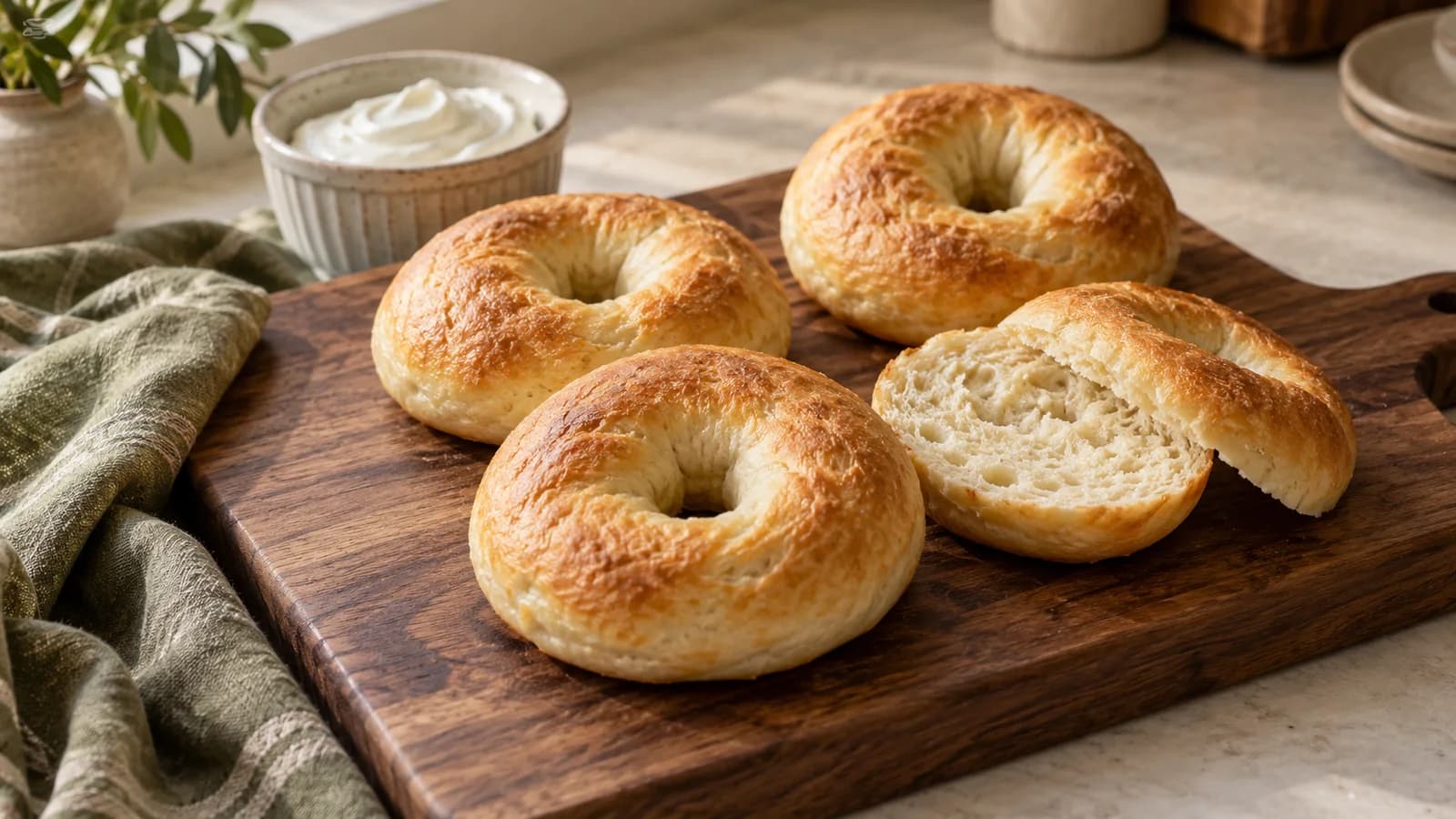
A good bagel breakfast has a particular rhythm: split the bread, toast the cut sides, then decide what belongs in the middle. Some mornings that is an egg and a few tomato slices. Other days it is a thin spread of cream cheese and a cup of coffee. These high protein bagels are a simple homemade option for that routine, using thick Greek yogurt and ordinary flour rather than yeast or a tub of protein powder.
The reference batch makes four bagels. Each one provides approximately 265 calories, 14g protein, 49g carbohydrate and 1g fat before any fillings, seeds or spreads. Greek yogurt supplies much of the protein, while the flour contributes both structure and some protein of its own. The small egg-white wash is included in the calculation. There is no need to count a sandwich filling as though it were baked into the bagel itself.
The kind of bagel you are making
This is a quick yogurt dough, raised with baking powder and baked directly on a sheet. It produces a soft, lightly tangy ring with a modest golden crust. A traditional yeast bagel is usually boiled before baking and has a different chew and surface. Knowing that distinction helps you choose the recipe for the breakfast you want, rather than expecting one dough to behave like another.
Allow about 15 minutes to mix and shape, approximately 25–30 minutes to bake, and at least 15–20 minutes to rest before splitting. The oven does most of the work. The preparation is short enough for an unhurried morning, and you can also bake a batch ahead, cool it fully and freeze individual portions for later.
A useful first batch
Start with plain rings and the measured ingredients. That gives you a chance to see how your yogurt behaves, how wide the holes need to be, and when your oven finishes the centres. Once you know that base, seeds and sandwich fillings are easy to add. The card below scales to four, eight or twelve bagels; the nutrition figures always describe one reference-size bagel.
Why You’ll Love This Recipe
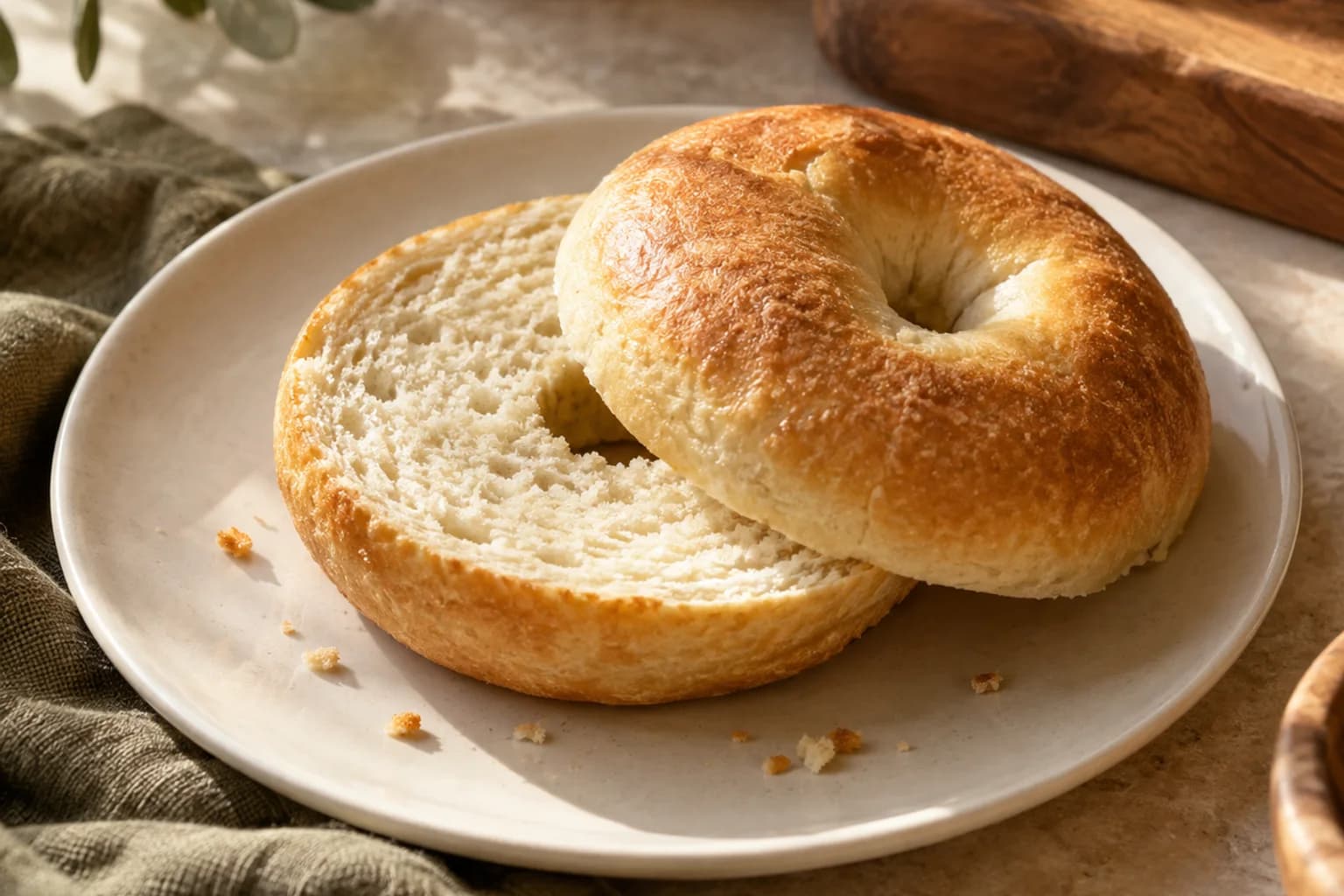
No waiting for dough to rise
There is no yeast activation or long proofing stage. You mix the dough, bring it together briefly and shape the rings while the oven heats. That makes the recipe approachable if bread baking usually feels like a whole-day project. It also means you need to use the quick-dough method: letting the shaped rings sit around for hours does not turn them into a traditional fermented bagel.
The main ingredients have practical jobs. Flour gives the ring enough structure to hold together, thick Greek yogurt brings moisture and protein, and baking powder helps it expand in the oven. Salt gives the plain bread flavour. An optional thin egg-white wash encourages a finished surface without adding a full egg to the dough. A short list is easier to check before you start.
The bagel can be the beginning of a meal
Plain rings leave you room to choose breakfast on the day. One can become an egg sandwich, another can carry cottage cheese and cucumber, and a third can sit beside yogurt and fruit. You do not have to commit the entire batch to a strongly sweet flavour or a particular filling. Keep the bagels plain for storage, then make the finished meal feel fresh when you eat it.
There is a small pleasure in pulling a tray of handmade rings from the oven. They may not all be perfectly symmetrical, and that is fine. What matters more is an open hole, an evenly baked centre and a portion that splits cleanly after cooling. A tidy bakery shape is less useful than a bagel you enjoy eating and can make again without stress.
It shares groceries with other breakfasts
Greek yogurt can also go into overnight oats, a yogurt bowl or a dip for lunch. Flour and baking powder are familiar pantry staples. You can use some yogurt for the dough and serve the rest alongside fruit, rather than buying several special ingredients for one recipe. If your usual yogurt is particularly thick, this is a sensible way to use it while learning a few straightforward shaping skills.
Nutrition at a Glance
- Calories
- 265kcal
- Protein
- 14g
- Carbs
- 49g
- Fat
- 1g
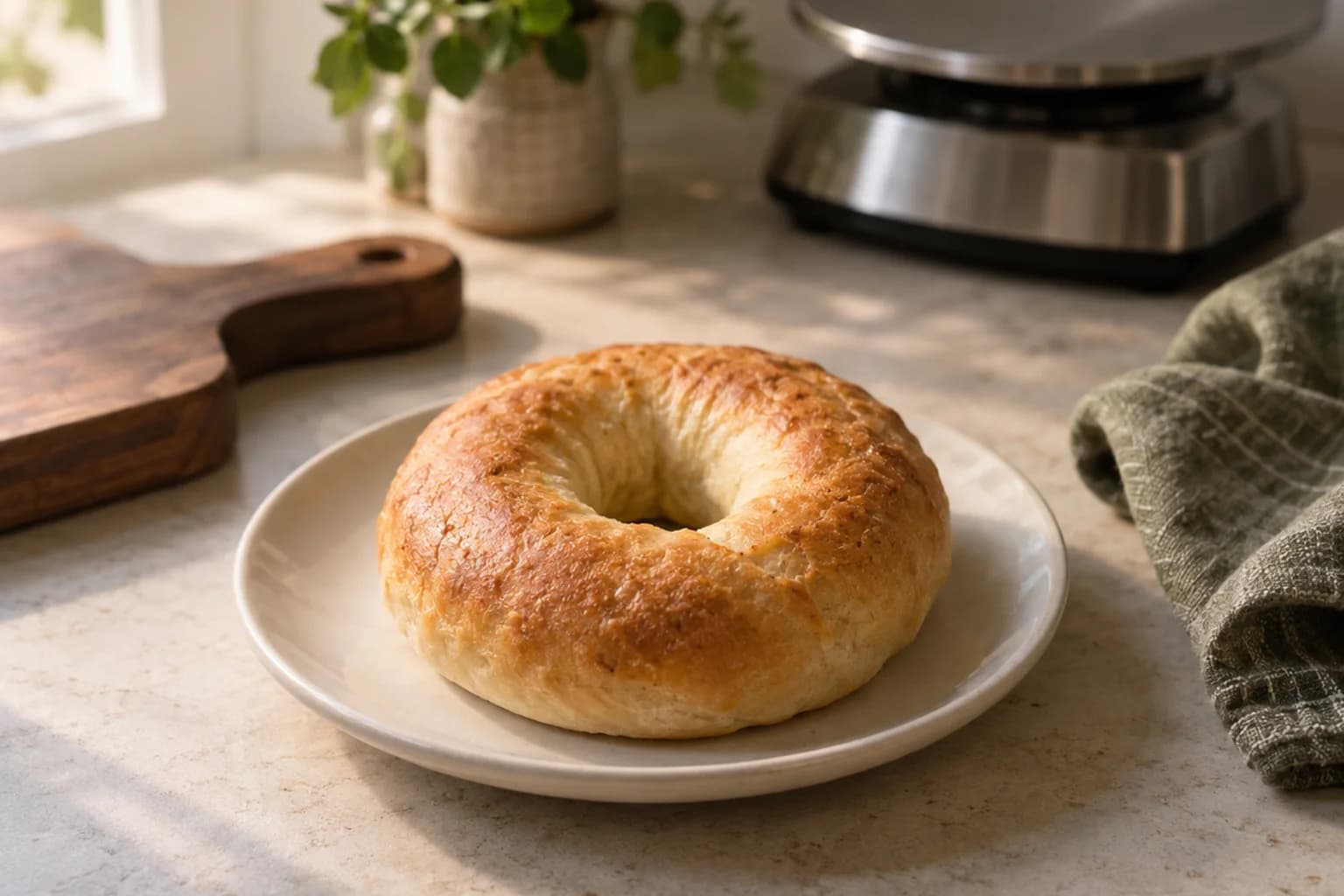
The numbers above refer to one quarter of the measured plain batch. They include the full flour allowance, Greek yogurt, baking powder, salt and 10g egg white divided among the four tops. They exclude sesame, everything seasoning, cream cheese, eggs used as fillings and other sandwich ingredients. Those additions can be useful parts of a meal, but they belong in its separate calculation.
Calories: approximately 265
Most of the energy comes from the flour, followed by yogurt. A bagel is still a substantial portion of bread even when some of its protein comes from dairy. The reference value is not a claim that any homemade yogurt bagel has the same calories. A larger ring or a recipe with more flour makes a different portion. Weighing the dough pieces helps keep the four bagels reasonably consistent.
Protein: approximately 14g
The unrounded figure is about 14.1g per bagel. Roughly 7.6g comes from the yogurt in each portion, about 6.2g from flour, and a small amount from the wash and baking powder. This is why the yogurt choice matters. A product with half as much protein per 100g cannot simply be swapped in while keeping the same headline number.
Carbohydrate: approximately 49g
Wheat flour supplies most of the carbohydrate, so these bagels are not a low-carb or keto recipe. The reference estimate includes about 1.6g fibre and 2.6g total sugars. There is no added granulated sugar or honey in the base dough, but lactose and other naturally occurring sugars still appear in the nutrition total. Sweetened yogurt would change that balance.
Fat: approximately 1g
Plain nonfat Greek yogurt keeps the reference fat low. A 2% or whole-milk yogurt can work differently for flavour and nutrition, and a spread adds its own contribution. The sodium estimate is approximately 520mg per bagel because both salt and baking powder matter. If you want less salt, the variation below reduces the measured table salt while keeping the flour and yogurt amounts unchanged.
Ingredients
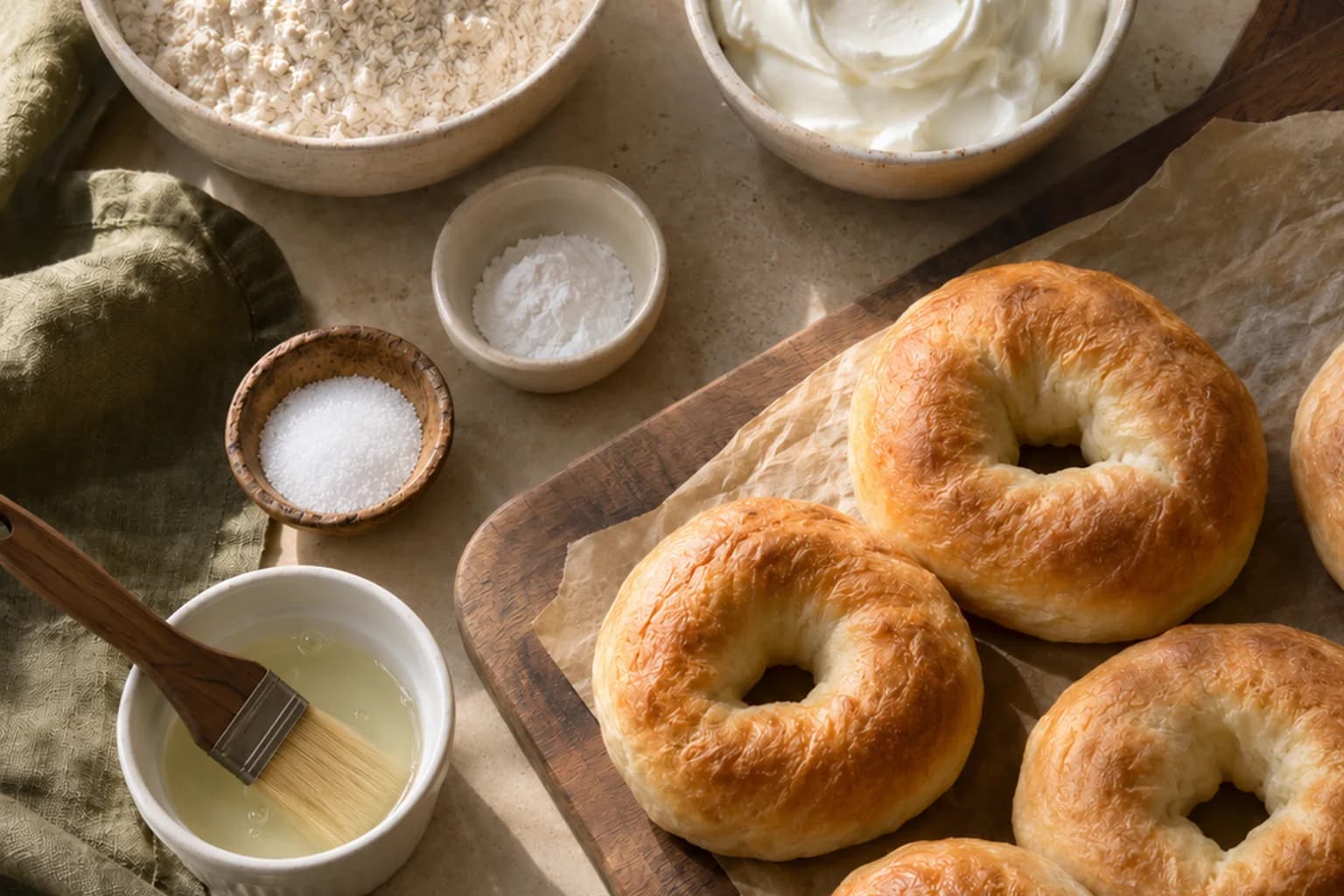
Flour: one measured allowance
Use 240g all-purpose flour for the whole batch. Reserve up to 10g from that amount for the work surface and shaping, then mix the remainder with the other dry ingredients. The reserved flour is part of the total, not an additional ingredient. If you pour a second handful onto the counter, the recipe no longer contains only the published 240g.
All-purpose flour is the starting point because it is widely available and provides a useful balance for a soft quick dough. Bread flour may give a different chew and absorb differently; whole-wheat flour changes the flavour and fibre. Neither is required for the reference batch. Keep the first version simple if you want a clear baseline for what your oven and yogurt produce.
Greek yogurt: plain, thick and unsweetened
Measure 300g plain nonfat Greek yogurt after pouring off any obvious liquid sitting on top. The texture should hold a spoon mark rather than flow like a drinking yogurt. Do not count the drained liquid as part of the 300g. The reference food provides 10.19g protein per 100g, so check your own tub if a precise protein total matters.
Thin regular yogurt introduces a different moisture balance. Adding enough flour to compensate can make a much larger batch and lower the protein concentration of each portion. Starting with an appropriately thick product is easier than repairing a loose mixture later. Sweetened vanilla yogurt also brings a different flavour and is not the plain base specified here.
Small ingredients deserve attention
Use 10g double-acting baking powder and 3g fine table salt. The two white powders can be easy to confuse when several dishes are on the counter, so measure deliberately. Baking soda is not a direct replacement for the powder. For the optional wash, weigh 10g liquid egg white and brush it thinly over the four rings. The dough itself contains no egg; the reference recipe includes egg because of that wash.
Your ingredient checklist
- All-purpose flourPlain wheat flour; includes up to 10g reserved for shaping240g
- Plain nonfat Greek yogurtVery thick and unsweetened; weigh after pouring off visible whey300g
- Double-acting baking powderAbout 2¼ teaspoons; reference uses phosphate baking powder10g
- Fine table salt½ teaspoon; reduce if you prefer less salt3g
- Liquid egg whiteAbout 2 teaspoons for a thin wash; optional, but included in nutrition10g
Contains wheat and milk; the reference egg-white wash adds egg. Seeds or fillings can introduce other allergens. Check every label.
Ingredient Substitutions
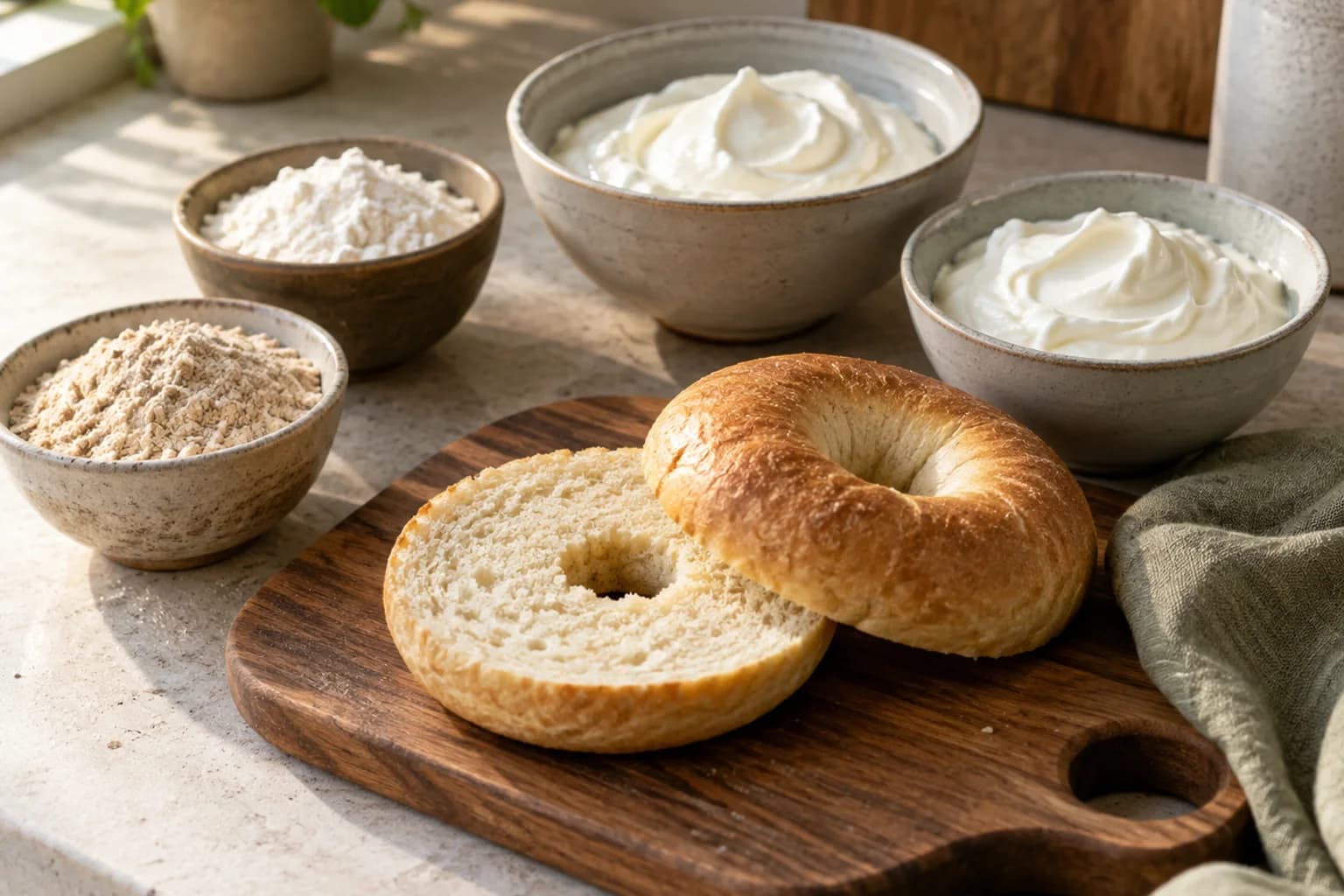
Yogurt swaps need a texture check
Plain low-fat Greek yogurt is a possible weight-for-weight starting point when its consistency is similarly thick. It will change fat and calorie totals, so use its own label. Skyr can be another option if it is thick and unsweetened, but products vary. A smooth high-protein dairy product is more relevant here than the word yogurt alone on the front of the packaging.
Blended cottage cheese is a common idea for protein baking, but its water, salt and curd structure differ from Greek yogurt. Blending removes visible lumps; it does not guarantee an identical dough. This formula has not been established for a direct cottage-cheese replacement. Choose a cottage-cheese bagel recipe designed for that ingredient if it is the food you specifically want to use.
Self-rising flour simplifies a different checklist
Self-rising flour already contains leavening and usually salt. If you use it, do not automatically add the full 10g baking powder and 3g salt again. Check the package and follow a suitable yogurt-dough recipe for that product, because the amounts already present vary. The reference nutrition here uses plain all-purpose flour plus separately measured powder and salt, not a generic self-rising-flour entry.
For a small whole-wheat experiment, replace 60g of the all-purpose flour with 60g whole-wheat flour and keep the rest of the recipe as written. That is a quarter of the flour allowance. Expect a nuttier taste, different absorption and a slightly different crumb. Update the ingredient calculation from your flour label; do not assume the change leaves every macro unchanged.
Dietary requirements change the formulation
For an egg-free surface, omit the egg-white wash. The base dough is already free of egg, but it still contains wheat and milk. For gluten-free needs, use a recipe developed around an appropriate gluten-free baking blend and handling requirements. Oat flour, almond flour and coconut flour are not simple replacements for all the wheat flour here. Dairy-free baking also needs a suitable yogurt replacement with its own protein and moisture profile.
A quick swap guide
Use the ingredient job and texture as well as the nutrition label to choose a change.
| Ingredient | Possible change | Practical consequence |
|---|---|---|
| Nonfat Greek yogurt | Similarly thick plain low-fat Greek yogurt | Different fat and calorie totals; compare thickness |
| Egg-white wash | Omit it | Egg-free base, less finished surface colour; about 13.8g protein per bagel |
| 60g of the white flour | 60g whole-wheat flour | Different absorption and flavour; use the flour label |
| Plain flour + powder + salt | Suitable self-rising flour recipe | Do not duplicate the leavening and salt already present |
| Greek yogurt | Blended cottage cheese | Not an established direct swap for this formula |
How to Make It
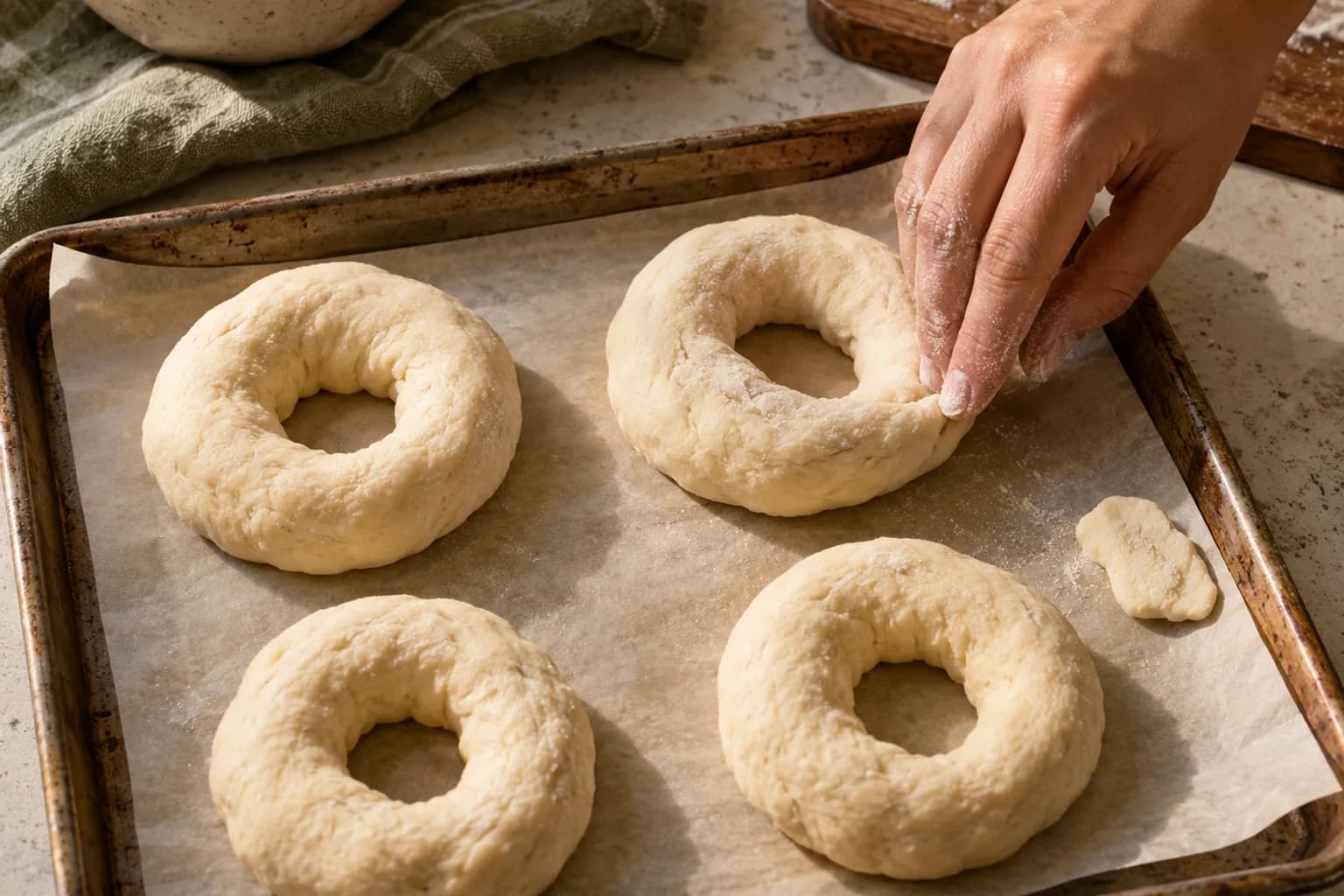
Set up the tray before mixing
Heat the oven to 375°F / 190°C conventional and line a large baking sheet with parchment suitable for that temperature. Place a rack near the middle. Set out the five measured ingredients, reserving up to 10g of the 240g flour for shaping. If the yogurt has a visible pool of whey, pour it off before weighing the thick portion.
Whisk the remaining flour, baking powder and salt until the powder is evenly distributed. Fold in the Greek yogurt with a sturdy spoon or spatula. At first the mixture may look like separate floury clumps rather than a finished dough. Keep bringing those clumps together, scraping the bottom of the bowl so a dry pocket is not left behind.
Knead briefly, then portion
Transfer to the work surface and knead for around one to two minutes, just until the dough becomes reasonably smooth and holds together. Use the reserved flour sparingly for sticky patches. A little tackiness is normal; a pourable mixture suggests a yogurt problem rather than a need for unlimited dusting. Stop before the dough becomes dry from repeated flour additions.
Divide into four equal pieces, preferably using the scale. Roll each piece into a short rope with an even thickness. Bring the ends together, overlap slightly and press the join firmly. Gently widen the hole to roughly 1½–2 inches. Dough expands inward as well as outward, so a tiny opening can close during baking. Put each ring on the lined sheet with at least two inches of space around it.
Bake the dough, not just the surface
Brush the measured egg white thinly over the tops, or omit it for an egg-free version. Bake for approximately 25–30 minutes, checking from 25 minutes. Look for coloured tops and bases and a set centre. If the outside seems ready but the dough inside remains wet, continue baking rather than accepting colour as proof. Move to a rack and rest at least 15–20 minutes before splitting; cool completely before wrapping for storage.
Tips for the Best Results
Solve sticky dough at the ingredient stage
The most useful first check is the yogurt. Very thick Greek yogurt gives a different dough from a loose product with lots of free liquid. Pour off visible whey before weighing, and avoid mixing in sweetened drinking yogurt just because it is what you have in the fridge. If the dough is extremely wet, adding large amounts of flour may make it shapeable but changes the recipe and portion calculation.
Use the reserved flour only where it is needed. A small dusting under the dough or on your fingers can help; repeatedly covering the whole surface can work much more flour into the batch. Keep track of any extra amount if you go beyond the measured allowance. The published macros are a reference, not a way to make those additions invisible.
Give the seam and hole separate attention
An even rope helps the ring bake consistently. If one section is much thicker, it may stay damp while a thin part becomes firm. Press the join so it is not simply two ends touching. If the seam opens slightly, the bagel is still usable, but sealing it better next time gives a tidier ring and makes sandwich assembly easier.
The hole needs room to shrink. A raw ring that looks almost comically open often becomes a recognisable bagel after expansion. Reopen a narrowed hole gently before the tray goes into the oven. Leave space between rings, too: touching bagels trap a softer patch at the join and make it harder to judge the surface of each piece.
Judge the crumb after a rest
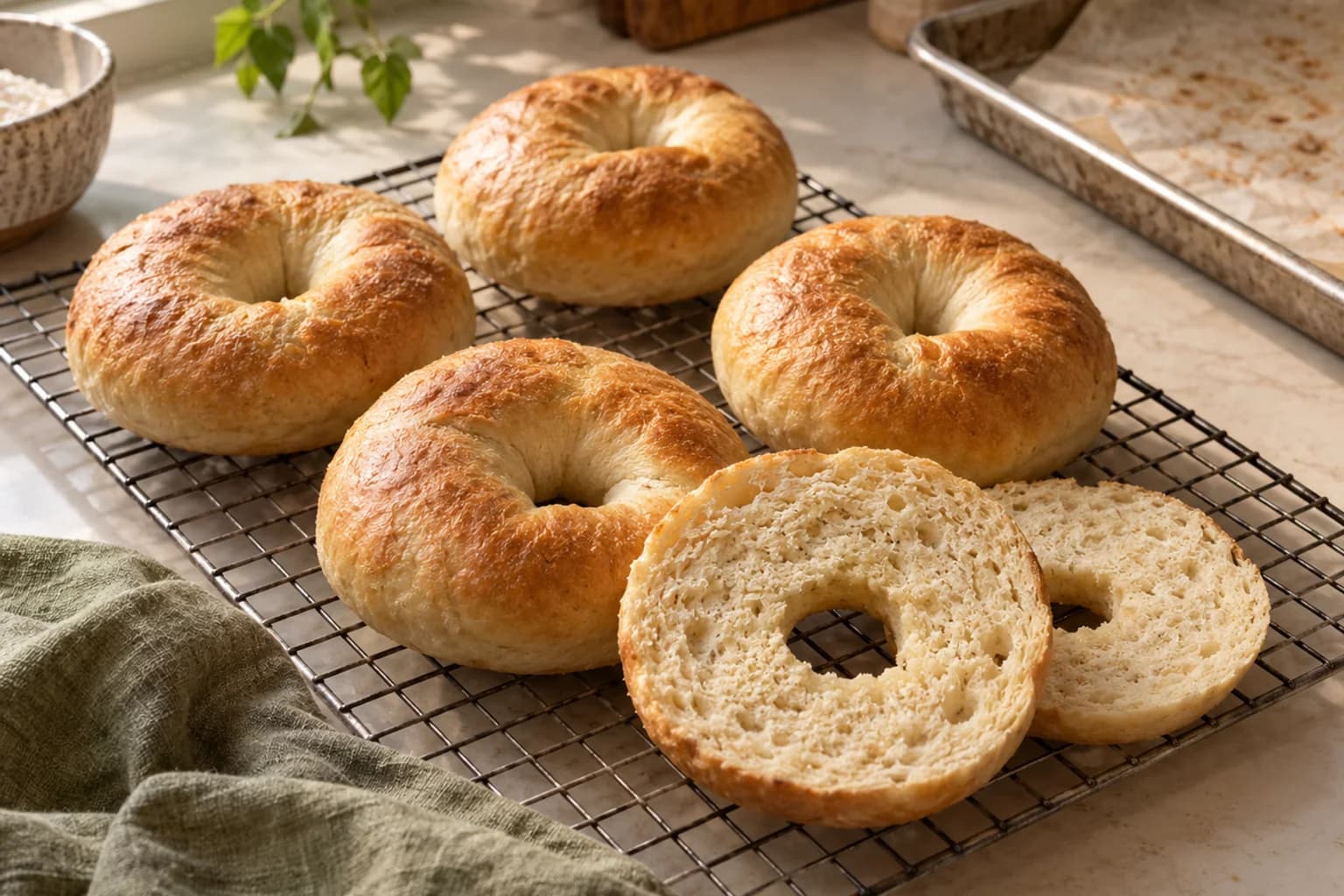
A hot bagel can look sticky inside because moisture has not settled. Let it rest before slicing, and use a clean cut to inspect the centre if you are unsure. Wet, paste-like dough is different from a soft bread crumb. If every batch is pale underneath, check the tray position and oven temperature. If rings are dry, review added flour, size and baking duration before changing several ingredients at once.
Troubleshooting the rings
Look for one likely cause first, then make a measured adjustment on the next batch.
| What you see | What to check | Practical response |
|---|---|---|
| Dough is very sticky | Yogurt thickness and flour allowance | Use thick yogurt; count any flour added beyond the recipe |
| Holes close in the oven | Initial hole width | Open to about 1½–2 inches before baking |
| Seams pull apart | How firmly the ends join | Overlap slightly and press the join securely |
| Wet or paste-like centre | Ring thickness and baking time | Continue baking; inspect a centre after a rest |
| Dry, firm crumb | Extra flour and excessive oven time | Measure additions; begin checking at the suggested time |
High-Protein / Lower-Calorie Variations
Increase meal protein without changing the dough
One reference bagel with 100g plain nonfat Greek yogurt served separately provides approximately 324 calories and 24.3g protein. That is a combined meal, not a claim that the bagel alone contains 24g. A fully cooked egg, cottage cheese, tofu or another preferred filling can also increase the protein of breakfast. Use the label or appropriate food entry for the amount you actually add.
Adding whey to the flour mixture is less straightforward. Protein powder changes how the dough takes up moisture and how it behaves in the oven. It is not necessary for this recipe, and another scoop is not an automatic improvement. If the plain rings work well for you, choosing a protein-rich side or filling keeps the baking formula predictable.
Smaller bagels change portion size
Divide the same batch into six smaller rings for approximately 177 calories and 9.4g protein each. Smaller pieces may finish sooner, so begin checking earlier rather than using the full-size baking time without thought. The batch still contains the same total energy and protein. A smaller bagel is a different serving size, not the original portion with calories removed.
Half of a reference bagel provides approximately 133 calories and 7.1g protein. That can suit an open-faced snack or a breakfast alongside another food. Make the portion description clear when tracking: two halves together equal one whole reference bagel. Cutting bread differently does not change the amount of food in the batch.
A lower-salt or egg-free version
Reducing table salt from 3g to 1.5g gives approximately 375mg sodium per reference bagel instead of 520mg, while the main macros stay essentially unchanged. Baking powder still contributes sodium, and different brands can vary. Omitting the 10g egg-white wash gives approximately 264 calories and 13.8g protein per bagel. The surface may be less glossy and toppings may stick differently.
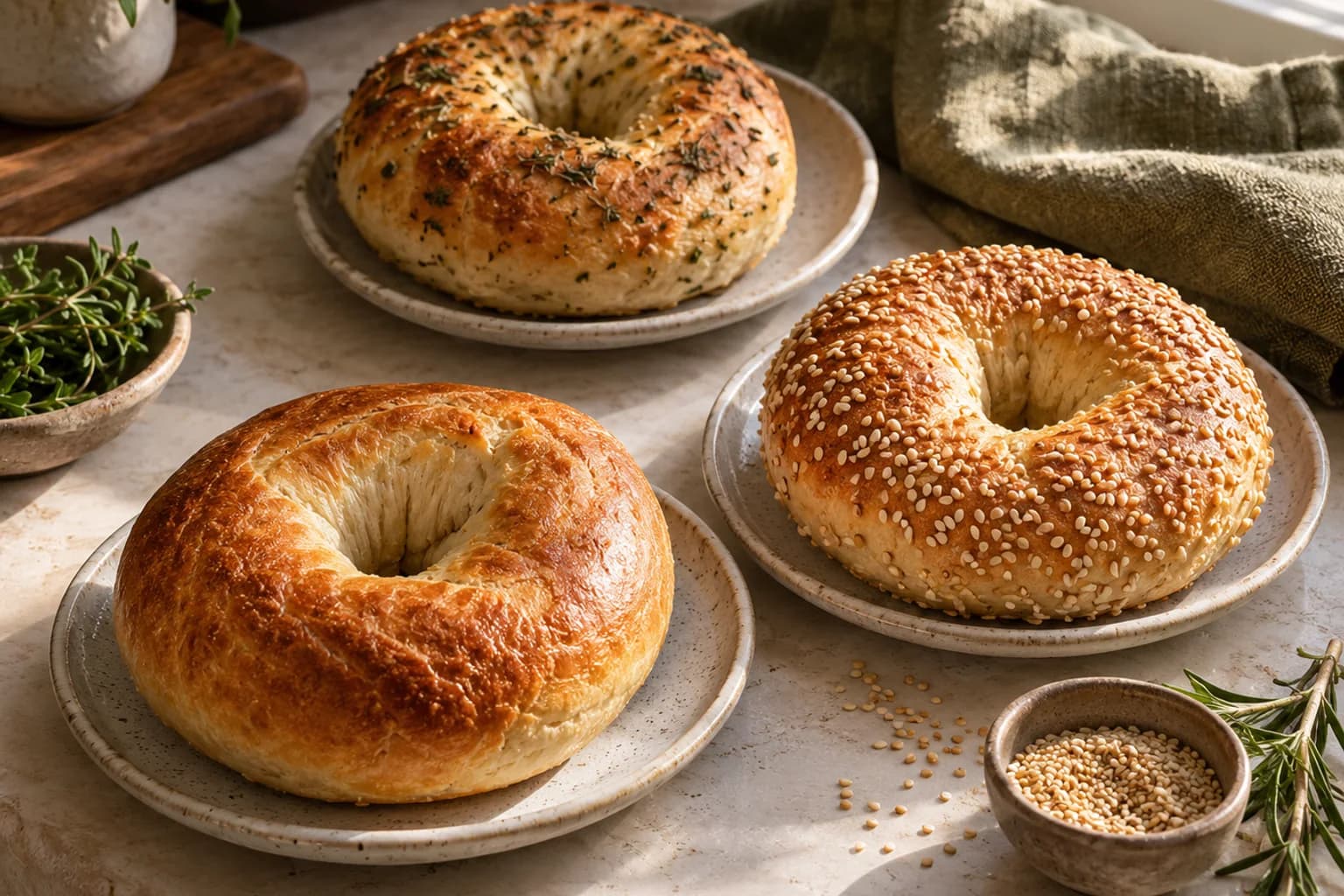
For sesame bagels, add a measured 8g sesame seeds across the batch. That adds approximately 11 calories and 0.4g protein to each bagel using generic seed values. Herbs or a little cracked pepper can also vary flavour. Everything seasoning often contains salt; count it from its label rather than treating it as a free addition.
These numbers use the same measured batch so you can compare portions fairly.
| Portion or version | Approximate calories | Approximate protein |
|---|---|---|
| 1 reference bagel, batch ÷ 4 | 265 kcal | 14.1g |
| Half of 1 reference bagel | 133 kcal | 7.1g |
| Batch divided into 6 smaller bagels | 177 kcal | 9.4g each |
| 1 bagel + 100g nonfat Greek yogurt | 324 kcal | 24.3g |
| No egg-white wash, batch ÷ 4 | 264 kcal | 13.8g |
| Table salt reduced to 1.5g per batch | 265 kcal | 14.1g; about 375mg sodium |
Serving Suggestions
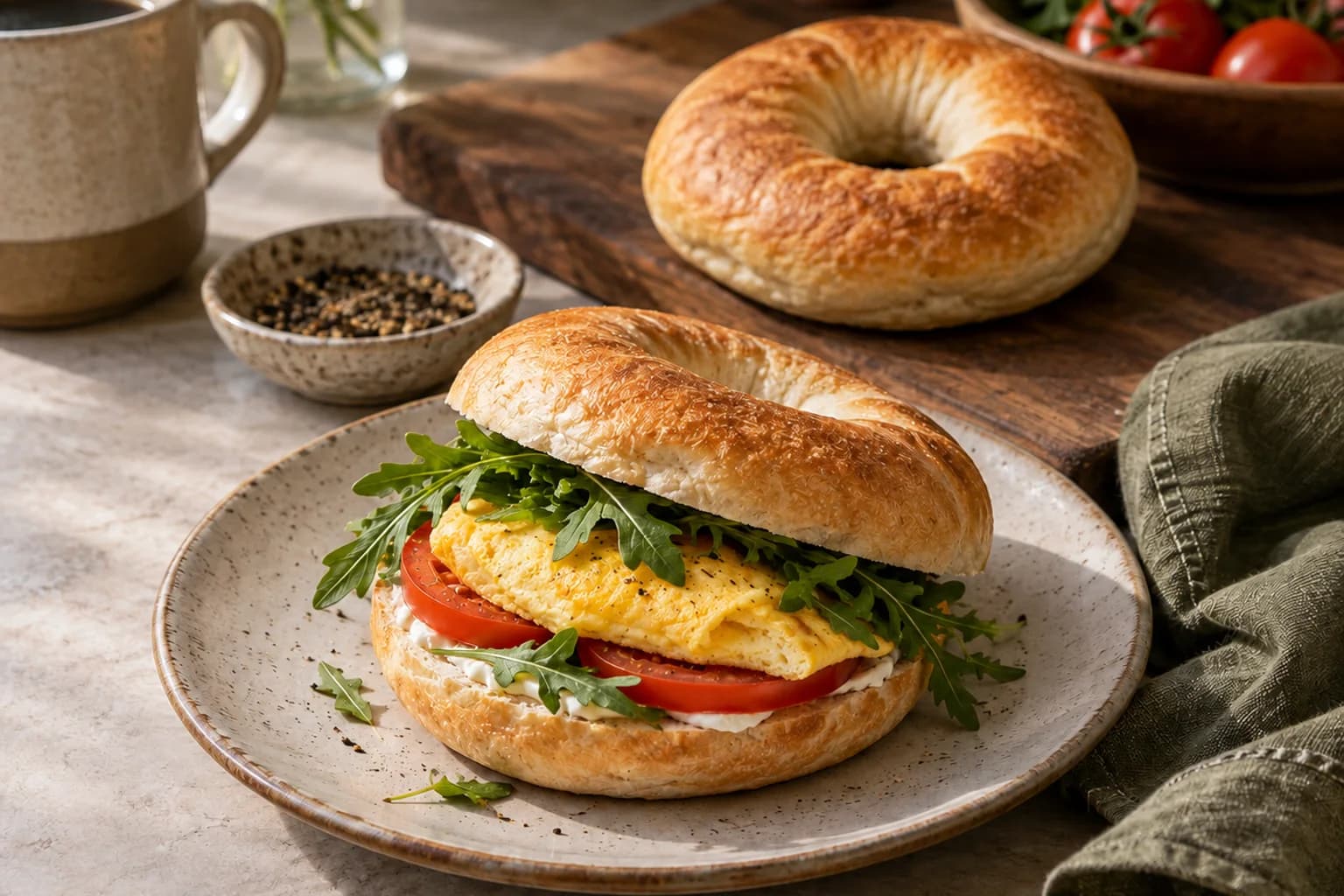
Toast the cut sides when you want contrast
A rested bagel can be eaten as it is, but a short toast adds a firmer cut surface. Split evenly and watch the first round: homemade pieces may be thicker than a packaged bagel and can brown at a different rate. The goal is a pleasant contrast between the toasted face and soft middle, rather than a hard shell all the way through.
For a savoury breakfast, add a fully cooked egg and tomato, or cottage cheese with cucumber and black pepper. Keep wet ingredients reasonably drained so they do not soak the bread immediately. A few leaves or crunchy vegetables can make the sandwich feel fresher. The filling amount depends on your appetite and goals, and its nutrition is additional to the bread reference.
Sweet and simple is an option too
A small spread of nut butter and a few banana slices goes well with plain yogurt dough. A little cream cheese and berries is another way to use the bagel. These are enjoyable combinations, but they bring their own calories and allergens. If you are tracking, weighing a spread is more useful than assuming a thin-looking layer is always the same amount.
You can also keep the bagel and a bowl of yogurt separate. That lets you enjoy the bread's texture while adding protein and fruit to the meal. It is particularly practical when taking breakfast to work: pack the dry bread apart from chilled yogurt, then assemble at the time you eat. Keep dairy and other perishable sides cold during transport.
Let the occasion choose the filling
A quick weekday breakfast may need only a bagel and one easy filling. A slower weekend breakfast can include eggs, vegetables and coffee at the table. Neither version needs a complicated topping list. The plain base gives you room to choose. If serving others, identify wheat and milk, explain whether the egg wash was used, and keep sesame or other allergen-containing additions clearly separate.
Meal Prep & Storage
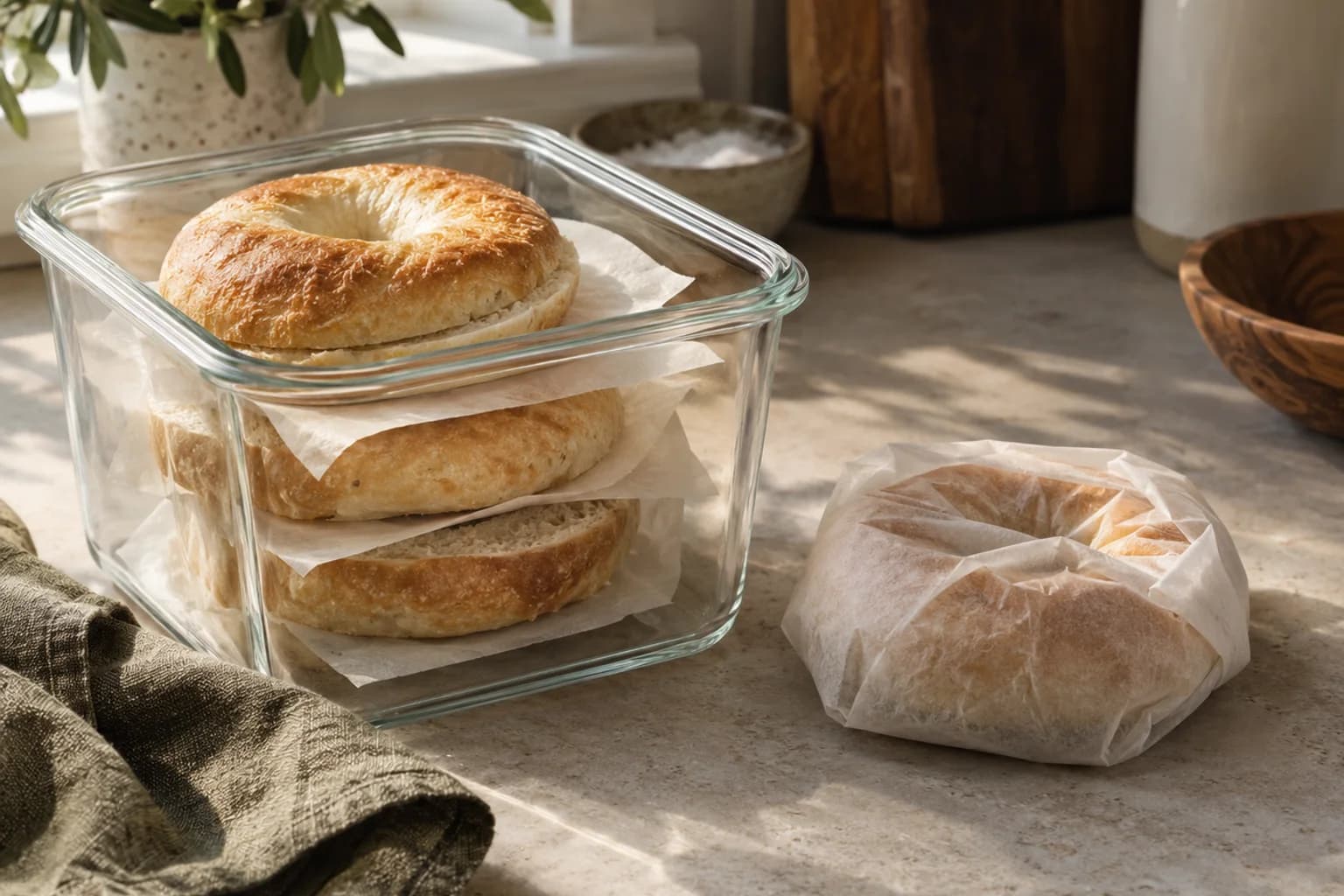
Cool fully before closing the container
Move baked bagels from the tray to a rack so air reaches the bottoms. Allow them to cool completely before packing. Warm bread releases steam; trapping it inside a sealed container can leave a damp surface and softer crust. Splitting is easier after an initial rest, and packaging should wait until the centre is no longer warm.
For this moist homemade yogurt dough, a conservative approach is to refrigerate cooled bagels at 40°F / 4°C or below and use within three to four days, or freeze them promptly. That is practical handling guidance, not a measured shelf-life result for this exact formulation. Do not copy the room-temperature storage claim of a different bagel recipe without knowing whether its ingredients and handling match yours.
Slice before freezing if that suits your routine
A bagel frozen in halves is easier to portion and toast later. Separate the cut surfaces with parchment, wrap well or use a suitable sealed freezer container, and label the date. Aim to use within about two months for good quality. Freeze a plain base and add fillings later; this keeps wet dairy, vegetables and eggs from turning the bread into a different stored meal.
Thaw in the refrigerator, or follow your toaster's instructions for frozen bread if it can safely accommodate the slices. Never force a thick piece into a slot that is too small. Warm only what you plan to eat. If a bagel shows mould or signs of spoilage, discard it rather than cutting away the visible spot.
Prep the dry ingredients ahead
You can measure flour, baking powder and salt in advance and keep them dry and covered. Add the yogurt when you are ready to shape and bake. Mixed baking-powder dough is not improved by a long overnight hold, and its rise may change. Keep the yogurt refrigerated until use, clean the work surface after handling raw flour, and wash utensils after the optional egg-white wash. Advance preparation should shorten the morning, while keeping the baking method recognisable.
Full Nutrition Information
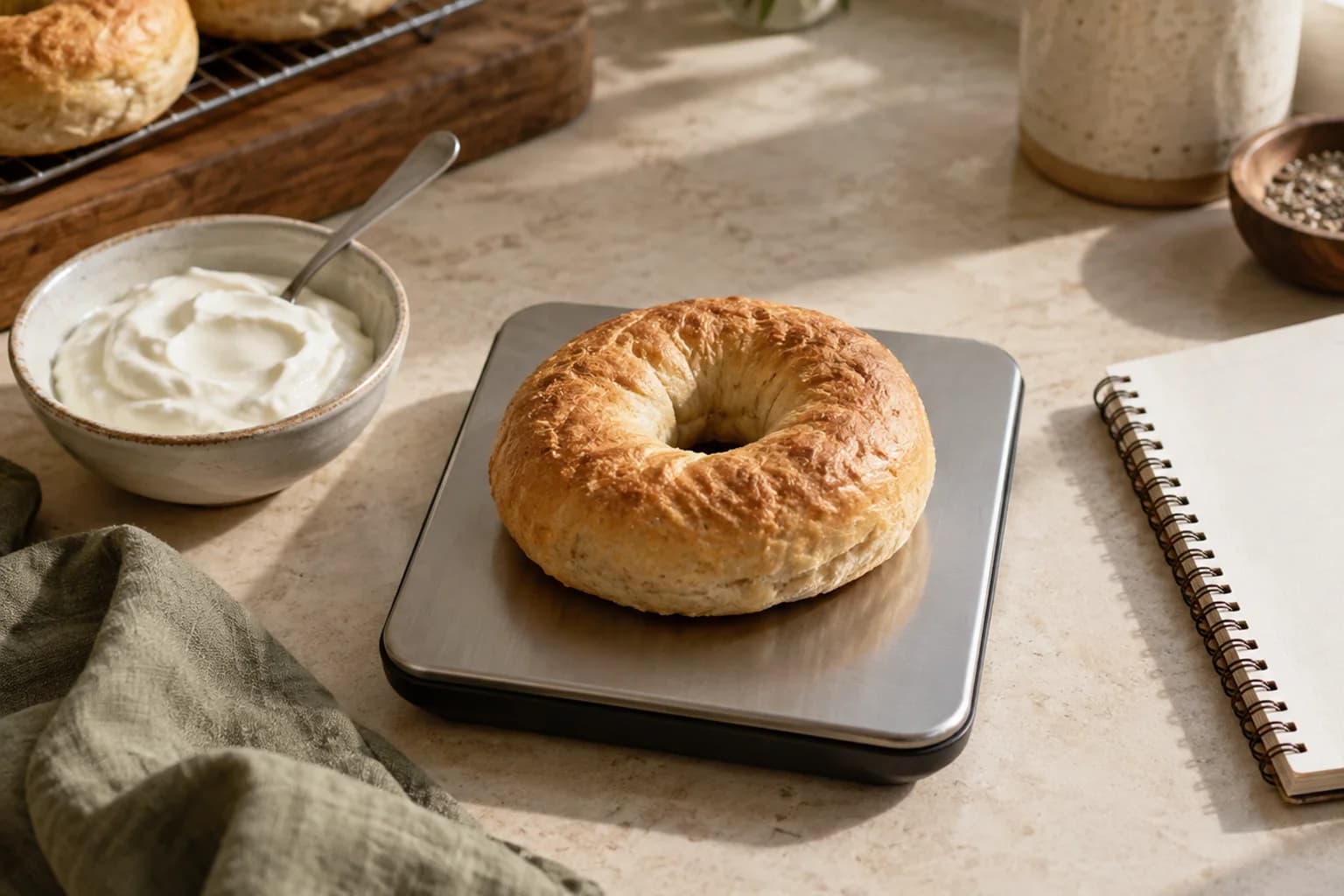
A calculation you can follow
The table below uses measured quantities rather than a generic database entry called protein bagel. It includes 240g flour, 300g nonfat Greek yogurt, 10g baking powder, 3g table salt and 10g egg white. All five ingredients appear in the batch total, including the small amounts that influence sodium or the surface wash. Each reference bagel receives one quarter of that total.
The food composition values come from USDA Standard Reference 28, a historical dataset with per-100g edible-ingredient values. The yogurt entry supplies 59 calories and 10.19g protein per 100g; the all-purpose flour entry supplies 364 calories and 10.33g protein. A current yogurt tub or flour package may differ from those generic foods. Your own labels take priority when you want a more specific estimate.
Batch totals and actual portions
The whole batch provides approximately 1,061 calories and 56.5g protein. Dividing by four gives about 265 calories and 14.1g protein per bagel. Flour left on the counter or a small amount of wash left on the brush means not every gram necessarily reaches the finished bread; the reference conservatively counts the complete measured allowance. Additional flour or toppings need adding to the calculation.
Baking changes water content and finished weight. It does not remove the ingredient calories from the batch. That is why this page does not promise one universal baked gram weight per bagel. To make portions consistent, weigh the raw dough pieces. If the finished pieces differ substantially, a weight-based fraction of the total cooled batch can be more informative than simply calling each one a bagel.
Small numbers still deserve context
Estimated fibre is about 1.6g, total sugars about 2.6g and saturated fat about 0.2g per reference bagel. Sodium is approximately 520mg because powder and table salt both contribute. Cholesterol, complete micronutrients and official daily-value percentages are not calculated here. The table is an ingredient estimate, not a laboratory analysis or a nutrition label certified for sale. It is intended to help you understand and adjust your own breakfast.
| Ingredient | Amount | Calories | Protein | Carbs | Fat |
|---|---|---|---|---|---|
| All-purpose flour | 240g | 874 kcal | 24.8g | 183.1g | 2.4g |
| Plain nonfat Greek yogurt | 300g | 177 kcal | 30.6g | 10.8g | 1.2g |
| Double-acting baking powder | 10g | 5 kcal | 0.0g | 2.4g | 0.0g |
| Fine table salt | 3g | 0 kcal | 0.0g | 0.0g | 0.0g |
| Liquid egg white | 10g | 5 kcal | 1.1g | 0.1g | 0.0g |
| Whole batch | 4 equal bagels | 1061 kcal | 56.5g | 196.4g | 3.5g |
| One reference bagel | Batch ÷ 4 | 265 kcal | 14.1g | 49g | 1g |
| Dietary fiber | 1.6g |
|---|---|
| Total sugars | 2.6g |
| Saturated fat | 0.2g |
| Sodium | 520mg |
Estimated recipe nutrition, not a laboratory analysis. Counts all measured flour and egg-white wash; any unused shaping flour or wash makes this a conservative estimate. Fillings and toppings are additional. Cholesterol and complete micronutrients are not calculated.
How This Fits Your Daily Protein Goal
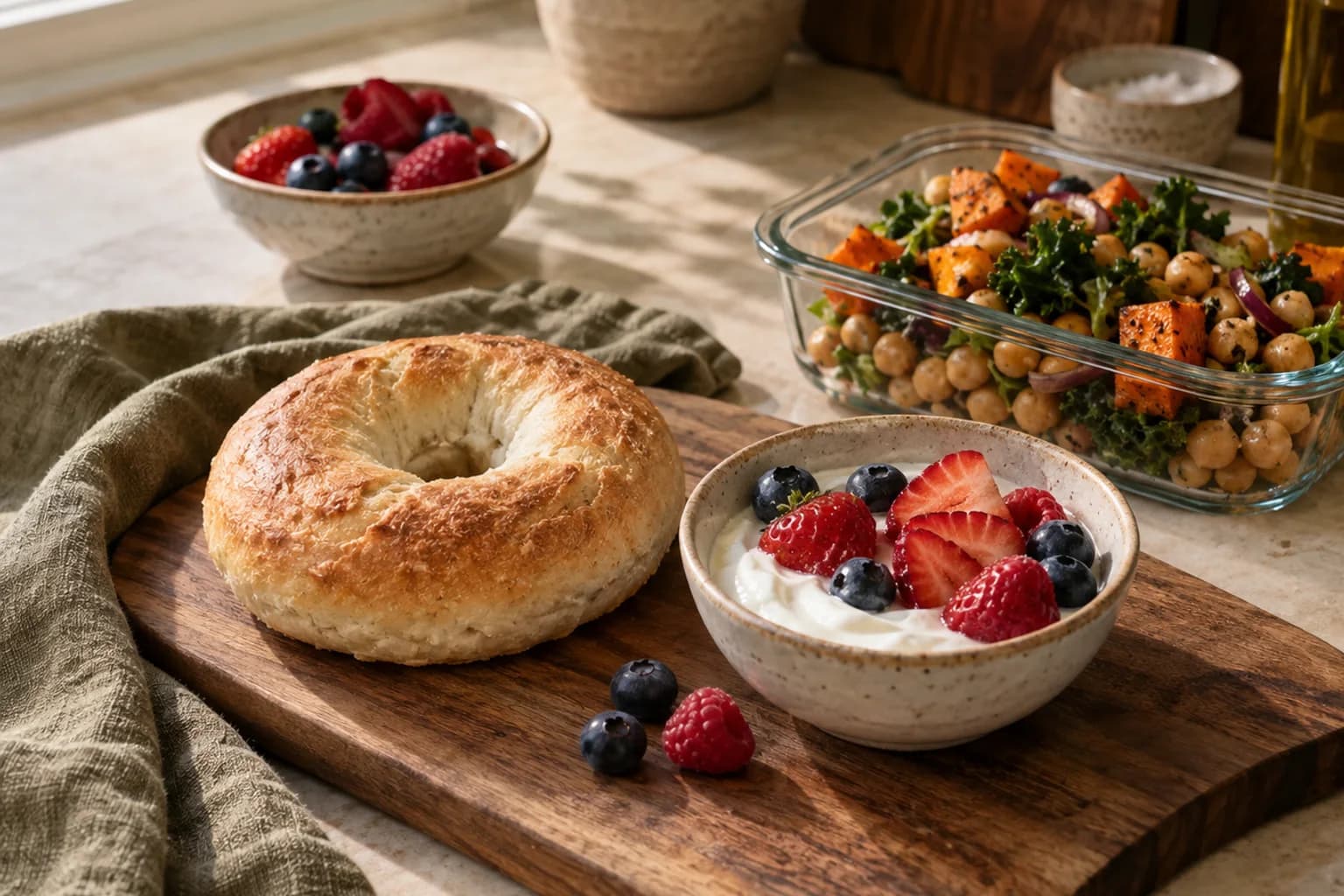
Put the serving beside your own target
One reference bagel contributes approximately 14.1g protein. Against an illustrative 100g daily target, that is about 14%; against 150g, about 9%. Those figures show the arithmetic, not a universal recommendation. Your daily needs depend on body size, activity, goals and personal circumstances. The protein calculator can help you estimate a target to discuss and use within your own context.
A bagel with 100g plain nonfat Greek yogurt provides approximately 24.3g protein for the combined plate. That can make a more substantial breakfast without changing the dough. An egg or another filling offers a different flavour and nutrition profile. Choose a combination you like, and record the combined meal rather than inflating the bread's own protein number.
Think about the rest of the day
Bread does not need to supply every protein source you eat. Lunch and dinner can bring beans, tofu, dairy, fish, poultry, eggs or other foods that fit your preferences and budget. Variety gives you different textures and nutrients as well as a way to distribute protein across meals. A bagel breakfast can coexist with familiar cultural dishes later in the day.
If you are regularly short of your target, look at the complete eating pattern before buying another specialised ingredient. You may find it simpler to increase a yogurt portion, add a protein source to lunch or prepare an easy dinner. This recipe is useful because its serving is defined, not because it promises to solve the entire day's food intake in one ring of bread.
Choose the portion for the meal
One bagel may suit breakfast or lunch, while half can work as a snack alongside something else. Two whole reference bagels provide about 530 calories and 28.2g protein before fillings, which is a substantially larger bread portion. Let appetite, the meal and your goals inform the choice. If you have an individual medical protein or sodium limit, use the ingredient information alongside the guidance you have been given rather than relying on the recipe title alone.
Make it personal
Where does a bagel fit in your day?
Estimate your daily protein target, then plan meals you enjoy.
Recipe Card
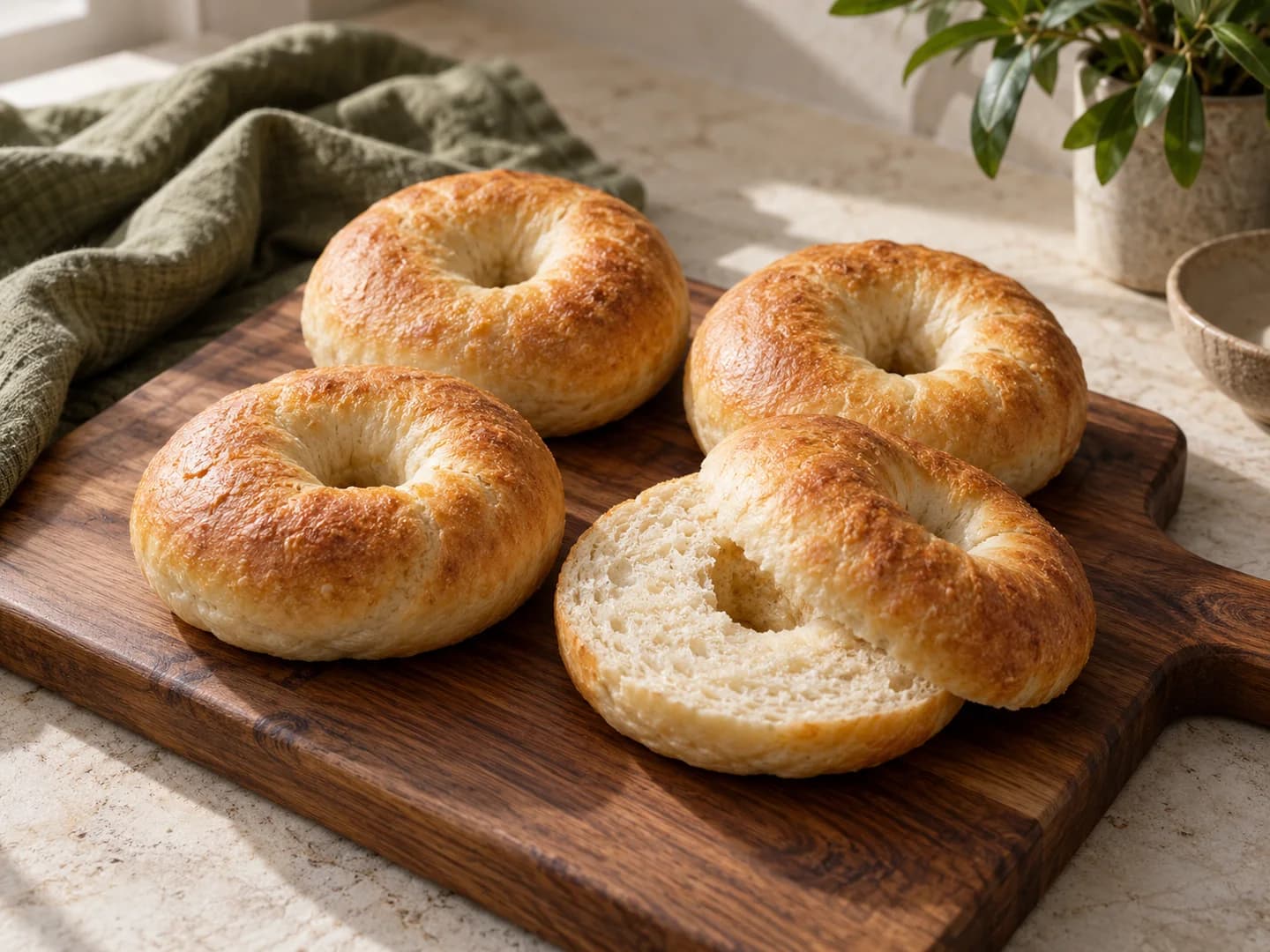
Choose the batch before measuring
The card below scales to four, eight or twelve bagels. The ingredient amounts update together, including the shaping flour allowance and wash. Four is the base recipe; eight doubles it and twelve triples it. Each bagel should remain approximately the same reference size. Increasing the batch is different from making four much larger rings with all the extra dough.
Use enough trays to leave room between the pieces. A crowded sheet can make the sides bake unevenly, and stacking trays in an oven changes airflow. If you need separate baking rounds, allow extra total time and check each round individually. The card's preparation and baking times describe the base batch, so they are working estimates rather than a promise that twelve bagels finish as quickly as four.
Keep the scale and the checklist together
Tick an ingredient when it has been measured. The flour amount includes what you reserve for shaping, so set that small portion aside before mixing. Changing the batch size resets the checkboxes because the quantities have changed. That gives you a chance to check the new amounts rather than accidentally mixing a half-scaled recipe.
The print button opens a compact browser print view containing the core ingredients, steps and nutrition. It is useful when you would rather leave your screen away from the floury work area. You can keep the longer sections available for dough troubleshooting or substitutions without needing to print the whole article.
Match the method to this dough
These rings bake directly; there is no yeast proof or boiling stage in the card. Knead briefly, give the hole room to shrink and let the centres finish in the oven. Rest before splitting and cool fully before storage. The formula and timing are a measured starting point informed by general yogurt-dough guidance, rather than a claim that this exact combination has been physically tested with every yogurt, tray and oven.
Your bagels, ready to shape
High-Protein Greek Yogurt Bagels
A soft quick dough. No yeast or protein powder.
*Base-batch estimates: bake about 25–30 minutes and check the centres. Larger batches may need extra trays or baking rounds. Nutrition stays per reference bagel.
Ingredients
Method
- Prepare the oven and ingredients
Preheat to 375°F / 190°C conventional. Line a large baking sheet with suitable parchment. Weigh the checklist ingredients. Reserve up to 10g from the measured 240g flour for shaping; it is included in the total.
- Make a soft dough
Whisk the remaining flour, baking powder and salt together. Fold in the thick Greek yogurt until rough clumps form. Bring together and knead briefly, about 1–2 minutes, just until the dough is reasonably smooth. Use the reserved flour sparingly if needed.
- Divide evenly
Divide the dough into 4 equal pieces, preferably by weight. Keep the portion sizes consistent so they bake at a similar rate. Roll each piece into a short rope without making the ends much thinner than the middle.
- Shape open rings
Join each rope into a ring and press the seam firmly. Gently widen the centre hole to about 1½–2 inches; it will shrink as the dough expands. Place on the lined sheet with at least 2 inches between rings.
- Brush and bake
Brush the measured egg white thinly across the tops. Bake on the middle rack for about 25–30 minutes, checking from 25 minutes. The tops and bases should colour and the centres should be set, without wet dough. Extend baking if needed; colour alone is not a doneness test.
- Cool, split and serve
Move to a rack and rest for at least 15–20 minutes before cutting. Check one centre if you are unsure: it should look baked and bread-like, not wet or paste-like. Cool fully before packing. Fillings, seeds and spreads are additional to the plain bagel nutrition.
Leave room between rings and check each tray. Do not multiply oven time automatically. Raw flour dough should not be tasted.
Includes the measured flour and wash. Fillings and seeds are additional. Contains wheat, milk and egg with the reference wash. Cool fully before wrapping; refrigerate for 3–4 days or freeze promptly.
Frequently Asked Questions
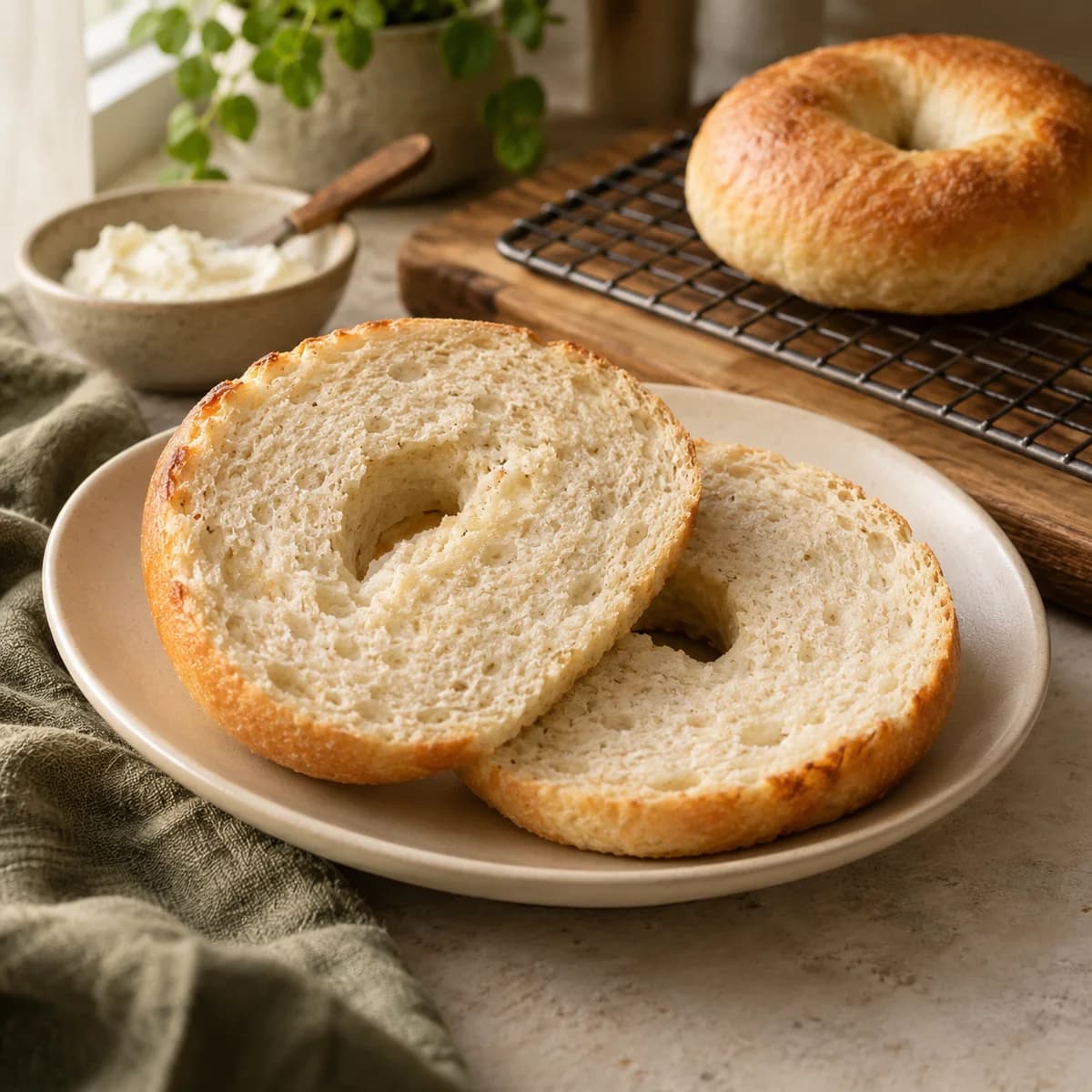
Bagel questions usually start with the yogurt tub: is it thick enough, can cottage cheese replace it, and does a higher-protein label guarantee a better dough? The practical answer depends on both nutrition and texture. An ingredient's job in baking matters as much as the number on the front of its package. The answers below refer to the measured quick-yogurt recipe on this page.
Check what a comparison includes
A shop-bought bagel, a homemade yogurt ring and a bagel sandwich are different things to compare. Look at the serving weight, flour quantity, added fats and fillings before deciding which has more protein or fewer calories. A high-protein sandwich may owe much of its protein to eggs or meat. That does not make its bread identical to this reference bagel.
The same care applies to social recipes described as two-ingredient bagels. Self-rising flour contains several components already, and an egg wash or seed topping adds something else. You can keep a short shopping list while still being clear about what is in the food. This recipe lists its flour, leavener and salt separately so the calculation is easier to follow.
Use one change to learn something
If you have a dough problem, start with the most likely variable: yogurt thickness, flour measurement, ring size or oven time. Changing the flour, yogurt, leavener and baking method at once makes it harder to understand the result. A simple first batch gives you a useful reference for later adjustments.
The FAQ provides the quick version; the method, tables and source notes explain the assumptions behind it. Gluten-free or dairy-free requirements may need a different formulation, while a lower-salt version can be a smaller adjustment within this base. Read the relevant answer before treating the original macros or timing as a guarantee for your substitutions.
How much protein is in one high protein bagel?
Approximately 14.1g, rounded to 14g, for one of four equal bagels from the measured batch. The bread estimate includes the flour, nonfat Greek yogurt, baking powder, salt and small egg-white wash. Fillings and seeds are additional. A bagel served with 100g nonfat Greek yogurt provides about 24.3g protein for the combined meal.
Are these traditional boiled bagels?
These are quick Greek yogurt bagels made with baking powder, without yeast or a boiling stage. Expect a soft, lightly tangy bread ring rather than the same crust and chew as a boiled yeast bagel. Follow this dough’s direct-baking method; adding a water bath does not automatically convert it into a traditional bagel formula.
Can I make them without protein powder?
Yes. The reference recipe contains no protein powder. Greek yogurt and wheat flour supply most of the approximately 14g protein per bagel. Adding whey is not necessary and would change moisture absorption, taste and baking behaviour. For more meal protein, add a measured yogurt side or an appropriate filling and count it separately.
Why is my Greek yogurt bagel dough too sticky?
First check that you used thick plain Greek yogurt, weighed after pouring off obvious liquid. Thin yogurt can make the dough much wetter. Use the reserved flour sparingly, and keep track if you exceed the total 240g allowance. A little tackiness is expected; a mixture that flows rather than holding together needs a different adjustment than a sticky patch on your fingers.
Can I replace Greek yogurt with cottage cheese?
Blended cottage cheese is not an established direct replacement in this formula. It differs in moisture, sodium and curd structure; blending makes it smooth without making it identical to Greek yogurt. If cottage cheese is your preferred ingredient, use a recipe formulated for it. The original nutrition and time should not be applied automatically to that substitution.
Can I use self-rising flour for two-ingredient bagels?
Self-rising flour contains leavening and usually salt already. Follow a suitable recipe and the product’s guidance, rather than adding the full baking powder and salt from this plain-flour version again. Greek yogurt and self-rising flour can be the two main ingredients, while an egg wash or seeds add others. Recalculate from the actual flour and yogurt labels.
Can I make gluten-free or dairy-free bagels?
The base recipe contains wheat and milk. Gluten-free baking requires an appropriate formulated flour blend and relevant cross-contact precautions; almond, coconut and oat flour are not guaranteed one-for-one replacements. Dairy-free yogurt varies greatly in protein and thickness. A recipe developed for those requirements is a more reliable starting point than several simultaneous swaps here.
How do I make these bagels without eggs?
Omit the optional 10g egg-white wash. The dough itself contains no egg. The calculated result is approximately 264 calories and 13.8g protein per bagel, and the surface may colour differently. Check all packaged ingredient labels and handling if an allergy matters. Wheat and milk remain in the base recipe.
Why did the bagel holes disappear?
The dough expands towards the centre as well as outwards. Start with an opening around 1½–2 inches and gently reopen narrowed holes before baking. Avoid making the rope much thicker in one place, and press the seam firmly. A closed ring is still bread, but a wider starting hole produces a more recognisable bagel shape.
Can I bake them in an air fryer?
The published method uses a conventional oven at 375°F / 190°C. A precise air-fryer method has not been established for this formula. Different baskets and airflow can brown the outside before the middle sets. Use a recipe and lining method appropriate to your appliance rather than transferring the full oven time without checking. Keep rings separated and judge the centres, not only the tops.
How do I store and freeze yogurt bagels?
Cool fully before wrapping. As conservative guidance for this moist homemade dough, refrigerate at 40°F / 4°C or below and use within three to four days, or freeze promptly. Slice first if convenient and separate halves with parchment. Aim to use frozen portions within about two months for good quality. This is not a measured shelf-life study of this recipe; discard bread showing mould or spoilage.
Are high protein bagels good for weight loss?
A reference bagel is about 265 calories before fillings and can fit a calorie-controlled day when the portion suits your needs. It does not cause weight loss on its own. A half bagel or six smaller rings from the batch gives a smaller portion, with less protein as well as fewer calories. Count spreads and fillings, and consider the complete day’s eating pattern.
Can I double or triple the recipe?
Yes: the card scales the measured ingredients to eight or twelve reference-size bagels. Divide into equal pieces and use enough trays for spacing. Multiple trays or separate rounds may take longer, so check each round and do not simply multiply the oven time. The nutrition stays per bagel, assuming each portion is the same size as the base batch.
How can I lower the sodium?
Reduce table salt from 3g to 1.5g in the four-bagel batch. The reference sodium estimate becomes about 375mg per bagel instead of 520mg. Baking powder still contributes sodium, and its label may differ from the phosphate-powder reference. Salted everything seasoning and sandwich fillings add more, so include them when comparing a whole meal.
More High-Protein Recipes
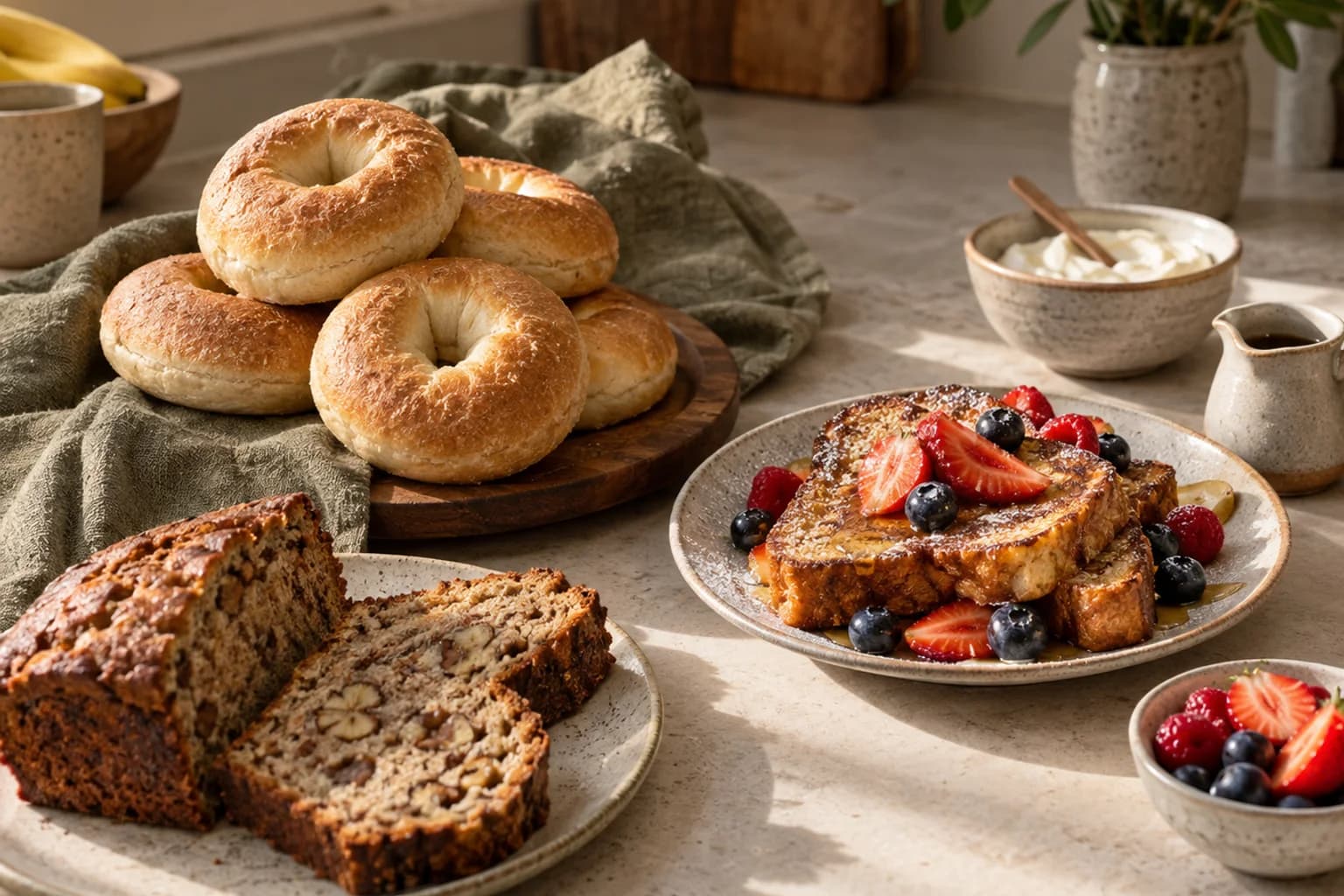
Choose another recipe for a different kind of morning
Banana bread offers a sliceable, make-ahead breakfast or snack with ripe fruit and a gently sweet flavour. French toast gives you warm pan-cooked bread with yogurt and berries when you have a little time in the morning. Both pair naturally with some of the groceries used here, but their nutrition describes different portions. Read each serving definition before comparing the protein number.
Pancakes and waffles suit a slower breakfast when you want a plate cooked fresh. Oatmeal provides a warm bowl, while overnight oats move the preparation to the previous evening. A yogurt bowl is especially useful when you have part of a tub left after making the dough. The best next recipe is the one that fits the time and equipment you actually have.
Plan around useful groceries
A large yogurt tub can support bagel dough, a breakfast side and a savoury dip rather than being purchased for a single dish. Flour can stay in the pantry for another bake; fruit and eggs can serve meals beyond breakfast. Choosing a few recipes with shared ingredients can simplify the shopping list without making every plate taste the same.
There is room for savoury meals later in the day too. The wider recipe collection includes options beyond breakfast, so you can vary both your protein sources and the amount of cooking required. A bread recipe is one helpful piece of that rotation, not a replacement for thinking about lunch and dinner.
Keep the useful habits
Carry three habits into the next recipe: weigh ingredients that affect the formula, check what the portion includes, and use doneness cues as well as a timer. They help you understand the food in front of you without turning breakfast into a complicated calculation. Start with something you want to eat, then use the recipe's measured details to make it fit your day.