
Browse the 15 recipe sections
One reference serving: four of eight equal crepes with 150g Greek yogurt and 100g strawberries, about 37.9g protein. Filling and measured pan oil are included; extra sauces are additional. Timings are estimates. See the breakdown.
Recipe Overview
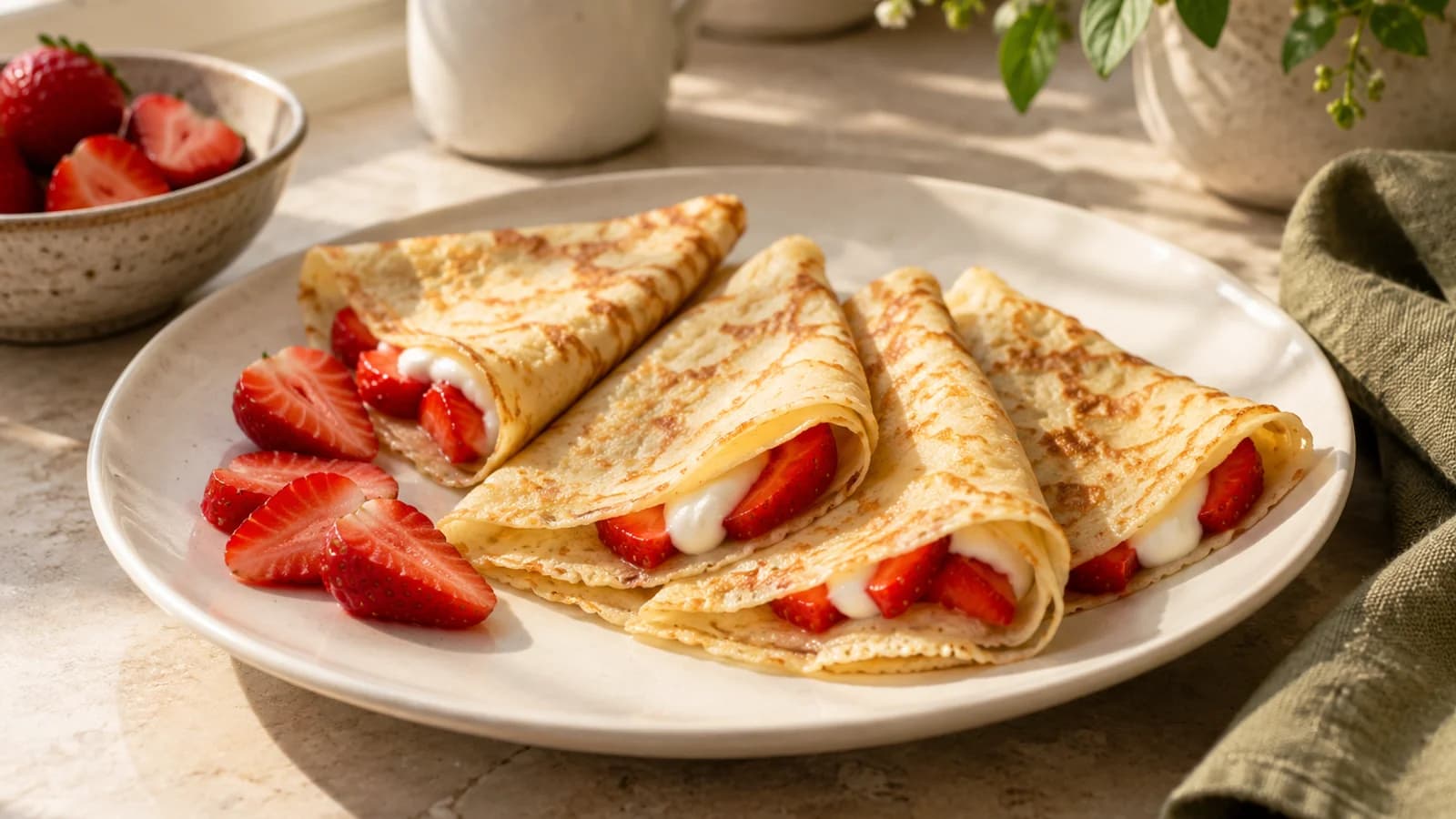
Thin folds, a cool filling and a warm plate
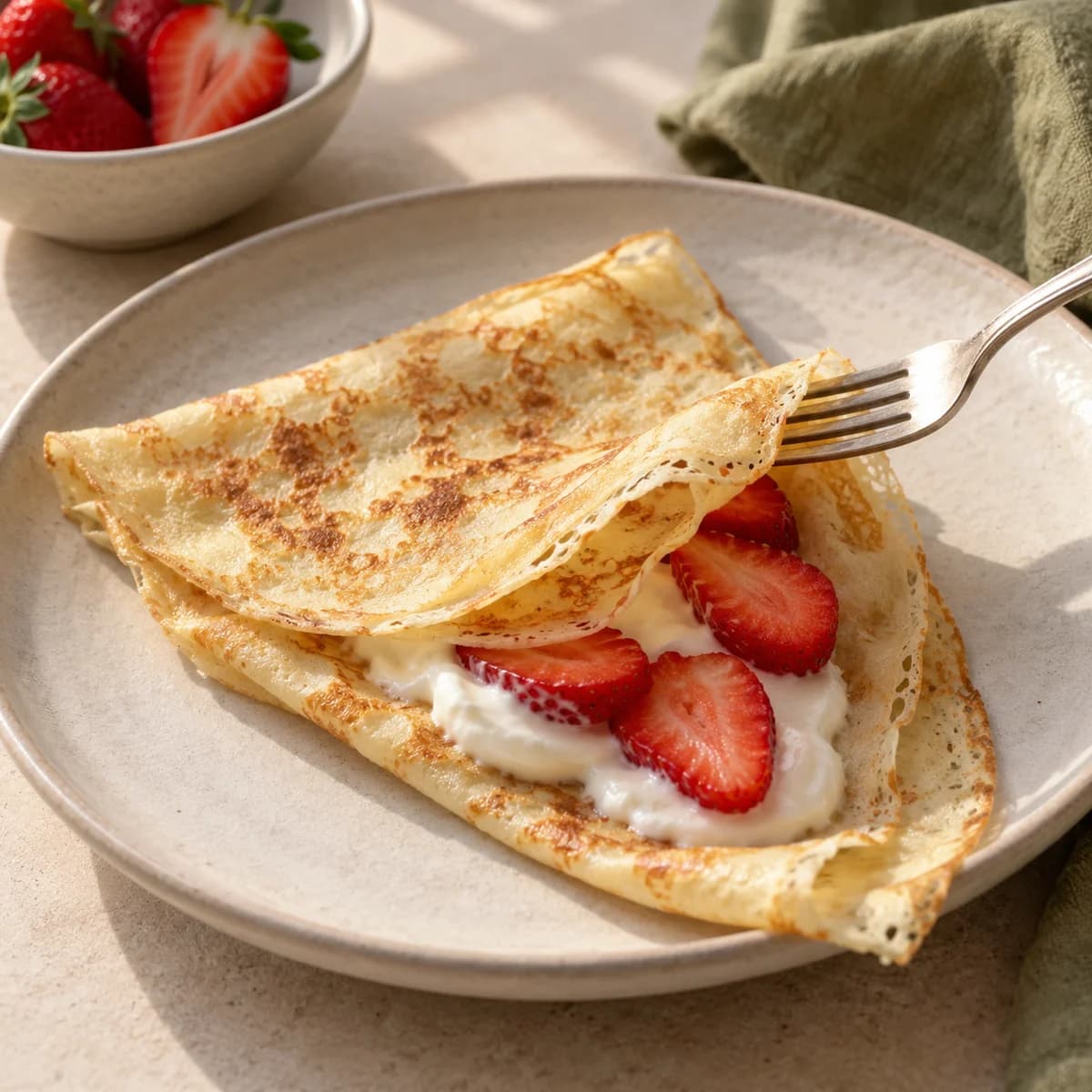
A good crepe gives way to the fork without feeling like a thick pancake. Its edges are delicate, the surface has a few irregular golden marks, and the filling does not need to hide the batter underneath. These high protein crepes pair whole egg and egg whites with a simple wheat-flour batter, then use thick plain Greek yogurt and fresh strawberries inside the folds. Vanilla gives the crepes a gentle sweetness of aroma without adding syrup to the reference recipe. The finished breakfast is soft, lightly tangy and easy to personalise at the table.
What the serving actually means
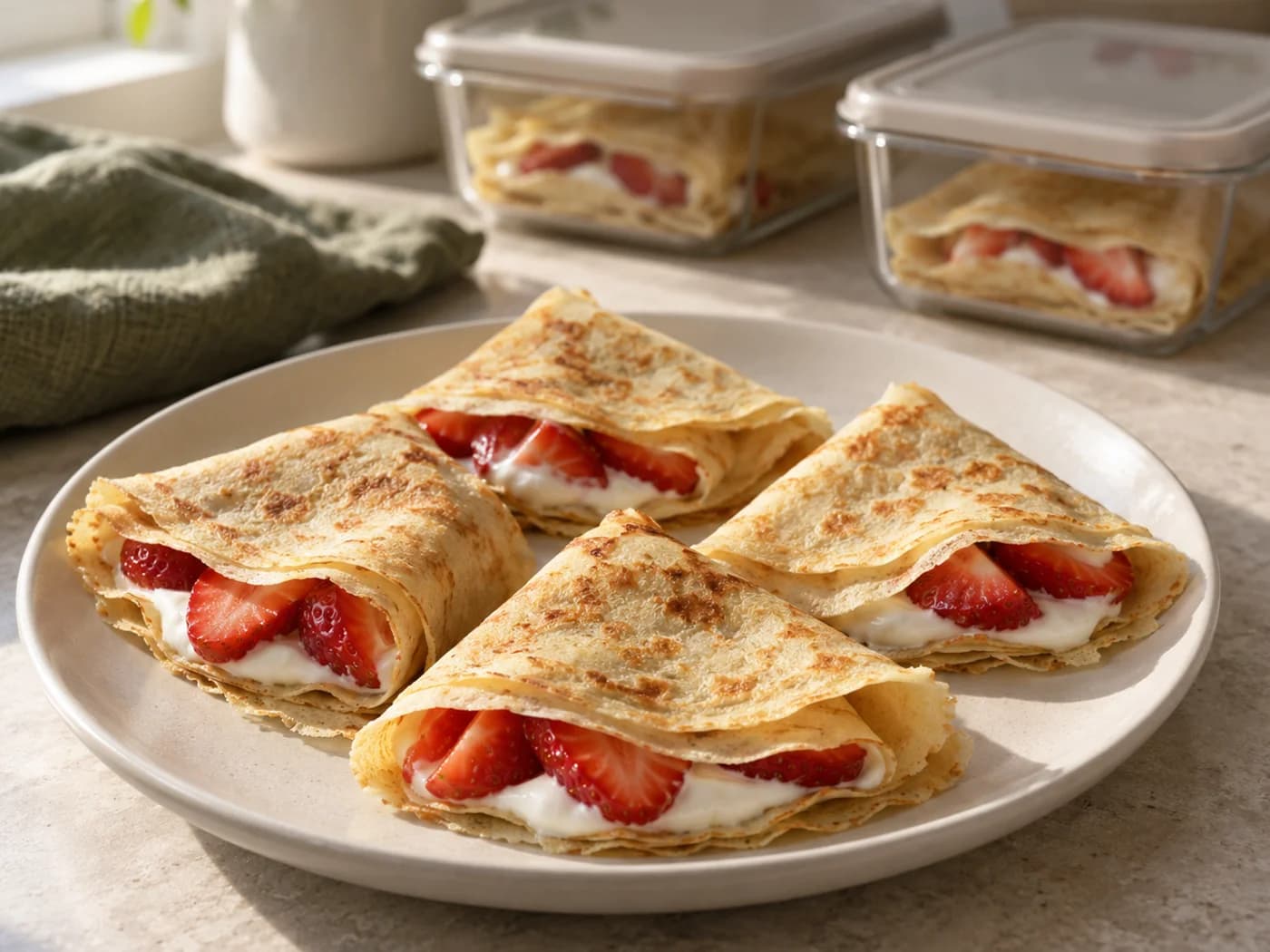
The reference makes eight thin crepes, roughly 24cm / 9½ inches across, divided into two complete breakfasts. Each breakfast includes four crepes, 150g plain nonfat Greek yogurt and 100g hulled strawberries. That full combination supplies approximately 451 calories and 37.9g protein, rounded to 38g in the headline. Four plain crepes alone are approximately 330 calories and 22.0g protein. Keeping those two descriptions separate matters: removing the filling changes the protein total even if the plate still contains four folded triangles.
A little patience belongs in the schedule
Allow about 10 minutes for weighing and mixing, 30 minutes for the covered batter to rest in the refrigerator, and roughly 20 minutes to cook eight crepes in one pan. The estimated total is around an hour. A slow first crepe, a small pan or a larger batch can extend that. You need a mixing bowl or jug, whisk, flexible spatula, kitchen scale and a reliable nonstick skillet with a flat cooking surface about 24cm across. A blender is optional; careful whisking is enough to start.
Clear expectations before you begin
This exact weighed formula has not been physically kitchen-tested. The method draws on established crepe techniques, while the egg-white balance, filling quantities and nutrition are specific to this proposed recipe. Photos illustrate the intended thin texture and serving rather than a documented trial batch. Make the reference quantity first, observe how the batter spreads in your pan, and use the doneness cues alongside the estimated times. The recipe contains wheat, egg and milk. There is no protein supplement, baking powder or added syrup in the reference ingredient list.
Why You’ll Love This Recipe
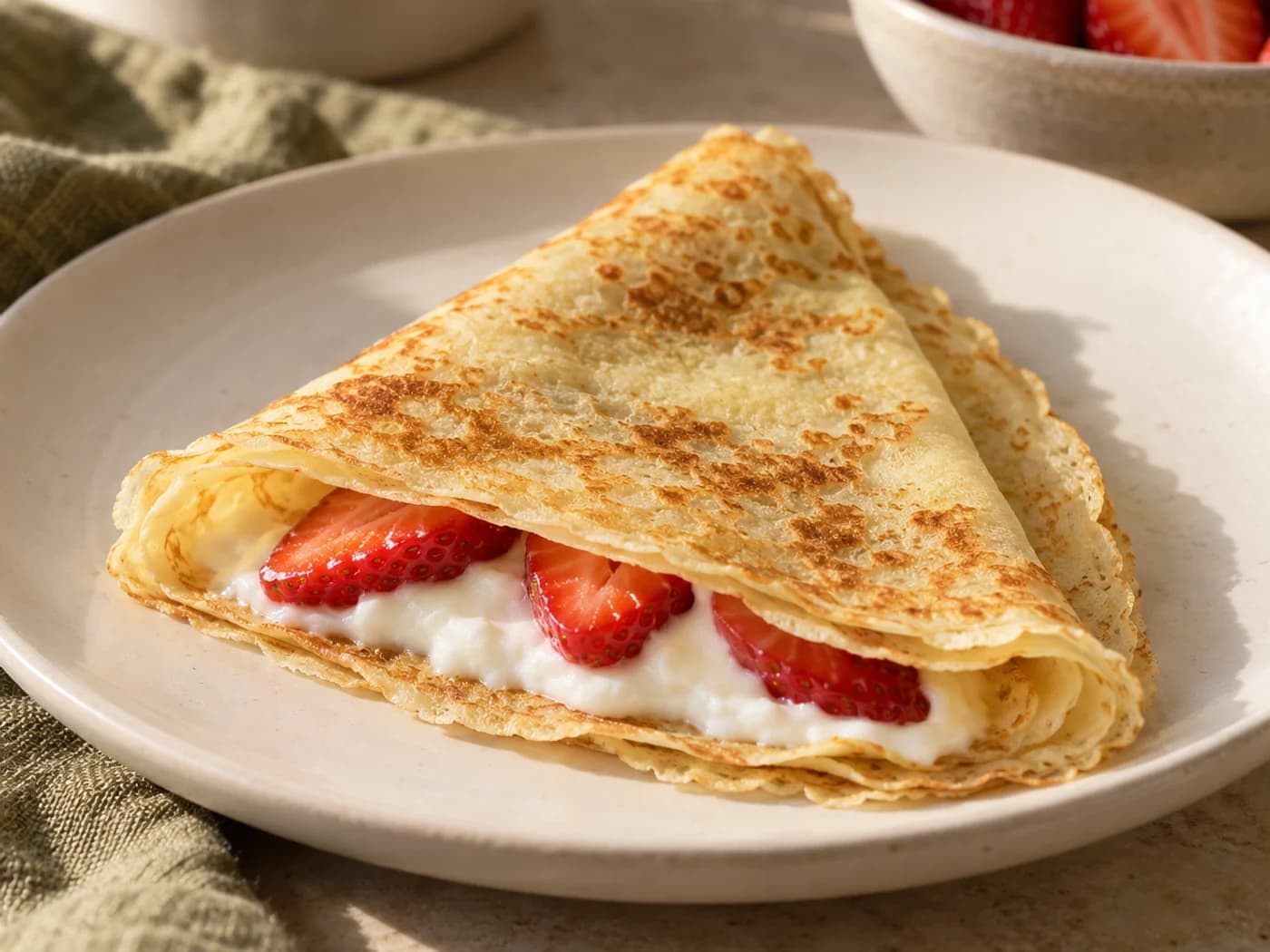
The contrast is the point
Warm crepes and cool yogurt meet somewhere between a breakfast bowl and a dessert, without requiring a sweet sauce. Strawberries add juicy little pieces, and the folded edges provide a slightly firmer bite than the soft middle. Use berries that taste good on their own; a bland fruit does not become sweeter simply because it is tucked into a crepe. If your berries are tart, taste the complete combination before deciding on any extra sweetener. The reference is deliberately simple enough that the fruit still has a clear role.
Protein without a scoop in the batter
Whole egg, egg whites, milk and Greek yogurt all contribute. The flour adds a smaller amount too. Using a familiar yogurt filling avoids making the batter carry every gram of protein by itself. There is no need to work around the flavour or thickening effect of a particular whey powder. That can be useful when several people share the breakfast and prefer different fillings. It does not make the recipe suitable for every diet: the eggs and dairy remain substantial ingredients rather than optional garnishes.
You can choose a breakfast-sized portion
Four thin crepes form the complete reference breakfast, while two crepes with half the yogurt and strawberries make a smaller serving of about 225 calories and 19g protein. Both have a clear definition. You can choose the smaller amount without calling it nutritionally identical to the full plate. For a leisurely breakfast, put the measured fillings on the table and assemble as you eat. For a busier morning, use a stack of previously cooked plain crepes and keep the cool filling separate until the last moment.
The first crepe gives useful feedback
Crepes can seem fussy until you treat the first one as a pan check. You can see whether the batter reaches the edges, how quickly it sets and whether the underside releases cleanly. That feedback is more practical than turning the heat up and hoping every following crepe will improve. A wide spatula and a pan you trust make the process calmer. Once the heat is steady, the work becomes a short sequence of pouring, swirling, waiting and turning, with a plate ready beside the stove.
Nutrition at a Glance

- Calories
- 451kcal
- Protein
- 38g
- Carbs
- 50g
- Fat
- 10g
Calories: approximately 451
One complete reference serving includes half of every weighed ingredient in the batch. That means the flour, eggs, milk, vanilla, salt and measured pan oil, as well as 150g yogurt and 100g strawberries. Extra butter, syrup, chocolate or a second spoonful of filling would be additional. The oil calculation counts the full 6g allocated to the eight-crepe batch even though some may remain on the brush or pan. This keeps the estimate explicit rather than quietly treating the cooking fat as free.
Protein: approximately 38g
The unrounded estimate is 37.9g for four crepes with their filling. The four plain crepes contribute about 22.0g, and the yogurt plus strawberries supply the rest. A single plain crepe is approximately 5.5g protein when the batter and pan oil are divided equally across eight. That distinction helps when you make a savoury filling or eat a different number of crepes. Use the protein value on your own yogurt label; a thinner regular yogurt may supply substantially less protein than the generic nonfat Greek yogurt used here.
Carbs: approximately 50g
The flour supplies much of the carbohydrate, with milk, yogurt and strawberries contributing as well. Estimated total sugars are approximately 16.0g per complete serving, including the naturally present milk sugars and fruit sugars. There is no honey, table sugar or syrup added in the reference formula, but that does not make the breakfast sugar-free. A separate added-sugars figure is not calculated. If you choose sweetened yogurt or a flavoured milk, the recipe's carbohydrate and sugar values need to be updated.
Fat: approximately 10g
Whole eggs and the measured canola oil account for most of the fat, with smaller contributions from milk, flour and yogurt. The estimated saturated fat is about 2.7g per full breakfast. There are also approximately 3.1g fibre and 489mg sodium. These are calculated generic food values rather than laboratory results. The detailed tables explain the ingredients behind them. A lower calorie target does not require guessing at the oil or omitting the filling from the log; a clearly measured smaller portion is easier to compare honestly.
Ingredients
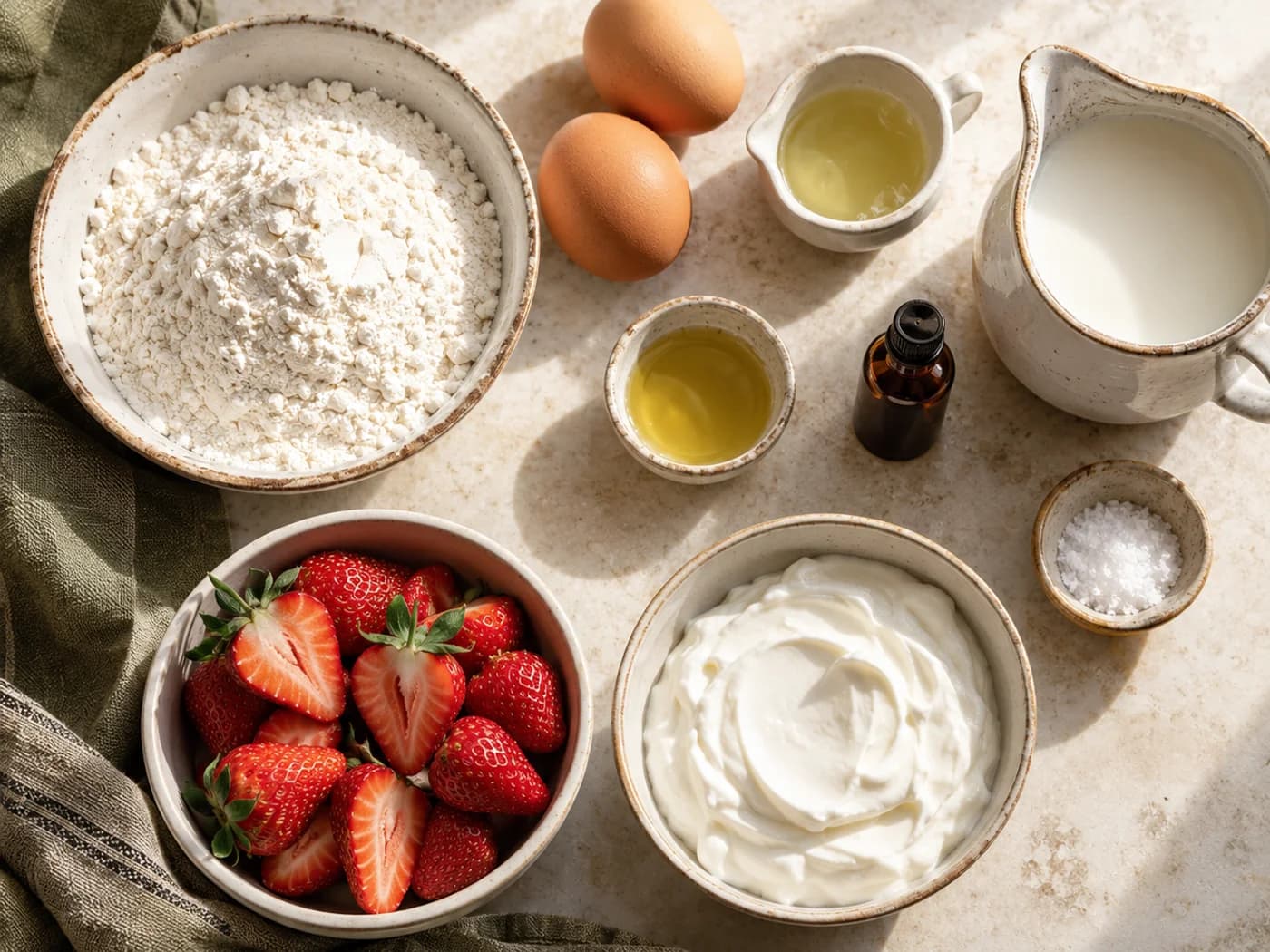
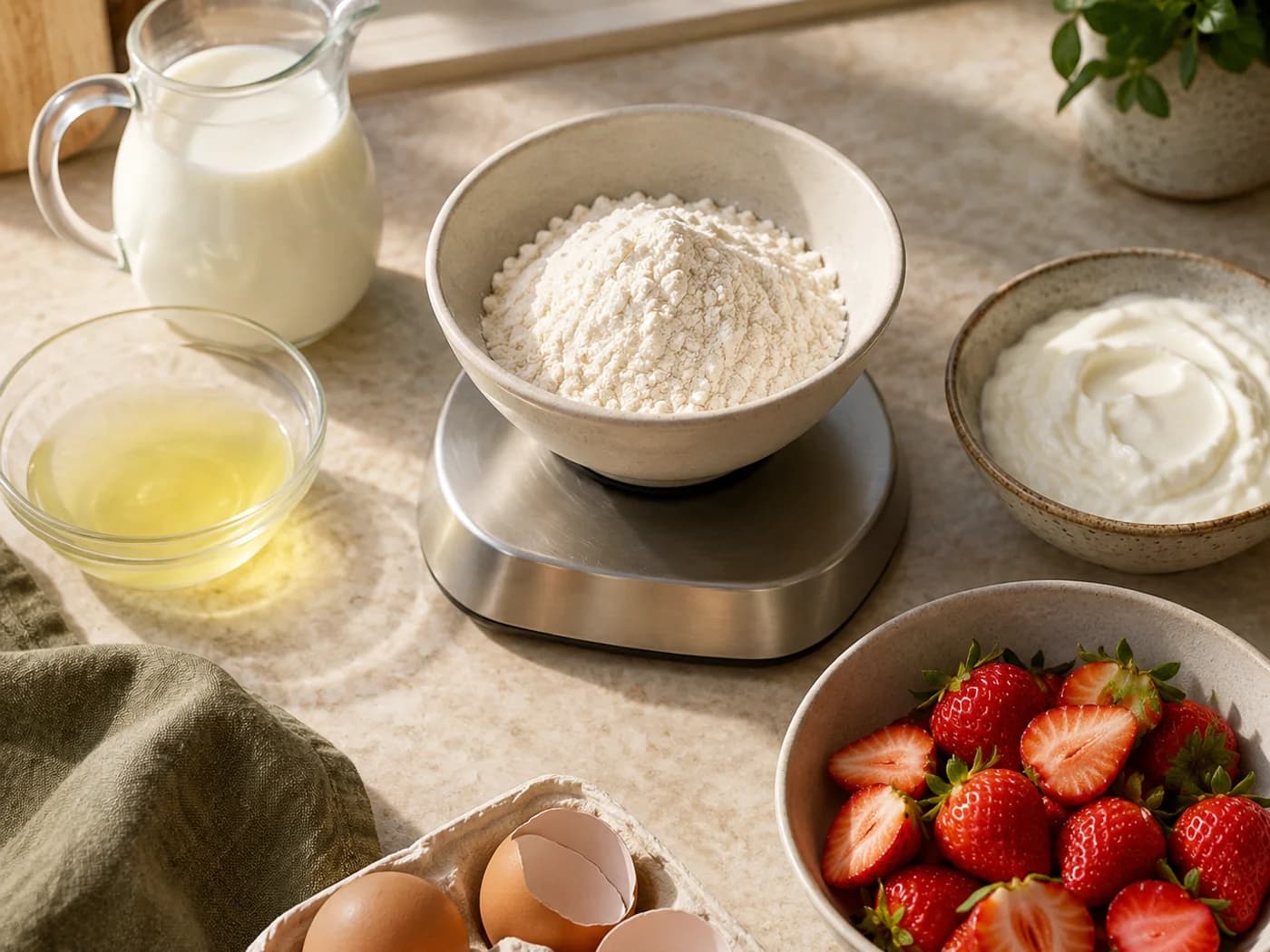
Flour for a flexible sheet
Use 80g plain all-purpose wheat flour, weighed dry. Self-raising flour introduces raising agents, and bread flour can change the feel of the crepe. This is an unleavened batter: it should spread into a thin sheet rather than puff into a stack. Break up any lumps before adding liquid. A scale is helpful because a densely packed scoop and a lightly spooned scoop can contain different amounts. Almond flour and coconut flour are not direct alternatives; they do not behave like the reference wheat flour when a thin crepe is lifted.
Whole egg and egg whites
Weigh 100g whole egg without shells, approximately two large eggs, then add 150g plain liquid egg whites. The whole egg contributes yolk fat and flavour, while the extra whites increase protein. Use an ordinary unflavoured carton if convenient and check whether its directions affect cooking or handling. Do not whip the whites into foam. Airy batter makes it harder to judge an even thin layer. Keep raw egg utensils away from the yogurt and sliced strawberries, and wash hands and surfaces after handling the batter.
Milk, vanilla and a small pinch of salt
The batter uses 200g plain 1% milk, 4g vanilla extract and 1g fine salt. Milk gives the flour a fluid base; the vanilla belongs in the batter rather than in an extra syrup. A vanilla-flavoured drink or sweetened coffee creamer is a different product. Measure the salt with a scale suitable for small quantities if possible. The reference does not include a casual second pinch at the stove, because small changes in salt can noticeably affect the sodium estimate for an otherwise lightly seasoned breakfast.
The pan oil is a measured ingredient
Put 6g canola oil in a small dish and use a brush to spread a very thin film across the pan as needed for all eight crepes. There is no extra oil in the batter. A clean nonstick surface makes that limited amount more practical than a badly worn pan. If your pan requires more fat to release the crepes, measure the additional amount and include it in your own nutrition calculation. Do not keep adding uncounted spray or butter while assuming the reference calorie figure still describes the batch.
A thick, plain filling
Choose 300g plain nonfat Greek yogurt for the batch and 200g washed, dried, hulled strawberries. The fruit weight is the edible amount after removing the tops. Slice the berries thinly enough that the folds close without a large lump in the middle. Stir the yogurt before weighing; do not use the liquid pooled on top as extra batter liquid. Each complete serving gets 150g yogurt and 100g berries, shared among its four crepes. Fresh filling stays cold and separate until the cooked crepes are ready to assemble.
Your ingredient checklist
- All-purpose wheat flourPlain flour, not self-raising; weigh dry80g
- Whole eggShell-free weight, about two large eggs100g
- Egg whitesPlain liquid egg whites; check carton label150g
- Low-fat milk (1%)Plain milk, weighed as supplied200g
- Canola oilTotal for all eight crepes; brush thinly, no extra oil6g
- Vanilla extractFor the batter, not vanilla syrup4g
- Fine saltFor the whole two-serving batter1g
- Plain nonfat Greek yogurtFilling: 150g per four-crepe serving300g
- StrawberriesHulled edible weight, washed and dried; 100g per serving200g
Contains wheat, egg and milk. Uses plain all-purpose flour, whole egg and egg whites; no baking powder or protein supplement. Check all actual labels and handling for your dietary needs. Keep raw batter utensils separate from ready-to-eat filling.
Ingredient Substitutions
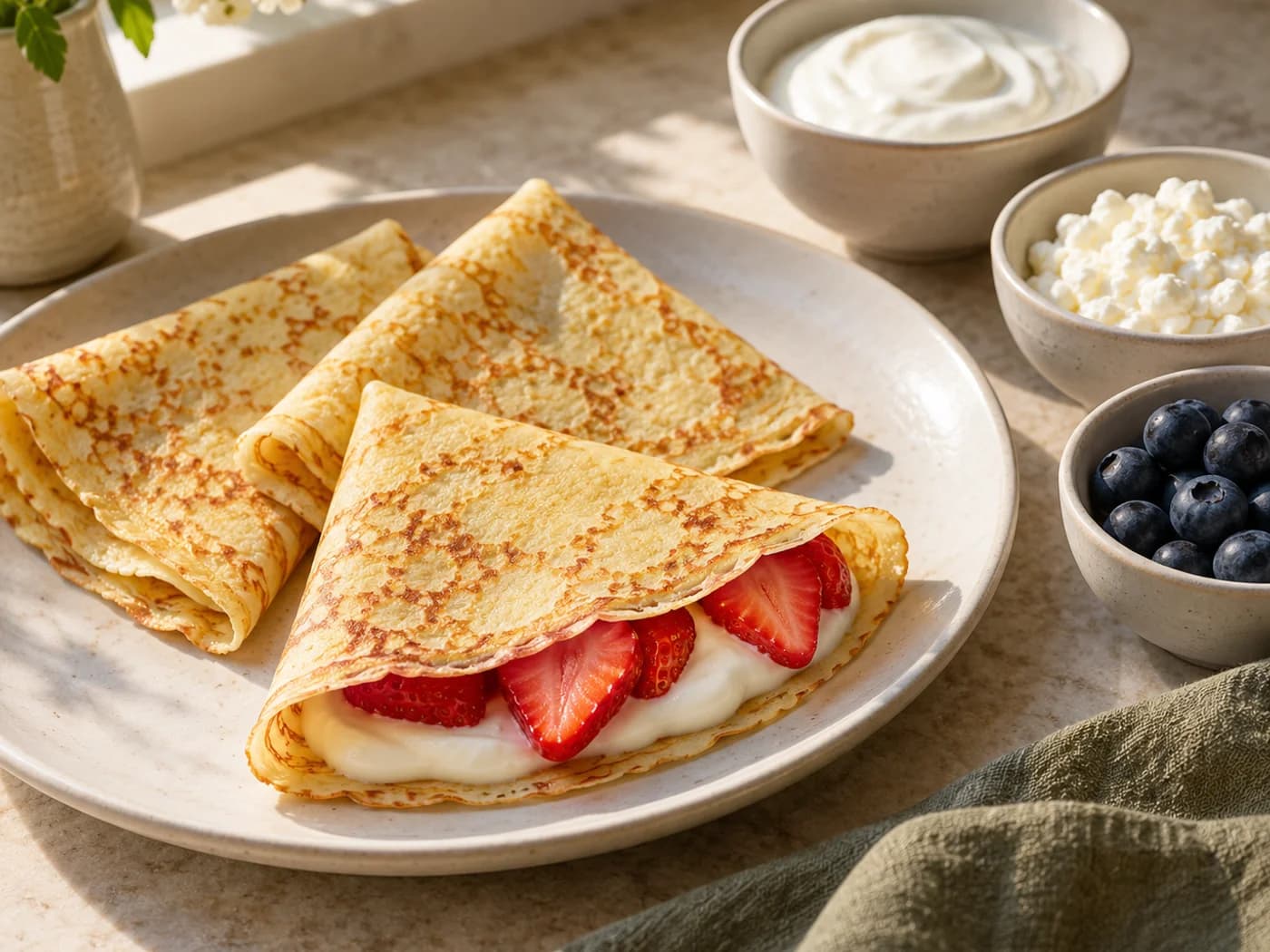
Separate a filling change from a batter change
Swapping strawberries for another fruit is a different task from removing the eggs that hold the crepe together. Start by deciding which part of breakfast you want to change. A filling can often be served alongside the crepes without affecting how they cook. A flour, egg or liquid substitution changes spreading, release and flexibility. Make one deliberate change at a time, use the actual product label, and keep a note of the weight. The alternatives below are ideas to assess, not physically tested identical versions.
Yogurt and cottage cheese options
A higher-fat Greek yogurt can be used as a filling if you prefer its flavour; its calories and fat will differ. Regular plain yogurt may be looser and lower in protein, so it can leak from a fold more easily. Blended cottage cheese is another possible filling, with a saltier taste and a different protein value. Keep it out of the batter unless following a separate formula developed for that purpose. A large spoonful of curdy cheese does not behave like the measured milk in this thin crepe mixture.
Fruit that fits inside the fold
Thin banana slices, blueberries or finely sliced ripe pear can replace strawberries as a serving experiment. Different fruits have different carbohydrate, fibre and water values. Frozen berries need particular care: thaw them appropriately and drain excess liquid so the filling does not flood the plate. Count the fruit you actually use rather than applying the strawberry value automatically. If you love warm fruit, serve a separately prepared compote on the side and account for any sweetener; it is not hidden inside the reference nutrition.
Milk and flour need more attention
A lactose-free dairy milk with a similar composition may be a practical option after checking the label. A plant drink changes the protein contribution and may contain added sweetener or thickeners. Gluten-free flour blends differ in starches and gums, so choose a crepe recipe developed for your specific blend instead of assuming a direct swap. Oat flour produces a different flavour and structure. The reference remains wheat-based even though it has egg whites and a protein-rich filling; those ingredients do not remove gluten from the flour.
Egg-free and dairy-free goals
The whole egg and whites form much of this crepe's structure. Replacing them with banana, flax or extra milk would require a new batter, cooking method and nutrition estimate. A plant-based yogurt filling alone does not make the recipe dairy-free, because milk remains in the batter. A vegan version would also need to replace the eggs. When a dietary exclusion is medically important, check labels and cross-contact carefully and choose a recipe designed around the exclusion. Treating a key ingredient as an optional decoration can lead to both poor cooking and misleading nutrition.
Keep batter changes separate from serving changes, and use the actual label values.
| Reference | Possible change | What to check |
|---|---|---|
| Greek yogurt filling | Higher-fat Greek yogurt | Protein, energy and thickness |
| Greek yogurt filling | Blended cottage cheese | Salt, texture and nutrition |
| Strawberries | Blueberries or banana | Edible weight and carbohydrate |
| 1% dairy milk | Another dairy milk | Fat, protein and label |
| Wheat flour | Gluten-free flour blend | Use a separately developed crepe formula |
| Whole egg and whites | Only whites or egg replacement | Needs a different batter balance |
How to Make It
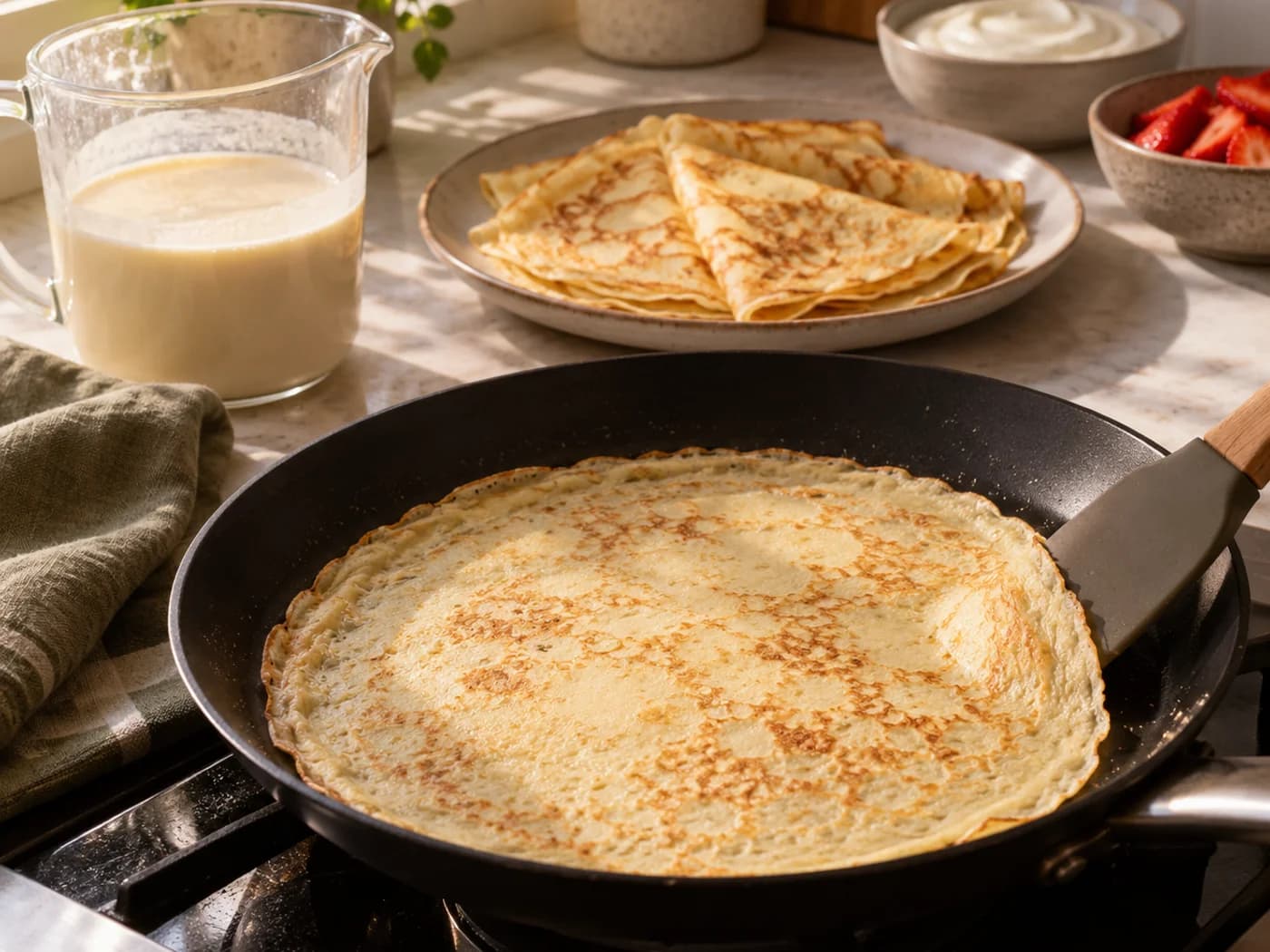
1. Whisk a smooth batter
Whisk the flour and salt in a large jug or bowl. In another bowl, combine the whole egg, egg whites, milk and vanilla without whipping in a large amount of air. Gradually whisk some liquid into the flour to make a smooth paste, then add the remainder. Scrape the bottom and sides so a pocket of dry flour does not remain. A brief blend is an option if the whisk leaves persistent lumps, but let any foam settle before measuring the batter into the pan.
2. Rest it in the refrigerator
Cover the batter and refrigerate for about 30 minutes. This gives the flour time to hydrate and makes the cooking stage less rushed. Keep the yogurt and strawberries chilled too, and use this pause to prepare plates, the oil dish and a wide flexible spatula. Do not taste the uncooked batter: raw flour as well as raw egg needs proper cooking. After resting, stir gently to bring any settled flour back into the mixture. It should pour readily rather than fall in a thick scoop.
3. Prepare the filling and the pan
Stir and weigh the yogurt, then wash, dry, hull and slice the strawberries using clean equipment. Keep both covered and chilled while cooking. Warm the nonstick pan over medium-low heat, following its manufacturer's limits; avoid leaving it empty over high heat. Brush with a little of the measured 6g oil. The goal is a thin sheen, not a pool. Have the batter jug close enough to pour safely and keep the filling utensils separate from the raw batter area.
4. Cook the first thin crepe
Divide the batter into eight roughly equal pours, about one eighth each. The reference batter weighs approximately 535g before pan oil, so a pour is around 67g if all ingredients reach the jug. Lift and tilt the pan as you pour, spreading a thin layer across its roughly 24cm flat surface. Set it back on the heat and allow about 60–90 seconds on the first side as a starting estimate. Look for a set, matte upper surface and edges beginning to release before sliding the spatula underneath.
5. Turn and finish, then repeat
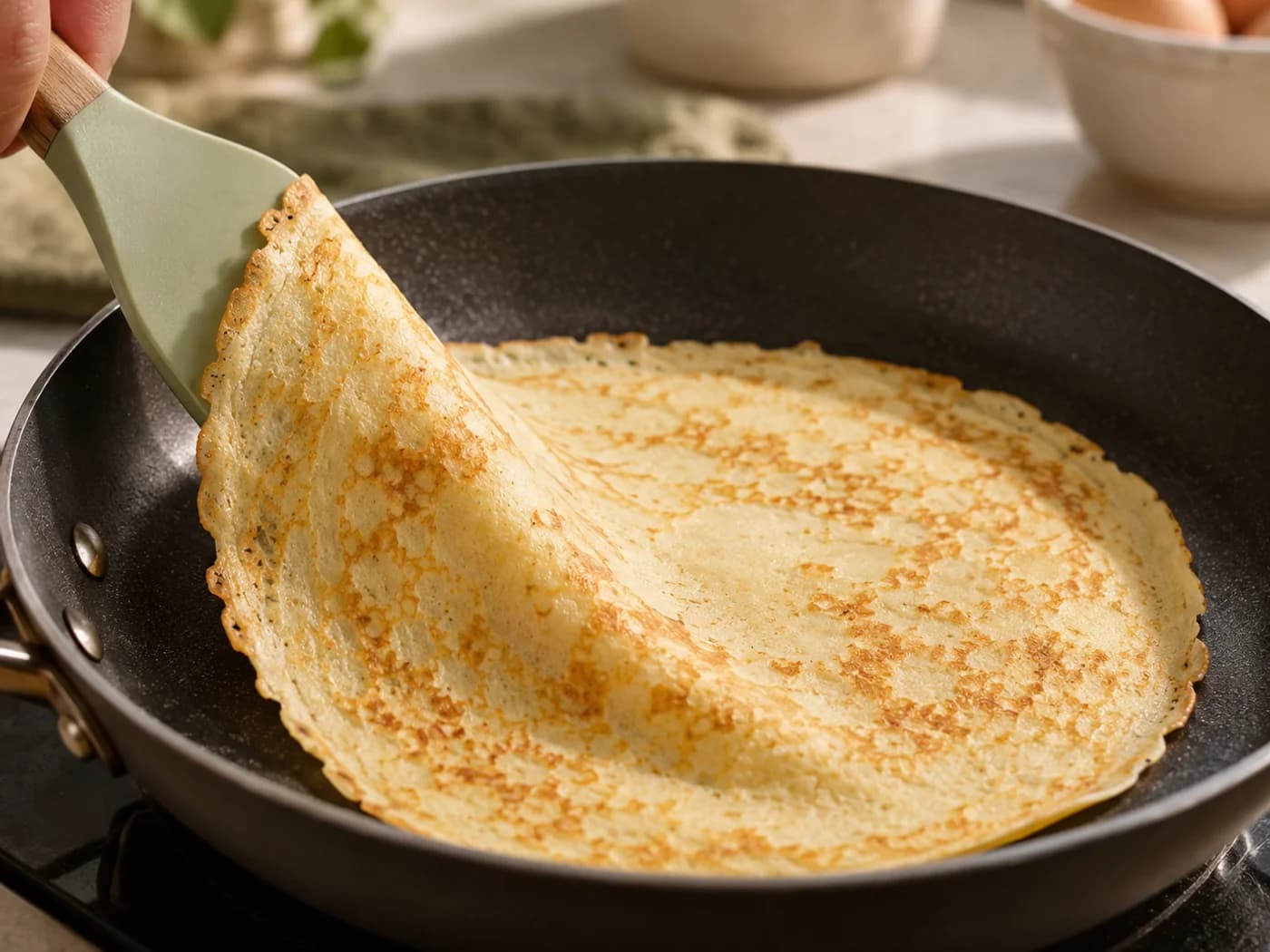
Turn carefully and cook the second side roughly 20–40 seconds, adjusting heat and timing as needed. Cook the egg-containing crepe fully, using 160°F / 71°C as the egg-dish endpoint where a suitable fine-tip thermometer can measure the food. Thin crepes are awkward to probe: keep the tip within the food, parallel to the layers of a freshly folded hot crepe, rather than touching the pan. Colour alone is not a temperature reading. Repeat with the remaining batter, stirring gently between pours and distributing the measured oil across the batch.
6. Fill after the pan work
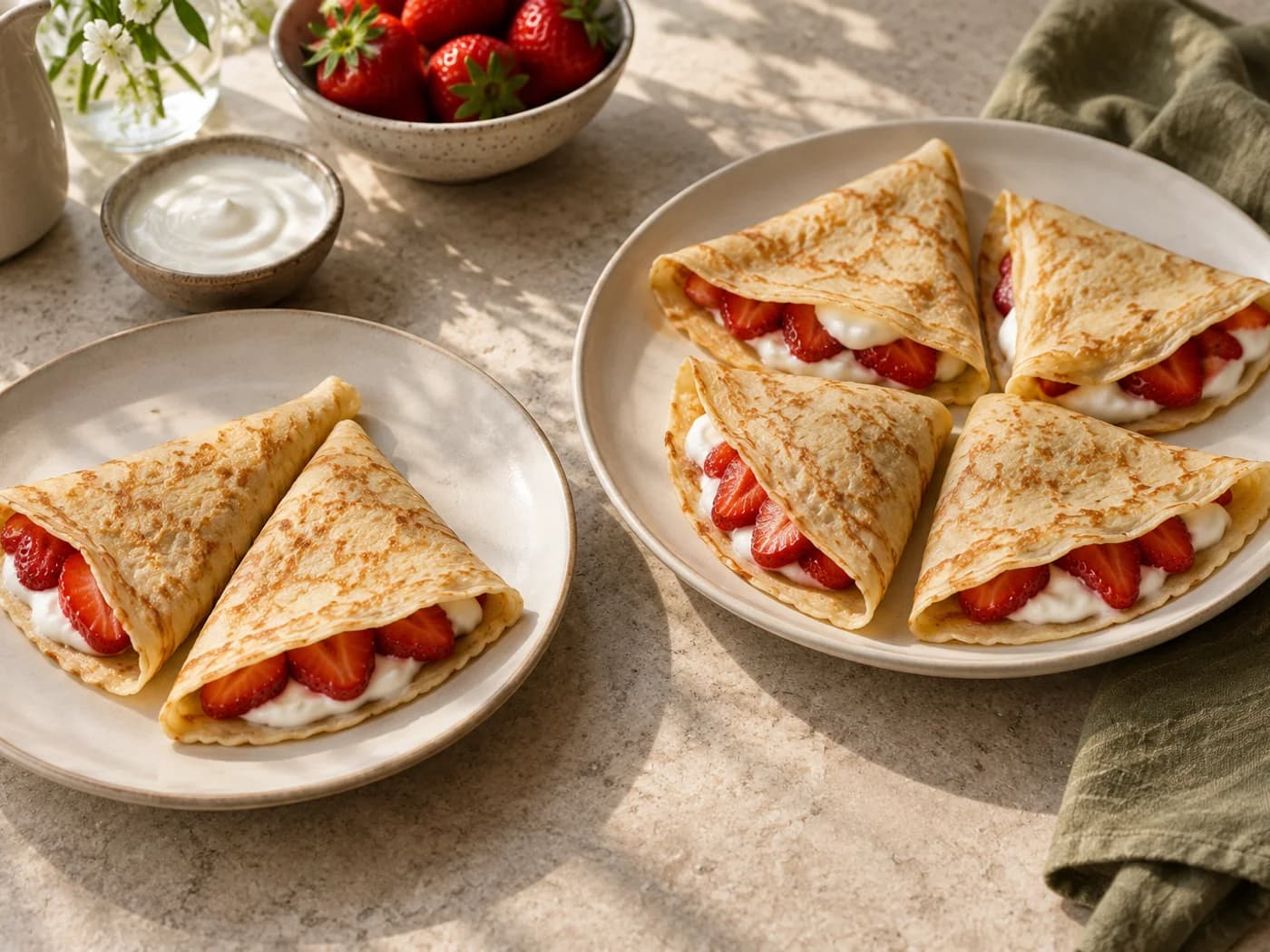
Let each crepe lose its fierce heat before adding the chilled filling. Divide all eight crepes between two plates, four per plate. Each plate receives 150g yogurt and 100g strawberries; spread the yogurt thinly and distribute the berry slices before folding into quarters. Serve promptly. For later meals, cool and refrigerate plain crepes promptly in shallow containers, then add fresh filling after reheating. More servings require more crepes and pan time, not larger mounds of batter in the same-sized pan.
Tips for the Best Results
Match the pour to the cooking surface
A pan labelled 28cm may have a smaller flat base, so look at the surface the batter actually covers. The reference is roughly 24cm across. A much smaller pan makes the same pour thicker; a very large one may leave gaps if you try to stretch it too far. Keep the first crepe close to the intended size and evaluate the layer. If you choose smaller crepes, divide the batter into more equal pieces and track the fraction of the full batch rather than pretending the original crepe count still applies.
Heat should give you time to swirl
If the batter sets into a thick streak before you can spread it, the pan may be too hot. Lift it away briefly, lower the heat and give the next pour a little more time to flow. If the crepe remains pale, wet and difficult to release, the pan may need more cooking time or a modest heat adjustment. Change one thing at a time. A very dark underside with a wet top is not a reason to turn the heat higher; it is a clue that the outside is moving faster than the centre.
Wait for release rather than digging
Trying to lift a still-wet edge often tears the crepe and leaves a rough patch stuck to the surface. Let the top set, loosen around the edge with a flexible spatula and support a broad section when turning. You do not need an airborne flip. If one crepe breaks, keep its pieces for your own plate and learn from the stage at which it tore. A damaged first crepe does not mean the remaining batter needs a handful of extra flour or a large splash of unmeasured oil.
Be careful with quick fixes
After resting, stir before deciding the batter is too thick; settled flour can make the bottom of the jug misleading. If a genuine adjustment is needed, measure any added liquid and update your own batch record. There is no established identical result for an arbitrary extra splash. Frothy batter can leave holes, while hard whisking at every pour can keep introducing more bubbles. Gentle stirring is enough to maintain consistency. Avoid repeatedly scraping loose cooked crumbs into the oil, since they can darken and mark later crepes.
Protect flexibility after cooking
Keep cooked crepes lightly covered while finishing the short batch so their edges do not become brittle. Do not press them into a tight stack while they are steaming heavily. For storing, let excess steam escape briefly, separate as needed and refrigerate promptly instead of leaving the whole stack on the counter for hours. At the table, fill with a modest layer and keep the berries thinly sliced. A crepe folded around a mound of filling is more likely to split, however carefully its batter was prepared.
High-Protein / Lower-Calorie Variations
Two crepes for a smaller breakfast
Half the complete serving is two reference crepes with 75g Greek yogurt and 50g strawberries. It supplies approximately 225 calories and 19.0g protein. This may be useful as a smaller breakfast or snack, depending on what else you eat. The reduction applies to the crepes, filling and allocated pan oil together. It is not achieved by calling four large crepes a smaller serving or leaving the yogurt out of the nutrition log. Keep the serving definition next to the number when comparing alternatives.
More yogurt alongside the same crepes
Adding another 100g plain nonfat Greek yogurt to a full reference serving gives approximately 510 calories and 48.1g protein using the same generic yogurt values. Serve that extra amount alongside rather than trying to force all 250g yogurt into four delicate folds. The batter remains unchanged, so the cooking method stays the same. Your actual yogurt label determines the closer estimate. There is no requirement to choose this larger serving; it is one measured option when it suits your appetite and overall meal plan.
Plain crepes as a separate component
Four plain reference crepes, with their share of measured pan oil, contain approximately 330 calories and 22.0g protein. One plain crepe is approximately 83 calories and 5.5g protein. Those numbers are useful when you want another filling, but they do not describe the original strawberry-yogurt breakfast. Record the replacement filling separately. A savoury plate with cheese, vegetables or meat needs its own complete meal total and appropriate cooking plan. The word “plain” should not quietly include a buttered pan and several unmeasured toppings.
Batter changes need their own trial
Using only egg whites, replacing flour with whey powder or removing the whole egg would affect flexibility, browning and flavour. Those are untested new formulas, not reliable lower-calorie shortcuts for this card. A measured smaller portion or an added yogurt side is easier to describe accurately because the base crepes stay the same. If you want to develop a different batter, start with a small batch and record the actual quantities and result. The comparisons below are arithmetic estimates, not a claim that every altered version has been cooked and verified.
These measured comparisons keep the plain crepe formula unchanged.
| Serving | Calories, approximately | Protein, approximately |
|---|---|---|
| Four crepes + 150g yogurt + 100g strawberries | 451 kcal | 37.9g |
| Two crepes + 75g yogurt + 50g strawberries | 225 kcal | 19.0g |
| Four plain crepes, pan oil included | 330 kcal | 22.0g |
| One plain crepe, pan oil included | 83 kcal | 5.5g |
| Full breakfast + 100g extra nonfat Greek yogurt | 510 kcal | 48.1g |
Serving Suggestions

Fold at the table if you have time
Put warm crepes on a plate and the measured yogurt and sliced berries beside them. Spread a thin layer across part of a crepe, add a few fruit slices and fold gently into quarters. You can assemble one at a time so the later crepes do not sit filled while you drink coffee. Divide the full filling across the serving rather than filling the first crepe generously and leaving the last three bare. A small spoon for yogurt and a fork for berries make the process pleasantly straightforward.
Keep the fruit dry enough to handle
Drying washed strawberries before slicing helps avoid watery puddles under the crepes. If the berries are particularly juicy, keep some alongside the folds rather than packing all of them into the middle. The yogurt should be thick enough to stay where you spread it. A little liquid is normal in a fruit breakfast, but a flooded plate makes thin layers awkward to lift. Use a plate large enough for four folded crepes without stacking them into a tall mound that hides their delicate texture.
Sweet extras are your choice
A drizzle of honey, maple syrup or chocolate sauce can be served separately if you want it. The reference already has vanilla, fruit and yogurt, so taste it first. Measure any addition when tracking nutrition, including a small amount that looks decorative in a photograph. Nut butter has a strong flavour and can be lovely with banana, but it also changes the calorie balance. You do not have to avoid favourite toppings; the useful habit is knowing which meal the headline numbers actually describe.
A savoury direction needs a different filling total
For a savoury experiment, omit the vanilla and choose a separately prepared filling you enjoy. Cook mushrooms or spinach so excess liquid does not soak the crepe, and follow the appropriate handling for any meat or egg filling. Recalculate the complete meal instead of carrying over the strawberry-yogurt estimate. For the first batch, the stated sweet reference is the clearest starting point. Once you know how the plain crepes behave in your pan, choosing another filling becomes a manageable change rather than several unfamiliar tasks at once.
Meal Prep & Storage
Cooked plain crepes first
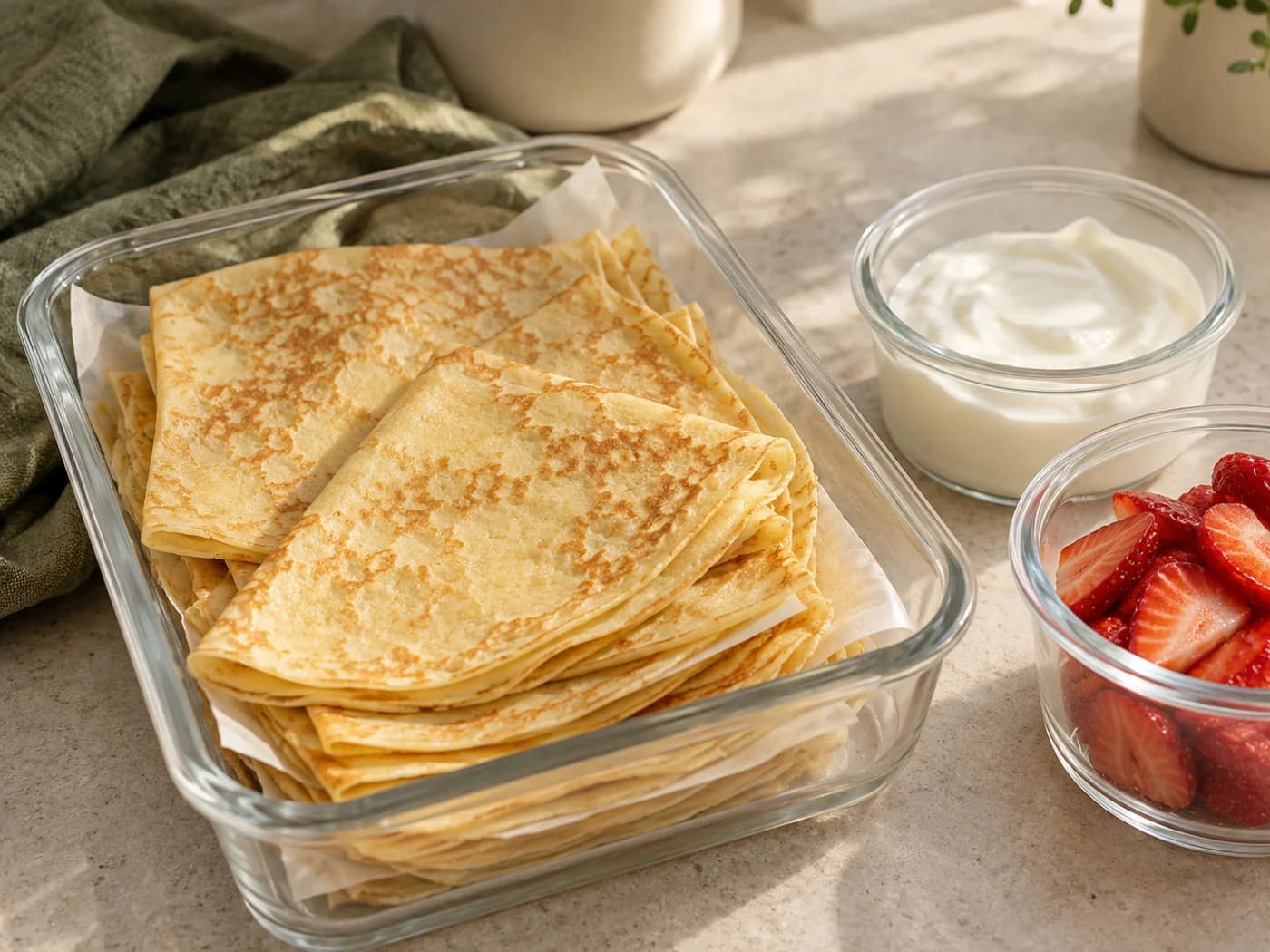
For meal prep, keep the crepes unfilled. Cool promptly in shallow containers and refrigerate at 40°F / 4°C or below, using within 3–4 days with suitable handling. Do not leave cooked food at room temperature for more than two hours, or one hour when it is above 90°F / 32°C. A deep warm stack can hold steam, so spread or separate the crepes briefly before packing. The exact texture and shelf life of this formula have not been measured; general leftover guidance is not a guarantee for poorly handled food.
Keep yogurt and strawberries separate
Follow the yogurt package's storage instructions and keep it chilled. Prepare strawberries with clean utensils, drain surface moisture and store them separately from the plain crepes. A filled crepe left overnight can soften where yogurt and fruit touch it, making reheating less pleasant. The crepes can be warmed before adding cold filling, which is simpler than trying to heat a folded breakfast evenly without splitting the yogurt. Portioning the components also makes it easier to distinguish a full reference meal from a smaller two-crepe snack.
Reheat the crepes before filling
Reheat stored cooked crepes thoroughly to 165°F / 74°C, checking the food rather than just the warm plate. A covered microwave-safe plate can help reduce drying, but microwave power and portion size vary, so no fixed seconds are guaranteed. A covered pan over gentle heat is another option; additional oil needs to be counted. Separate stuck layers carefully and check the centre of the portion for cold spots. Add yogurt and fruit after reheating. Heating the crepes until they feel vaguely warm is not the same as checking the leftover temperature.
Freeze a plain stack in usable portions
Place parchment between cooled plain crepes and use freezer-suitable airtight packaging. Pack two or four together if those are the amounts you expect to eat. About one month is an untested quality target for this exact formula, not a shelf-life study. Thaw in the refrigerator, then reheat properly before adding fresh filling. Avoid repeatedly thawing a large stack just to remove one crepe. If the edges become dry or the layers stick, note that for your next batch and freeze fewer at a time.
Batter made ahead needs care too
The stated 30-minute rest happens covered in the refrigerator. If you must mix earlier, use a conservative same-day or within-24-hours chilled plan, stir gently before cooking and follow any stricter egg-product directions. That is a planning suggestion, not measured batter shelf life. Raw batter still contains raw flour and egg, even if a carton of whites is pasteurised. Keep it covered, separate from ready-to-eat filling, and never taste it to judge safety. For the most predictable first attempt, mix, rest and cook in one session.
Full Nutrition Information
The calculation behind the plate
Historical USDA Standard Reference release 28 values are used for nine weighed ingredients. Each food's per-100g values are multiplied by the amount in the batch, then the total is divided by two complete servings. Flour is weighed dry, eggs without shells, dairy as supplied and strawberries after hulling. The milk reference is plain 1% milk and the yogurt is plain nonfat Greek yogurt. All nine food entries include the eight nutrient fields displayed here, rather than treating a missing field as a measured zero.
The batch and its portions
The full two-serving recipe provides approximately 902 calories and 75.8g protein. It includes eight equal crepes, 300g yogurt and 200g strawberries. Half the whole recipe is the full reference breakfast: four crepes, 150g yogurt and 100g fruit. If one crepe is much larger than another, simply taking any four does not guarantee an equal half of the batter. Aim for similar pours, or divide the total cooked plain crepe weight equally between the two servings before adding their measured filling.
Plain and filled values are different
The plain crepe batch, including all pan oil, is approximately 661 calories and 43.9g protein. Dividing that by eight gives approximately 83 calories and 5.5g protein per plain crepe. Those values become useful when you choose another filling. The complete reference adds yogurt and strawberries to reach about 451 calories and 37.9g protein per breakfast. A single filled fold is not automatically a full serving, and a photographed plate does not establish nutrition without the ingredient weights behind it.
Make your own products the reference
Use the food calculator to organise a changed ingredient list from the labels on your flour, milk, carton whites and yogurt. Enter the full amount used in the batch, then choose the actual number of equal servings. Record any extra pan oil or sauce too. Greek-style yogurt can vary in both protein and thickness, so the product name alone is not enough to guarantee the reference figure. The generic calculation is a transparent starting point, while your package values give a closer estimate for what you prepare.
Read the limits of the numbers
Main cards round calories and macronutrients to whole numbers. Detailed tables keep a decimal for selected values so the ingredient contributions remain easier to follow. Total sugars include fruit sugars and lactose; separate added sugars, cholesterol and a complete micronutrient panel are not calculated. The historical milk row has a small difference between its carbohydrate and sugar fields, illustrating why generic database fields should not be treated as a perfect modern product label. No missing nutrient is presented as absent, and these estimates are not laboratory testing or individual medical advice.
| Ingredient | Amount | Calories | Protein | Carbs | Fat |
|---|---|---|---|---|---|
| All-purpose wheat flour | 80g | 291 kcal | 8.3g | 61.0g | 0.8g |
| Whole egg | 100g | 143 kcal | 12.6g | 0.7g | 9.5g |
| Egg whites | 150g | 78 kcal | 16.4g | 1.1g | 0.3g |
| Low-fat milk (1%) | 200g | 84 kcal | 6.7g | 10.0g | 1.9g |
| Canola oil | 6g | 53 kcal | 0.0g | 0.0g | 6.0g |
| Vanilla extract | 4g | 12 kcal | 0.0g | 0.5g | 0.0g |
| Fine salt | 1g | 0 kcal | 0.0g | 0.0g | 0.0g |
| Plain nonfat Greek yogurt | 300g | 177 kcal | 30.6g | 10.8g | 1.2g |
| Strawberries | 200g | 64 kcal | 1.3g | 15.4g | 0.6g |
| Whole batch | 2 complete four-crepe servings | 902 kcal | 75.8g | 99.5g | 20.3g |
| One reference serving | Batch ÷ 2 | 451 kcal | 37.9g | 50g | 10g |
| Dietary fiber | 3.1g |
|---|---|
| Total sugars | 16.0g |
| Saturated fat | 2.7g |
| Sodium | 489mg |
Estimated recipe nutrition, not laboratory analysis. Includes all batter ingredients, measured pan oil, Greek yogurt and strawberries. Extra fillings, butter and sauces are additional. Uses historical generic USDA values; actual labels take priority. Cholesterol, separate added sugars and complete micronutrients are not calculated.
How This Fits Your Daily Protein Goal
Start with your own daily plan
The protein calculator can provide an estimate based on your details, then you can compare it with the meals you enjoy. This full crepe breakfast contributes approximately 37.9g protein. That does not mean everyone needs this size or that a larger number is always a better breakfast. Your appetite, other meals and individual needs matter. If a health condition requires a specific protein limit or plan, follow advice from the qualified professional who knows your situation rather than changing portions solely to match a recipe headline.
Put the contribution in context
For illustrative daily targets of 100g, 120g and 150g, the complete reference breakfast contributes approximately 38%, 32% and 25% respectively. These are arithmetic examples, not recommendations for every reader. The smaller two-crepe serving provides about 19g protein, while four plain crepes without the reference filling provide about 22g. Keeping the version explicit makes the percentage useful. It also leaves room to plan lunch and dinner without assuming that a high-protein breakfast has already answered every nutrition question for the day.
Choose the size you can enjoy
If four crepes feel like too much, take the smaller complete serving and distribute other protein-rich foods across the rest of your meals. If you enjoy a bigger yogurt side, the measured extra-yogurt variation is available without rebuilding the batter. There is no advantage in forcing down a large plate merely because it carries the reference numbers. A meal you can repeat comfortably is easier to plan around than one selected only for its protein total. Include the filling you actually eat and leave uneaten portions out of your log.
Make meal prep support the plan
Keeping plain crepes and filling in separate containers lets you assemble the amount you want each morning. Label a two- or four-crepe portion if it helps you remember, and keep the yogurt amount next to it. You can rotate another breakfast on days when you want a different texture or less pan work. Protein planning does not require turning every food into a supplement carrier. Here, eggs and dairy do much of the work while the crepe format gives you a breakfast that feels different from another yogurt bowl.
Make it personal
Where does this breakfast fit in your day?
Estimate your daily protein target, then plan meals you enjoy.
Recipe Card

Bring the quantities to the stove
The card collects the weighed ingredients and six main steps, with two complete servings selected by default. Each serving contains four thin crepes and its measured yogurt and strawberries. The four- and six-serving settings multiply every ingredient, including pan oil and filling. The crepe diameter stays the same, so larger settings require sixteen or twenty-four crepes and more cooking time. The checklist can follow your weighing, and Reset checklist clears it without changing the serving setting. Changing the batch size also clears the checks for a fresh start.
Read the timing as a single-batch estimate
The card includes the 30-minute refrigerated rest in its roughly 60-minute total. It does not claim that all six servings can be cooked in the same twenty-minute pan window as the reference batch. Keep waiting batter chilled and use steady, manageable cooking rounds. If you are preparing breakfast for several people, cook the plain crepes first and assemble with the cold filling when ready to serve. A larger pan is not automatically a shortcut if it changes the size and thickness of every crepe.
Print the version you mean to make
The print button uses the current card setting for ingredient amounts and method instructions. Choose two servings for the original eight-crepe sheet, or select the larger setting before printing a shared breakfast. Per-serving nutrition stays at the reference full breakfast amount. Keep the filling, oil and storage notes with the card rather than trimming them away; they explain what the displayed numbers include and how the meal is handled. The full article remains useful for pan troubleshooting and substitutions when something behaves differently from the starting formula.
Thin crepes, a fresh filling
High-Protein Crepes
Egg-white crepes with plain Greek yogurt and strawberries. Four crepes per complete serving.
*Planning estimates, including the chilled rest. More crepes need more pan time. Exact formula not physically kitchen-tested. Use equal pours and cook fully; filling and all measured pan oil are counted.
Ingredients
Method
- Whisk the batter
Mix 80g plain all-purpose flour and 1g salt. Separately whisk 100g shell-free whole egg, 150g plain egg whites, 200g 1% milk and 4g vanilla. Gradually whisk the liquid into the flour until smooth, without whipping into foam.
- Rest, then stir
Cover and refrigerate the batter for 30 minutes. Keep filling ingredients chilled. Stir gently after resting to bring settled flour back into the mixture. Do not taste raw batter; flour and egg need cooking.
- Prepare filling and pan
Using clean utensils, stir 300g plain nonfat Greek yogurt and slice 200g washed, dried, hulled strawberries. Keep chilled. Warm a nonstick pan with a roughly 24cm flat base over medium-low heat. Brush thinly using part of 6g total canola oil for all eight crepes; no extra oil.
- Pour and swirl
Divide the approximately 535g batter into eight equal pours, roughly 67g each. Tilt the pan promptly to make a thin layer. Cook the first side roughly 60–90 seconds, until the upper surface sets and edges begin to release. Adjust heat rather than forcing a wet crepe off the pan.
- Turn and cook fully
Turn with a wide spatula and cook the second side roughly 20–40 seconds. Cook fully to the egg-dish endpoint of 160°F / 71°C. For a fine-tip temperature check, keep the tip within the layers of a freshly folded hot crepe, parallel to the food and away from the pan. Repeat, stirring batter gently and sharing the measured oil across all crepes.
- Fill, serve or chill
Let fierce heat subside before filling. Make two plates of four crepes, each with 150g yogurt and 100g strawberries, then fold gently. For later meals, keep plain crepes separate from filling. Refrigerate promptly at 40°F / 4°C or below and use within 3–4 days with suitable handling; reheat plain crepes throughout to 165°F / 74°C before adding fresh filling.
Turn only after the surface sets and edges release. Thin crepes need a suitable fine-tip food-temperature check, not a reading from the pan.
Includes all batter, filling and measured oil. Extra sauces and toppings are additional. Contains wheat, egg and milk. Keep raw batter and filling utensils separate; do not taste raw flour or batter. Cool and refrigerate leftovers promptly; reheat plain crepes to 165°F / 74°C before adding fresh filling.
Frequently Asked Questions
Start with the part that changed
A crepe that tears, a filling that leaks and a nutrition total that looks too high are different problems. The questions below help separate the pan stage from the cold filling and the portion calculation. Check your flour, pan surface, pour size and yogurt label before changing several ingredients at once. For the original quantities, return to the recipe card. For a different complete meal, use the plain-crepe values and add the actual filling you choose.
How much protein is in one serving?
One complete reference serving has four thin crepes, 150g plain nonfat Greek yogurt and 100g strawberries: approximately 37.9g protein and 451 calories. The headline rounds protein to 38g. Four plain crepes without that filling provide about 22.0g protein and 330 calories, including their share of pan oil.
How many crepes does the recipe make?
The two-serving reference makes eight roughly 24cm crepes from eight equal batter pours. Each full breakfast contains four. The card scales to sixteen crepes for four complete servings or twenty-four for six. Keep the size and thinness similar; changing the pan size or pour amount changes the piece count.
How much protein is in a single plain crepe?
One eighth of the plain crepe batch supplies approximately 5.5g protein and 83 calories, including its share of measured pan oil. Yogurt, strawberries and other fillings are excluded from that single-plain-crepe value. Equal batter pours are important if you want each piece to represent the same fraction.
Do I need protein powder?
No protein supplement is included. Whole egg, egg whites, milk and the Greek-yogurt filling provide much of the protein. Replacing flour with whey or adding a scoop changes the batter and requires a new formula, cooking assessment and nutrition estimate. The stated figures describe the ingredients listed on this page.
Can I use only egg whites?
An all-white batter has not been established for this recipe. Whole egg contributes yolk fat, flavour and structure as well as protein. Removing it or replacing it with more whites can change flexibility and browning. Use the stated balance for the reference, or a separately developed all-egg-white crepe method.
Why should I rest the batter?
The covered 30-minute refrigerated rest gives the flour time to hydrate and lets you organise the pan and filling. Stir gently afterwards because flour can settle. The exact formula remains physically untested, so the pause is a starting method rather than a guarantee of identical results with every flour or pan.
Why do my crepes tear when I flip them?
A wet upper surface, insufficient release, a worn pan or a narrow spatula can contribute. Let the crepe set, loosen the edge and support a broad section when turning. A thick or uneven pour can also cook unevenly. Adjust heat and technique before adding unmeasured flour or oil to the remaining batter.
Why does the batter set before I can swirl it?
The pan may be too hot. Lift it briefly from the heat, lower the setting and give the next pour time to spread. Aim for a thin layer over the flat cooking surface rather than pouring a thick patch in the centre. A dark underside with a wet top suggests uneven cooking, not a need for more heat.
Can I use a different flour?
The reference uses plain all-purpose wheat flour. Self-raising flour, oat flour, almond flour and coconut flour behave differently. A gluten-free blend needs a recipe developed for that blend and checks on all other ingredients and handling. Do not assume a flour swap leaves the texture or nutrition unchanged.
Can I use regular yogurt or another fruit?
Those are possible filling experiments. Regular yogurt may be looser and lower in protein; blueberries, banana or pear change the fruit values. Use the actual label and edible fruit weight to calculate the meal. Keep excess liquid out of the folds and remember that the headline includes the reference Greek yogurt and strawberries.
What is the smaller lower-calorie serving?
Two crepes with 75g reference yogurt and 50g strawberries provide approximately 225 calories and 19.0g protein. That is half of the complete breakfast, including half its allocated pan oil. It reduces protein and other nutrients too. Four plain crepes without filling are a different comparison, not the same smaller serving.
Can I make the batter the night before?
For a conservative plan, keep covered batter refrigerated and cook the same day or within 24 hours, following any stricter egg-product instructions. Exact batter shelf life has not been measured. Stir gently before cooking and never taste it raw. For the first attempt, mix, rest and cook in one session.
How should I store and reheat cooked crepes?
Store plain crepes promptly at 40°F / 4°C or below and use within 3–4 days with suitable handling. Keep yogurt and fruit separate. Reheat cooked crepes throughout to 165°F / 74°C before adding fresh filling. Freeze plain separated portions if needed; one month is an untested quality target for this exact formula.
Is the recipe gluten-free, dairy-free or vegan?
The reference contains wheat, egg and milk, so it is none of those as written. Plant yogurt alone does not remove milk from the batter, and a dairy-free drink alone does not replace the yogurt or eggs. Medically required exclusions need suitable labels, handling and a recipe designed around the ingredient changes.
More High-Protein Recipes

Another breakfast from the skillet
French toast uses bread soaked in an egg mixture, giving a different texture from these thin crepes. The protein pancake guide covers fluffy stacks and several batter options. Both can be useful when you want a warm breakfast, but their cooking cues and portion sizes are not interchangeable with this recipe. Choose the format you feel like eating, then follow its own ingredient list. A pancake's bubbles do not tell you when a crepe will release, and a crepe's thin pour is not a rule for a thick stack.
A bowl or a bake for another morning
Granola brings dry crunch to yogurt, while baked oats offers a warm soft ramekin. Banana bread is a sliceable option when you prefer something you can portion ahead. Their nutrition references describe different meals, so compare the complete amount you intend to eat, including any yogurt or toppings. You might keep one prepared option for busy mornings and save crepes for a day with time at the pan. Variety can come from texture and preparation style as much as from a new flavour in the same batter.
Savoury options belong in the rotation too
A breakfast sandwich, breakfast pizza or casserole can provide a change when you want eggs and dairy in a savoury meal. The recipe collection links to those guides alongside homemade bakes and sweeter breakfasts. Start with recipes that suit your equipment and household, and keep notes on the portions you actually enjoy. There is no need to prepare every option in one week. A small collection of reliable meals is more helpful than a long list you never cook, and this crepe breakfast can be one part of that collection.