
Browse the 15 recipe sections
One reference serving: one complete ramekin, or half the full batter and measured greasing oil. Protein is about 35.1g before rounding. Extra toppings are additional; timings are estimates. See the breakdown.
Recipe Overview
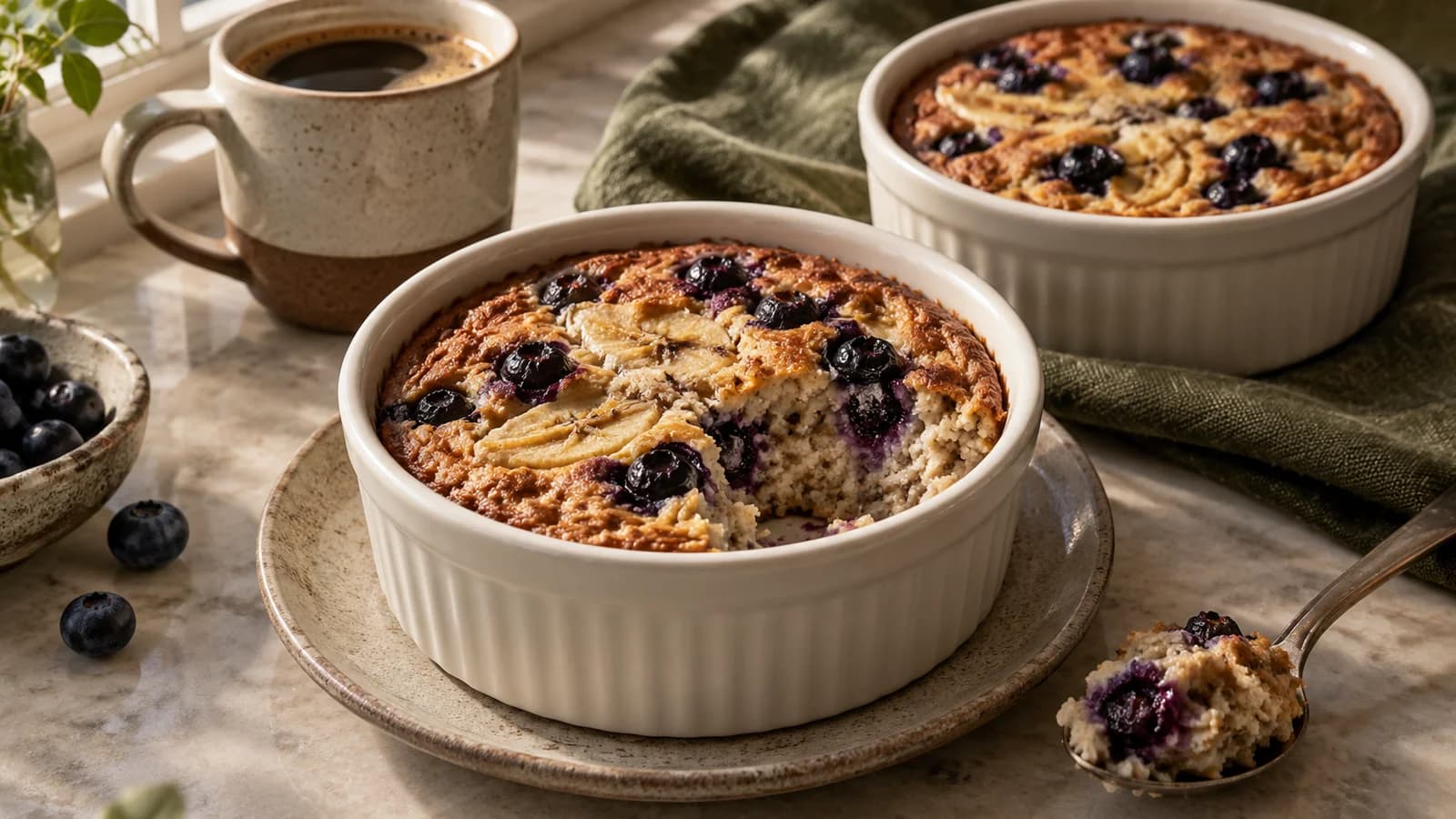
Breakfast with a little oven warmth
High protein baked oats turn a familiar bowl of oats into something you can scoop through like a small breakfast cake. The edges become gently golden, the banana sweetens the batter, and blueberries soften into little purple pockets. Vanilla and cinnamon make the kitchen smell inviting without needing a layer of frosting. The aim is a tender, set centre that holds a spoonful together, with enough moisture to feel comfortable to eat. This is a substantial breakfast, rather than a tiny bite with an oversized protein claim.
What the reference recipe makes
The base recipe makes two equal servings in two separate wide, ovenproof 16-ounce / 480ml ramekins. It uses 80g rolled oats, 40g vanilla whey blend, 100g whole egg, 120g peeled banana, 100g nonfat Greek yogurt, 100g skim milk and 80g blueberries. The smaller ingredients are measured too, including 4g oil for the dishes. One complete ramekin provides approximately 448 calories and 35.1g protein under those assumptions. Fruit and yogurt already inside the batter are counted; anything served alongside is additional.
The texture to expect
Blending the oats gives this version a finer crumb than a tray of baked oatmeal with visible flakes. It is still an oat bake: slightly closer and more moist than a light flour sponge. Banana, egg, yogurt and milk support the batter around the whey, which can become firm if baked too long. A little settling after removal from the oven is normal. A glossy raw middle, however, is not the intended result. Let the dish stand briefly before deciding whether the centre feels properly set.
A practical recipe to work from
Plan roughly ten minutes for preparation, including a short batter rest, twenty-five to thirty-five minutes in the oven and five to ten minutes before serving. Oven, powder, fruit and dish shape affect those estimates. This exact adapted weighed formula has not been physically kitchen-tested; the method is informed by established blended baked-oat technique, with ingredient assumptions and observable doneness checks explained throughout. The photographs illustrate the intended food. Use the measured recipe as a starting point and record what happens with your own ingredients rather than assuming every kitchen behaves identically.
Why You’ll Love This Recipe
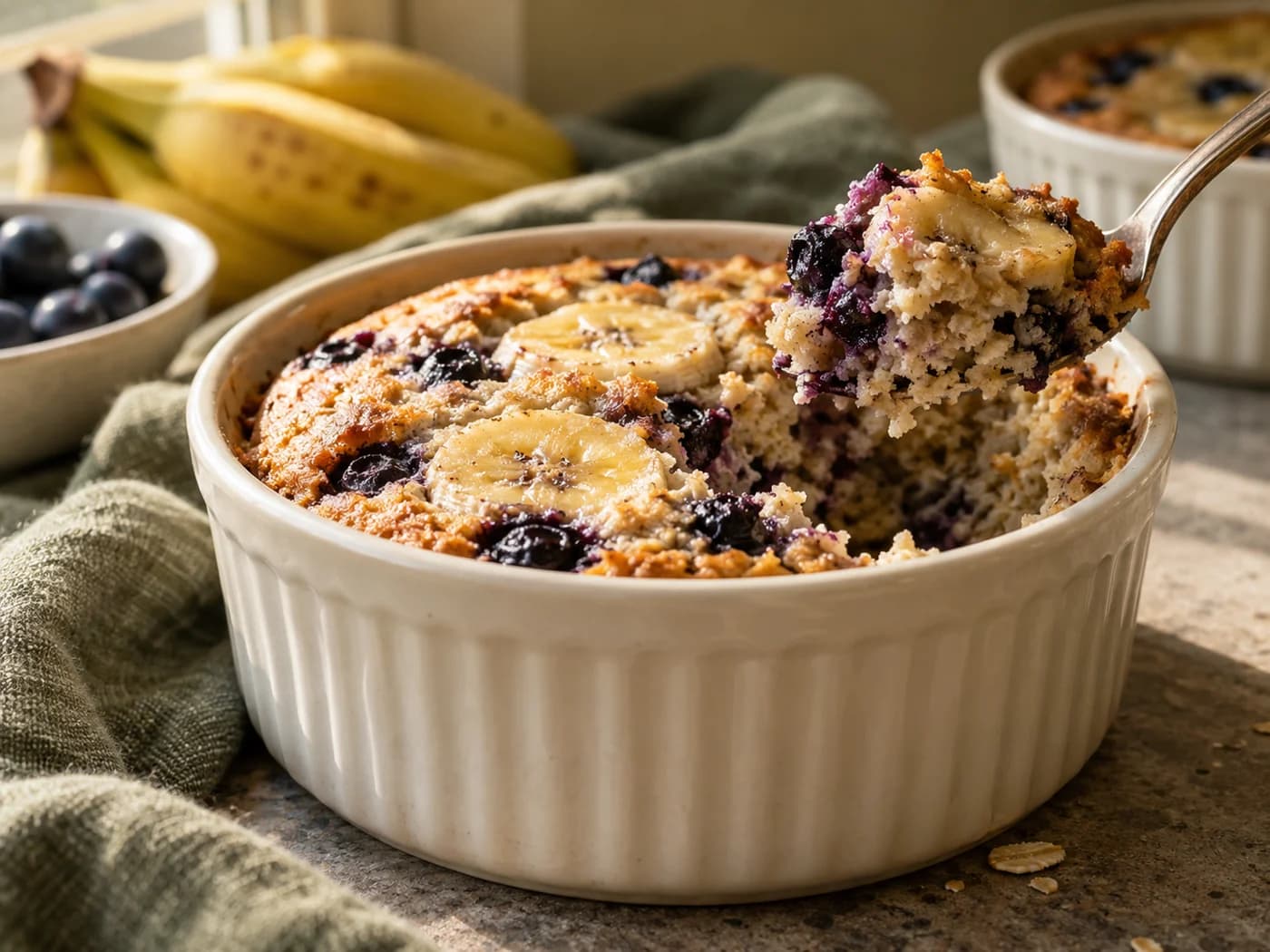
A different way to enjoy oats
If creamy porridge never quite appeals to you, a baked texture offers another way to use the same cupboard staple. The top and edges give a little resistance before the spoon reaches the softer middle. Blending keeps large flakes from dominating each mouthful, while the blueberries add small bursts of flavour. You can eat straight from the cooled ramekin without carefully slicing a loaf. It feels like a deliberate breakfast even when the ingredient list is built mostly from ordinary fridge and pantry foods.
Protein spread across familiar ingredients
Whey contributes the largest share of protein here, but it works alongside whole egg, Greek yogurt, milk and oats. That combination matters in the kitchen as well as in the calculation. Egg helps the batter set, yogurt and milk add moisture, and oats give the bake its body. Trying to achieve the whole number with extra powder alone would make a very different mixture. The reference keeps the powder at 20g per serving and makes the rest of the breakfast from ingredients with useful cooking roles.
Two portions without guesswork
Separate dishes make serving size easy to understand. Half the batter and half the measured greasing oil belong to each complete breakfast. You do not need to decide whether a large corner slice is really one sixth of a tray. If one portion is for today and one for tomorrow, leave the second untopped and cool it for storage. The card can scale to four or six matching ramekins while retaining the same amount of food in each one. More portions require more dishes, rather than smaller servings disguised by a higher yield.
Gentle sweetness, useful flexibility
Ripe banana, berries and the sweetened vanilla powder provide the reference sweetness; there is no separate sugar or honey ingredient. That does not mean the recipe has no sugar. Fruit and dairy contribute naturally occurring sugars, and powder labels vary. The flavour leaves room for a measured yogurt side or a little nut butter if you want one. You can also keep the breakfast plain and enjoy the vanilla-cinnamon base. Choosing toppings at the table makes it easier to serve two people with different preferences without changing the whole batter.
Nutrition at a Glance
- Calories
- 448kcal
- Protein
- 35g
- Carbs
- 54g
- Fat
- 11g
The reference serving
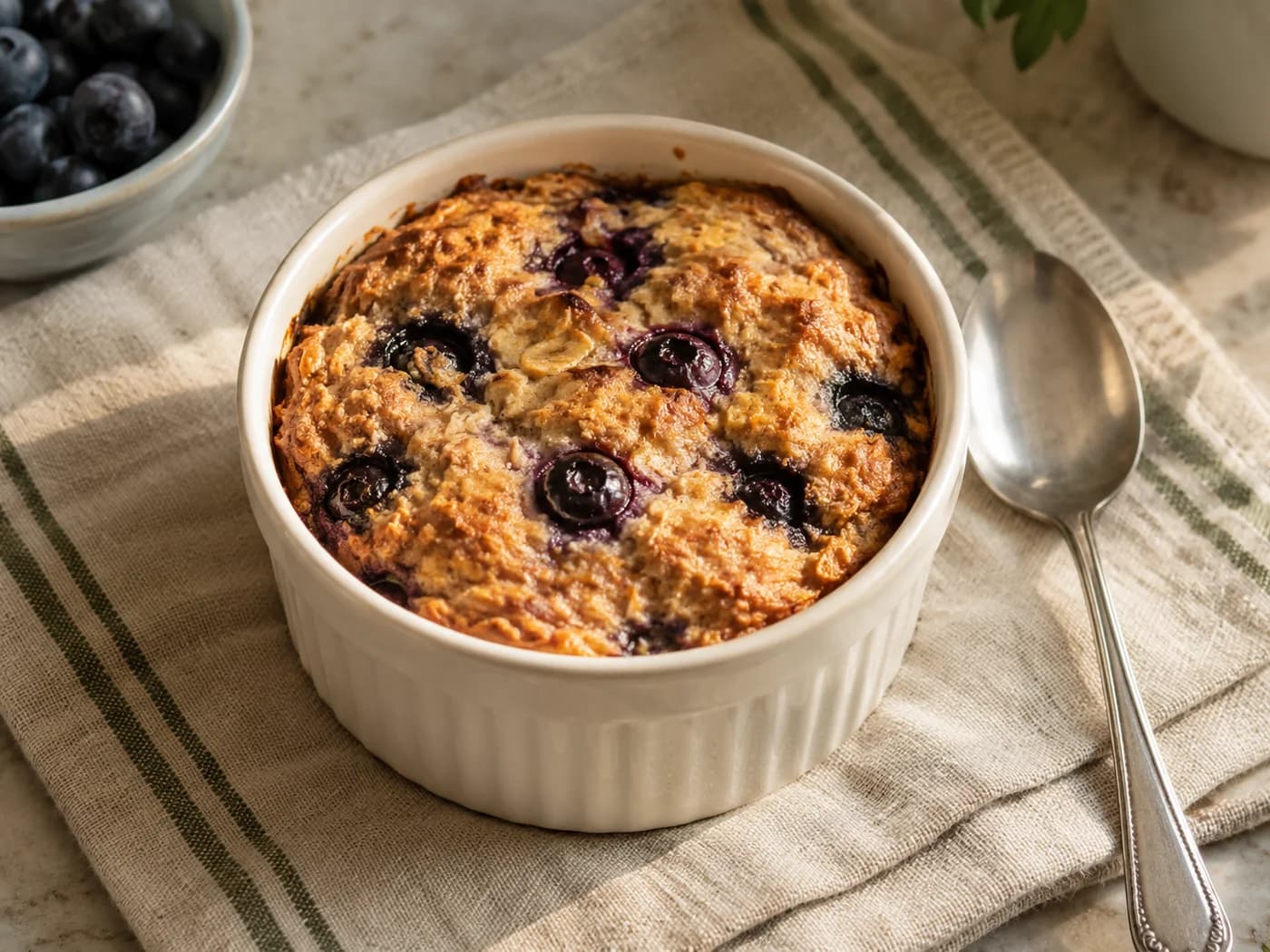
The quick figures are approximately 448 calories, 35g protein, 54g carbohydrate and 11g fat for one complete reference ramekin. Protein before rounding is about 35.1g. These figures include the banana, blueberries, whole egg, milk and yogurt in the batter, as well as 2g of the total greasing oil assigned to that serving. They describe food made from the listed weights, not a generic product called protein oats. A different powder, milk or topping can change the result appreciably.
Calories and carbohydrate
Oats provide a substantial part of the energy and carbohydrate, with banana and blueberries adding more. That is expected for a breakfast built around a grain and fruit. Calling a food high in protein does not automatically make it low in calories or low in carbohydrate. Consider the whole 448-calorie serving when fitting it into your usual morning. If you prefer a lighter snack, half a complete reference portion is about 224 calories and 17.6g protein. It is half the food, with the same recipe composition.
Protein and fat
The reference powder supplies 79g protein per 100g, so 40g contributes 31.6g to the two-serving batch before the other ingredients are added. Whole eggs contribute protein and most of the recipe's fat beyond the oats and greasing oil. Nonfat yogurt and skim milk add further protein with relatively little fat under the selected generic entries. These roles explain why substituting only water for milk or removing the eggs changes more than one line of the nutrition table. Texture and portion structure need attention too.
What the quick panel leaves out
The fuller estimate includes about 7.1g fibre, 17.0g total sugars, 2.6g saturated fat and 559mg sodium per serving. Sodium includes the salt and baking powder; it is not just the small amount naturally present in the foods. The whey label does not declare fibre, so no powder fibre contribution is calculated. Cholesterol, added-sugar totals and a complete micronutrient panel are not estimated here. The detailed section shows the ingredient calculation so you can distinguish a useful estimate from a laboratory nutrition analysis.
Ingredients
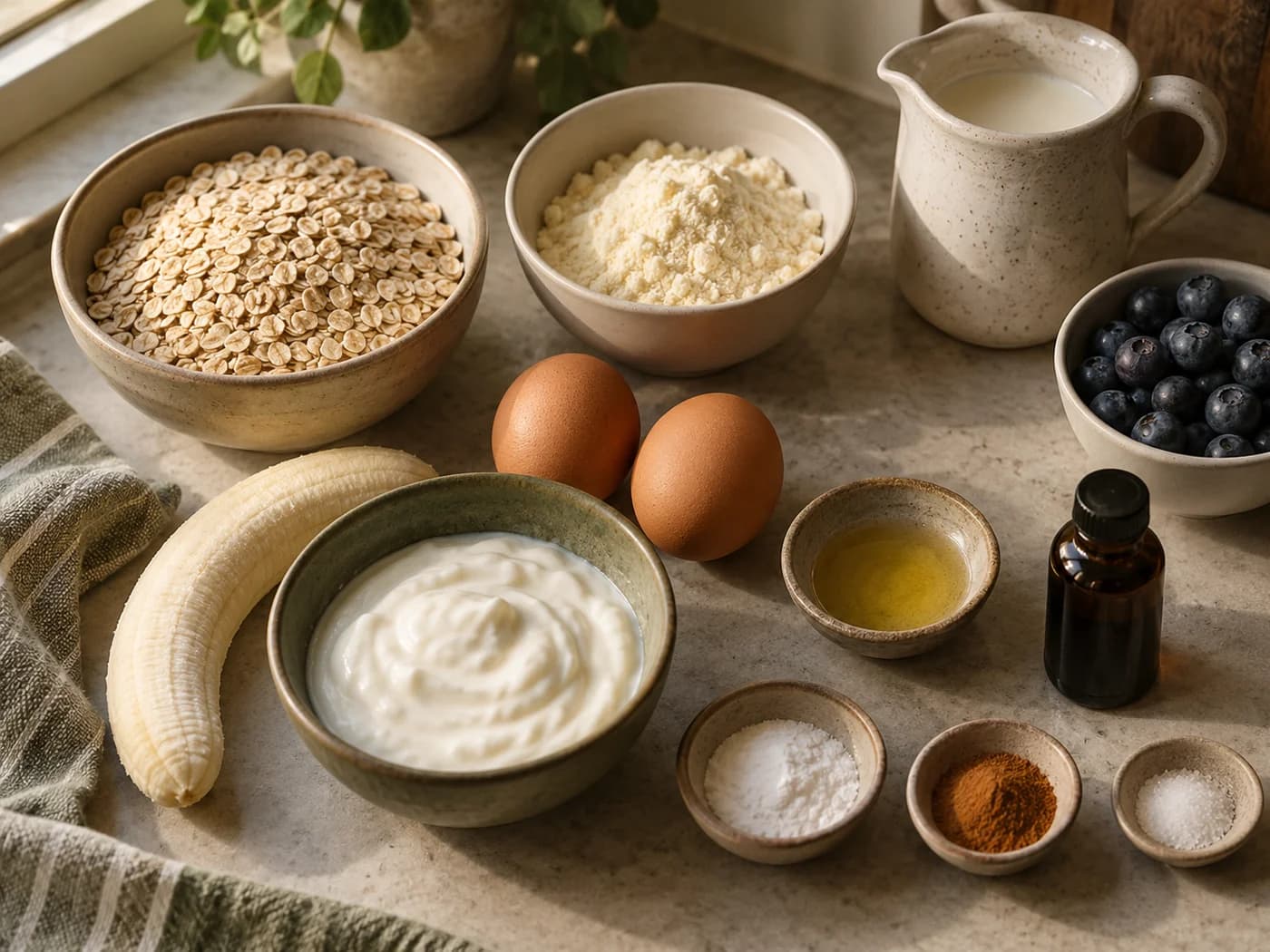
Oats and vanilla whey
Use 80g plain dry rolled oats for the two-serving batch. Blend them finely before adding the wet ingredients, or start with finely milled plain oat flour at the same weight while reviewing its label. Instant flavoured sachets add ingredients the reference does not contain, and steel-cut oats need a different hydration and cooking method. Weigh 40g vanilla whey blend separately. A scoop is a packaging utensil, not a reliable unit of weight. The calculation uses the linked French Vanilla product's per-100g information, with milk and soy allergens noted.
Egg, banana and dairy
Weigh 100g whole egg without shells, roughly two large eggs depending on size. Use 120g peeled ripe banana with yellow skin and some brown speckles; weigh the edible fruit rather than assuming any one banana is the correct amount. The dairy is 100g thick plain nonfat Greek yogurt and 100g fluid skim milk. All of it goes into the batter. There is no reserved yogurt topping in the base recipe. Those distinctions keep the batter instructions and nutrition aligned when several bowls or ingredients are on the counter.
Berries and small measures
Use 80g washed, dried blueberries. Fold them in after blending so the batter remains pale with distinct berry pockets. Add 4g double-acting baking powder, 2g ground cinnamon, 1g fine salt and 4g liquid vanilla extract to the batter. Brush the entire 4g canola oil allocation over the two ramekins, 2g each. None is reserved for the blender or added as an unmeasured drizzle. The estimate conservatively counts the whole amount even if a trace stays on the brush or inside a dish.
Equipment and readiness
Set out a kitchen scale, blender, spatula, mixing bowl, baking tray and two matching ovenproof ramekins. Each should have roughly 16-ounce / 480ml capacity, a broad opening about 11–12cm across and sufficient depth for the batter plus expansion room. Capacity is a guide, not a reason to fill to the rim. Ceramic varies in thickness and heating behaviour, so use comparable dishes and follow their oven instructions. A thin food thermometer and a wooden skewer help assess the centre. Keep raw egg equipment away from toppings and finished food.
Your ingredient checklist
- Rolled oatsBlend finely; plain dry rolled oats80g
- Vanilla whey protein blendWeighed powder; reference contains milk and soy40g
- Whole eggAbout two large eggs; weigh without shells100g
- Ripe bananaPeeled edible weight; blend into batter120g
- Plain nonfat Greek yogurtThick strained yogurt, blended into batter100g
- Skim milkFluid milk; weigh in grams100g
- BlueberriesWashed and dried; fold in after blending80g
- Canola oil2g per ramekin, all included in nutrition4g
- Baking powderDouble-acting reference; weigh carefully4g
- Ground cinnamonFor batter2g
- Fine saltOne gram for the full two-serving batch1g
- Vanilla extractWeighed liquid extract4g
Contains egg and dairy; the reference whey contains soy. For gluten-free suitability, check certified oats and every other ingredient label, including trace warnings.
Ingredient Substitutions
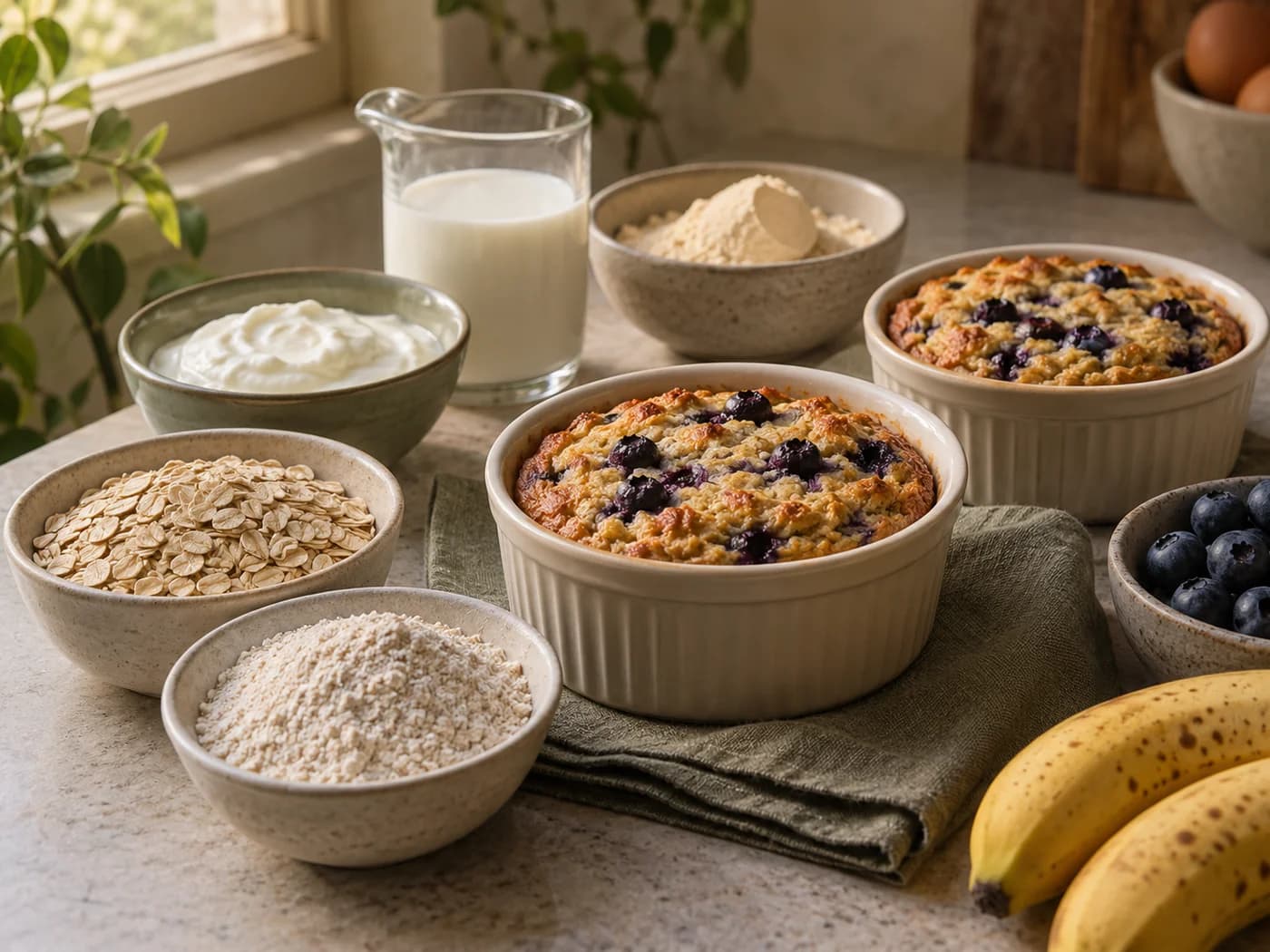
Different oats and powders
Plain oat flour is the closest change to pre-blended rolled oats, but brand and grind can affect absorption. Quick oats can also be ground, while steel-cut oats are not an established direct substitute. Changing whey flavour usually means reviewing sweetness, calories and allergens as well as colour. Casein and plant powders often produce a different thickness; this recipe does not establish an equal-weight swap for them. Before changing both the powder and the liquid, make a small trial with one change so you know which adjustment affected the centre.
Dairy alternatives
Thick skyr or a strained 2% Greek yogurt may be reasonable starting points, with their own label values and moisture behaviour. A thin drinking yogurt is a much larger change to the batter. Replacing skim milk with unsweetened soy beverage changes protein and sometimes sweetness; almond or oat drinks can contribute very different amounts. Use the label from the actual carton. A dairy-free beverage alone does not make the recipe dairy-free while whey and Greek yogurt remain. A genuinely dairy-free adaptation needs an independently developed batter and an allergen review.
Banana, eggs and berries
Banana provides sweetness, moisture and body. Applesauce or pumpkin purée changes all three, so matching grams does not prove an equivalent bake. Egg whites alone remove the yolk fat and alter setting behaviour. Flax mixtures and commercial egg replacers also require their own formula rather than a casual one-line swap. Blueberries are easier to vary within the fruit component: chopped strawberries or raspberries can be tried at the same starting weight, with different juices and nutrition. Large wet pieces may leave pockets that complicate the centre check.
Allergens and honest alternatives
The reference contains egg and dairy; the selected whey contains soy and may have other trace warnings. Oats require certified gluten-free sourcing if that matters, and the powder, baking powder and other ingredients must also suit the person's requirements. There is no wheat flour in the reference, but that alone does not establish a gluten-free claim. Avoid presenting a recipe with several replacement ingredients as the original with identical macros. Record the new weights and labels, assess whether it actually bakes well, and describe it as a separate version when the changes are substantial.
Review both the nutrition and the actual batter when changing ingredients.
| Reference | Possible change | What to check |
|---|---|---|
| Rolled oats | Plain fine oat flour | Grind and label |
| Rolled oats | Steel-cut oats | Needs a different method |
| Vanilla whey blend | Another whey flavour | Weight, label and sweetness |
| Whey | Casein or plant powder | Not an established direct swap |
| Thick nonfat Greek yogurt | Skyr or 2% Greek yogurt | Moisture and label |
| Skim milk | Unsweetened soy beverage | Protein and liquid behaviour |
| Blueberries | Chopped strawberries | Juice and centre doneness |
| Banana or whole egg | Purée or egg alternative | Needs developed formula |
How to Make It
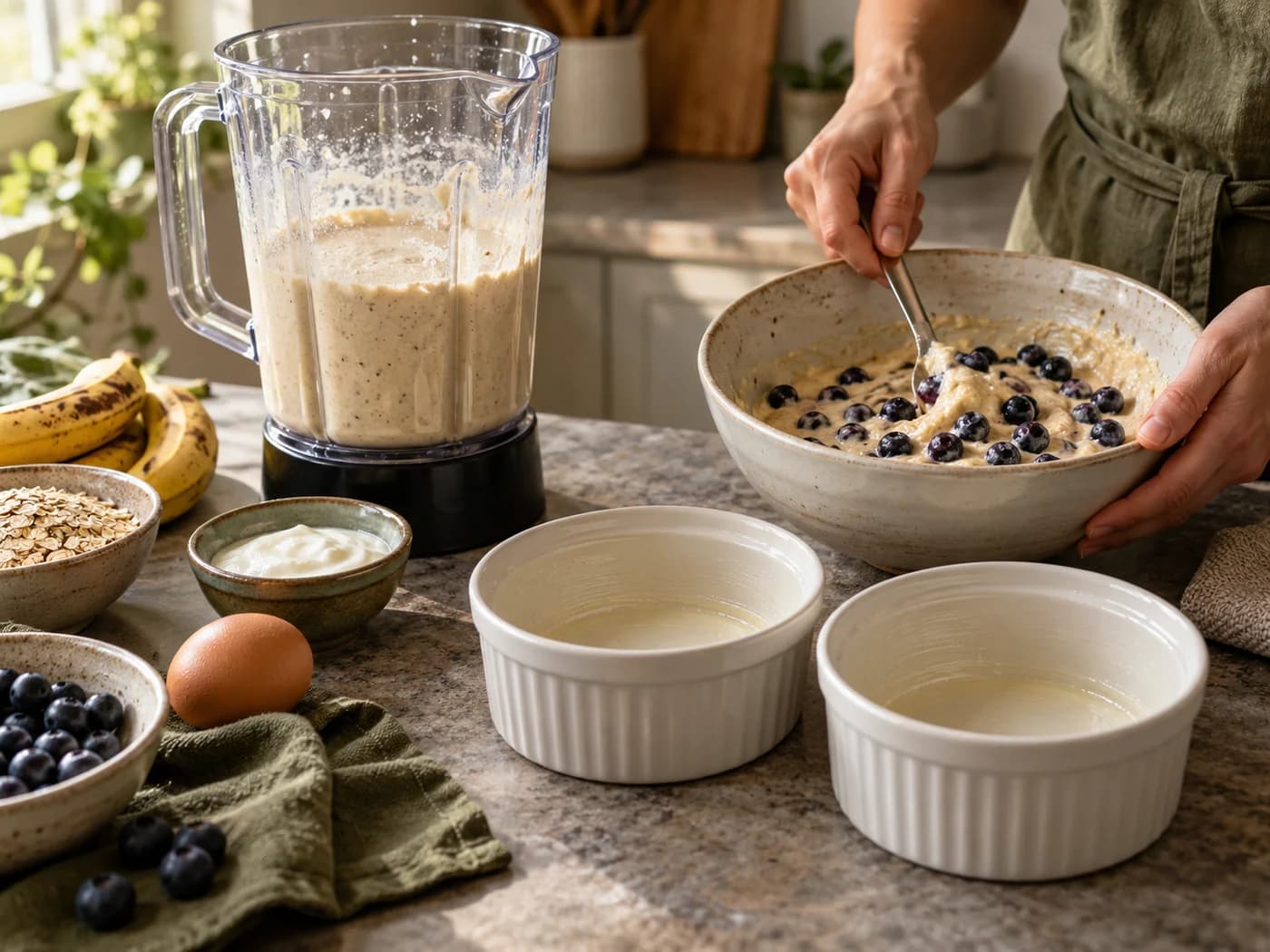
Prepare the oven and dishes
Preheat a conventional oven to 350°F / 175°C with a rack near the middle. Put two matching wide ovenproof ramekins on a baking tray so they are easier to move safely. Brush 2g oil over the inside of each dish, covering the base and lower sides. Weigh all ingredients before starting the blender, including the peeled banana and shell-free egg. It is easier to keep the quantities correct now than to remember later whether a generous handful of fruit was part of the measured recipe.
Blend a smooth base
Grind the 80g oats finely in the blender. Add the whey, baking powder, cinnamon and salt, followed by the egg, banana, Greek yogurt, milk and vanilla. Blend just until the mixture is smooth and evenly combined, stopping to scrape safely as needed. A large machine may require a little patience with this modest batch; do not add an unmeasured cup of milk simply to get its blades moving. Switch the machine off before reaching in with a spatula, and do not taste the raw egg-containing batter.
Rest and portion
Let the blended base stand for about three minutes so the ground oats can begin absorbing liquid. Gently fold in all 80g blueberries. Divide the batter evenly between the two ramekins, leaving room for expansion. The theoretical batter weight is 631g before blender and bowl losses, or roughly 316g per dish. Use equal actual weights rather than trying to recover a precise theoretical gram from every utensil. If your dishes are too narrow or too small, use suitable larger dishes instead of stacking the mixture deeply or filling to the rim.
Bake, check and pause
Bake for approximately twenty-five to thirty-five minutes, beginning checks around twenty-five. The top should look set and gently golden; a skewer placed into oat crumb away from a berry should show no liquid batter. Check an egg-containing centre with a thermometer, at least 160°F / 71°C away from the hot dish, while also judging whether the crumb is set. That minimum is a safety check, not a promise that the exact batter is finished at that point. Rest on a rack for five to ten minutes, protect hands from hot ceramic, and serve or cool promptly for storage.
Tips for the Best Results
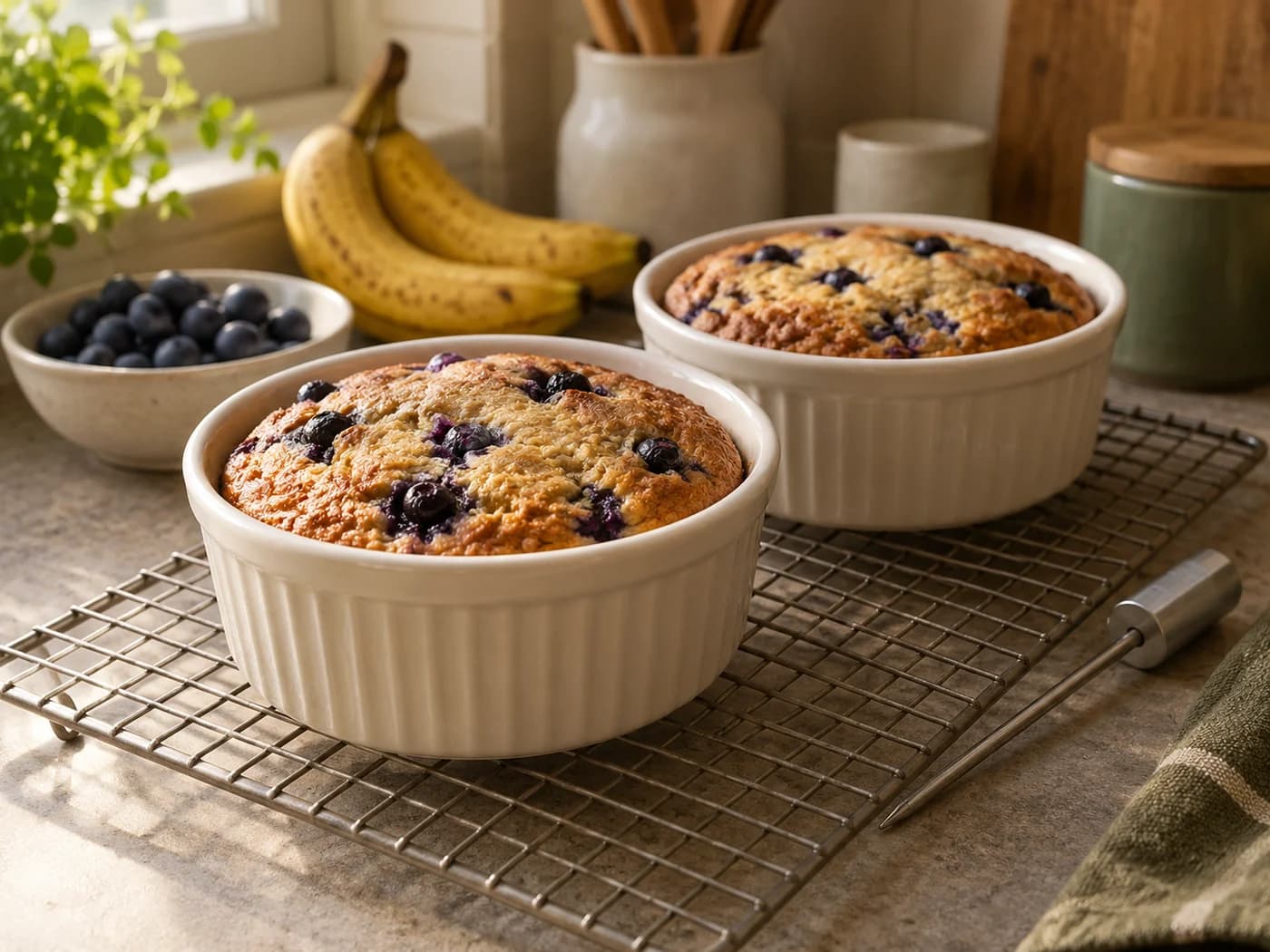
Keep the dish shape consistent
Two containers with the same volume can have very different shapes. A narrow, deep cup puts more batter between the surface and the centre than a broad ramekin. It may leave a dark top over an under-set middle even when the nominal capacity matches. Use the reference's wide dishes for your first attempt and keep portions equal. If one ramekin is smaller, do not force the same weight into it. Compare actual batter depth, leave headroom, and choose equipment that allows the centre to cook without needing to overbake the edges.
Give the oats a fine grind
A coarse grind leaves larger particles that may feel chewy or uneven after a short bake. Grind dry oats first, then blend the wet base until the mixture looks consistent. Scrape down dry powder stuck above the blades rather than adding more liquid to wash it away. After the short rest, the batter should be pourable but have some body. A very stiff paste or a thin drink suggests an ingredient, weighing or powder difference worth checking before it goes into the oven. Do not compensate with several simultaneous additions.
Use several centre cues
A blueberry can stain a skewer and make cooked crumb look wet. Move the probe slightly away from the fruit and inspect the oat mixture itself. Surface colour alone does not tell you whether the middle has set, especially with pale ceramic dishes. Check both ramekins if they are positioned differently on the tray. Leave a little space between them for heat circulation. If the centre still contains liquid batter, continue cooking and review frequently rather than assuming a particular minute on the clock guarantees the same result in every oven.
Protect tenderness after baking
Whey-rich batters can become noticeably firm when cooked well beyond the point they need. Once the centres are properly cooked and set, move the tray out of the oven and give the dishes their brief rest. The cooling pause helps the crumb settle and makes a hot fruit pocket less likely to surprise you. For later reheating, use modest increments and check the middle rather than repeatedly drying the surface. A separate spoonful of yogurt can make serving pleasant, but it cannot repair an undercooked original bake or reverse prolonged overbaking.
High-Protein / Lower-Calorie Variations
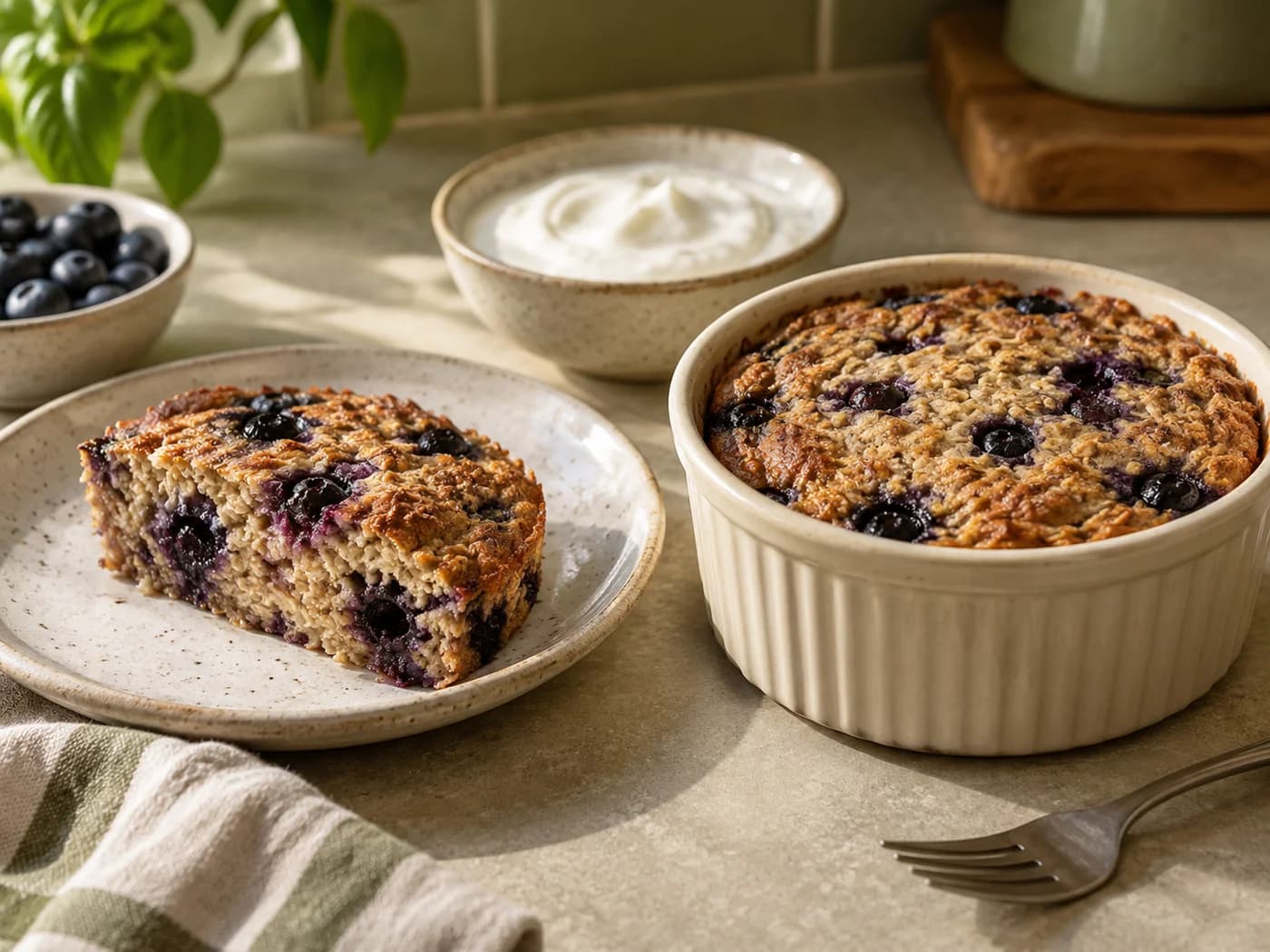
A smaller serving with clear numbers
Half a complete reference ramekin supplies about 224 calories and 17.6g protein. That can suit a smaller appetite or a snack, while a complete dish may be more comfortable as breakfast. Split the cooked portion by weight if you want reasonably even halves, rather than taking only the top or leaving most berries in one piece. The card's two-, four- and six-serving options increase the number of full reference portions. They do not shrink the ramekins and then claim the same protein number for less food.
Add protein at the table
A separate 100g portion of the reference nonfat Greek yogurt adds about 59 calories and 10.2g protein. With one full baked-oat serving, the combined example is approximately 507 calories and 45.3g protein. With half a serving, it is about 283 calories and 27.7g protein. These are straightforward measured-food combinations, not instructions to eat either amount. Serving the yogurt on the side preserves the original batter and lets the person choose how much feels comfortable. Extra whey blended into the original recipe would need another baking assessment.
Flavour variations worth considering
For a strawberry version, begin with the measured berry component and review the actual fruit entry. Smaller pieces distribute more evenly than very large chunks, though more exposed fruit can release extra juice. A cocoa version needs cocoa added to the calculation and a review of batter thickness; changing vanilla powder to chocolate does not automatically duplicate a developed chocolate recipe. Lemon zest can change aroma with a small quantity, while nuts or chocolate chips create a more substantial nutrition difference. Measure the additions before they disappear into the batter.
Lower-calorie changes with practical limits
Choosing a smaller portion or omitting optional toppings is the clearest adjustment. Replacing banana, removing egg yolks or swapping dairy can change sweetness, binding and moisture as well as calories. Do not call those changes proven equivalents simply because a spreadsheet gives a lower number. Keep the reference amounts for a first bake, then work on one variation at a time if you want to develop another version. A breakfast should also fit your appetite and enjoyment; chasing the smallest possible calorie total can make a substantial, useful recipe into an unsatisfying portion.
These examples alter the served portion or add a separate yogurt side; the original batter stays the same.
| Serving | Approximate calories | Approximate protein |
|---|---|---|
| One complete reference ramekin | 448 kcal | 35.1g |
| Half a complete serving | 224 kcal | 17.6g |
| One serving + 100g reference Greek yogurt | 507 kcal | 45.3g |
| Half a serving + 100g reference Greek yogurt | 283 kcal | 27.7g |
| Two complete servings | 896 kcal | 70.2g |
Serving Suggestions
Straight from the ramekin
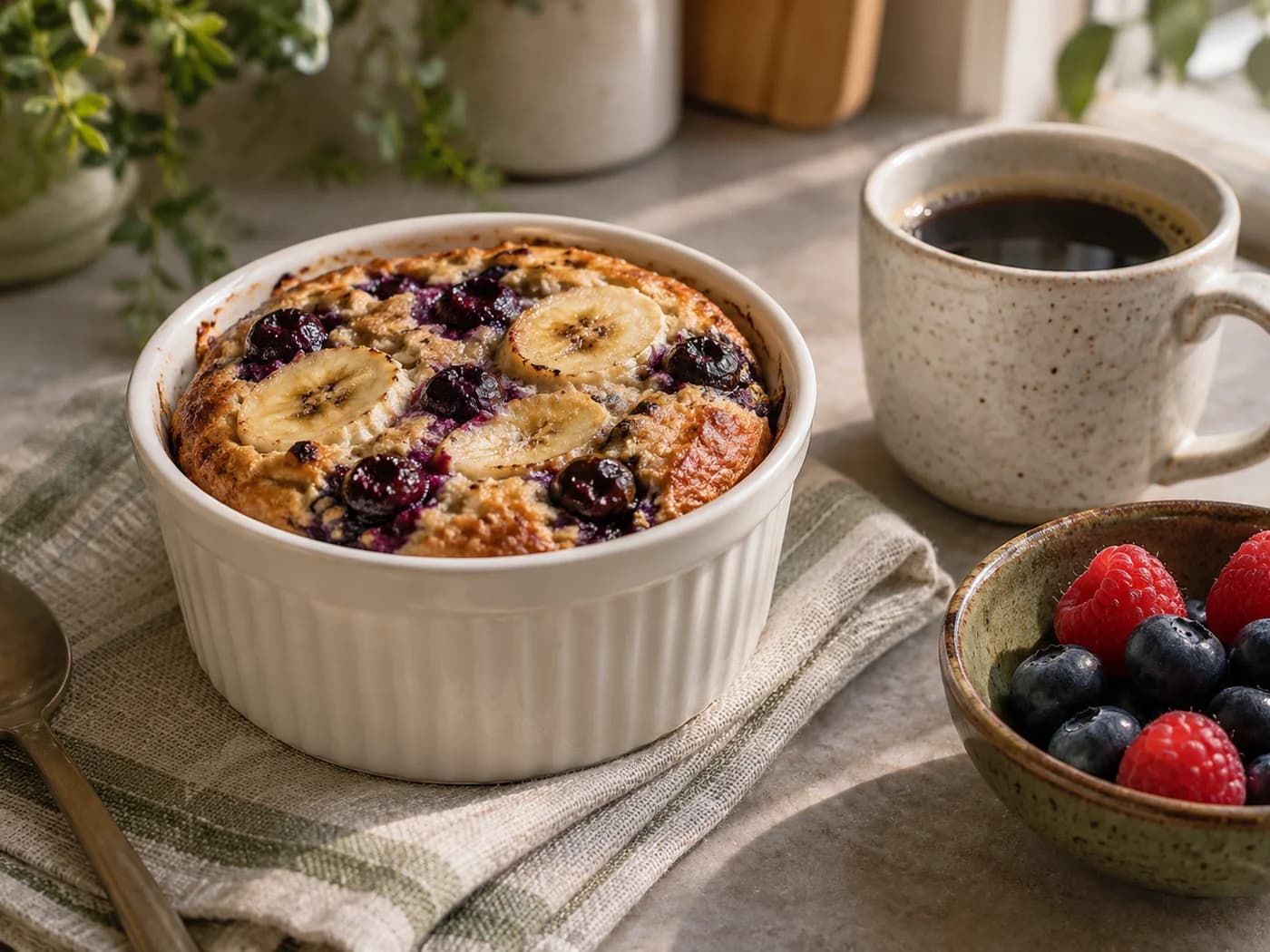
After the brief cooling pause, place the hot dish on a suitable trivet or plate and serve with a spoon. The soft centre and lightly set edge are intended for scooping, so you do not need to turn it out like a celebration cake. Warn anyone joining you that the ceramic and fruit can stay hot. A plain coffee or tea makes an easy companion. If the ramekin is for a child or someone who may forget it is hot, transfer the food to a cooler plate before serving.
A cool yogurt contrast
Plain yogurt alongside warm oats adds a cool, tangy contrast. Keep it in a separate small bowl if you want the baked top to remain visible and to measure the portion clearly. The recipe already contains 50g yogurt per reference serving in its batter; this side is extra. A 50g side would add roughly 30 calories and 5.1g protein under the same entry. Different brands may be thicker or sweeter, so use their labels if you regularly track the combination. A decorative drizzle is still food that contributes to the meal.
Fruit, crunch and spreads
The baked blueberries provide soft fruit pockets, while a few fresh berries on the side add a brighter texture. Toasted nuts or seeds can introduce crunch, but they also add energy and should be weighed if you want a meaningful total. A small measured spoon of nut butter may suit the banana flavour without requiring a sweet syrup. Spread it over a bite or serve it separately rather than flooding the dish. There is no need to use every topping at once; one contrast often makes breakfast more enjoyable than a crowded bowl.
Serving two different preferences
The base batch is convenient when two people want the same warm breakfast with different finishing touches. Leave both bakes plain, then offer toppings separately. One person might prefer a little yogurt, while another enjoys the original berry pockets and cinnamon. For a brunch table, clearly identify the egg, dairy and selected powder allergens and keep utensils separate where needed. Larger batches require matching dishes and more oven planning. Let appetite determine how much each person eats rather than treating one ramekin as an obligation simply because it is the reference unit.
Meal Prep & Storage
Cook before storing
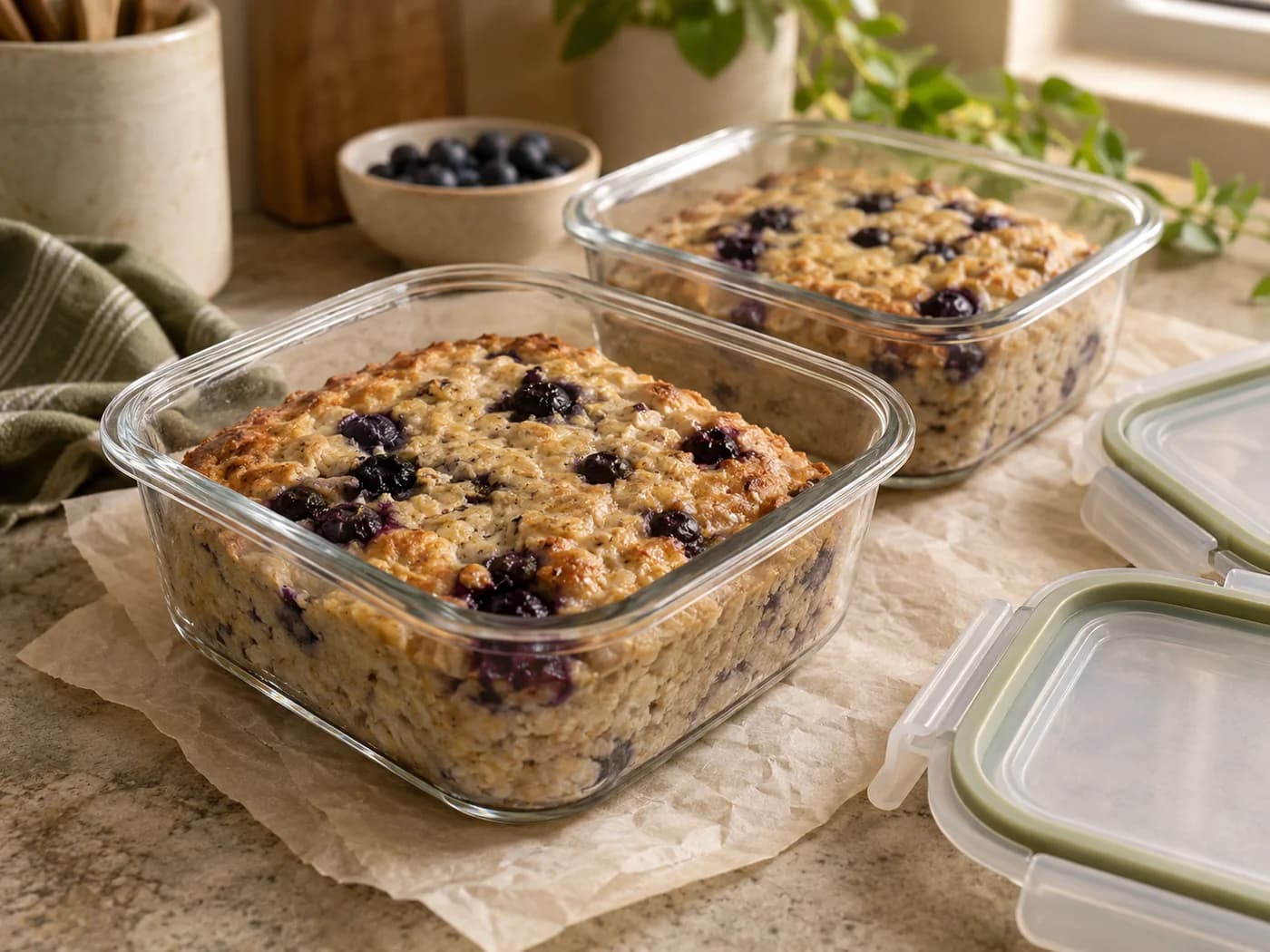
The easiest meal-prep approach is to bake the portions, cool them safely and store them without extra toppings. Raw batter contains egg and dairy, so it should not sit on the counter while you complete several oven rounds. Refrigerate waiting batter and avoid planning an unverified overnight raw-batter hold as if it were the same as a no-cook oat jar. If you only have two suitable ramekins, let them cool enough to handle safely between rounds. Do not expose hot ceramic to a sudden cold-water shock.
Refrigerate with ordinary leftover care
Keep finished portions covered at 40°F / 4°C or below and use a conservative three- to four-day window with suitable handling. This follows general leftover guidance, rather than a shelf-life study of this particular oat formula. Refrigerate perishable leftovers within two hours, or one hour when the environment is above 90°F / 32°C. Do not leave the dishes out for several hours while waiting for them to become completely cold. Transfer to appropriate shallow storage containers if necessary, following the cookware's instructions and avoiding sudden temperature changes.
Freeze individual portions
Freezing cooled untopped portions separately lets you take out one breakfast at a time. Use freezer-suitable containers, label the date and protect the surface from air. About one month is a practical quality target to try, not a measured maximum shelf life. Banana-oat crumb may become a little firmer or release moisture after thawing, and berries can leave darker streaks. Thaw in the refrigerator rather than on the counter. Check that any ceramic dish is actually freezer-safe before using it for long storage; a glass food container may be more suitable.
Reheat the centre without scorching the edge
Remove lids that are not approved for heating and use equipment suitable for the method. A microwave can warm a refrigerated portion in short increments, while an oven takes longer; neither has a universal time for every container and starting temperature. Reheated leftovers should reach 165°F / 74°C in the centre. A splash of measured milk can help with a firm surface, but it is an addition to the meal. Add chilled yogurt only after reheating. Discard food with uncertain handling rather than using smell or a decorative fresh topping as a safety check.
Full Nutrition Information
How the calculation is built
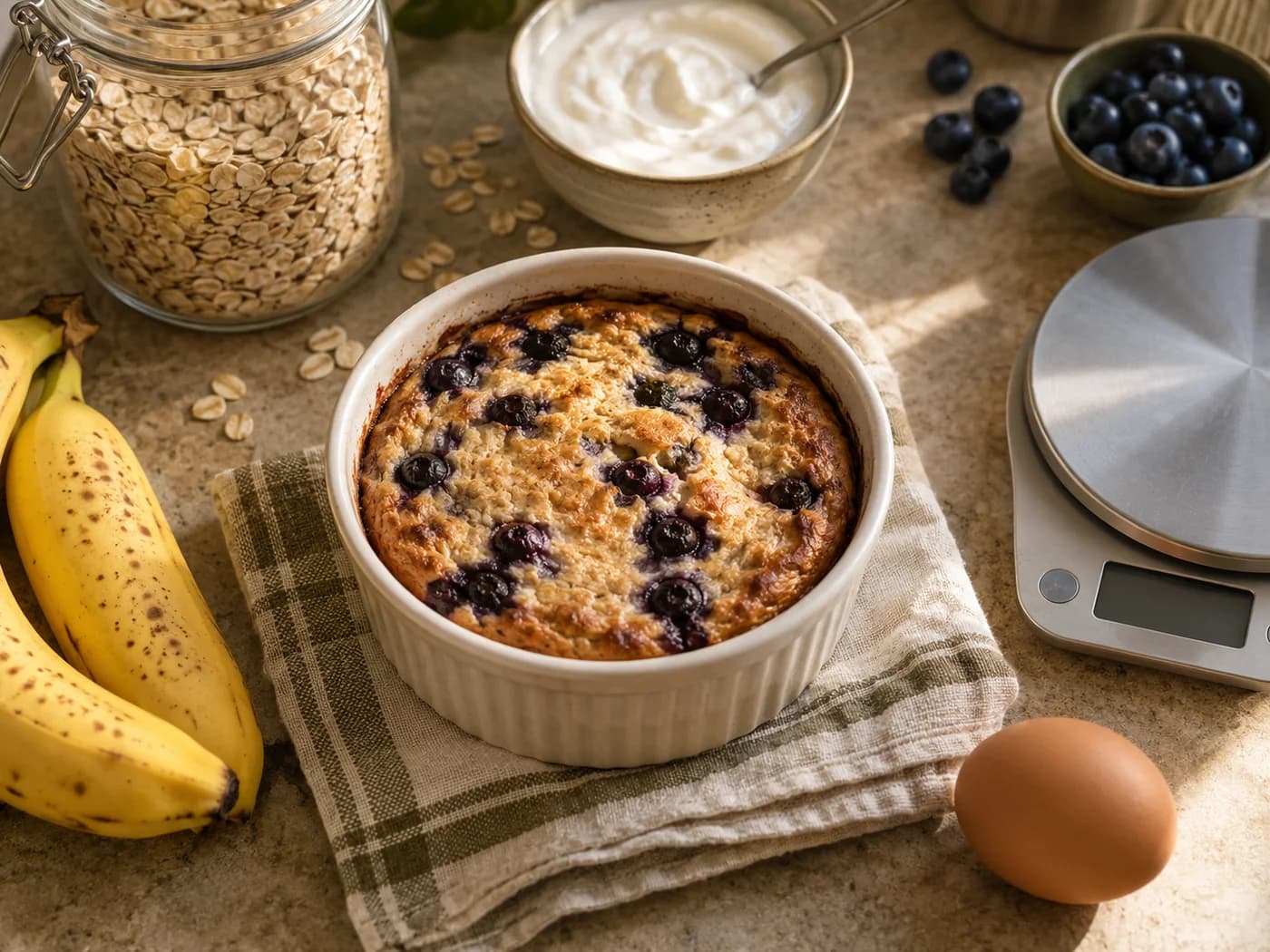
For each ingredient, its per-100g reference is multiplied by the grams used and divided by one hundred. Those contributions are summed for the complete two-serving recipe, then divided by two. The base batch is approximately 896 calories and 70.2g protein, before optional serving additions. All 4g greasing oil is included. Blender and bowl residues are not measured, so the calculation conservatively treats the weighed ingredients as consumed. It does not pretend a precise cooked weight was observed or use water loss to manufacture extra protein.
References behind the numbers
The generic food entries come from the historical USDA Standard Reference release 28 archive: plain dry regular/quick oats, raw whole egg, raw banana, plain nonfat Greek yogurt, fluid skim milk, raw blueberries, canola oil, double-acting baking powder, ground cinnamon, table salt and vanilla extract. These are reference foods rather than proof that every supermarket product has identical values. Whey uses the separately linked French Vanilla label, including its 79g protein and 376-calorie per-100g declaration. Package values should replace these assumptions when you calculate your own regular ingredients.
Reading a complete serving
One complete reference serving is approximately 448 calories, 35.1g protein, 53.9g carbohydrate and 10.8g fat before display rounding. Additional estimates are 7.1g fibre, 17.0g total sugars, 2.6g saturated fat and 559mg sodium. The quick panel rounds the main macros to whole numbers, so multiplying displayed values may not perfectly reproduce the unrounded batch. Fibre from the powder is undeclared and contributes nothing to the estimate; that is an information gap, not a claim that every powder contains no fibre. Baking powder and added salt are both included in sodium.
Using your own labels
Recalculate with actual weighed ingredients when changing yogurt, powder, milk or fruit. You can use the food calculator to organise a meal, while keeping raw ingredient entries distinct from cooked branded dishes. A finished ramekin's weight depends on water loss and retained crumbs, so per-100g cooked values would need an actual weighed outcome. This article supplies a serving estimate, not a full label analysis. It does not calculate cholesterol, a complete vitamin/mineral panel or added-sugar totals, and it avoids assigning false precision to nutrients the selected product label does not declare.
| Ingredient | Amount | Calories | Protein | Carbs | Fat |
|---|---|---|---|---|---|
| Rolled oats | 80g | 303 kcal | 10.5g | 54.2g | 5.2g |
| Vanilla whey protein blend | 40g | 150 kcal | 31.6g | 2.1g | 1.7g |
| Whole egg | 100g | 143 kcal | 12.6g | 0.7g | 9.5g |
| Ripe banana | 120g | 107 kcal | 1.3g | 27.4g | 0.4g |
| Plain nonfat Greek yogurt | 100g | 59 kcal | 10.2g | 3.6g | 0.4g |
| Skim milk | 100g | 34 kcal | 3.4g | 5.0g | 0.1g |
| Blueberries | 80g | 46 kcal | 0.6g | 11.6g | 0.3g |
| Canola oil | 4g | 35 kcal | 0.0g | 0.0g | 4.0g |
| Baking powder | 4g | 2 kcal | 0.0g | 1.1g | 0.0g |
| Ground cinnamon | 2g | 5 kcal | 0.1g | 1.6g | 0.0g |
| Fine salt | 1g | 0 kcal | 0.0g | 0.0g | 0.0g |
| Vanilla extract | 4g | 12 kcal | 0.0g | 0.5g | 0.0g |
| Whole batch | 2 complete ramekin servings | 896 kcal | 70.2g | 107.7g | 21.6g |
| One reference serving | Batch ÷ 2 | 448 kcal | 35.1g | 54g | 11g |
| Dietary fiber | 7.1g |
|---|---|
| Total sugars | 17.0g |
| Saturated fat | 2.6g |
| Sodium | 559mg |
Estimated recipe nutrition, not a laboratory analysis. Includes complete oat batter, banana, blueberries, egg, dairy and all measured ramekin oil. Extra toppings and sides are additional. Powder fibre is undeclared, so its contribution is not calculated. Cholesterol, added sugars and complete micronutrients are not calculated.
How This Fits Your Daily Protein Goal
Begin with your own target
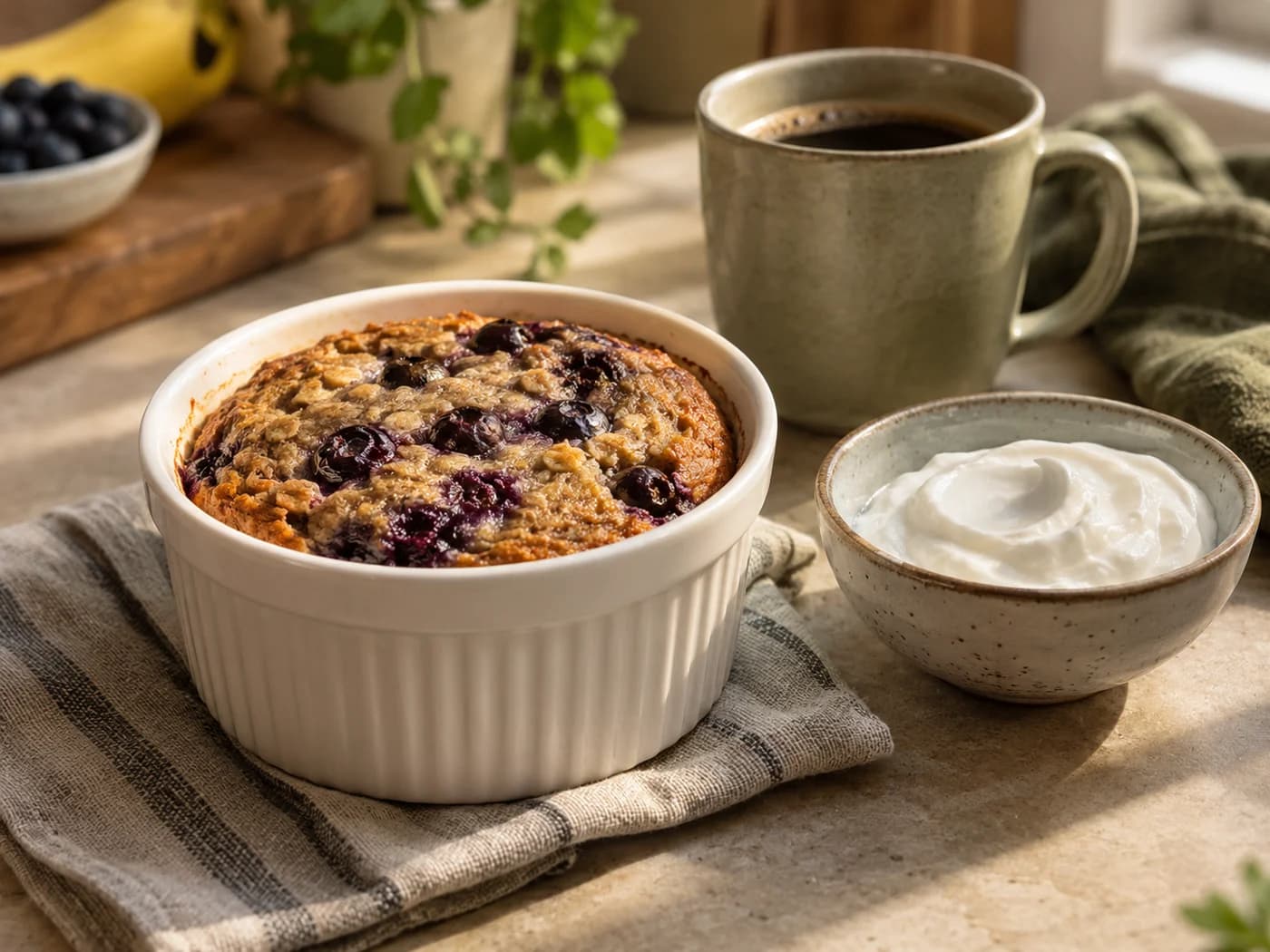
A protein target belongs to your wider eating pattern, body size, activity and goals; this recipe does not assign the same target to everyone. The protein calculator can help estimate a general starting point using those inputs. Treat the result as planning support rather than a reason to force a large breakfast when you are not hungry. One reference ramekin adds about 35.1g protein, alongside about 448 calories and the rest of its nutrients. It is one possible breakfast among several ways to distribute food comfortably across a day.
A worked example
Suppose you use a 120g daily target for your own planning. A complete reference breakfast supplies about 35.1g, leaving approximately 84.9g to come from the remaining meals and snacks. A lunch with around 30g and a dinner with around 35g would bring that example to roughly 100g before other food. The point is the arithmetic, not a prescription for three particular dishes. Count the egg, yogurt and whey already in the bake through its complete recipe total rather than adding them again as separate meal entries.
Portion size can still be flexible
Someone who prefers a smaller morning meal may choose half a portion and eat other foods later. Half the reference contributes about 17.6g protein, while half plus 100g of the reference yogurt totals roughly 27.7g. Another person may enjoy a full portion as a longer breakfast. Neither amount is automatically better just because one number is higher. Consider comfort, energy needs and the foods already planned. You do not need to keep adding powder or toppings after reaching a useful meal simply because the dish has protein in its name.
Think beyond a single breakfast
Beans, lentils, dairy, soy foods, eggs, fish or other suitable foods can contribute protein elsewhere in the day. A varied pattern also provides flavours, textures and nutrients that a repeated oat-and-whey breakfast cannot cover alone. If a particular health condition affects your protein intake, follow individual advice rather than choosing a target from a recipe page. For ordinary planning, keep the recipe's complete serving definition visible and compare it with your other meals. Consistency with food you enjoy is more practical than treating one unusually large protein number as the whole goal.
Make it personal
Where does this breakfast fit in your day?
Estimate your daily protein target, then plan meals you enjoy.
Recipe Card
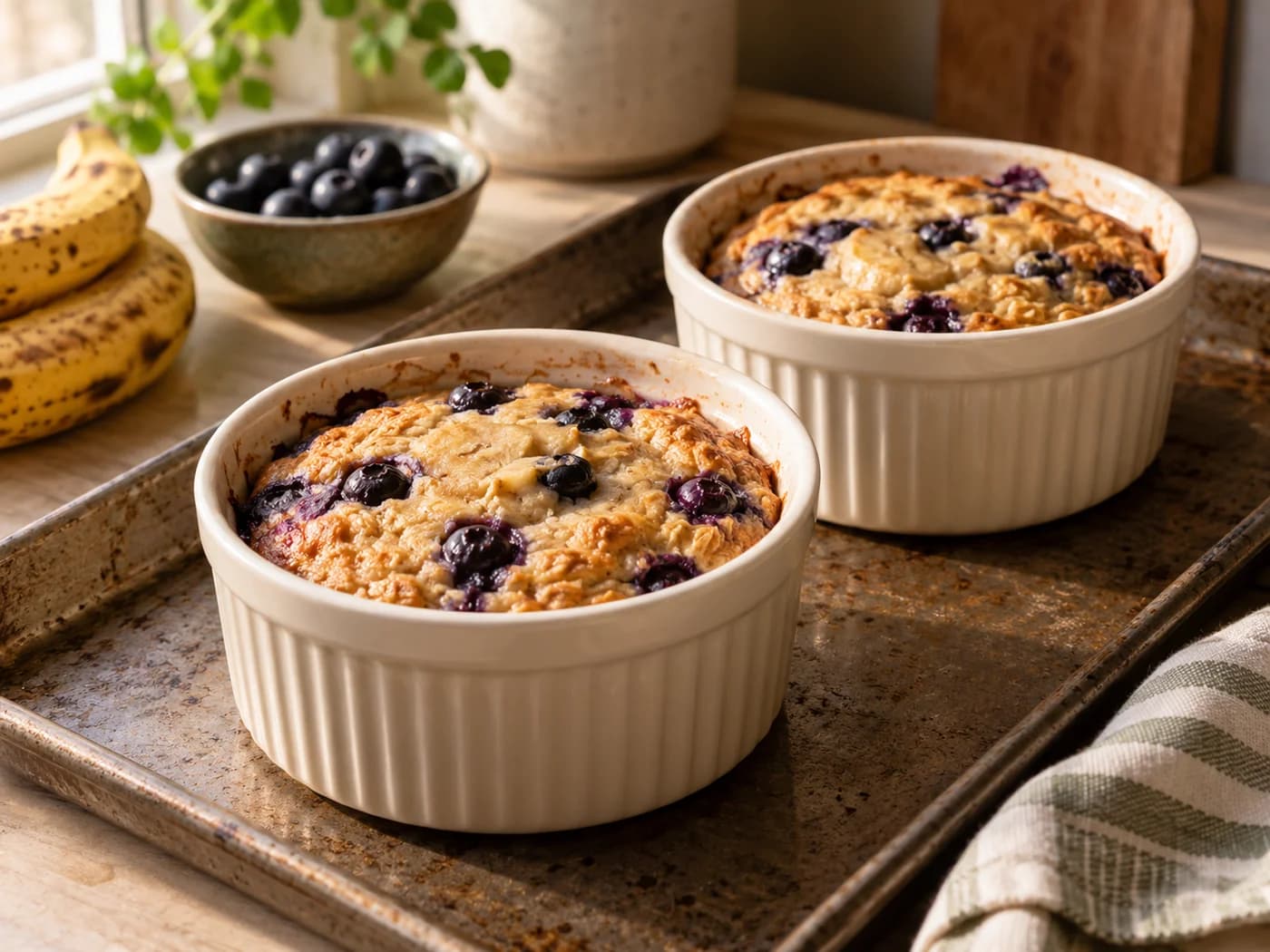
A compact version for the kitchen
The card below gathers the weighed ingredients, preparation steps, oven temperature and serving estimate in one place. Start with the two-serving setting if you are learning how your blender and ramekins behave. The checklist helps you keep track of the small ingredients before blending, and the print button produces a clean cooking card. The flour-free batter still contains raw egg, so keep preparation utensils away from finished food. A few minutes spent weighing accurately are easier to manage than trying to diagnose an unexpectedly runny mixture after it has already baked.
What the serving buttons change
Selecting four servings doubles the ingredients and requires four matching reference ramekins. Six servings triples the ingredients and requires six. Each dish still receives one equal reference share and its own 2g allocation of greasing oil. If your blender is small, mix in separate base batches rather than filling past its capacity; the total ingredients can be divided into equal two-serving sets. Per-serving nutrition remains unchanged because the amount of food per serving is the same. More oven rounds or a fuller tray may need extra elapsed time and individual centre checks.
Keep a useful note after the first bake
Write down the exact powder, yogurt, banana weight and dish dimensions, together with the time at which the centre actually became set. Note whether the crumb was tender, firm or unusually wet once the dish had rested. Those observations are more useful than a general judgement based only on the top's colour. If you change something next time, choose one adjustment so you can interpret the result. A successful repeat depends on a recognisable set of ingredients and equipment, not on remembering that you used approximately one scoop and a large banana.
Use the complete serving definition
The card's nutrition includes the whole measured batter and the oil assigned to the dishes. It excludes optional yogurt sides, extra fruit, nut butter, honey or other finishes. If you eat half a dish, count half its reference amount, ideally dividing a cooked portion evenly. If food remains in the blender or in the ramekin, the conservative calculation still reflects the recipe weights rather than a measured recovery study. The card is intended to make those assumptions easy to follow while you cook, serve and store the breakfast.
Your warm breakfast, ready to make
High-Protein Baked Oats
Blended banana-blueberry oats with Greek yogurt, egg and vanilla whey.
*Base-batch planning estimates, including a three-minute batter rest. Larger batches may need separate blender batches or extra oven rounds. Each serving keeps the same ingredient share; these settings add full portions.
Ingredients
Method
- Prepare the dishes
Preheat a conventional oven to 350°F / 175°C. Place 2 matching wide ovenproof 16oz / 480ml ramekins, about 11–12cm across, on baking trays. Brush 4g total oil across them, 2g per dish. Leave expansion room; use suitable larger dishes if needed.
- Blend the base
Grind 80g rolled oats finely. Add 40g whey, 4g baking powder, 2g cinnamon and 1g salt, then 100g whole egg without shells, 120g peeled banana, 100g yogurt, 100g skim milk and 4g vanilla. Blend just until smooth, scraping safely. Use 1 separate equal two-serving base batch if needed for blender capacity. Do not taste raw egg batter.
- Rest and fold
Rest each blended base about three minutes, then fold in its equal share of the total 80g washed, dried blueberries. Keep waiting raw batter refrigerated if making extra oven rounds.
- Divide evenly
Divide batter equally between 2 dishes, roughly 316g per dish before utensil losses. Keep dishes wide with expansion room; do not fill to the rim. Use equal actual portion weights rather than adding unmeasured liquid.
- Bake and check
Bake roughly 25–35 minutes, checking from twenty-five. Tops and centres should be set; a skewer in oat crumb away from a blueberry should show no liquid batter. Egg-containing centres should reach at least 160°F / 71°C, checked away from ceramic. This minimum is a safety check; also assess the actual set crumb.
- Rest, serve and store
Rest on a rack for 5–10 minutes before serving; ceramic stays hot. For leftovers, cool promptly and refrigerate covered at 40°F / 4°C or below, using within 3–4 days with suitable handling. Keep toppings separate. Reheat leftovers to 165°F / 74°C in the centre.
Check oat crumb away from berries and away from the hot dish. The minimum egg temperature is a safety check; also judge a properly set centre.
Protein before rounding: 35.1g. Includes fruit, egg, dairy and all measured ramekin oil. Serving extras are additional. Contains egg and dairy; reference whey contains soy. Check all ingredient labels. Refrigerate at 40°F / 4°C or below and use within 3–4 days with suitable handling.
Frequently Asked Questions
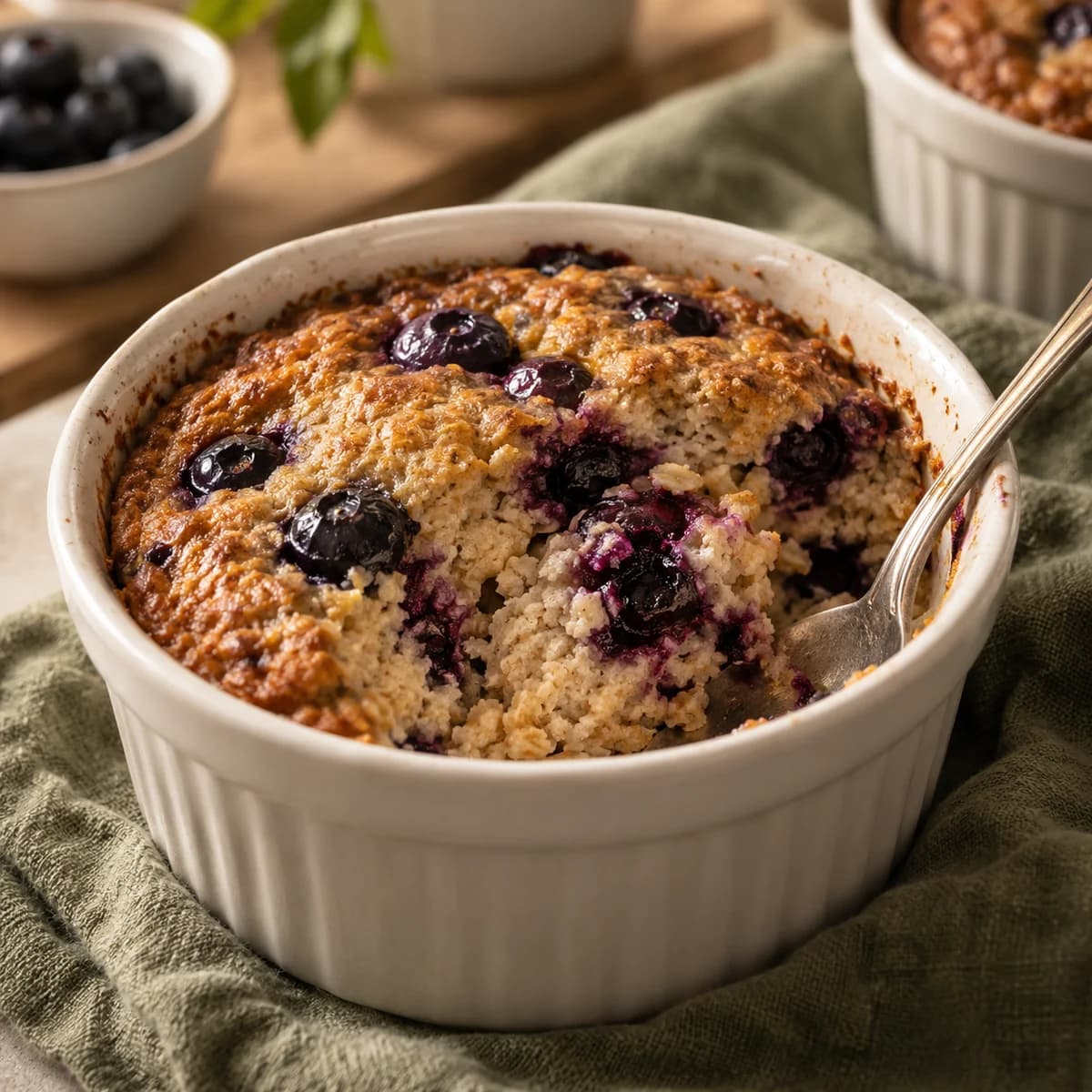
Questions that matter before preheating
Most baked-oat problems come from a few practical differences: a deep dish, a changed protein powder, a large unweighed banana, or a centre judged only by the colour on top. Those details affect how the batter behaves and how long it takes to set. Read the answers below with your actual equipment in mind. A recipe with the same name on another site may be a flake-based tray bake, a single smaller ramekin or an air-fryer version, so its times and serving numbers are not interchangeable with this reference.
Moist does not mean raw
Blended banana and yogurt produce a soft centre, and warm blueberries can release juice. That should not be confused with uncooked egg batter. Check oat crumb away from a berry, use a thermometer in the middle without touching ceramic, and let the finished dish pause briefly before eating. A set crumb can be tender without becoming a dry sponge. If you are unsure whether the centre is cooked, continue checking rather than covering it with yogurt and assuming the topping solves the problem. Temperature and texture serve different purposes.
Powder questions need label questions too
A scoop of whey, casein or plant protein can contain different grams and produce a different batter. The protein number on the front of a tub does not establish how a particular serving will bake. Compare the per-100g label and weigh the actual amount. Consider flavours, thickeners and sweeteners alongside protein content. The reference is not a claim that one brand is necessary; it is a way to make the calculation understandable. A different product can work differently and needs its own trial before an identical result is promised.
Smaller appliances and different portions
A microwave or air fryer changes the heating environment, and a large baking dish changes batter depth. This article does not establish universal conversion times for those alternatives. The card keeps matching individual oven dishes because that makes the portion and method clearer. If your kitchen setup is different, use an independently developed method suited to it instead of assuming a shorter cook time is enough. The questions below also distinguish a full reference breakfast from half portions, no-powder versions and serving extras so you can choose an appropriate next step.
How much protein is in one serving?
One complete reference ramekin contains approximately 35.1g protein and 448 calories. The quick panel rounds protein to 35g. The calculation divides all weighed recipe ingredients, including the greasing oil, between two equal servings. Your actual powder and food labels may change the estimate.
Are baked oats the same as protein oatmeal?
The reference here is a blended banana, egg and oat batter baked in individual ovenproof ramekins until set. Stovetop protein oatmeal is a spoonable bowl of cooked oats with protein stirred in using its own method. Overnight oats are another preparation: chilled, no-cook jars.
Can I make baked oats without a blender?
Finely milled plain oat flour, thoroughly mashed banana and well-mixed wet ingredients are a possible starting point, but this exact unblended method has not been tested. Whole flakes produce a different texture. Do not assume steel-cut oats will cook like fine blended oats in the same time.
What size ramekins should I use?
Use matching wide ovenproof ramekins of about 16oz / 480ml capacity, with an opening roughly 11–12cm across. Leave expansion room and follow cookware instructions. A narrow deep dish heats differently even if it has the same volume. Do not fill an undersized dish to the rim.
Why are my baked oats wet in the middle?
A deep dish, extra liquid, large fruit pieces or insufficient baking can leave an under-set centre. Check the oat crumb away from a juicy blueberry. The centre should have no liquid batter, and egg-containing batter should reach at least 160°F / 71°C away from ceramic. Also assess texture; the minimum temperature alone does not guarantee a set bake.
Why did the baked oats turn dry or rubbery?
Too much powder, different powder behaviour, less moisture or overbaking can make the crumb firm. Weigh the reference amounts and use several centre checks. Remove the dishes once properly cooked and set, then rest briefly. Adding yogurt at the table cannot undo prolonged overbaking.
Can I make this without protein powder?
Removing the whey changes protein, solids, sweetness and texture. A no-powder version needs its own ingredient balance and baking assessment. The 35g protein estimate belongs to the listed whey-containing recipe and should not be kept unchanged after removing the powder.
Can I use casein or plant protein?
This formula uses a vanilla whey blend. Casein and plant powders can absorb liquid differently and are not established gram-for-gram substitutes here. Use a recipe developed for that powder or make a separate trial with your actual label and quantities; recalculate its nutrition.
Can I use frozen blueberries?
Frozen berries change the starting temperature and may release extra juice. They are not the reference, which uses washed and dried fresh berries. A trial needs its own timing and centre checks, particularly around fruit pockets. Follow the berry packaging instructions and do not assume the exact fresh-fruit result.
Can I make it in an air fryer or microwave?
This recipe is written for a conventional oven at 350°F / 175°C. Air fryers, microwaves and their safe cookware have different heating behaviour. Universal conversion times have not been established for this batter. Use a method developed for the appliance rather than assuming an identical cook time.
Does the nutrition include toppings?
It includes banana, yogurt, milk and berries inside the batter and all measured greasing oil. Optional yogurt sides, fruit, nut butter, syrup or other finishes are additional. One serving plus 100g of the reference nonfat Greek yogurt is approximately 507 calories and 45.3g protein.
Can I double or triple the recipe?
Yes, the card scales two complete servings to four or six, using four or six matching reference ramekins. Every portion retains the same ingredient share and 2g oil allocation. Use separate base batches if the blender is too small. More dishes or oven rounds may need extra elapsed time.
How long can I keep cooked baked oats?
With suitable handling, refrigerate covered at 40°F / 4°C or below and use a conservative 3–4-day window. This follows general leftovers guidance, not a shelf-life study of this formula. Freeze cooled untopped portions separately if useful; about one month is a practical quality target to try.
Is this gluten-free or dairy-free?
There is no wheat flour, but gluten-free suitability depends on certified oats and every other ingredient label, including powder and baking powder. The reference contains egg and dairy; the selected whey contains soy and may have trace warnings. Replacing only the milk does not remove whey or yogurt dairy.
More High-Protein Recipes
Prefer spoonable stovetop oats?
The high-protein oatmeal guide uses cooked oats with protein stirred in off the heat, making a softer proats bowl. That can be convenient when you want breakfast quickly and do not want to heat an oven. It is a different method from blending egg and banana into a batter and baking it until set. Follow the oatmeal guide's own liquid amounts and handling instructions. This baked-oat recipe should not be poured into a saucepan with the expectation that its measured ramekin nutrition proves an equivalent stovetop result.
Want breakfast waiting in the fridge?
The overnight oats guide focuses on a chilled, no-cook preparation. Those jars can suit mornings when you prefer something cool or need breakfast ready before leaving home. They are not the same as raw egg-containing baked-oat batter held overnight, and that distinction matters when planning ahead. For this recipe, meal prep means cooking the portions and then cooling and storing them appropriately. Choose the jar method if that is the texture and preparation style you want, with its own serving definition and ingredient assumptions.
More baking options
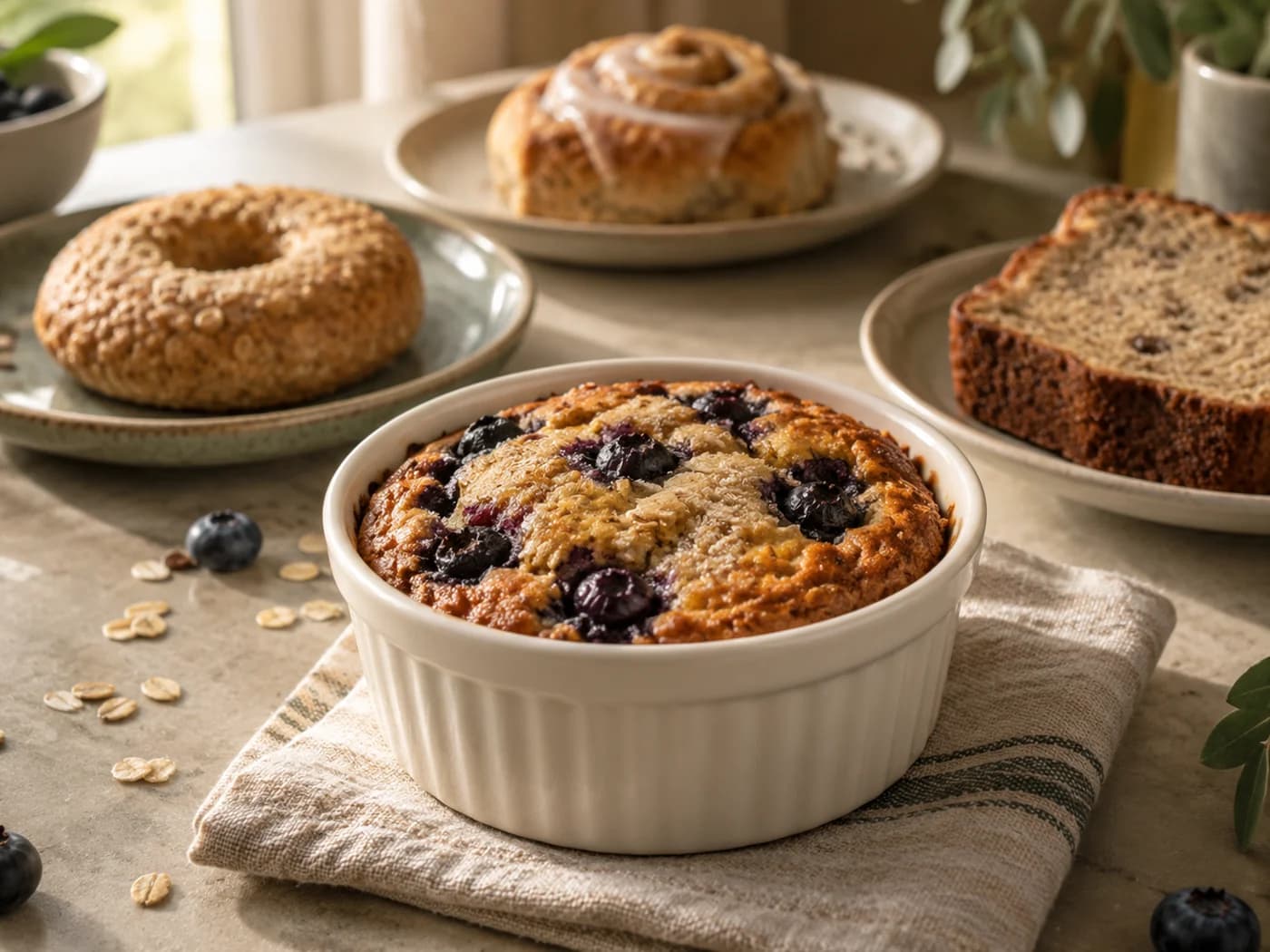
Banana bread offers a sliceable loaf, while donuts give small baked rings and cinnamon rolls add a measured filling and glaze. Cookies provide individual bites with oats, peanut butter and chocolate; cheesecake is a different dessert built around dairy and a biscuit base. These foods have different portion sizes, so compare complete servings rather than lining up protein numbers alone. A breakfast ramekin and a cookie are not equal amounts of food. The most useful next recipe is one that fits your appetite, cookware and available preparation time.
Build a comfortable rotation
A weekly routine does not need every breakfast to contain oats and powder. French toast, bagels, ordinary yogurt bowls or other suitable meals can bring different textures into the same week. The recipe hub makes the individual guides easy to find, with each page explaining its own cooking method and nutrition assumptions. Choose a few recipes you can repeat without turning each morning into a project. Keep space for other foods you enjoy and use the detailed guides when you want to bake something specific, rather than feeling that one recipe must cover every meal.