
Browse the 15 recipe sections
One reference serving: one eighth of the completely cooled granola batch, about 11.9g protein. Weigh your finished batch to find its portion weight. Yogurt and fruit are additional; baking and cooling times are estimates. See the breakdown.
Recipe Overview
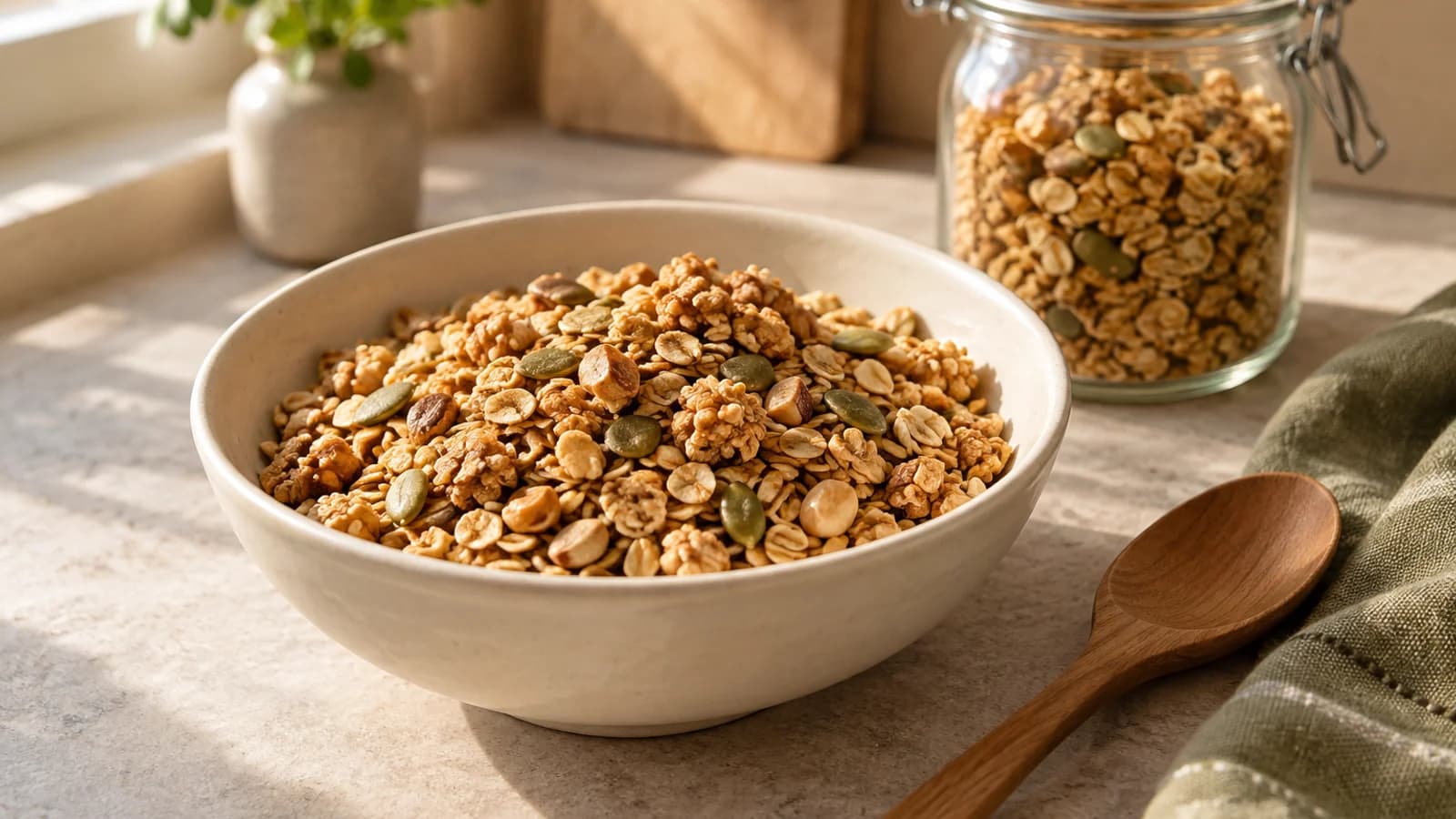
A little crunch makes breakfast feel finished
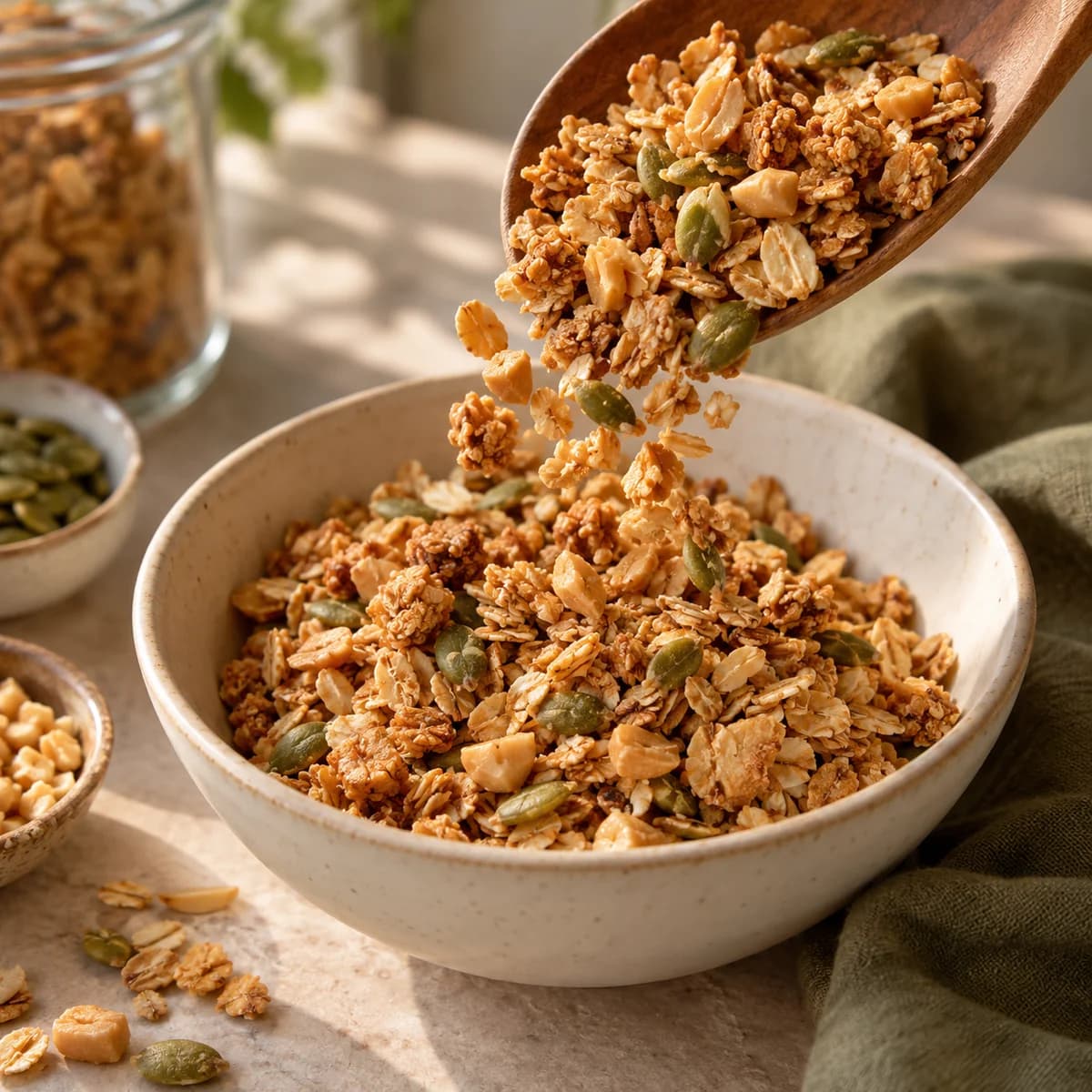
A spoonful of granola brings something a bowl of yogurt cannot provide on its own: toasted edges, a little salt and an uneven, satisfying crunch. This high protein granola recipe builds that texture with rolled oats, roughly chopped peanuts and green pumpkin seeds. Plain nonfat dry milk supplies additional protein and a lightly milky flavour. Honey, cinnamon and vanilla round it out without turning the tray into a sticky dessert. Expect loose flakes and small clusters, with plenty of nut and seed pieces in each spoonful.
What you are making
The reference batch makes eight portions. One portion means one eighth of the finished, completely cooled granola, approximately 272 calories and 11.9g protein. The finished weight depends on how much moisture leaves during baking, so there is no invented fixed gram weight or cup measure for that serving. Weigh your own cooled batch and divide by eight. A kitchen scale, large mixing bowl, small saucepan, spatula and a rimmed baking sheet about 46 × 33cm / 18 × 13 inches are the main equipment.
Time to bake, time to cool
Allow about 10 minutes to weigh and mix, roughly 35 minutes in a conventional oven, and around an hour to cool before packing. Baking may take approximately 30–45 minutes; the milk-rich coating can colour before the centre has dried. The estimated total is 105 minutes, including cooling, rather than a promise that breakfast is ready in ten. Plan the tray while you are already home doing something else, keeping a timer nearby. Extra batches need separate baking rounds and their own cooling space.
A clear starting point
This exact combination has not been physically kitchen-tested. It is a proposed home recipe informed by established granola methods, with nutrition calculated from weighed ingredients. The photographs illustrate the intended ingredients and texture; they do not document a trial bake. Follow the appearance and cooled-texture checks alongside the time estimates, and make the single reference batch before multiplying it. There is no whey supplement in the ingredient list, but there is milk powder, so the granola is neither dairy-free nor a recipe without any powder.
Why You’ll Love This Recipe
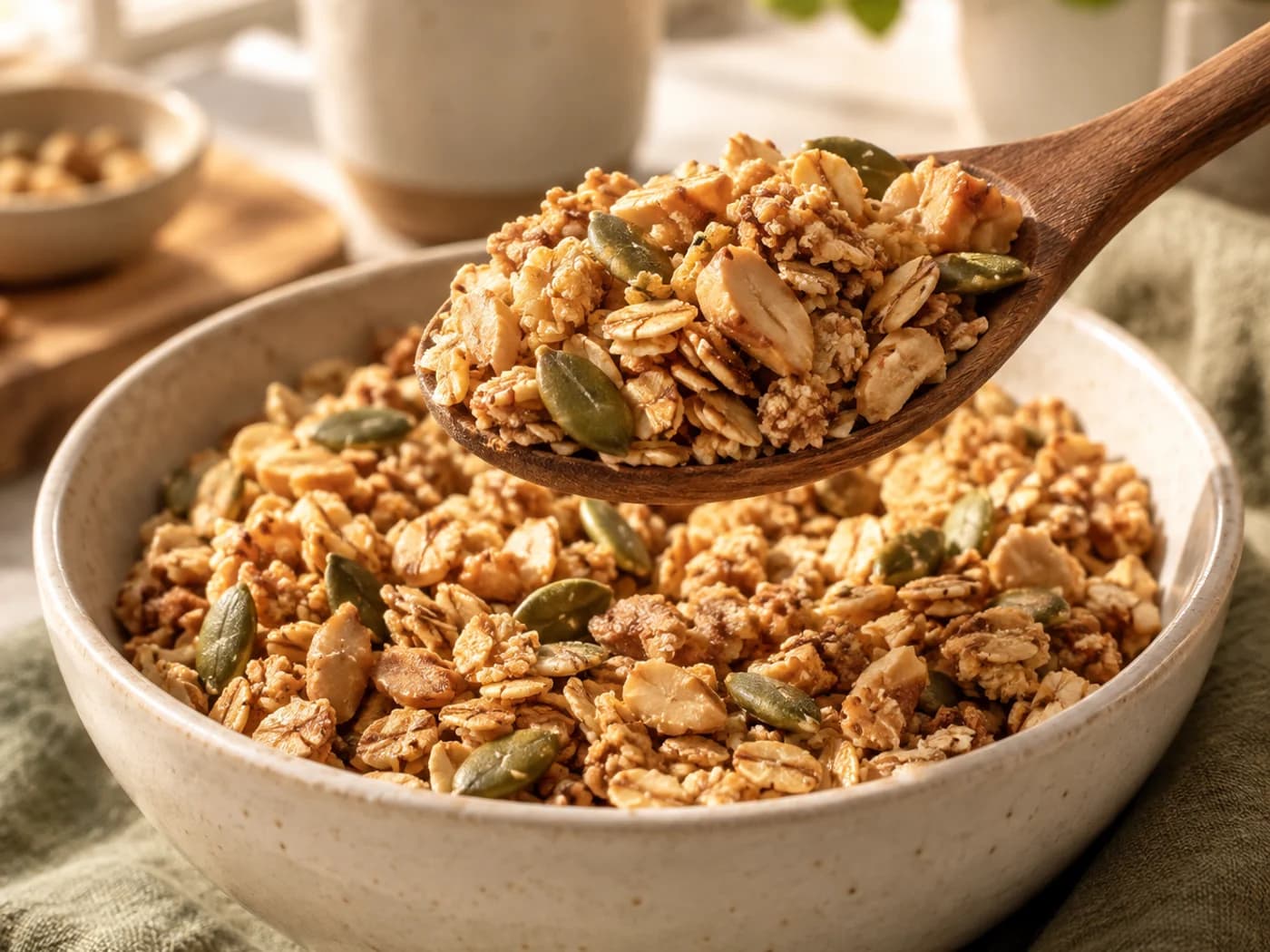
The flavour has somewhere to go
Peanuts bring a rounded roasted flavour, while pumpkin seeds add a more earthy bite. Cinnamon sits in the background rather than overwhelming the bowl. A small pinch of salt gives the honey more definition, which matters when a recipe is meant to be eaten with plain yogurt. You can taste the toasted ingredients instead of relying on a thick sugary coating. A particularly strong honey will be noticeable; choose one you already enjoy rather than buying an expensive jar solely for baking.
Protein comes from several ingredients
The dry milk, oats, peanuts and pumpkin seeds all contribute to the batch total. That makes the recipe useful when you want a crunchy breakfast component with some protein of its own. It also keeps the headline grounded: the granola alone supplies about 12g per reference portion. A larger breakfast can come from pairing it with a measured protein-rich food, without pretending that a few decorative crumbs carry the nutrition of a full bowl. You can choose the size that suits your appetite that morning.
Ordinary tools do the job
There is no blender to wash, dough to knead or egg mixture to cook separately. A spoon can work the coating through the oats, and parchment helps collect the little pieces when the tray is cool. The useful bit of preparation is weighing everything before warming the honey. Once the sticky mixture reaches the bowl, you can concentrate on coating it evenly rather than trying to measure vanilla with one hand. A spatula with a flexible edge is particularly helpful for scraping the saucepan clean.
It gives plain breakfasts a second texture
Thick yogurt, sliced fruit and a handful of crunchy oats feel different from another smooth smoothie. You can pack the granola separately and add it when you sit down, which makes a desk breakfast more pleasant. On a day when you want something smaller, half a reference portion works as a topping. On a hungrier day, keep the full portion and add yogurt. The recipe is flexible at the table, even though the weighed baking formula stays specific enough to follow.
Nutrition at a Glance
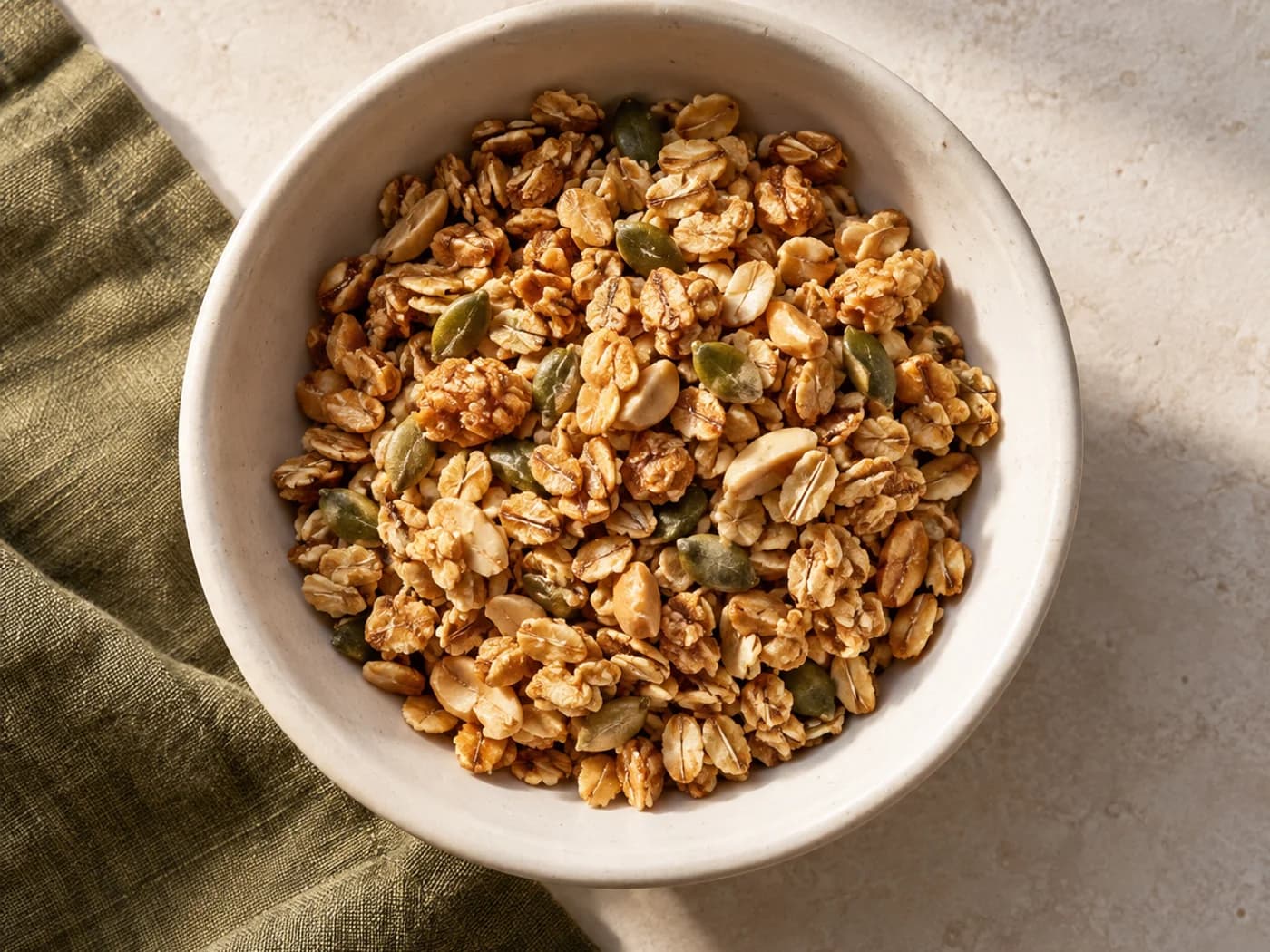
- Calories
- 272kcal
- Protein
- 12g
- Carbs
- 28g
- Fat
- 14g
Calories: approximately 272
The oats, peanuts, pumpkin seeds, milk powder, honey, oil, cinnamon, vanilla and salt are all counted. Water adds weight before baking but no calories. This is a concentrated dry food, so a small-looking bowl can carry more energy than its volume suggests. The calorie figure describes the reference fraction of the batch, not every scoop from any container. Adding milk, yogurt, fruit or a second drizzle of honey changes the meal total and should be treated as a separate addition.
Protein: approximately 12g
The unrounded estimate is 11.9g per portion. That is useful protein in a crunchy component, but it is not the 25–30g some people expect from a complete breakfast. Adding 170g plain nonfat Greek yogurt brings this particular calculated combination to about 29.2g protein. That second number belongs to the yogurt-and-granola bowl. Your yogurt label may differ from the generic value used here, especially if you choose a flavoured, plant-based or lower-protein style.
Carbs: approximately 28g
Rolled oats, milk powder and honey account for much of the carbohydrate. The estimated 12.2g total sugars include both honey sugars and the lactose naturally present in milk powder. Total sugars and added sugars are different measures; a separate added-sugars value has not been calculated for this article. The recipe is not sugar-free, low-carbohydrate or keto. If you enjoy it with berries or banana, those foods add carbohydrate too, which may be entirely appropriate for your breakfast.
Fat: approximately 14g
Most of the fat comes from the peanuts, pumpkin seeds and measured oil. The estimated saturated fat is about 2.0g per portion. Nuts and seeds bring flavour and texture along with their energy, so removing them changes more than a single number. The batch also provides approximately 3.7g fibre and 106mg sodium per reference portion. These are generic recipe estimates, not laboratory measurements or a substitute for the actual labels on your ingredients. Small rounded numbers will not always add up perfectly.
Ingredients
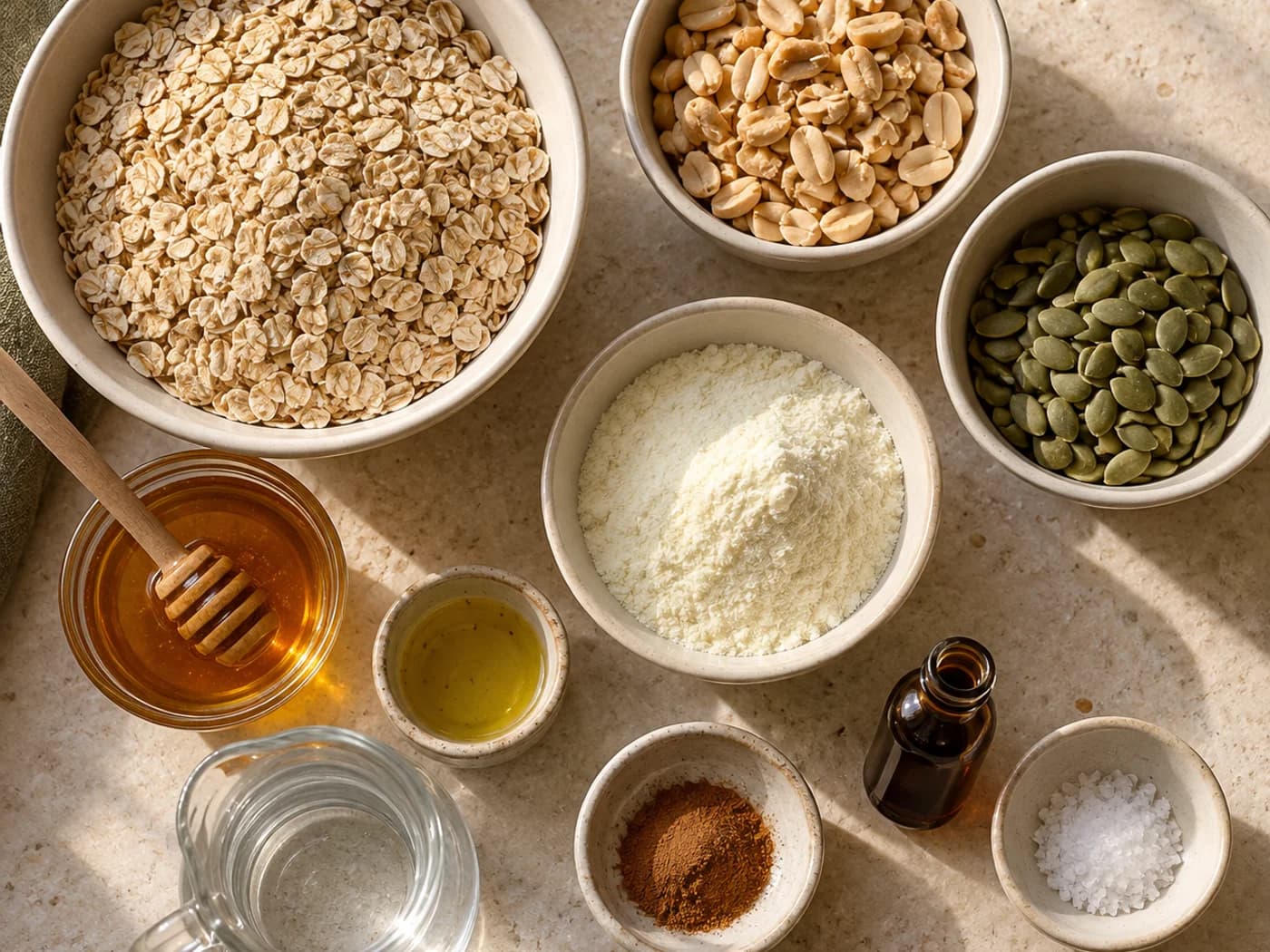
Start with oats that keep their shape
Use 160g plain old-fashioned rolled oats. Their broad flakes give the granola a recognisable bite and help carry the coating. Steel-cut oats are hard little pieces with a different cooking requirement, and instant sweetened porridge packets include ingredients this formula does not count. Quick oats are thinner and may produce a more crumbly result. If gluten is a concern, choose oats specifically labelled for that need and check every other package; ordinary oats are not automatically suitable because the grain itself is not wheat.
Peanuts and pumpkin seeds do different jobs
Weigh 80g raw unsalted peanuts after removing any shells, then roughly chop them. A few larger pieces are fine; a bowl of peanut dust is less useful because tiny fragments colour quickly. Use 80g raw hulled pumpkin seeds, also called pepitas. They are the flat green kernels, not the pale whole seeds with hard white shells. The nutrition calculation uses those edible kernels. Buying salted or pre-roasted versions changes both the label values and how soon the pieces taste toasted in the oven.
Choose plain milk powder
The 80g nonfat dry milk powder is a substantial ingredient, not a dusting on top. Look for plain skimmed milk powder with milk as the ingredient. Coffee whitener, sweetened milk drink powder, malted milk and whey supplement are different products. Powder density varies, so a cup measure copied from another recipe may be far off. Break up obvious lumps before combining it with the oats. The milk contributes protein and lactose, and the coating can pick up colour quickly once it begins to toast.
The coating and small ingredients
Measure 60g honey, 20g canola oil and 50g water for the coating. Add 3g ground cinnamon, 4g vanilla extract and 1g fine salt. Use a scale that can read small quantities reliably; if yours struggles below five grams, a small precision scale is helpful. Vanilla syrup is not the same as extract. Keep a flexible spatula ready so the measured honey and oil reach the granola rather than remaining in the saucepan. There are no dried fruits, chocolate chips or extra oils in the reference calculation.
Get the tray ready first
A light-coloured rimmed metal sheet, approximately 46 × 33cm / 18 × 13 inches, provides room to spread the mixture. Line it with parchment suitable for the oven temperature and keep the paper within the tray edges. A small deep roasting dish concentrates the mixture and makes drying less predictable. Have a heatproof landing spot and cooling rack ready before starting. These practical choices matter more than a decorative bowl: the recipe depends on exposing the mixture evenly and letting the finished tray cool without being hurried into a jar.
Your ingredient checklist
- Old-fashioned rolled oatsPlain dry rolled oats, not steel-cut oats or sweetened cereal160g
- Raw unsalted peanutsShelled edible weight; roughly chop80g
- Raw hulled pumpkin seedsGreen pepitas, not whole seeds in white shells80g
- Nonfat dry milk powderPlain skimmed milk powder; not whey or coffee creamer80g
- HoneyAll the sweetener for the reference batch60g
- Canola oilNeutral oil; all measured oil is counted20g
- WaterFor the coating; no calories or protein50g
- Ground cinnamonPlain ground spice3g
- Vanilla extractPlain extract, not vanilla syrup4g
- Fine saltFor the whole eight-portion batch1g
Contains milk and peanuts. Check all labels and handling for your dietary needs; gluten-free suitability requires appropriate oats and other ingredients. Uses plain nonfat dry milk, not whey supplement. Honey means the reference is not vegan.
Ingredient Substitutions
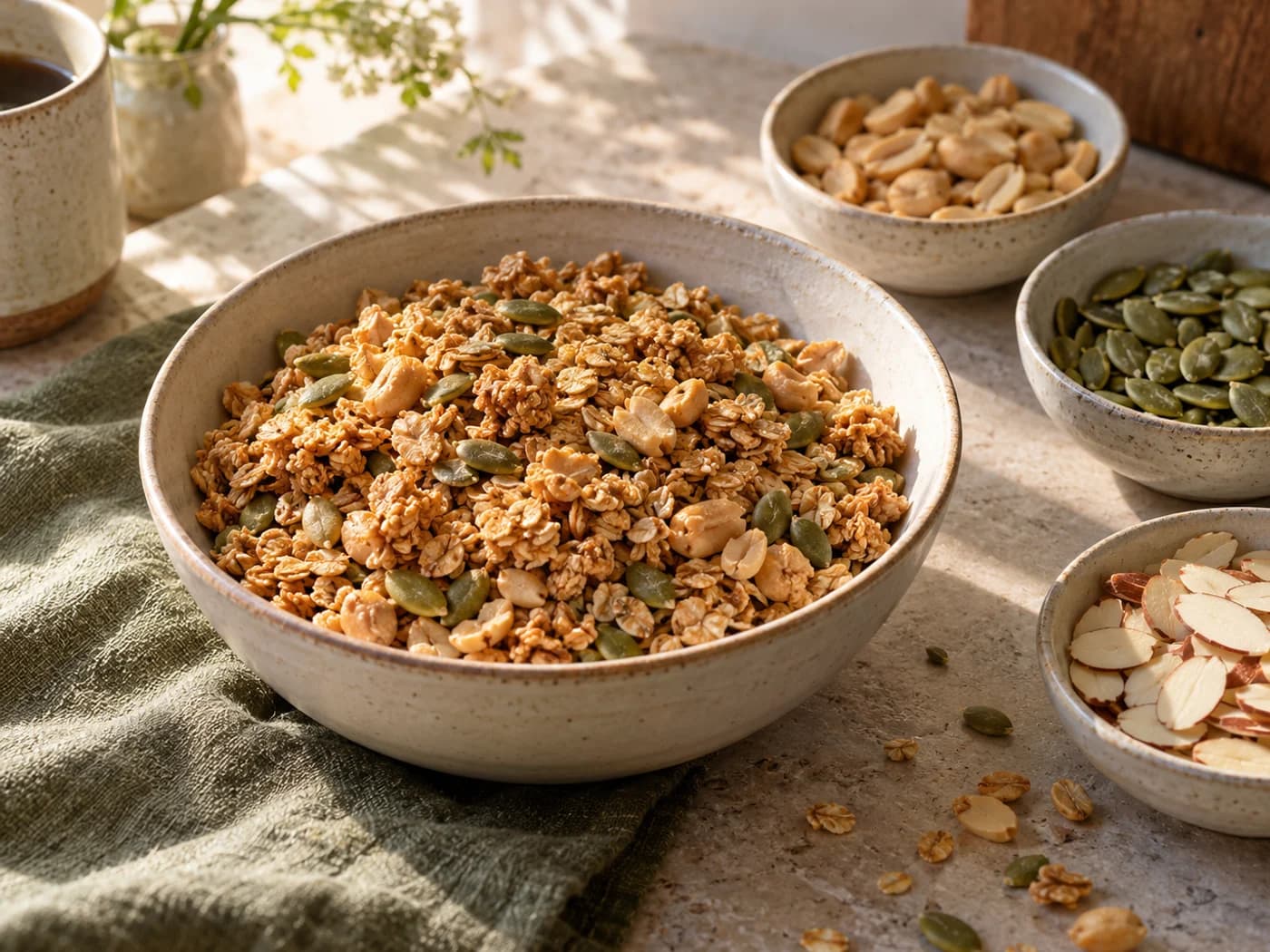
Change one thing at a time
Granola invites experimentation, but changing the oats, milk powder, sweetener and oil together leaves you with a new recipe. Start with the reference batch to learn the intended coating and tray depth. Then choose a single ingredient change, write down the weight and use the new package label to update nutrition. If the result is too soft or browns early, you will have a useful clue about what changed. The listed alternatives are suggestions to evaluate, not physically tested interchangeable versions.
Other nuts or seeds
Unsalted almonds can replace peanuts by weight as a flavour experiment. Chop them to a similarly manageable size and expect a different bite. Sunflower kernels may be useful when you want a different seed, but they have their own flavour and fat content. Replacing peanuts does not automatically make the batch safe for a peanut allergy: ingredients, equipment and cross-contact all matter. For a medically required exclusion, use products and a recipe designed for that need rather than relying on a casual swap in a mixed kitchen.
Milk powder is not whey powder
Whey, casein, plant protein and skimmed milk powder absorb moisture and brown differently. A scoop-for-scoop exchange also changes the lactose, sweetener and protein totals. Do not assume the 80g milk powder can be replaced with 80g flavoured whey while keeping the same water and oven schedule. If your aim is a supplement-based granola, start with a recipe developed for that powder. A dairy-free batch likewise needs a new coating formula; replacing the serving yogurt leaves the milk inside the granola unchanged.
Honey, oil and flavour changes
Maple syrup is a possible honey alternative, but it is a thinner sweetener with different water content. Keep the proposed swap by weight, observe the drying behaviour and recalculate the sugar and calorie contribution. A neutral liquid oil can take the place of canola if you enjoy its flavour; coconut oil may set differently when cool. Ground ginger or cardamom can replace part of the cinnamon in a small flavour trial. Avoid pouring in extra vanilla or syrup merely to loosen the bowl; additional liquid changes the drying task.
Gluten-free and vegan intentions
For gluten-free preparation, suitable labelled rolled oats are a starting point, alongside checks on the milk powder, spices and handling. The base formula contains milk and peanuts. It has no egg ingredient, but that does not establish an allergen-free claim for your actual products. A vegan adaptation would need to replace both milk powder and honey and rebuild the nutrition estimate. The simplest way to personalise the reference without changing the bake is to choose a different serving accompaniment and keep that addition separate.
Use weighed ingredients and recheck the label values after a change.
| Reference | Possible change | What changes |
|---|---|---|
| Raw peanuts | Unsalted almonds | Flavour, fat, protein and browning |
| Raw green pepitas | Sunflower kernels | Texture, flavour and nutrition |
| Nonfat dry milk | Whey or plant supplement | Needs a separately developed coating |
| Honey | Maple syrup | Water content and sweetness |
| Canola oil | Another neutral liquid oil | Flavour and label values |
| Rolled oats | Steel-cut oats | Not a direct substitute |
How to Make It
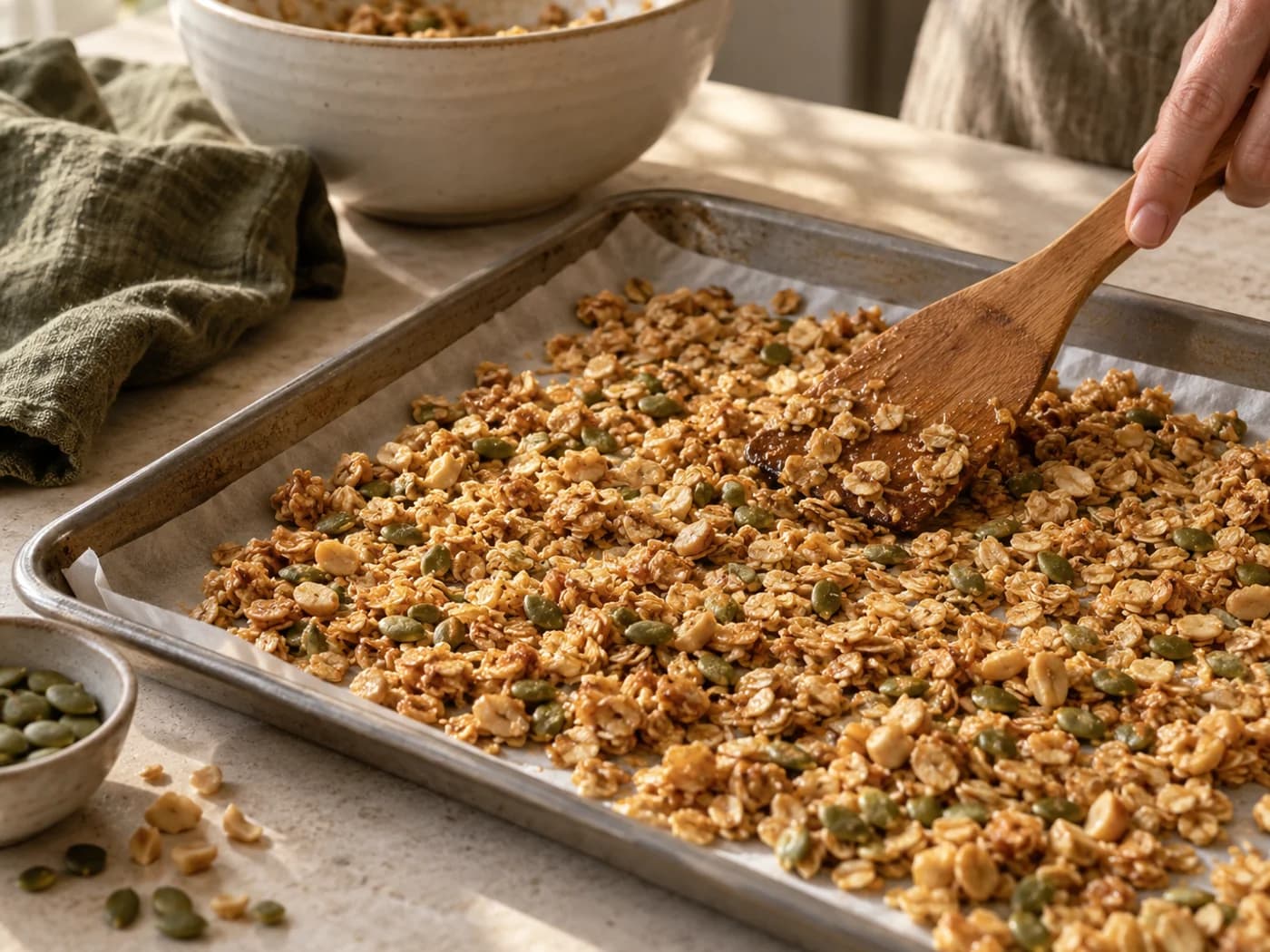
1. Set up the oven and dry bowl
Preheat a conventional oven to 300°F / 150°C and line the specified rimmed sheet with parchment. Weigh the rolled oats, roughly chopped peanuts and hulled pumpkin seeds into a large bowl. Add the milk powder, cinnamon and salt, then stir until the white powder is distributed instead of sitting in a layer at the bottom. Break up any dry milk lumps with the back of a spoon. Leave enough room in the bowl to fold the mixture without tossing small pieces onto the counter.
2. Make a fluid coating
Put the honey, canola oil and water in a small saucepan. Warm gently just until the honey loosens and the mixture can be stirred easily; it does not need to boil or become a caramel. Take the pan off the heat before adding the vanilla. Give the liquid another stir, then pour it over the dry ingredients. Scrape the pan well. The oil may not remain perfectly blended with the water, so stir immediately before pouring rather than leaving separated liquid standing while you find a spoon.
3. Coat, then spread
Fold patiently from the bottom of the bowl, rotating it as needed. Look for dry powder pockets hiding beneath the oats or inside a lump of coating. Press those apart with the spatula and bring them back through the mixture. Transfer everything to the tray and spread it across the usable surface in a thin, reasonably even layer. Do not mound the middle or pack the mixture into a deep slab. There should be enough space to move the granola during baking without spilling it over the rim.
4. Bake with checkpoints
Use about 35 minutes as a planning estimate, allowing roughly 30–45 minutes depending on the tray and oven. Stir at about 15 minutes, bringing the outer pieces towards the centre and redistributing the mixture evenly. Start inspecting closely around 20 minutes because the milk coating can colour early. Stir again around 30 minutes if it is still baking. Look for a dry-looking surface and light golden colour, with no wet pockets. A dark brown coating is not the goal; remove a tray that is scorching rather than chasing a timer.
5. Let cooling answer the texture question
Set the tray on a heatproof rack and let it cool completely, roughly 45–60 minutes. Warm granola can feel softer than the finished result, so assess a small sample only after it has cooled. Break up the cooled mixture gently into loose flakes and small clusters. If a cooled sample is still damp or tacky, it is not ready to pack: spread it out again and try short additional oven intervals with close checks. Extra time cannot undo burnt flavour, and elapsed minutes alone cannot guarantee dryness.
6. Divide the actual finished batch
Weigh the cooled granola in a clean bowl after taring the scale, then divide that weight by eight for a reference portion. Mix the batch gently before portioning so the seed-heavy pieces are not all left at the bottom. Add yogurt or fruit only when serving. For a larger card setting, use one reference batch per tray and bake separate rounds; do not triple the depth on a single sheet. Pack completely cooled granola in clean airtight containers and follow the chilled storage guidance below.
Tips for the Best Results
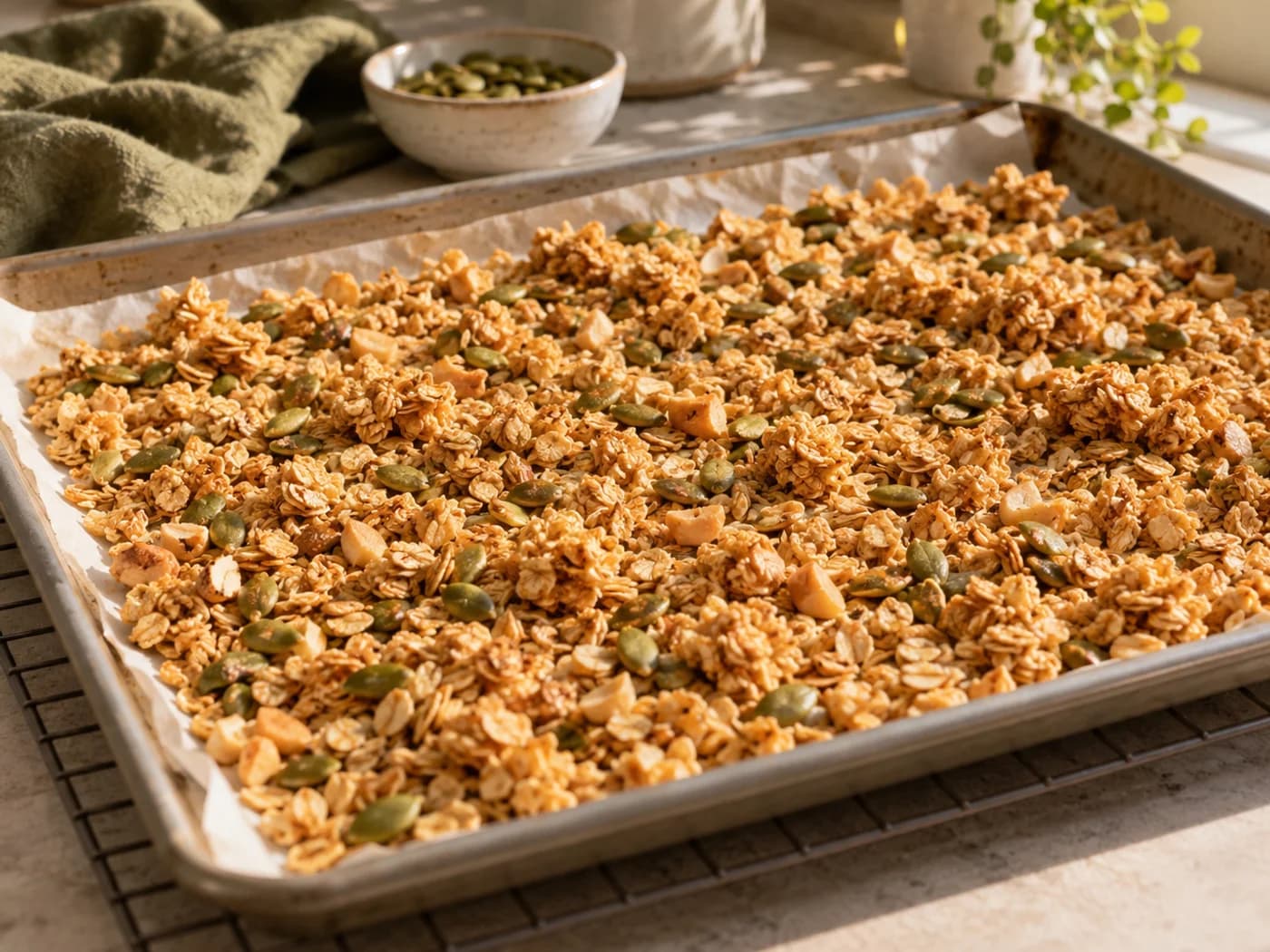
Read the colour of the coating
Milk powder changes the appearance of the tray. Tiny coated oat edges may turn golden while a thicker patch is still moist underneath, so check the whole sheet rather than the darkest corner. Stirring should move both the fine crumbs and larger peanut pieces. If your tray has a noticeably hotter end, rotate it when you stir. Keep the oven door open only as long as needed, then reset the timer. A strong toasted smell is a reason to look, not proof that the entire batch has reached the same texture.
Avoid turning a small problem into a bigger one
If the mixture seems stubborn in the bowl, first scrape the bottom and break apart the milk powder rather than adding an unmeasured splash of oil. Oil may make the mixture look glossier without solving uneven hydration. If the oven is running hot, lowering the heat and checking frequently may protect a pale batch, but it will not rescue blackened crumbs. Remove obviously scorched pieces and assess the flavour of the remainder; do not hide bitterness under more honey and continue calling it the reference recipe.
Small clusters are a reasonable expectation
This is a stirred granola with modest binder, not a tray of large crunchy bars. Some loose oats are part of the intended result. Heavy pressing and skipping every stir may leave unevenly dried areas just to preserve a few big chunks. If large bakery-style clusters are your priority, choose a separate cluster recipe rather than forcing this one into that shape. A loose texture actually works well when you want an even sprinkle across yogurt instead of a single hard piece in each spoonful.
Protect the crunch after baking
The cooling tray needs open air around it, followed by a dry airtight container once the mixture is completely cool. A warm lid can collect moisture, and a wet serving spoon introduces another source of dampness. Keep yogurt and fruit in their own containers. For a packed breakfast, a small dry tub beside the yogurt is worth the extra item: the granola can be scattered on at the last moment. Use a spoon you can comfortably eat from; big decorative clusters are less helpful if breakfast is happening at a desk.
Keep a useful first-batch note
Write down the actual bake time, tray size, oven setting and cooled batch weight. A simple note such as “pale at 30, crisp after cooling at 38” is more useful for your next tray than trying to remember how the photograph looked. If you changed an ingredient, record its brand and weight too. Repeat the successful single batch before making a larger quantity. That approach gives you a recipe suited to your equipment without suggesting that every oven or milk powder must behave identically.
High-Protein / Lower-Calorie Variations
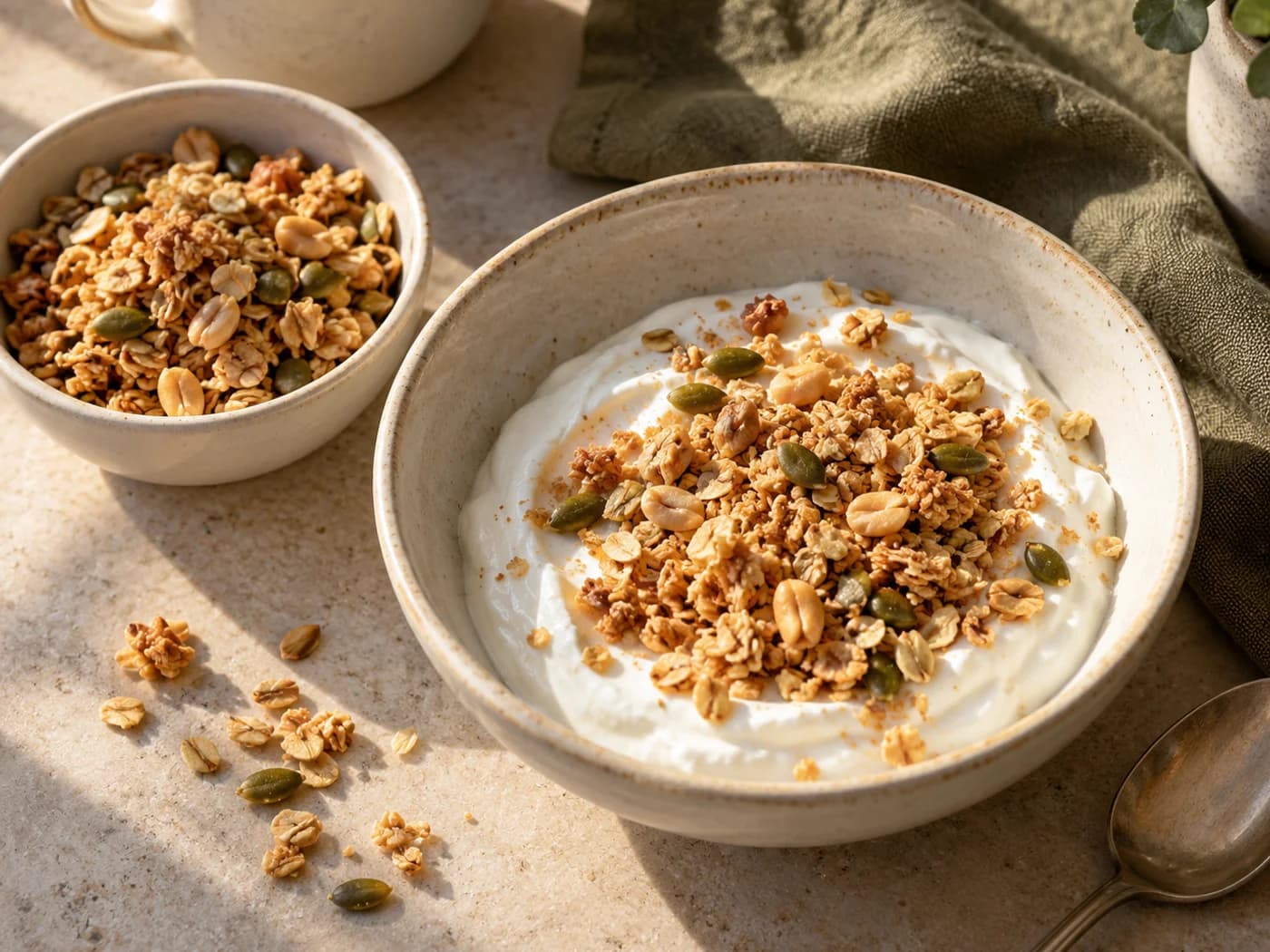
A higher-protein breakfast bowl
Keep one reference portion of granola and serve it with 170g plain nonfat Greek yogurt. Using the stated generic yogurt value, the combination is approximately 372 calories and 29.2g protein before fruit or additional toppings. The yogurt supplies the extra protein; the dry granola has not somehow become more protein-dense in the jar. This is a straightforward way to build a more substantial breakfast while keeping the crunchy part enjoyable. Check the yogurt tub, since products with similar names can differ considerably in protein.
A smaller topping portion
Half a reference portion is one sixteenth of the cooled batch, approximately 136 calories and 5.9g protein. It can be enough when the purpose is to add crunch to a bowl that already has other ingredients. Weigh half of your calculated reference serving rather than trying to remove all the peanuts from a scoop. The smaller portion reduces every nutrient proportionally, including protein and fibre. There is nothing wrong with choosing that size; just record the smaller amount if you are comparing meals.
A modest change to the peanut balance
A calculated version replacing 40g of the batch peanuts with 40g additional rolled oats would contain approximately 262 calories and 11.3g protein per eighth. The new amounts would be 200g oats and 40g peanuts, with the other ingredient weights unchanged. That saves only about nine calories per reference portion, while lowering fat and slightly lowering protein. It is a flavour and texture experiment, not a dramatic calorie reduction. Its baking performance has not been physically checked, so start small and observe the altered coating distribution.
What not to promise from a swap
Replacing honey with water, removing all the oil or doubling the milk powder would change how the mixture coats and dries. Those are recipe-development tasks, not reliable shortcuts with a predictable identical result. A practical lower-calorie meal may simply use a smaller granola portion alongside a food you already enjoy. Likewise, a high-protein serving can come from yogurt without loading more powder into the baking bowl. The comparison below uses measured portions and explicit ingredients so the nutrition differences can be understood without guessing.
These are calculated comparisons. Altered baking formulas have not been physically tested.
| Serving or change | Calories, approximately | Protein, approximately |
|---|---|---|
| Reference portion, batch ÷ 8 | 272 kcal | 11.9g |
| Half portion, batch ÷ 16 | 136 kcal | 5.9g |
| Reference portion + 170g plain nonfat Greek yogurt | 372 kcal | 29.2g |
| Replace 40g batch peanuts with 40g oats; one eighth | 262 kcal | 11.3g |
Serving Suggestions
Yogurt first, crunch last
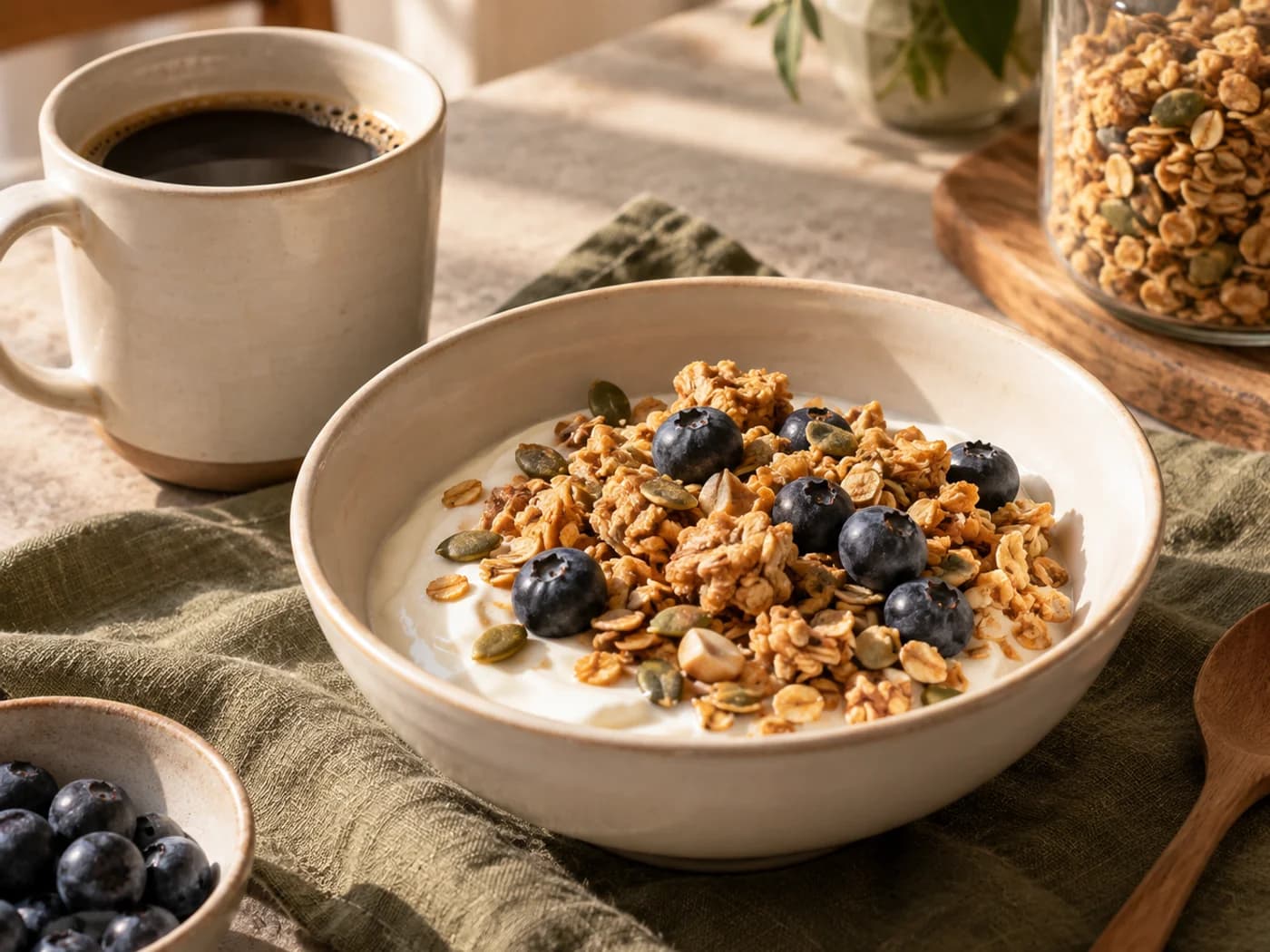
Spoon thick plain yogurt into a bowl, add any fruit you want, then scatter granola over the surface just before eating. Leaving a small patch of yogurt uncovered gives you somewhere to collect a spoonful without sending oats over the edge. If you like the granola dry and crisp, avoid stirring the entire bowl immediately. For a slower breakfast, keep part of the portion in a little dish and add it halfway through. That preserves a second round of crunch without requiring another serving.
Milk makes a different breakfast
You can eat the granola as a cereal with milk, but the texture will soften as it sits. Pour a little at a time if you prefer more bite, and use a bowl with enough depth to mix comfortably. Dairy milk and plant drinks have different protein values; the word “milk” on its own is not enough to estimate the meal. Measure the amount you actually pour when nutrition matters to you. The milk powder baked into this granola still counts as dairy, regardless of the drink you serve alongside it.
Fruit and simple flavour pairings
Blueberries, strawberries or sliced banana can add freshness to a yogurt bowl. A few slices of ripe pear work well with cinnamon too. There is already honey in the granola, so taste the assembled breakfast before adding another drizzle. Chocolate chips, coconut flakes and dried fruit are optional additions after cooling, each with its own portion and label. They are not hidden ingredients in the base recipe. Keeping the jar plain lets different people at the table choose their own topping without changing the whole batch.
Snacks and portions that make sense
A small dry tub is convenient beside a yogurt pot, though loose granola is less tidy to eat while walking than a sandwich. Sit down with a spoon when possible, or use the smaller topping portion rather than pouring straight from a large jar. For a snack plate, fruit and a protein-rich accompaniment can be served separately. The attractive photograph is a serving idea, not a prescription to copy its apparent bowl volume. Your calculated portion comes from the actual cooled batch and the amount you choose to eat.
Meal Prep & Storage
Begin with a small batch
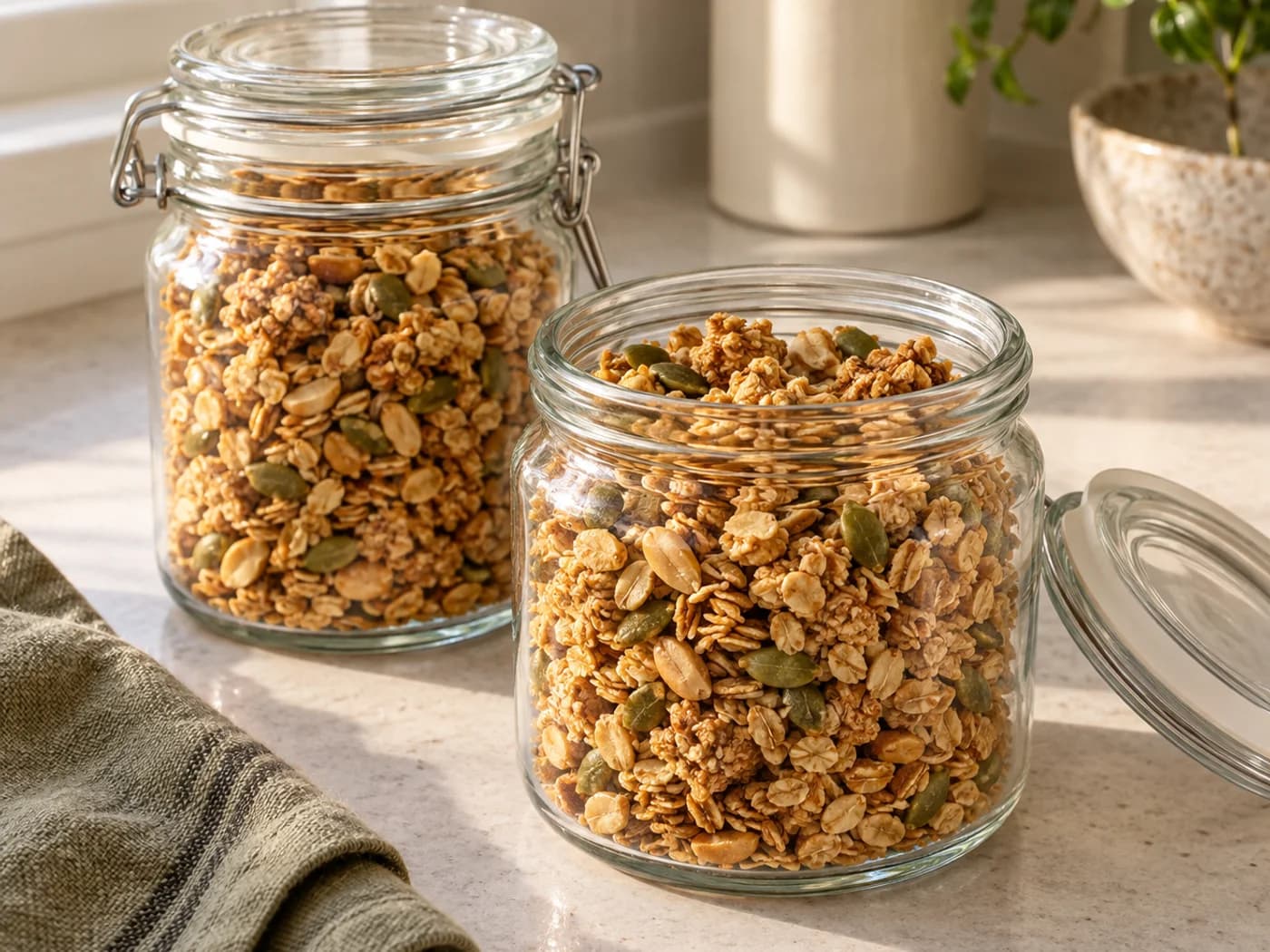
This exact formula has no measured shelf-life study. For a cautious home plan, keep fully cooled granola airtight in the refrigerator at 40°F / 4°C or below and use within 3–4 days; freeze the rest rather than assigning it a long pantry life. That is a conservative handling plan, not a guarantee that any damp batch is safe for four days. Make sure the mixture has dried and cooled properly first. General granola recipes can have different storage advice because their ingredients and moisture levels are different.
Cool before closing the container
Spread the tray where it can cool without being splashed or covered. Once completely cool, transfer it with clean dry utensils into clean airtight containers. Do not seal a warm batch and hope the lid will finish the job. If you see moisture collecting inside, reassess the cooling and dryness before storing it. Divide the batch into a few small containers rather than repeatedly opening a large jar. Keep the granola away from yogurt, cut fruit and damp lunch-box compartments until you are ready to eat.
Freeze the portions you will not use soon
Use freezer-suitable airtight packaging and portion the dry granola before freezing so you can take only what you need. About one month is a starting quality target for this untested formula, not a validated texture promise. Thaw a closed portion so humid room air is not immediately drawn into an open cold container. Once ready to serve, add it to your bowl and return remaining chilled portions promptly. Repeated warm-up and cooling cycles are less helpful than a few deliberately sized containers.
Keep breakfast components separate
Prepare yogurt and fruit according to their own labels and storage needs. Pack the dry granola in a separate compartment and combine at the table. A parfait assembled the evening before may still be enjoyable, but its topping will usually soften; that is a different eating experience from crisp granola. If any stored food develops mould, an unusual smell or signs of spoilage, discard it rather than trying to toast it back into use. Good smell alone also cannot prove a food is safe, so follow handling and time guidance.
Plan the week without overbaking
Eight reference portions can be more than one person needs over a few days. Freeze part of the first batch instead of leaving it on the counter while you work through it. For a household that eats granola differently, label the intended portion weight after weighing the cooled batch. One person may use half a portion for crunch and another a full portion with yogurt. The jar does not have to dictate an identical breakfast every morning, and a small fresh batch is easier to assess than several unfamiliar trays at once.
Full Nutrition Information
How the estimate is built
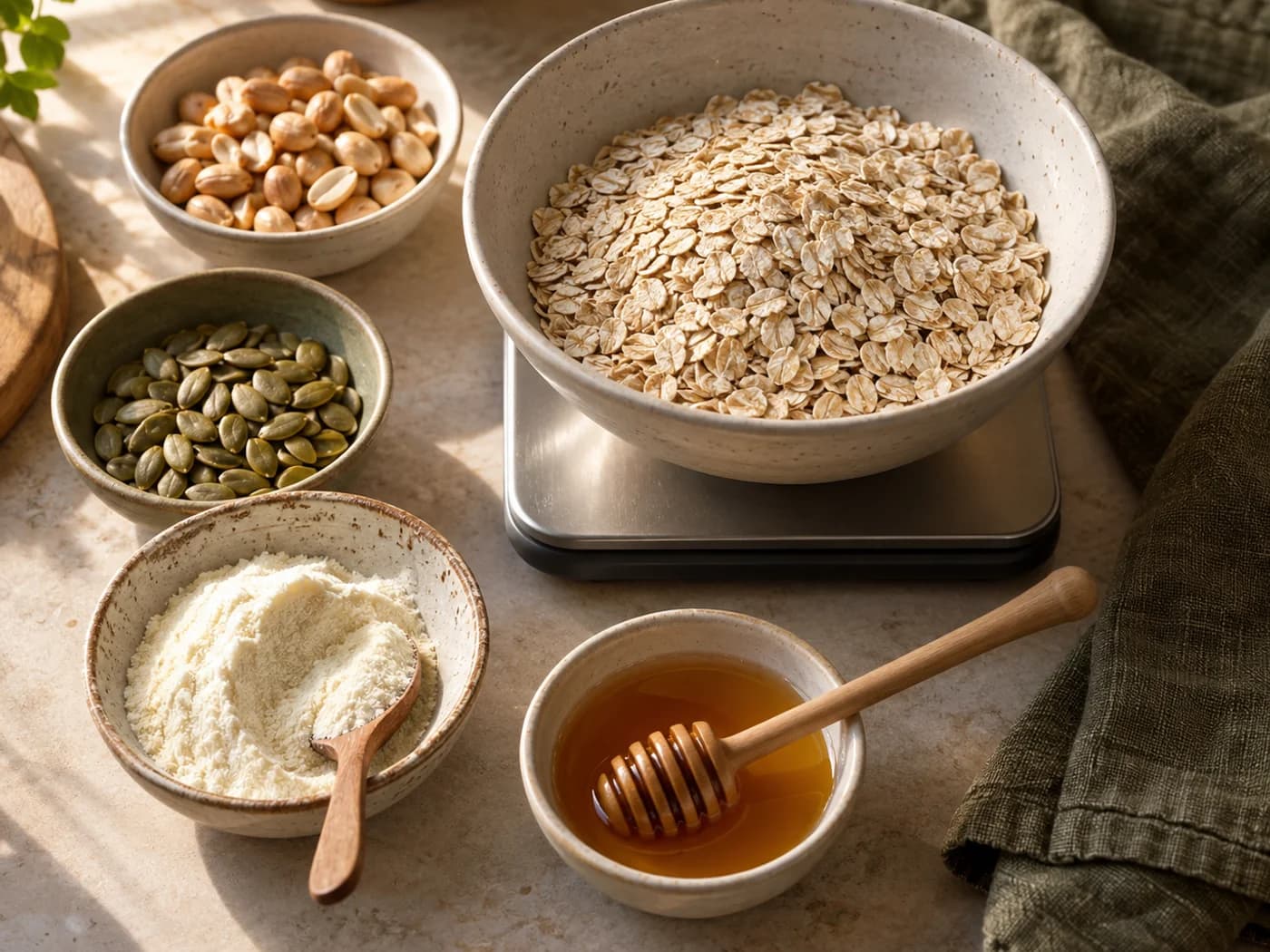
The calculation uses historical USDA Standard Reference release 28 generic food values. Each ingredient's per-100g values are multiplied by its weighed amount, then the batch total is divided by eight. Nine food entries supply all eight reported nutrient fields; water is explicitly counted as zero. Raw shelled peanuts and dried hulled pumpkin kernels are the specific nut and seed references. The table shows their individual contributions so you can see why both the energy and protein totals change when an ingredient is substituted.
What the total includes
The reference contains 160g oats, 80g peanuts, 80g pumpkin seeds, 80g nonfat dry milk, 60g honey, 20g canola oil, 50g water, 3g cinnamon, 4g vanilla and 1g salt. All the measured oil and honey are included, even if a little stays on the utensil in practice. Yogurt, fruit, milk poured over the bowl, chocolate and any extra sweetener are excluded. The approximate batch energy is 2,175 calories and its protein is 95.1g, shared across eight reference portions.
Finished weight changes concentration
Water evaporating does not create protein. It changes how much a given gram of the final granola represents. If your cooled batch happened to weigh 560g, one eighth would weigh 70g; that is an arithmetic example, not a predicted yield. If it weighed differently, your reference gram portion would change accordingly. Mix the cooled batch before dividing because seeds and fine pieces can settle unevenly. Do not apply the whole-portion estimate automatically to a 30g spoonful or an arbitrary half-cup measure.
Use the labels you actually have
The food calculator can help organise a changed ingredient list using the values on your packages. Milk powder protein, salted nut sodium and sweetened ingredient sugars can differ from the generic references. Enter the amount used in the complete batch and the number of equal portions you actually make. Keep serving additions separate when comparing the granola alone. The reference here is useful for understanding the formula, while your own labels give a closer estimate for the products in your cupboard.
Rounding and unreported nutrients
The main cards round calories and macronutrients to whole numbers; the detailed table retains a decimal for protein and other selected nutrients. Calculated calories may not exactly match a simple four-four-nine conversion because food databases and rounding conventions differ. Cholesterol, separate added sugars and a complete set of micronutrients are not calculated. A missing value is not a claim that the food contains none. The figures describe an estimated recipe portion and should not be read as a laboratory certificate, medical recommendation or a regulated nutrient-content assessment.
| Ingredient | Amount | Calories | Protein | Carbs | Fat |
|---|---|---|---|---|---|
| Old-fashioned rolled oats | 160g | 606 kcal | 21.0g | 108.3g | 10.4g |
| Raw unsalted peanuts | 80g | 454 kcal | 20.6g | 12.9g | 39.4g |
| Raw hulled pumpkin seeds | 80g | 447 kcal | 24.2g | 8.6g | 39.2g |
| Nonfat dry milk powder | 80g | 290 kcal | 28.9g | 41.6g | 0.6g |
| Honey | 60g | 182 kcal | 0.2g | 49.4g | 0.0g |
| Canola oil | 20g | 177 kcal | 0.0g | 0.0g | 20.0g |
| Water | 50g | 0 kcal | 0.0g | 0.0g | 0.0g |
| Ground cinnamon | 3g | 7 kcal | 0.1g | 2.4g | 0.0g |
| Vanilla extract | 4g | 12 kcal | 0.0g | 0.5g | 0.0g |
| Fine salt | 1g | 0 kcal | 0.0g | 0.0g | 0.0g |
| Whole batch | 8 equal granola portions | 2175 kcal | 95.1g | 223.7g | 109.7g |
| One reference serving | Batch ÷ 8 | 272 kcal | 11.9g | 28g | 14g |
| Dietary fiber | 3.7g |
|---|---|
| Total sugars | 12.2g |
| Saturated fat | 2.0g |
| Sodium | 106mg |
Estimated recipe nutrition, not a laboratory analysis. Includes all oats, peanuts, hulled pumpkin kernels, milk powder, honey, measured oil and seasonings; water is zero. Yogurt, fruit and other additions are separate. Uses historical generic USDA values; actual labels take priority. Cholesterol, separate added sugars and complete micronutrients are not calculated.
How This Fits Your Daily Protein Goal
Start with a target that fits you
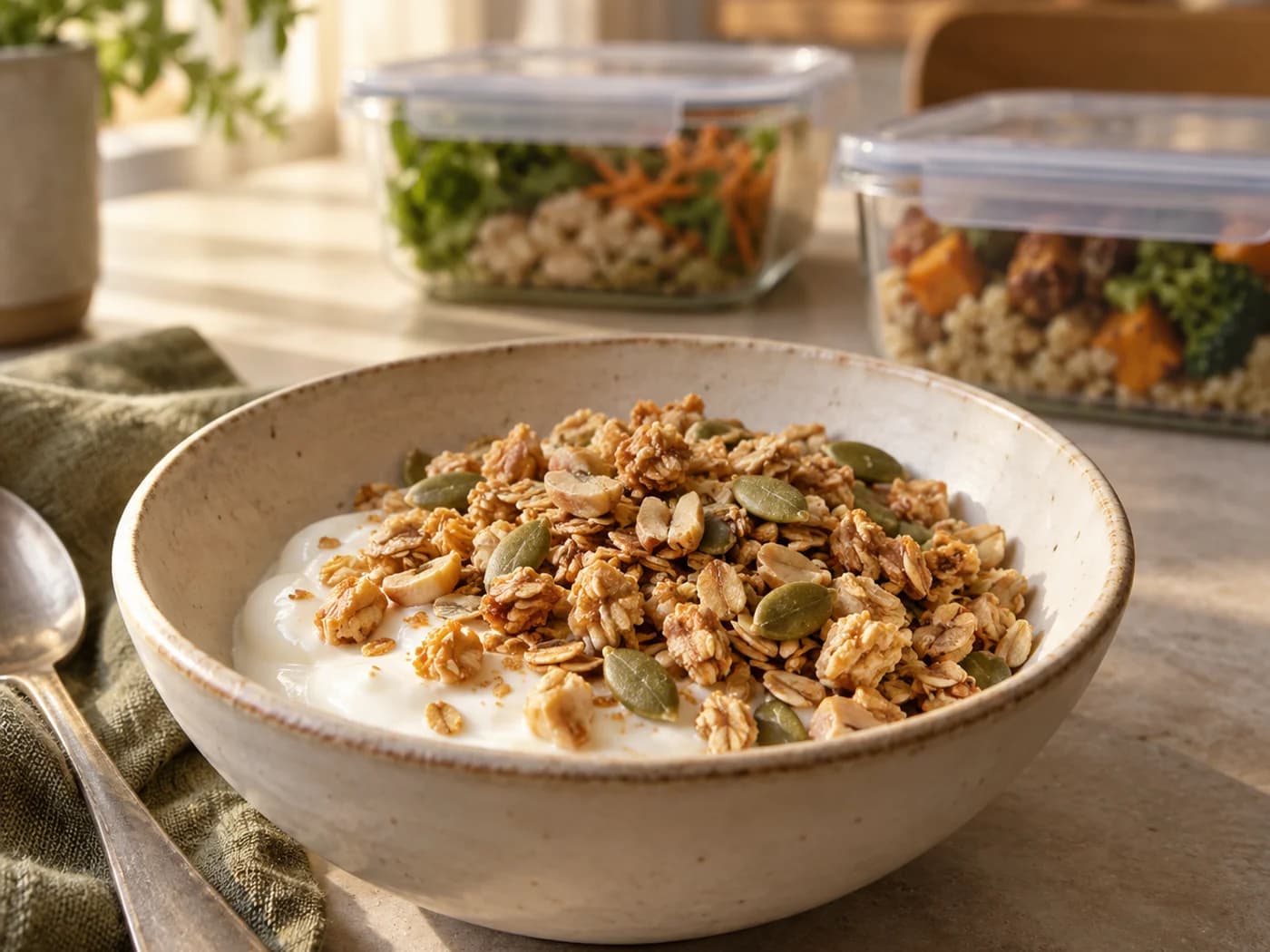
Use the protein calculator if you want an estimate based on your own details, then look at the meals you already enjoy. This granola contributes about 11.9g protein per reference portion, so it can support a breakfast without being responsible for the entire day. An individual target is not established by the recipe title. If you have a medical reason to restrict or adjust protein, use the advice of the qualified professional who understands your situation rather than increasing portions just because a food is described as high protein.
See the contribution in real numbers
For an illustrative 100g daily target, a reference granola portion accounts for roughly 12%; for 120g, about 10%; and for 150g, about 8%. Those targets are examples for arithmetic, not recommendations for every reader. The bowl with 170g plain nonfat Greek yogurt would contribute about 29g protein instead. You can decide whether that combination fits your appetite and the rest of your meals. Percentages are only useful when the portion and the target are both defined, so keep them visible when making comparisons.
Avoid asking granola to do every job
Trying to reach a large protein target by continually enlarging a dry granola portion also adds substantial calories and fat. That may not be the breakfast you want. A measured crunchy portion beside yogurt, a separate egg dish or another food you enjoy can be easier to eat than a huge bowl of cereal. There is no need to stack every protein ingredient into one recipe. Keep lunch, dinner and snacks in view, and use the granola for the texture and flavour it brings to the meal.
Make the plan easy to repeat
After the first batch cools, calculate its portion weight and keep that number with the container. A repeatable amount makes breakfast simpler without requiring you to weigh every individual pumpkin seed. If your appetite changes, choose half or a full reference portion and account for it honestly. If another yogurt or milk tastes better to you, use its label. A daily plan is more practical when it includes food you look forward to and realistic preparation, rather than a breakfast selected only because the largest number appears in its title.
Make it personal
Where does this breakfast fit in your day?
Estimate your daily protein target, then plan meals you enjoy.
Recipe Card
Bring the useful details to the counter
The card collects the complete weighed formula and the six main cooking steps in one place. Start at eight portions for the first batch. The sixteen- and twenty-four-portion settings multiply every ingredient and reset the checklist so a previously checked item does not carry into a new batch size. Protein and calories remain per reference portion; larger settings create more portions rather than a stronger serving. Use the checklist as you weigh, and choose Reset checklist whenever you want to start again at the same batch size.
Scale trays as well as ingredients
One reference batch belongs on one approximately 46 × 33cm / 18 × 13 inch rimmed sheet. Two or three batches need two or three separate tray rounds, with enough cooling space for each. A large bowl of mixture should not be piled onto the original tray at triple depth. The card's timing describes the single reference batch, so a larger setting increases total elapsed time. Assess each tray independently because a later round may dry or colour differently once the oven has been running longer.
Read the portion line before printing
One reference serving is one eighth of a cooled single batch. For a doubled batch mixed together after cooling, divide the total by sixteen; for a tripled batch, divide by twenty-four. If you keep the trays separate, divide each tray's finished granola by eight. The print button produces a compact recipe sheet using the currently selected ingredient amounts and instructions. Return to the reference setting if you want an eight-portion copy. Keep the cooling, dryness and storage notes with the recipe; they are part of the preparation, not optional decoration.
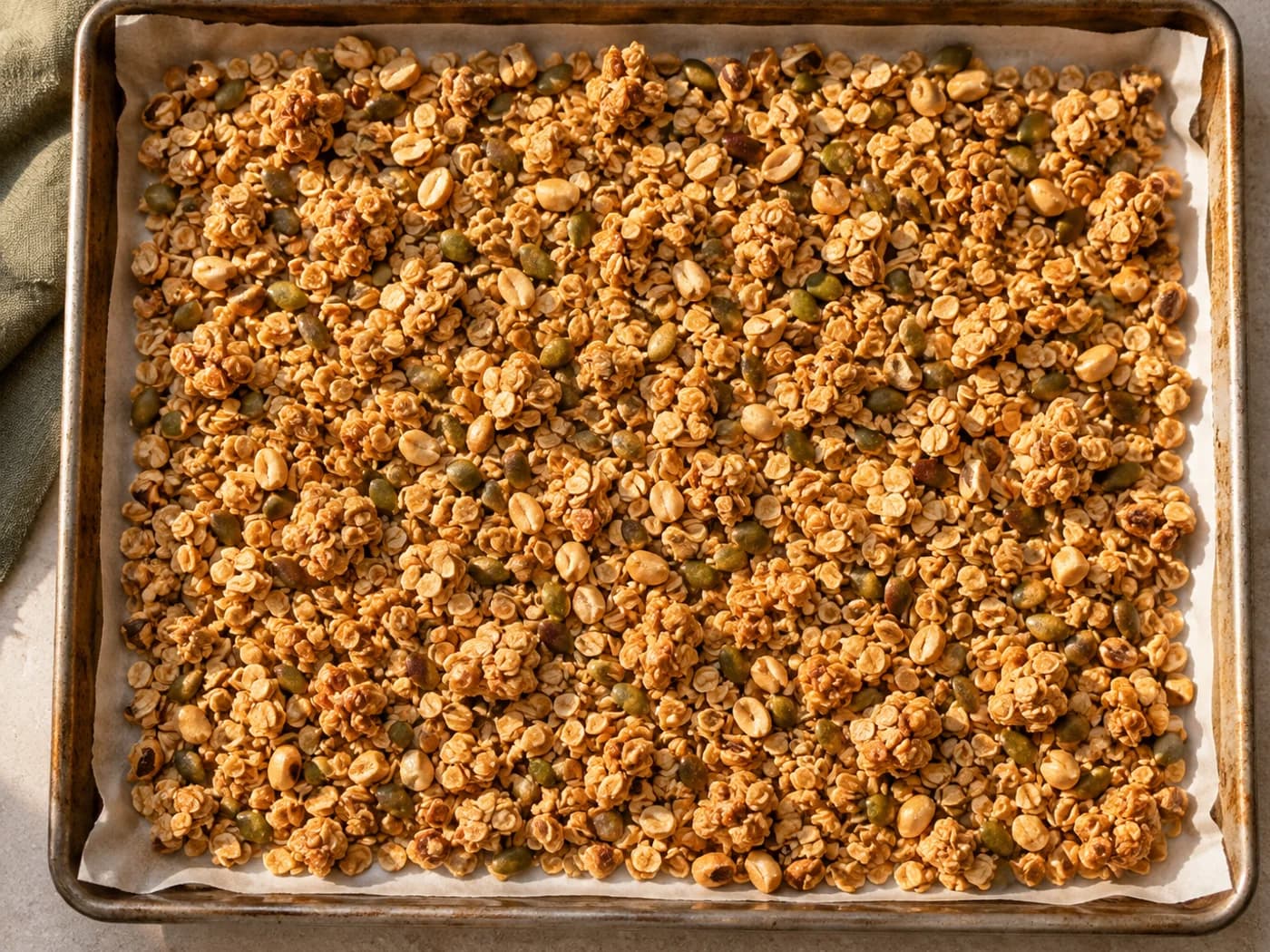
Golden flakes, ready for your bowl
High-Protein Granola
Rolled oats, peanuts and pepitas with nonfat milk powder, honey and cinnamon.
*Single-batch estimates, including cooling. Extra tray rounds add time. Exact formula not physically kitchen-tested. Weigh the cooled granola to establish its actual portion weight.
Ingredients
Method
- Prepare the oven and dry mix
Preheat a conventional oven to 300°F / 150°C. Line one 46 × 33cm / 18 × 13 inch rimmed baking sheet with parchment. Mix 160g rolled oats, 80g roughly chopped raw unsalted peanuts, 80g raw hulled pumpkin seeds, 80g nonfat dry milk powder, 3g cinnamon and 1g salt.
- Warm the coating
Gently warm 60g honey, 20g canola oil and 50g water just until fluid; do not boil. Remove from heat and stir in 4g vanilla extract. Stir again immediately before pouring over the dry mixture.
- Coat and spread thinly
Fold thoroughly, scraping the bowl and breaking up dry milk pockets. Scrape all coating into the mixture. Spread evenly and thinly across the lined sheet; do not mound or pack into a deep slab.
- Bake with regular checks
Bake roughly 30–45 minutes; 35 minutes is a planning estimate. Stir at about 15 minutes and again at 30 if still baking. Begin close checks at 20 minutes. Look for a dry-looking surface and light golden colour without wet pockets; milk powder can brown early.
- Cool and check the texture
Cool completely on the tray, roughly 45–60 minutes. Judge a cooled sample: it should be dry and crisp, with loose flakes and small clusters. If still damp or tacky, spread out and use short extra baking intervals with close checks, then cool again. Do not pack damp granola.
- Weigh, portion and store
Gently mix and weigh the completely cooled granola, then divide the actual weight by eight. One eighth is one reference portion. Pack airtight and refrigerate at 40°F / 4°C or below for a conservative 3–4-day plan; freeze the rest. Exact shelf life has not been measured. Keep yogurt and fruit separate.
Cooled texture matters more than a timer alone. Aim for light gold; a deep or scorched coating is not the goal.
Includes all measured honey, oil and seasonings. Yogurt and fruit are additional. Contains milk and peanuts; check labels and handling for your needs. Store fully dry and cooled, airtight and chilled; freeze portions you will not use within 3–4 days.
Frequently Asked Questions
Check the question that matches your batch
The most useful answer usually comes from identifying what changed: a different powder, a deeper tray, a larger portion or a bowl assembled the night before. The questions below distinguish those situations so you can adjust with a clear reason. For the exact ingredient list and scaling, use the card above. For nutrition, compare the whole batch and your own serving fraction before comparing a headline with another recipe's numbers.
How much protein is in this granola?
One eighth of the cooled reference batch provides approximately 11.9g protein and 272 calories, rounded to 12g in the headline. That is dry granola alone. Adding 170g plain nonfat Greek yogurt gives approximately 29.2g protein and 372 calories for the combined bowl, using generic values.
How many grams are in one serving?
Weigh the actual completely cooled batch and divide by eight. The finished weight depends on moisture lost during baking, so a fixed gram or cup portion is not assumed. For example only, a 560g cooled batch would give eight 70g portions. A different final weight gives a different portion weight.
Is milk powder the same as protein powder?
No. The reference uses plain nonfat dry milk, not whey, casein or plant protein supplement. It contributes both protein and lactose and behaves differently in the coating. A scoop-for-scoop supplement substitution needs its own formula and nutrition calculation. The recipe contains a powder and dairy even though it contains no whey supplement.
Can I leave out the milk powder?
Leaving it out removes a significant protein source and changes the coating. The stated 12g protein would no longer apply. A dairy-free version needs a separately developed balance of dry ingredients and binder. Serving the original granola with plant-based yogurt does not remove the milk powder already baked into it.
Which pumpkin seeds should I buy?
Use raw hulled green pumpkin-seed kernels, commonly called pepitas. The pale whole seeds with white shells are a different ingredient and are not the nutrition reference. Weigh 80g edible kernels for the eight-portion batch. Salted or roasted kernels have different labels and may colour differently during baking.
Can I use quick oats or steel-cut oats?
Old-fashioned rolled oats are the reference. Quick oats are thinner and can make a more crumbly mixture, so that change needs observation. Steel-cut oats have a different texture and cooking requirement and are not a direct substitute here. Sweetened instant porridge packets also introduce ingredients that this calculation does not include.
Why is my granola still soft when warm?
Warm granola can firm as it cools. Let a small sample cool before judging it. If the cooled sample remains damp or tacky, spread the mixture out and try short additional oven intervals with close checks, then cool again. Do not seal it while warm or use storage to finish drying it.
Why did the coating brown before the middle dried?
A deep layer, uneven spreading, hot spots or a dark tray can contribute. Milk powder can colour early, so begin close checks around 20 minutes and redistribute the edges when stirring. Aim for light gold rather than dark brown. Extra baking cannot remove a burnt flavour or prove that a crowded centre has dried.
How do I get large granola clusters?
This stirred formula is intended to produce loose flakes and small clusters. Large hard clusters are not guaranteed. Pressing it into a thick slab or skipping necessary stirring can leave unevenly dried areas. If large clusters are your priority, use a recipe developed for that texture rather than treating this one as a granola-bar formula.
Can I add chocolate or dried fruit?
Add those separately after the granola has completely cooled and count the amount you use. Chocolate may melt into warm oats, and dried fruit can become unpleasantly hard if baked throughout the full schedule. Neither ingredient is included in the reference nutrition. Fresh fruit should stay separate until serving.
Can I double or triple the recipe?
The card offers eight, sixteen or twenty-four portions. Use one reference batch per 46 × 33cm / 18 × 13 inch sheet and bake separate tray rounds. Do not multiply the layer depth on one tray. Larger settings take more elapsed time; assess and cool each tray before dividing it into eight portions.
Can I make it in an air fryer?
An air-fryer method has not been established for this formula. Loose flakes, strong airflow, basket holes and a nearby element can change both containment and browning. Use the stated conventional oven method for the reference recipe, or choose a separately developed air-fryer granola method suited to your equipment.
How long does it keep?
Exact shelf life has not been measured. For a conservative home plan, pack fully dry, completely cooled granola airtight, refrigerate at 40°F / 4°C or below and use within 3–4 days. Freeze remaining portions; about one month is an untested quality target. Keep yogurt and fruit separate and discard spoiled food.
Is this gluten-free, vegan or low calorie?
The reference contains milk and peanuts, and honey means it is not vegan. Gluten-free suitability needs appropriately labelled oats, other ingredients and handling. It is an energy-dense granola, approximately 272 calories per reference portion. Half a portion is approximately 136 calories and 5.9g protein; changing the portion reduces protein too.
More High-Protein Recipes
Stay with oats, change the texture
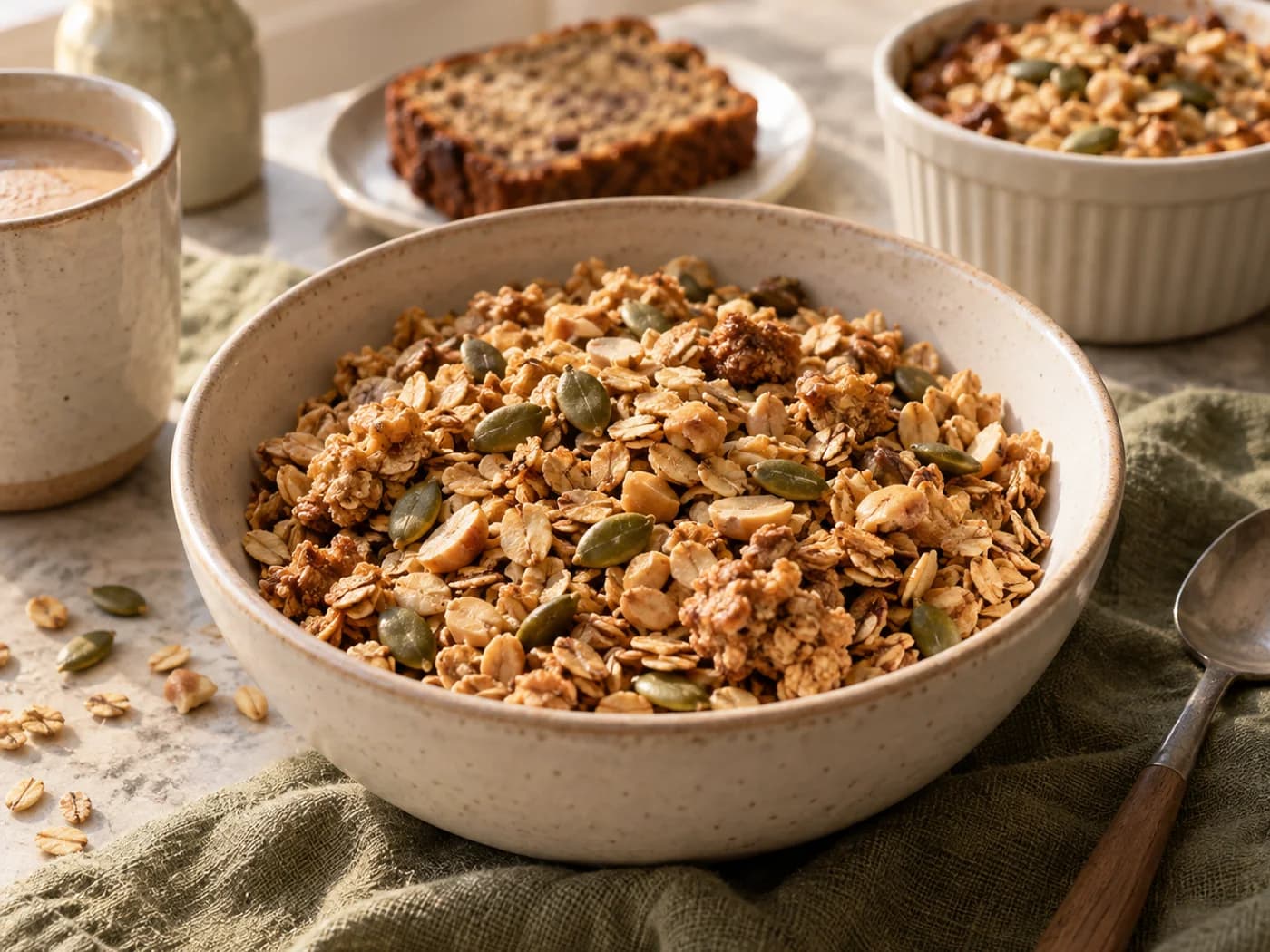
If you like oats but want a warm spoonable breakfast, the baked-oats recipe offers a different direction with individual ramekins, banana and blueberries. It is a moist bake with its own ingredients and timing, so it is not a shortcut version of this dry granola. You might choose one for a relaxed morning and keep the other as a crunchy yogurt topping. The useful distinction is how you want breakfast to feel and how much preparation time you have, rather than assuming every oat recipe is interchangeable.
Something sliceable or savoury
Banana bread is convenient when a slice suits you better than a bowl. French toast takes breakfast to the skillet, while bagels give you a bread option for fillings you already enjoy. For a savoury meal, a breakfast sandwich or breakfast pizza can provide eggs and dairy in a different format. Each linked recipe has its own reference serving and nutrition notes. Compare complete meals, including the toppings you actually choose, instead of expecting equal protein from equal-looking pieces of different foods.
Build a collection you will use
The recipe collection brings together breakfasts, bakes and savoury meals so you can rotate flavours without starting from scratch every day. Keep the recipes that fit your equipment and appetite, and make a note of any successful changes. There is no requirement to prepare an entire week's menu at once. One reliable granola batch, a yogurt you enjoy and a few alternatives for mornings when you want something warm can be enough to make breakfast feel less repetitive and more manageable.