
Browse the 15 recipe sections
One reference serving: one of twelve equal plain donuts, including all batter ingredients and measured pan oil. Protein is about 8.5g before rounding to 9g. Glaze and sides are additional; timing is approximate. See the breakdown.
Recipe Overview
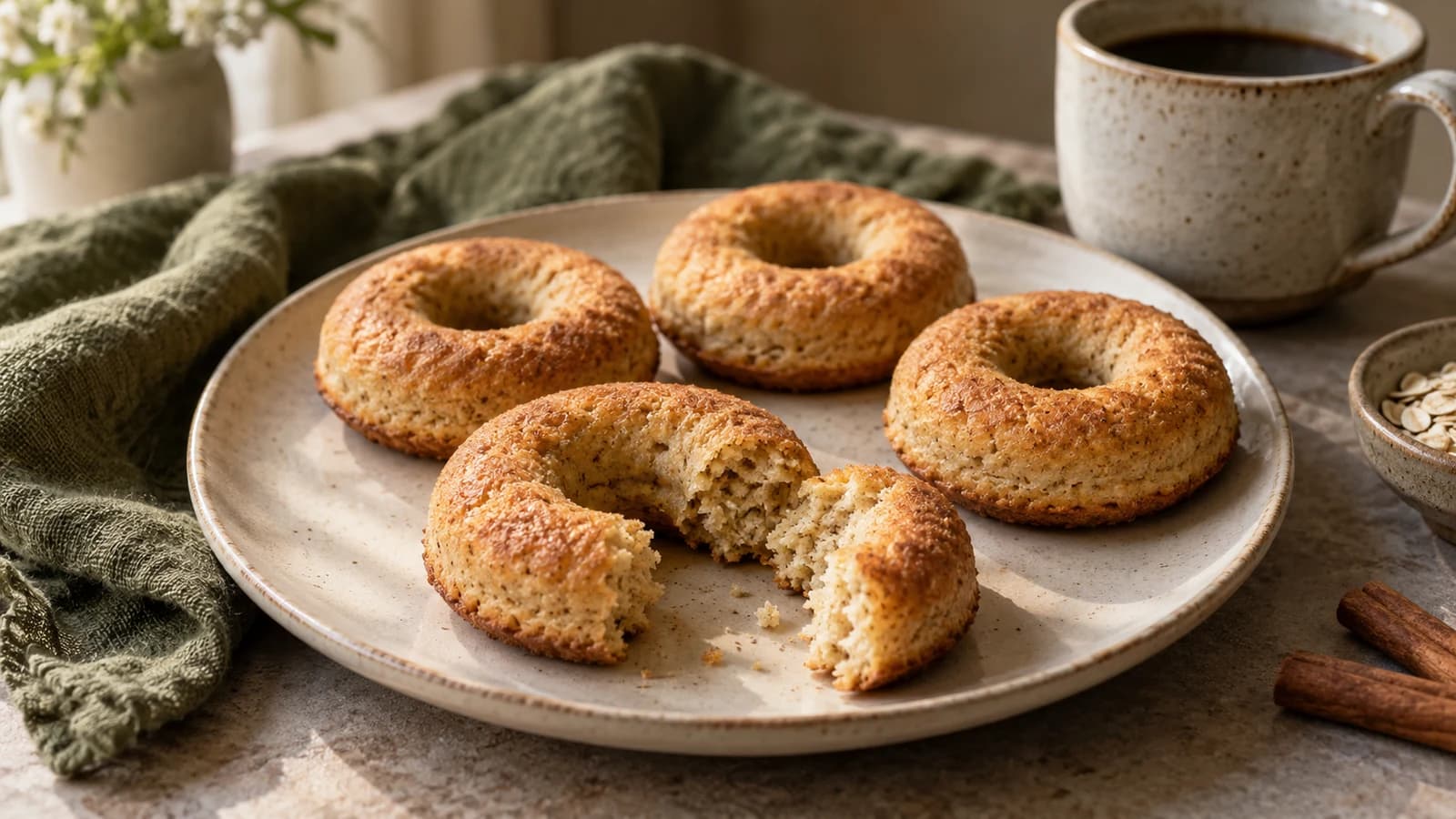
A small ring-shaped bake can make an ordinary coffee break feel a little more inviting. These high protein donuts use finely ground oats, vanilla whey, thick Greek yogurt and eggs to make a simple cake-style batter. They bake in a donut pan and come out with lightly golden edges, an open centre and a soft oat crumb. Vanilla supplies the main flavour, with a little cinnamon in the batter. The reference version is served plain, so the nutrition does not quietly depend on a glaze you have not measured.
The batch and the portion
The measured batch makes twelve small, equal donuts in standard ring wells roughly 3 inches / 7–8cm across. One plain donut is approximately 122 calories with 8.5g protein. The quick summary rounds protein to 9g; two donuts provide about 245 calories and 17g protein before any sides. The portion definition matters: a larger bakery-sized ring, a mini ring and one of these standard reference donuts are different amounts of food. All batter ingredients and the measured pan oil are included in the calculation.
What to expect
Think of a small vanilla-cinnamon cake with a hole through the middle. The crumb comes from ground oats, yogurt, eggs and whey, so its texture will depend partly on your powder and how finely you grind the oats. The recipe uses baking powder for lift and canola oil for the batter and pan. There is no yeast-rising period or deep-frying stage. A donut pan gives the batter its ring shape; a cooling rack helps the underside stay comfortable rather than damp.
Give yourself a clear first attempt
Allow about twenty minutes to prepare and briefly rest the batter, around fifteen minutes to bake and another fifteen minutes to cool enough for serving. Fifty minutes is a planning estimate for the base batch, with extra rounds needed if you have one six-well pan. This exact weighed formula has not been physically kitchen-tested; method and timing are informed by established baked-donut and protein-baking examples, and the ingredient assumptions are explained below. A scale and attention to the actual batter will help more than treating every brand as identical.
Why You’ll Love This Recipe
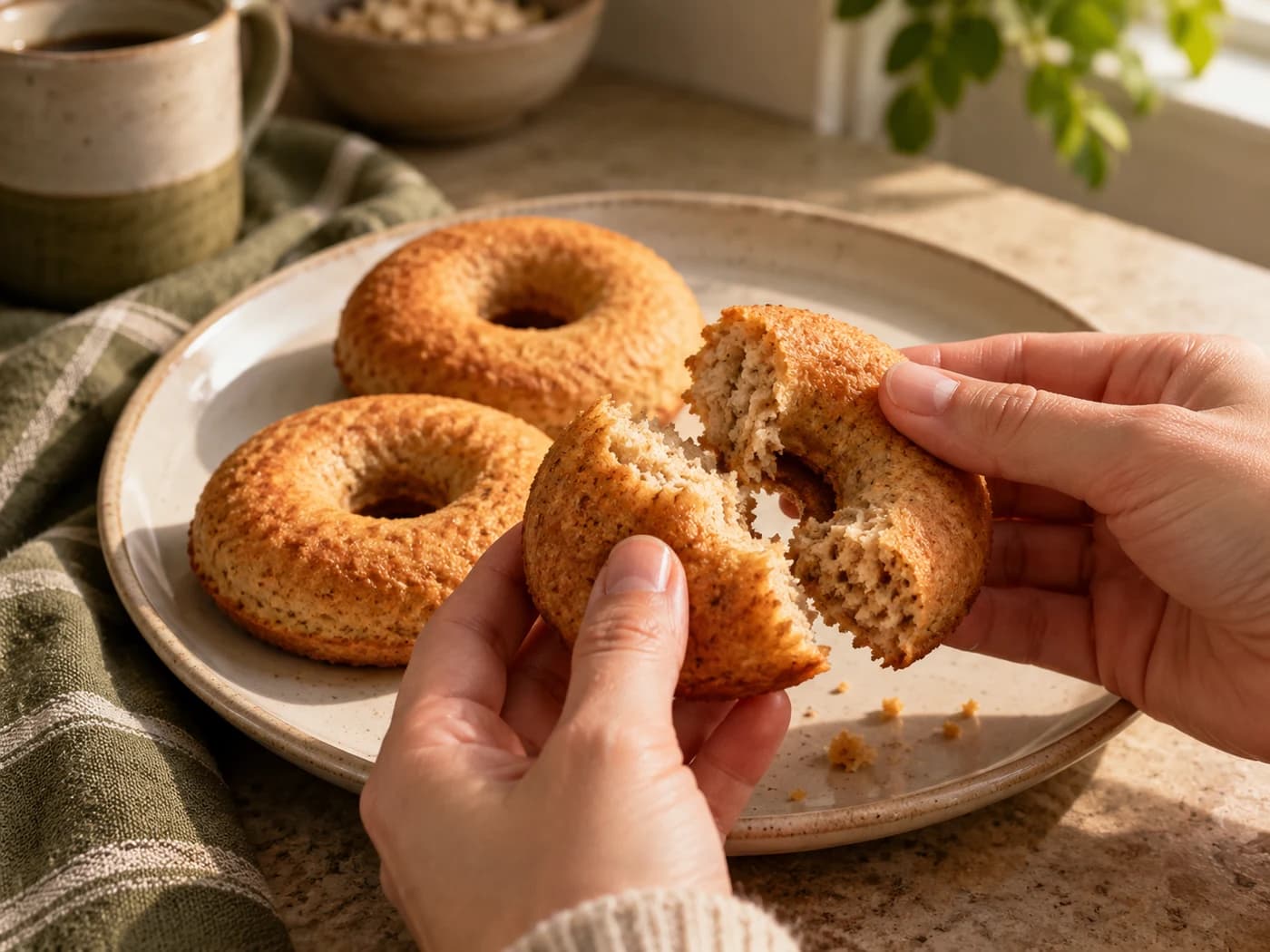
The pleasure of these donuts is fairly simple. They are small enough to hold comfortably, easy to put on a side plate and lightly flavoured enough to pair with coffee, tea or berries. The centre hole gives the shape a little character without requiring a complicated finish. You can serve them plain while still enjoying vanilla and cinnamon through the crumb. A cooling rack full of modest homemade rings feels welcoming even when the tops are a little uneven.
A useful protein contribution
Vanilla whey, Greek yogurt, oats, eggs and skim milk contribute to the roughly 102g protein in the complete twelve-donut batch. The whey provides the largest single share, while the yogurt brings protein and moisture together. You do not have to add a separate powder glaze to reach the stated amount. That makes the plain portion easier to describe and calculate. If you prefer a more substantial snack, you can choose two rings or serve one with a weighed yogurt portion.
A short baking session
The mixture comes together in two bowls, and the oven does the rest. Grinding the oats and filling the wells take a little attention, but there is no long proving stage. A piping bag can make the ring wells easier to fill, though a spoon also works. The base batch suits two six-well pans or two rounds in one pan. Plan the equipment before mixing so you are not searching for a tray while a bowl of egg-and-yogurt batter sits on the counter.
Flexible at the table
A plain donut gives you a neutral starting point for serving. Fruit adds freshness, yogurt adds tang and a little chocolate can add richness when you choose to count it. You can make those choices on individual plates and keep the remaining rings plain for another day. The food does not need to carry a label such as a reward, cheat or perfect snack. Choose the portion and flavour you enjoy, and let the measured ingredients make the nutrition estimate useful.
Nutrition at a Glance
- Calories
- 122kcal
- Protein
- 9g
- Carbs
- 14g
- Fat
- 4g
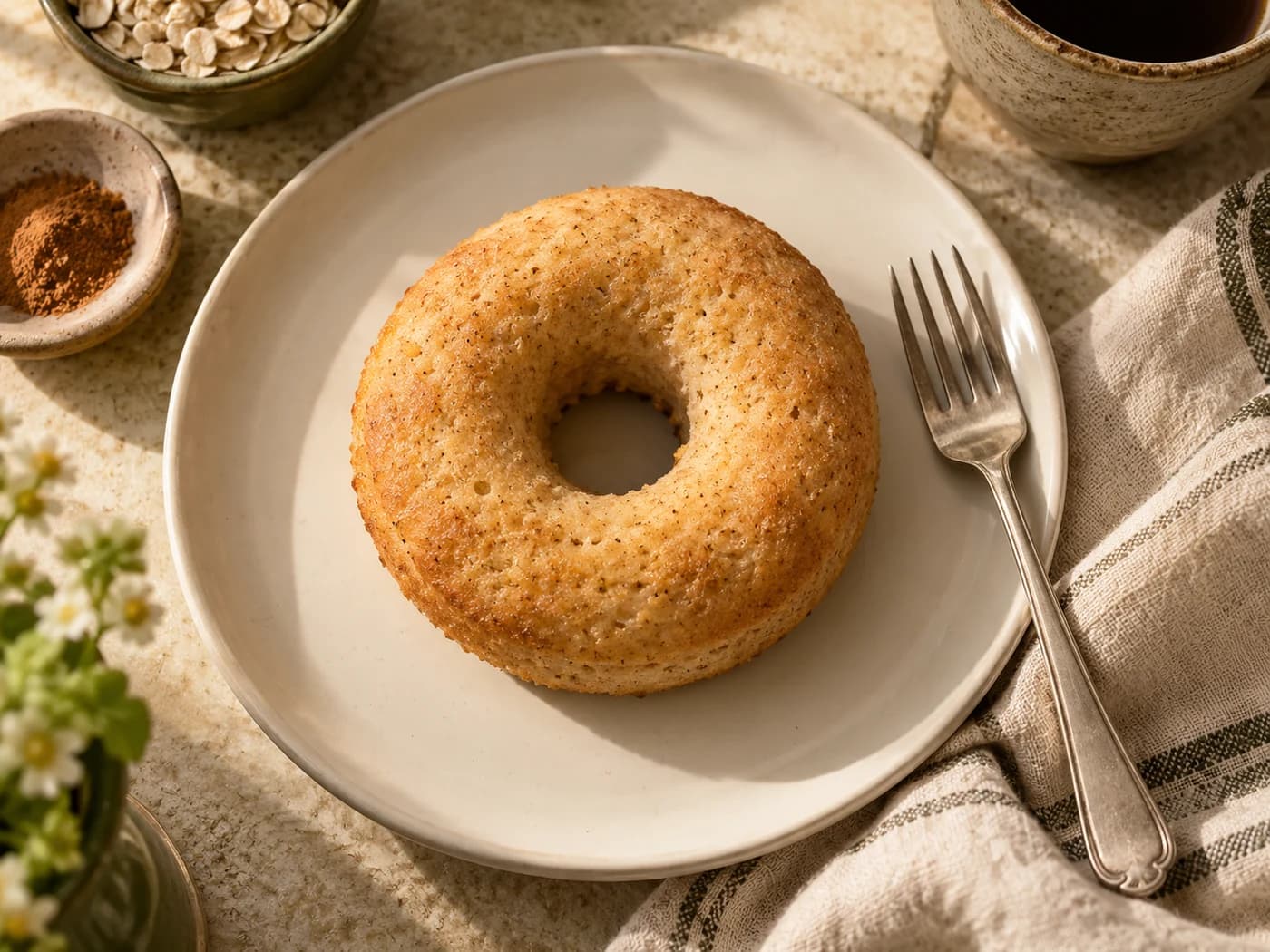
One reference donut provides approximately 122 calories, 9g protein, 14g carbohydrates and 4g fat after rounding. The protein value before rounding is about 8.5g. These estimates include every listed batter ingredient and all 20g of the recipe oil, including the 4g assigned to greasing twelve wells. The calculation conservatively counts the full measured oil even if a little remains on the pan or brush. Glazes, sugar coatings, chocolate and side dishes are additional.
Calories
A single small ring is around 122 calories, while two are around 245. That is useful portion arithmetic, rather than a claim about the energy in every product called a protein donut. Your own powder, milk and yogurt labels can shift the result. So can the number of rings you make from the batch. If the same batter is divided into six larger donuts, each carries approximately twice the reference nutrition, and the baking method needs reassessment for the deeper wells.
Protein
About 8.5g protein comes with each of the twelve equal portions. Two donuts provide roughly 17g. A single donut plus 100g of the reference nonfat Greek yogurt provides about 18.7g protein for the combined plate. The extra yogurt also adds calories, bringing that plate to about 181 calories before fruit. Compare portions that you would actually eat, and remember that the quick card uses whole-number rounding to keep the summary readable.
Carbohydrates and fat
The roughly 14g carbohydrates include the oats, measured sugar, dairy sugars and other small contributions. The roughly 4g fat comes mainly from canola oil, egg yolks and oats, with smaller amounts from the other ingredients. The base recipe contains 50g granulated sugar across twelve donuts, and the whey label includes a sweetener. There is no promise of a sugar-free or calorie-free bake. The detailed section later includes total sugars, fibre, saturated fat and sodium, together with the limits of the reference calculation.
Ingredients
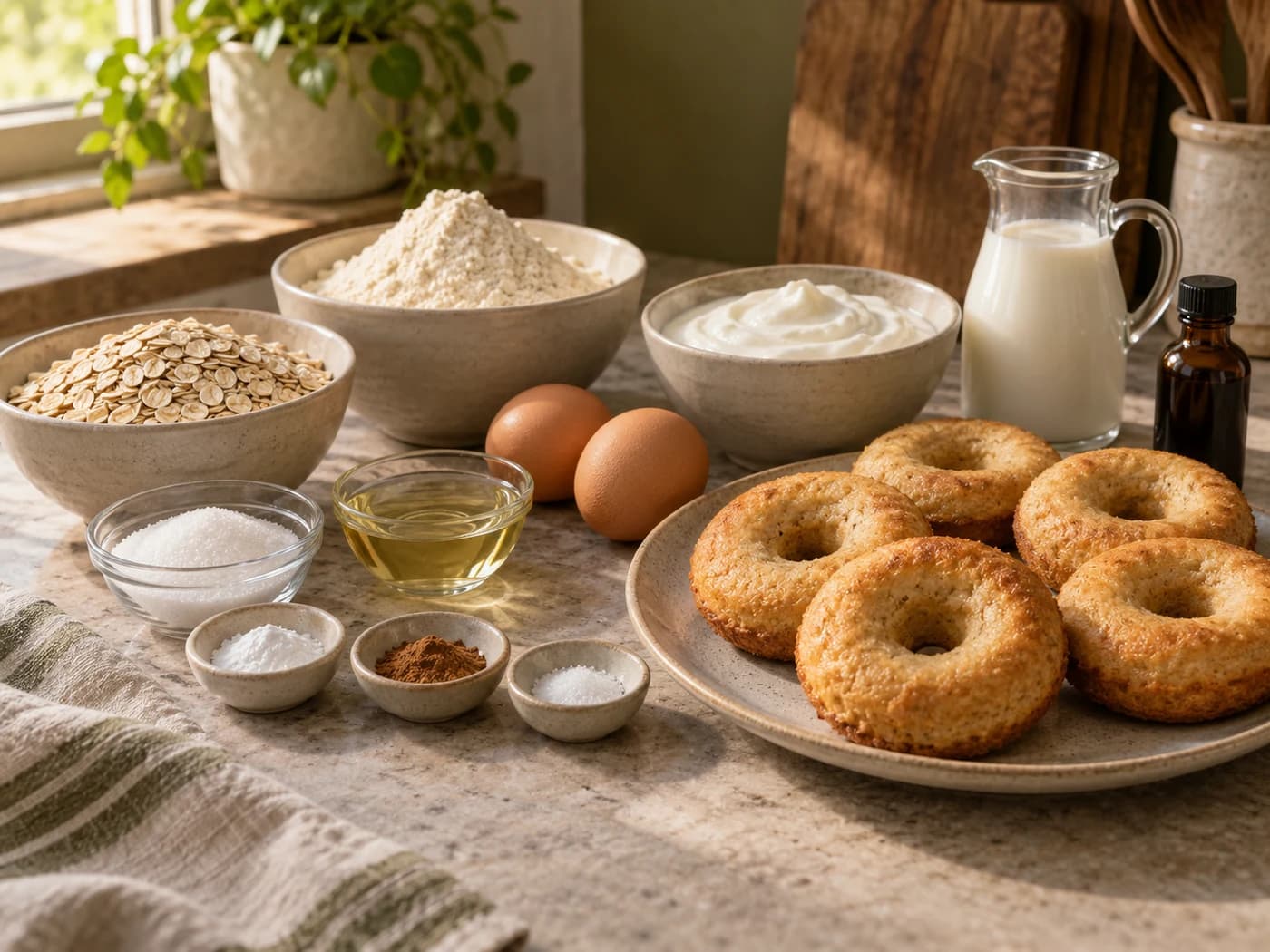
For twelve reference donuts, weigh 150g rolled oats, 60g vanilla whey protein blend, 200g plain nonfat Greek yogurt, 100g whole egg without shells, 60g skim milk, 50g granulated sugar, 20g canola oil, 6g baking powder, 2g ground cinnamon, 1g fine salt and 5g vanilla extract. Of the oil, reserve 4g to brush across the twelve pan wells and use the remaining 16g in the batter. The full 20g is counted in nutrition. There is no separate spray or unlisted butter in the reference.
Oats and whey
Grind the oats finely enough to resemble a flour, and transfer the complete weighed amount into the mixing bowl. Large flakes make a coarser crumb and can be harder to pipe. Plain oat flour can be explored at the same starting weight, with attention to grind and absorption. The whey reference is a vanilla blend with 79g protein per 100g on its linked manufacturer label. Weigh 60g rather than assuming any two scoops have the same mass or composition. Flavours, sweeteners and thickeners vary between products.
Yogurt, eggs and milk
Use thick strained Greek yogurt. A drinkable yogurt or a flavoured pot may add more liquid or sugar than the reference. The eggs are weighed after their shells are removed; two large eggs are a practical starting point for 100g. Lightly combine them before measuring if sizes vary. The 60g skim milk is fluid milk, not dry milk powder. Together these ingredients provide moisture and contribute protein. Keep them refrigerated until the preparation is ready to begin.
Sugar, oil and lift
Granulated sugar goes into the batter, rather than forming a coating on the finished rings. Canola oil is divided deliberately between the mixture and the wells so the amount is visible. Brush the centre posts as well as the outer curves. Baking powder supplies lift; the reference is double-acting, and its sodium contribution is included. Do not substitute baking soda gram for gram. Cinnamon, fine salt and vanilla are small amounts, but weighing them keeps the flavour and calculation consistent across batches.
Equipment worth setting out
Use two standard six-well ring pans, or plan two rounds in one pan. Set out a scale, two bowls, a whisk, a flexible spatula and a rack. A piping bag or clean food-safe bag with a small corner cut can help fill the wells. Silicone moulds need a firm baking sheet underneath and may bake differently from metal. The timing estimates are a starting point; the wells should comfortably hold equal portions without being filled to the brim.
Your ingredient checklist
- Rolled oatsGrind finely, or use plain oat flour at the same starting weight150g
- Vanilla whey protein blendVanilla whey blend; weigh 60g. Reference contains milk and soy.60g
- Plain nonfat Greek yogurtThick strained yogurt, not drinking yogurt200g
- Whole eggAbout 2 large eggs, weighed without shells100g
- Skim milkWeighed liquid, not dry milk powder60g
- Granulated sugarAll goes into the batter; no sugar coating included50g
- Canola oil16g for batter plus 4g for all twelve pan wells20g
- Baking powderDouble-acting reference; weigh carefully6g
- Ground cinnamonMixed into batter, not a surface coating2g
- Fine saltOne gram added to the complete batch1g
- Vanilla extractWeighed liquid extract5g
Contains egg and milk; the reference whey contains soy. Check all labels and oat cross-contact if avoiding gluten.
Ingredient Substitutions
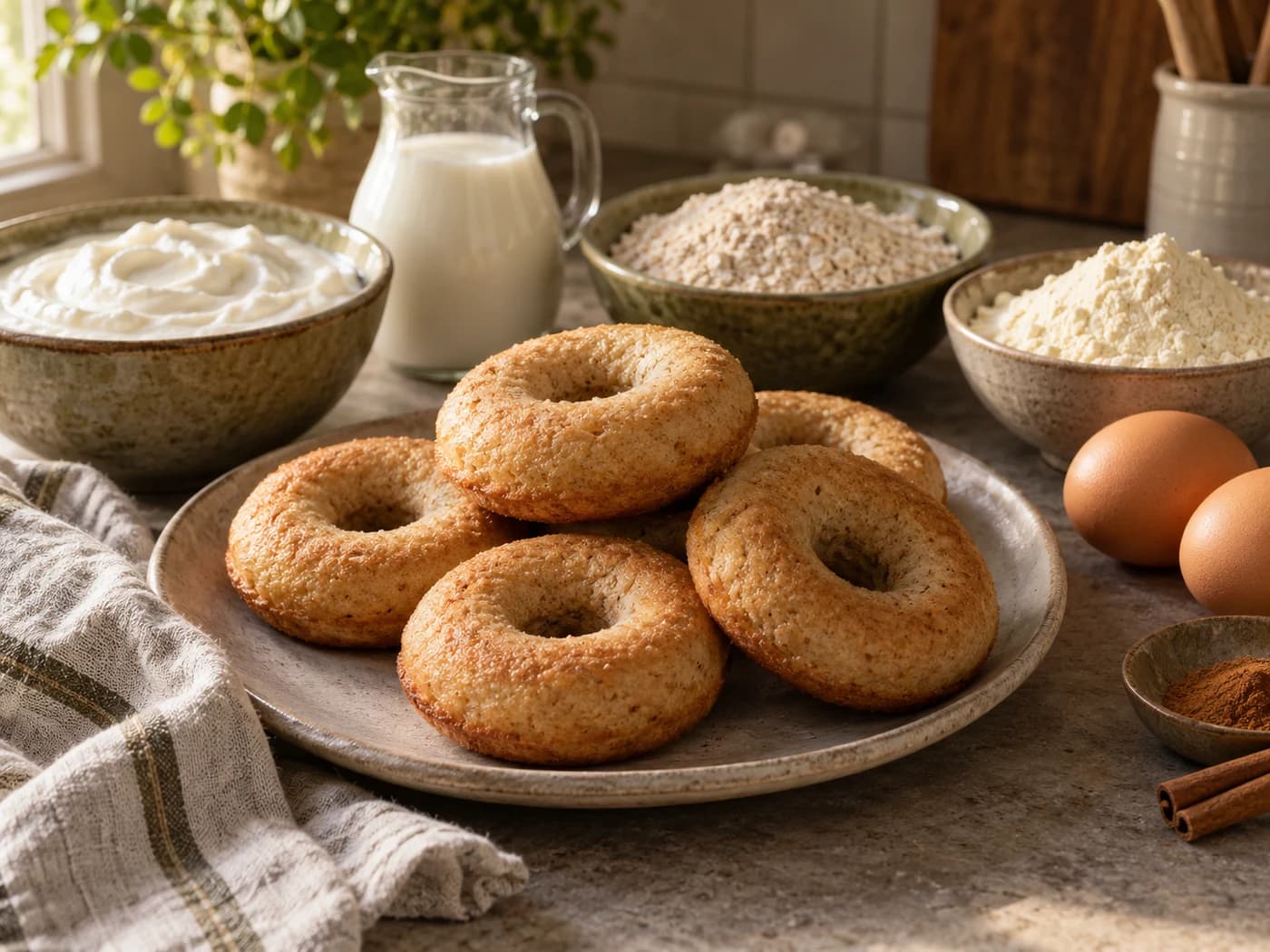
Substitutions are easiest to judge when you change one ingredient at a time. In this mixture, the oats and powder absorb liquid while yogurt, milk and eggs supply moisture. A different powder or a much looser yogurt can move that balance noticeably. Keep the first attempt close to the published types if you want a useful baseline. Record the product and weight of any change, then calculate its nutrition from the actual label rather than retaining the reference macros automatically.
Another whey product
A different vanilla whey blend can be used as an exploration at the same starting weight. Its sweetness, flavour and thickening ingredients may differ, so review the rested batter before piping. An unflavoured whey changes the sweetness as well as the flavour. Casein, plant powders and meal-replacement blends can absorb moisture differently and are not established direct swaps here. The scoop printed on a container is a serving suggestion for that product; it does not replace the recipe’s 60g weight.
Yogurt and milk alternatives
A thick plain 2% Greek yogurt is a possible change with different fat and calories. Thick skyr may also be explored, though an identical bake is not promised. A thin natural yogurt brings more moisture and can produce a different batter. Unsweetened soy milk has a different protein and fat profile from skim milk, while some almond drinks contribute very little protein. Choose a milk alternative for your needs, review all other ingredients and use its label when recalculating the batch.
Oats, oil and sugar
Finely milled plain oat flour is the closest practical alternative to grinding your own rolled oats. Wheat flour, coconut flour and almond flour are different ingredients with different composition and absorption, so they do not inherit the same method and macros. A suitable neutral liquid oil can replace canola as an exploratory change, but keep the total weighed amount and pan allocation clear. Syrup and zero-calorie sweeteners have different moisture or bulk from granulated sugar and have not been validated in this exact mixture.
Dietary restrictions
The reference contains milk and eggs, and the example whey contains soy. Ordinary oats can have gluten cross-contact, so this is not presented as certified gluten-free. Suitable labelled oats and compatible remaining ingredients and preparation conditions are required if avoiding gluten. A plant powder plus egg replacement creates a more substantial reformulation. The page does not label that combination a verified vegan version. For allergies, review the powder, vanilla and every other package rather than relying on one ingredient change.
Keep a record of the product label and adjusted amount when exploring a change.
| Reference | Possible change | What to consider |
|---|---|---|
| Ground oats | Plain oat flour | Grind and absorption |
| Vanilla whey blend | Another whey flavour | Label, sweetness and thickening |
| Whey | Casein or plant powder | Not an established direct swap |
| Nonfat Greek yogurt | Thick 2% Greek yogurt | Fat and moisture |
| Skim milk | Milk alternative | Protein and calories |
| Whole eggs | Egg replacement | Requires a developed method |
| Sugar | Syrup or alternative sweetener | Bulk and moisture |
How to Make It
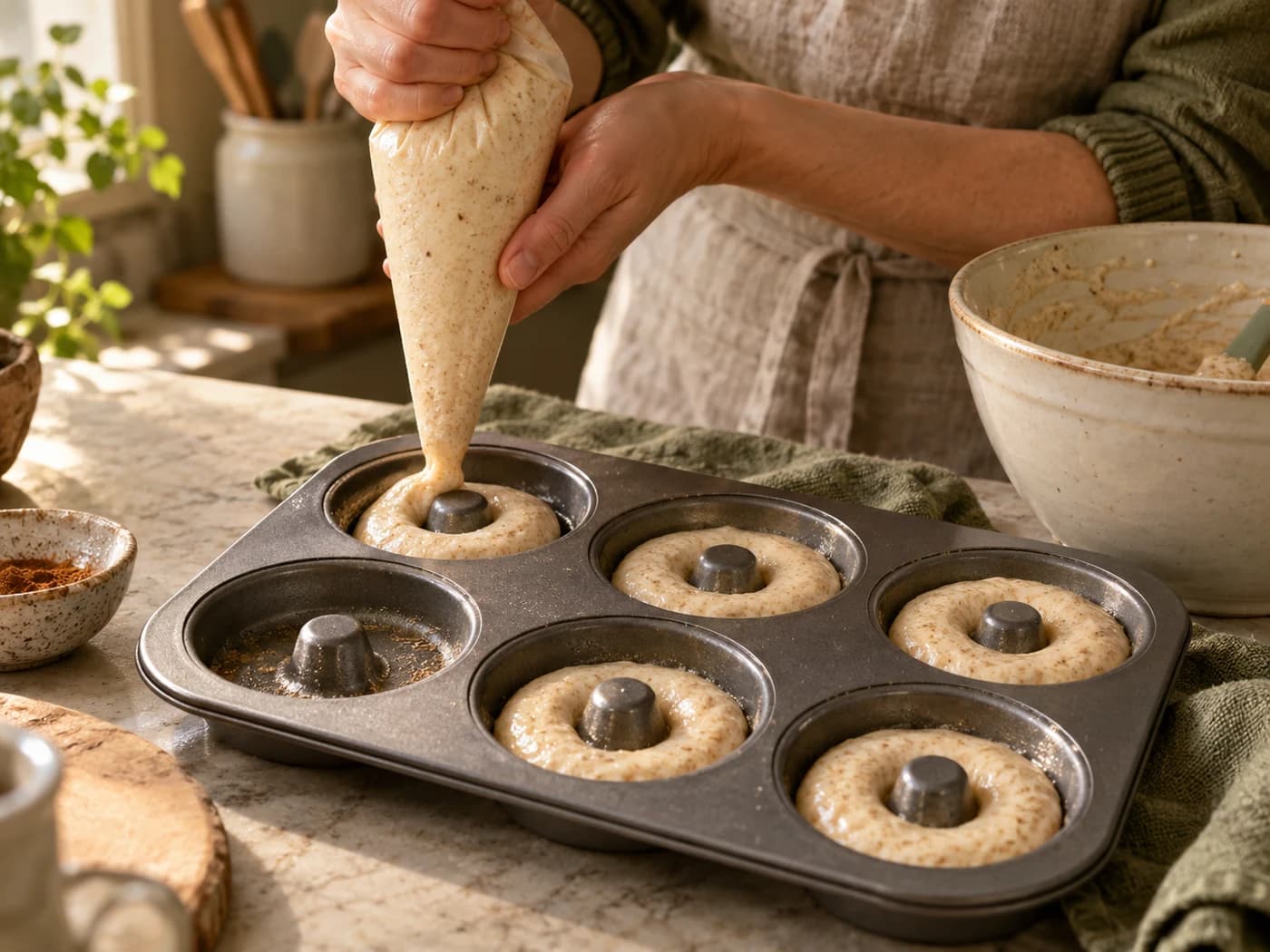
Preheat a conventional oven to 350°F / 175°C and arrange a rack near the middle. Brush the measured 4g pan oil thinly across twelve standard donut wells, covering both the outer curves and the centre posts. If using one six-well pan, reserve half of the pan oil for the second round. Place flexible silicone moulds on a firm baking sheet before filling. Set out a rack and make space for the hot pans so the cooling stage is ready before the donuts finish.
Make a fine dry mixture
Grind the 150g oats finely, then whisk them with the 60g whey, baking powder, cinnamon and salt. Break up visible powder clumps before adding liquid. Scrape all the ground oats from the processor so the weighed ingredient does not partly remain in the machine. A coarse grind can leave a more rustic crumb, while a fine grind is easier to distribute through the ring wells. Keep the baking powder measured to 6g rather than adding more to compensate for a dense-looking powder.
Combine the wet ingredients
In another bowl, lightly whisk the weighed eggs with yogurt, milk, sugar, vanilla and the remaining 16g oil. Aim for an evenly mixed liquid with no large yogurt lumps. Fold the dry mixture into it until no dry pockets remain, scraping the bowl. Let the batter stand for about five minutes so the oats can begin to hydrate. It should be thick but pipeable or spoonable. Do not taste the raw batter, and keep egg-contact utensils away from ready-to-eat sides.
Divide the batter
Divide the entire batter into twelve equal portions. The ingredient reference gives roughly 650g batter before bowl losses, or around 54g per well, but weighing your actual mixed batter is more reliable than assuming that exact mass. Pipe or spoon it around each centre post, keeping the hole clear and the fill level below the rim, roughly two thirds to three quarters full. If the mould is too small for that portion, use additional wells or a suitable larger standard pan and recalculate the serving definition. Do not force an overflowing fill merely to reach twelve.
Bake and check
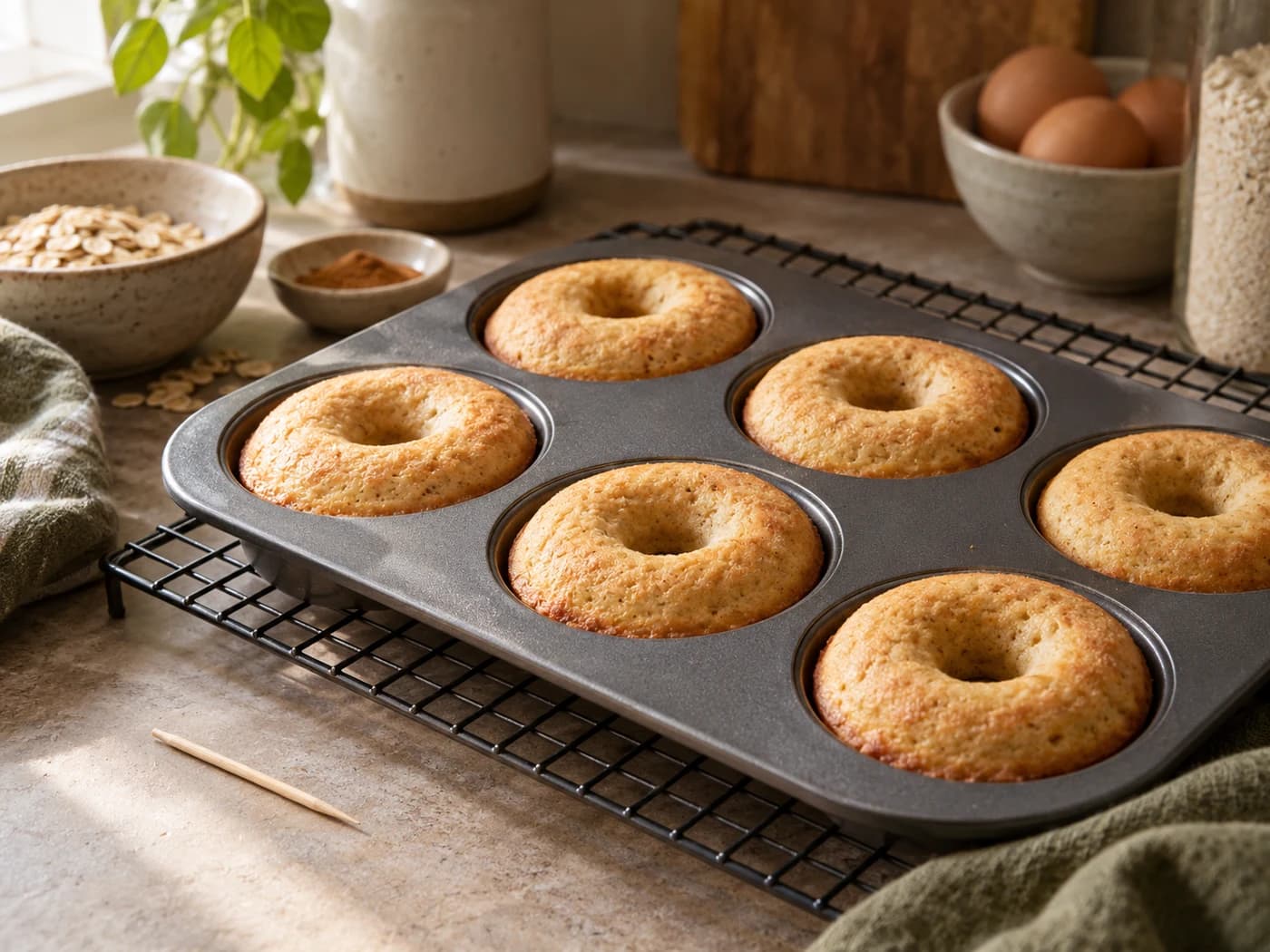
Bake for approximately twelve to sixteen minutes, beginning to inspect around ten minutes. Look for set surfaces, lightly coloured edges and a centre that springs back gently rather than denting into wet batter. A toothpick inserted into the thick part should come out without raw batter; a few moist crumbs are acceptable. The egg-containing mixture should reach at least 160°F / 71°C internally when checked with a food thermometer, keeping the probe away from the pan. Use the texture cues as well; a temperature minimum alone does not describe the ideal finished crumb.
Release and cool
Leave the donuts in their pan for about five minutes, then ease them out carefully onto a rack. Support the ring instead of pulling at one side. Cool for at least another ten minutes before serving, and cool fully before sealing for storage. If you need a second round, let the pan become safe to handle, brush on the reserved oil and refill it. Keep waiting raw batter refrigerated. Larger batches need extra equipment or oven rounds and more elapsed time than the base estimate.
Tips for the Best Results
The details that make these donuts easier to handle are practical ones: a fine oat grind, an evenly mixed batter, consistent portions and a few minutes in the pan after baking. Work through those before adding extra powder or extending the bake simply to get a darker top. Protein powders vary, so a useful result comes from reading the actual mixture and crumb. The goal is a set ring with a comfortable cake texture, not the deepest possible brown surface.
Give the oats a short rest
The five-minute rest helps you judge the mixture after the oats have started absorbing liquid. Batter that looks loose immediately after folding may thicken slightly during that interval. Avoid repeatedly adding dry whey before the rest is complete. If the mixture becomes unusually stiff, first review the weights and powder type. A major liquid adjustment creates a new version and should be recorded. The reference has a defined 60g milk quantity rather than an unlimited amount added until the batter resembles a photograph.
Grease the posts as well as the wells
The middle post is easy to overlook, yet it touches the part of the donut that can catch when you turn it out. Brush the measured pan oil thinly across all contact surfaces. Nonstick coatings vary and damaged pans can be harder to release. A small flexible utensil can help loosen the edge after the brief cooling period. Avoid scraping a coated pan with a sharp metal tool. If a ring tears, keep the usable baked portion and review pan preparation for the next round.
Keep portions similar
A thin ring can finish before an overfilled neighbour. Equal portions help the tray bake more consistently and keep the nutrition estimate meaningful. Piping makes the distribution easier around the post, but a spoon can work when you take time to spread the batter evenly. Keep the centre opening visible. If your cavities are unusually small, make more rings and divide the whole-batch nutrition by the actual yield. That is more honest and more useful than calling differently sized donuts the same portion.
Protect the crumb from a long bake
Begin checking early and continue only until the rings are set. Whey-rich bakes can feel drier after an unnecessarily long oven stay, and they firm further as they cool. A lightly golden surface is sufficient. Let a cooled sample tell you about the final texture before deciding your next batch needs a longer bake. If it is gummy, check whether the oats were too coarse, the wells too deep or the batter insufficiently baked, rather than assuming the top colour tells the whole story.
High-Protein / Lower-Calorie Variations
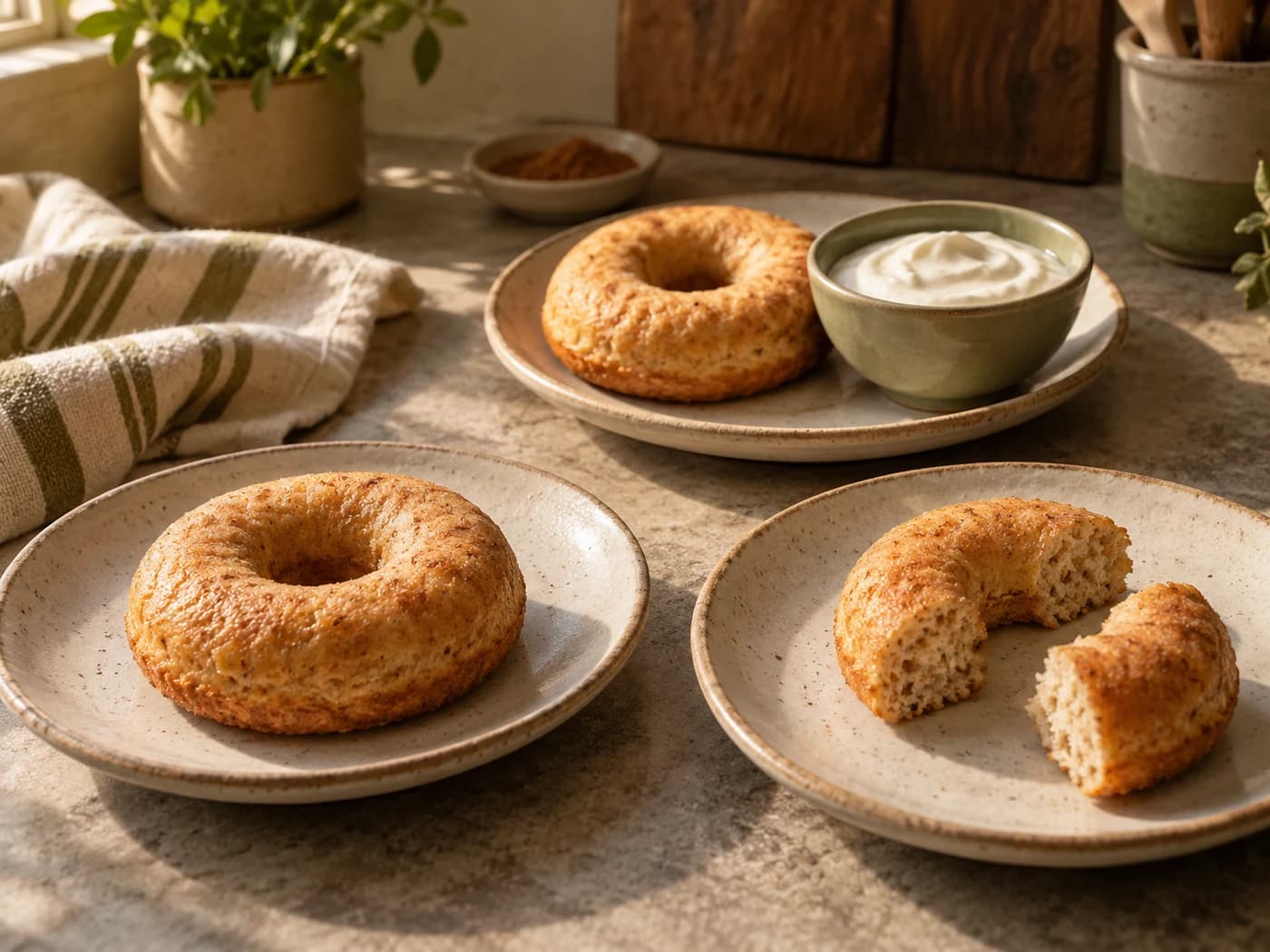
Start by deciding how much of the original bake you want. A smaller portion changes the amount of food without asking the batter to behave differently. Adding a weighed side changes the plate while keeping the donut recipe intact. A change to sugar, oil or powder also changes the mixture and may need a different method. The variations below distinguish those choices so the protein and calorie figures remain connected to the food you actually serve.
Half a ring
Half of one reference donut provides about 61 calories and 4.3g protein. That can be a useful few bites alongside a larger breakfast or when sharing different bakes. It is simply a portion of the original donut; no new pan or timing is required. Dividing the original batter into twenty-four mini rings is another size change, but it needs smaller wells and a separate doneness assessment. The card’s twenty-four-donut setting instead doubles the ingredients to make twenty-four standard reference rings.
A yogurt side
One plain donut with 100g of the reference nonfat Greek yogurt provides approximately 181 calories and 18.7g protein. Two donuts with that yogurt provide about 304 calories and 27.2g protein before fruit. Put the yogurt beside the rings or use it as a dip at serving time. It is easier to measure and store separately than to spread an unweighed layer over the complete batch. A flavoured yogurt or another portion needs its own calculation.
Less sugar as an arithmetic scenario
Using 30g rather than 50g granulated sugar in the same twelve-donut batch gives an ingredient-based estimate of about 116 calories per donut, with protein still around 8.5g. That is a calculated scenario, not a verified equivalent bake. Removing sugar can change flavour, browning and the cooled crumb. The whey also contains a sweetener in the reference label, but that does not make its sweetness or bulk equivalent to granulated sugar. Keep the change modest and evaluate the result rather than promising it will taste identical.
More powder is not a free adjustment
Adding whey raises dry ingredients as well as protein. The existing liquid and egg balance may no longer suit the mixture. Casein or plant powder can create a different balance again. If you want substantially more protein per ring, choose a formula developed around that amount or use the yogurt side above. A clearer serving arrangement is more useful than an impressive number attached to a batter whose texture and baking time have not been established.
The estimates change only the named portion or ingredient; fruit and extra toppings are additional.
| Version | Calories | Protein |
|---|---|---|
| One plain donut | 122 kcal | 8.5g |
| Two donuts | 245 kcal | 17.0g |
| Half a donut | 61 kcal | 4.3g |
| One donut + 100g reference yogurt | 181 kcal | 18.7g |
| Two donuts + 100g reference yogurt | 304 kcal | 27.2g |
| 30g instead of 50g sugar per batch* | 116 kcal | 8.5g |
| *Ingredient calculation | Bake requires reassessment | Not verified as identical |
Serving Suggestions
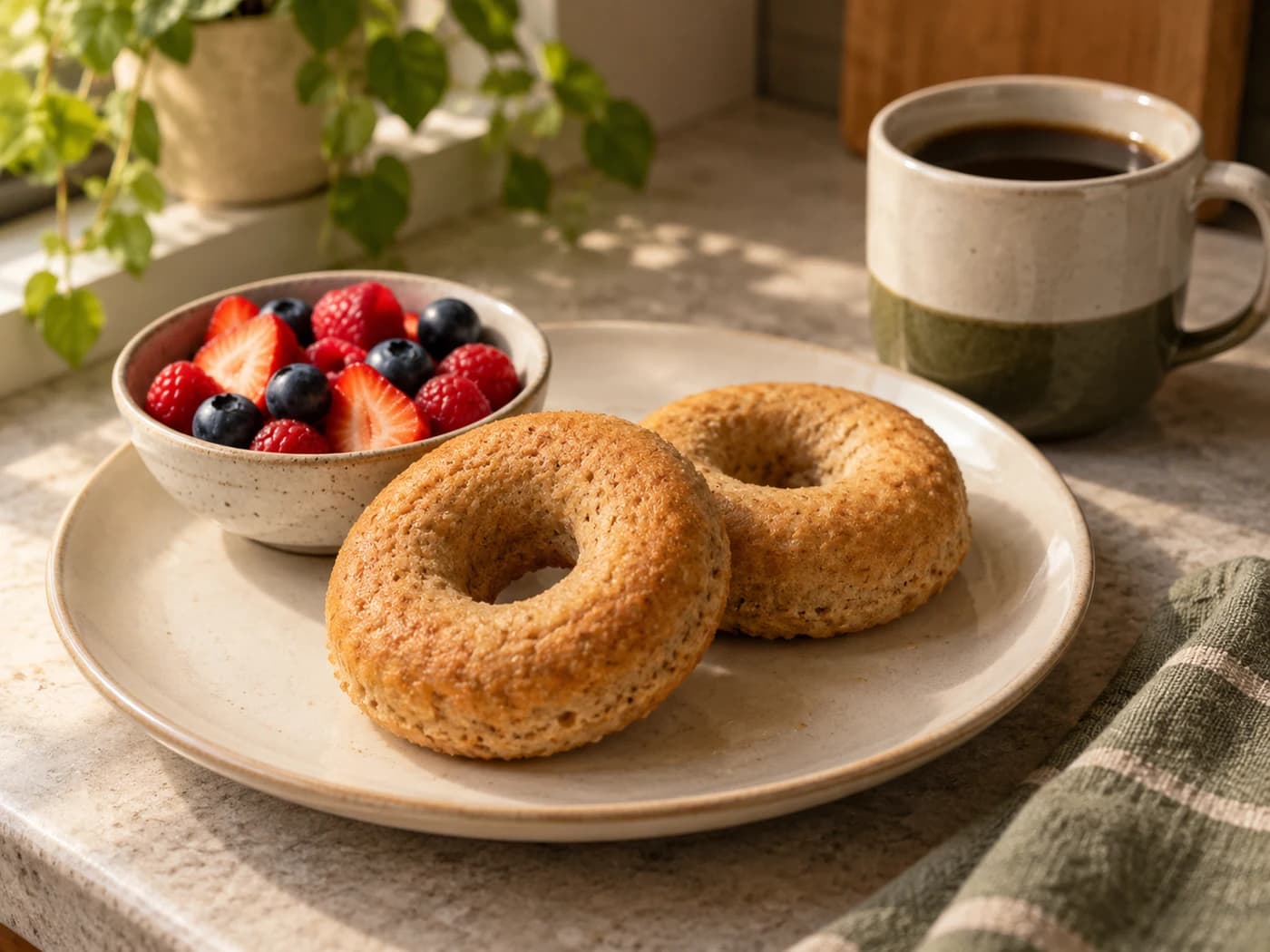
Serve the donuts after their short cooling period, when the rings are firm enough to lift without tearing. The plain vanilla-cinnamon flavour suits an unsweetened coffee or tea. A few fresh berries beside the plate give a juicy contrast to the oat crumb. They do not have to be pressed into the batter or piled over every ring. A simple plate also makes it clear which part belongs to the reference donut and which part you have added.
For breakfast
One or two rings can sit alongside whatever else you normally eat in the morning. A weighed yogurt portion is one option, while fruit can add variety. Consider the complete meal rather than judging breakfast only by the donut’s protein figure. If you add a sweetened drink, nut butter or a generous topping, include those amounts when tracking. The plain recipe offers a useful starting point, but it does not describe every possible breakfast plate made around it.
For an afternoon snack
A single donut can be enough when you want a small bake with your drink. Two give a more substantial portion with about 17g protein and 245 calories. Choose according to appetite and the time until your next meal. You do not need to turn every snack into a large protein target. A comfortable, repeatable portion is often more useful than changing the batter each week to chase a higher number.
If you want a glaze
A thin glaze, chocolate drizzle or cinnamon-sugar coating is an optional serving choice. Measure what actually goes onto the rings and add it to the calculation. An entire bowl of prepared glaze is not necessarily the amount consumed if some remains behind, so track the applied portion when possible. Yogurt toppings should be treated as chilled dairy and stored accordingly. The photographs and reference macros show plain donuts, avoiding the confusion of a frosted appearance paired with uncoated nutrition.
Serve a few at a time
For a shared plate, put out the portion you expect to eat soon and keep the rest stored appropriately. Use a clean utensil for any yogurt dip and a separate spoon for other toppings. Let anyone with allergies know that the reference contains egg and dairy and that the example whey contains soy. Labels and cross-contact statements still matter. A homemade ring can be a cheerful little bake without making claims about health outcomes or needing elaborate decoration.
Meal Prep & Storage
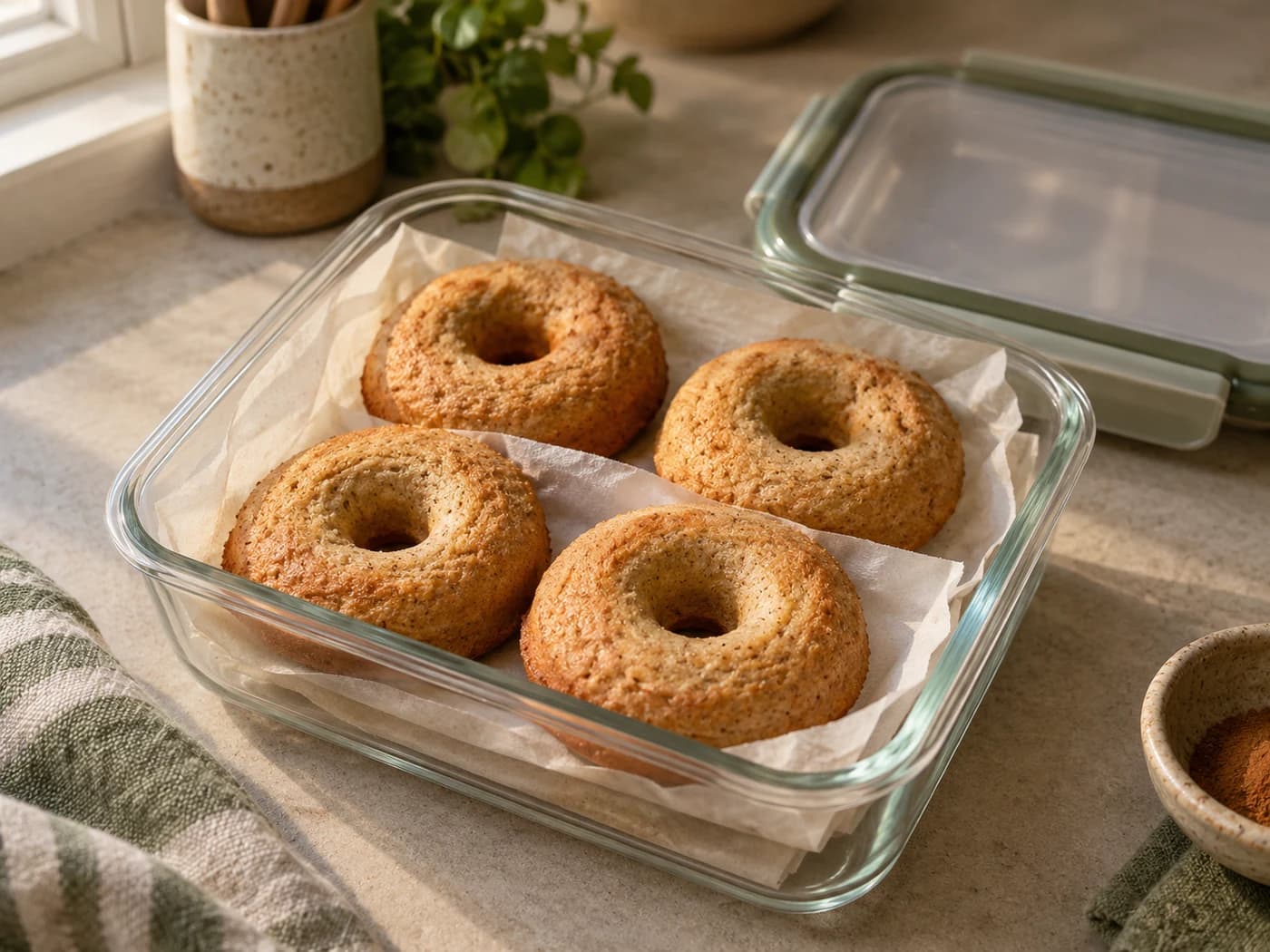
Bake the rings, let them cool fully and then pack the plain portions. Refrigerate at 40°F / 4°C or below and plan to use them within three to four days with suitable handling as a conservative storage window. This guidance follows general leftovers and cooked-egg handling principles; it is not a measured shelf-life study of this exact donut formula. The texture may become firmer or drier during refrigeration, which is a quality consideration separate from the need to keep food stored appropriately.
Keep moisture out of the container
Warm donuts can release steam into a closed box and leave the bottoms damp. Use a rack until they have cooled, then arrange them with a little space or separate layers with parchment. Keep fruit, yogurt and glaze separate when possible. A wet topping stored directly on a ring can soften its surface and change how long the plated food is pleasant to eat. Pack what you actually plan to serve rather than decorating the whole batch in advance.
Plan extra batter rounds safely
If you have one six-well pan, keep the waiting half of the raw batter refrigerated while the first round bakes and the pan cools enough to handle. The second round can behave slightly differently after a longer rest, so check it independently. Do not leave bowls of egg-and-yogurt batter on the counter for a long series of oven rounds. For a large batch, mixing in manageable base batches may be easier than storing one oversized bowl while you repeatedly refill a single pan.
Freezing individual rings
Freeze fully cooled plain donuts in suitable packaging, with about one month as a practical quality target. That is a planning suggestion rather than a tested promise of identical texture. Separate the rings so you can take one or two without thawing the entire batch. Note the preparation date and protect the food from freezer air and strong smells. Thaw a portion in the refrigerator and keep perishable yogurt toppings chilled. A topping added just before eating generally gives a clearer portion and a better surface.
A short warm-up if you prefer
A refrigerated plain donut can be served cold or warmed briefly for comfort. Microwave heating is fast and can make a small whey bake rubbery if it runs too long; start with a short interval and judge the result. Any reheating guidance for leftovers should be followed where applicable. Do not use warming to repair food that has been left out too long. Keep total time outside refrigeration within two hours, or one hour when the environment is above 90°F / 32°C, and return remaining perishable sides promptly.
Full Nutrition Information
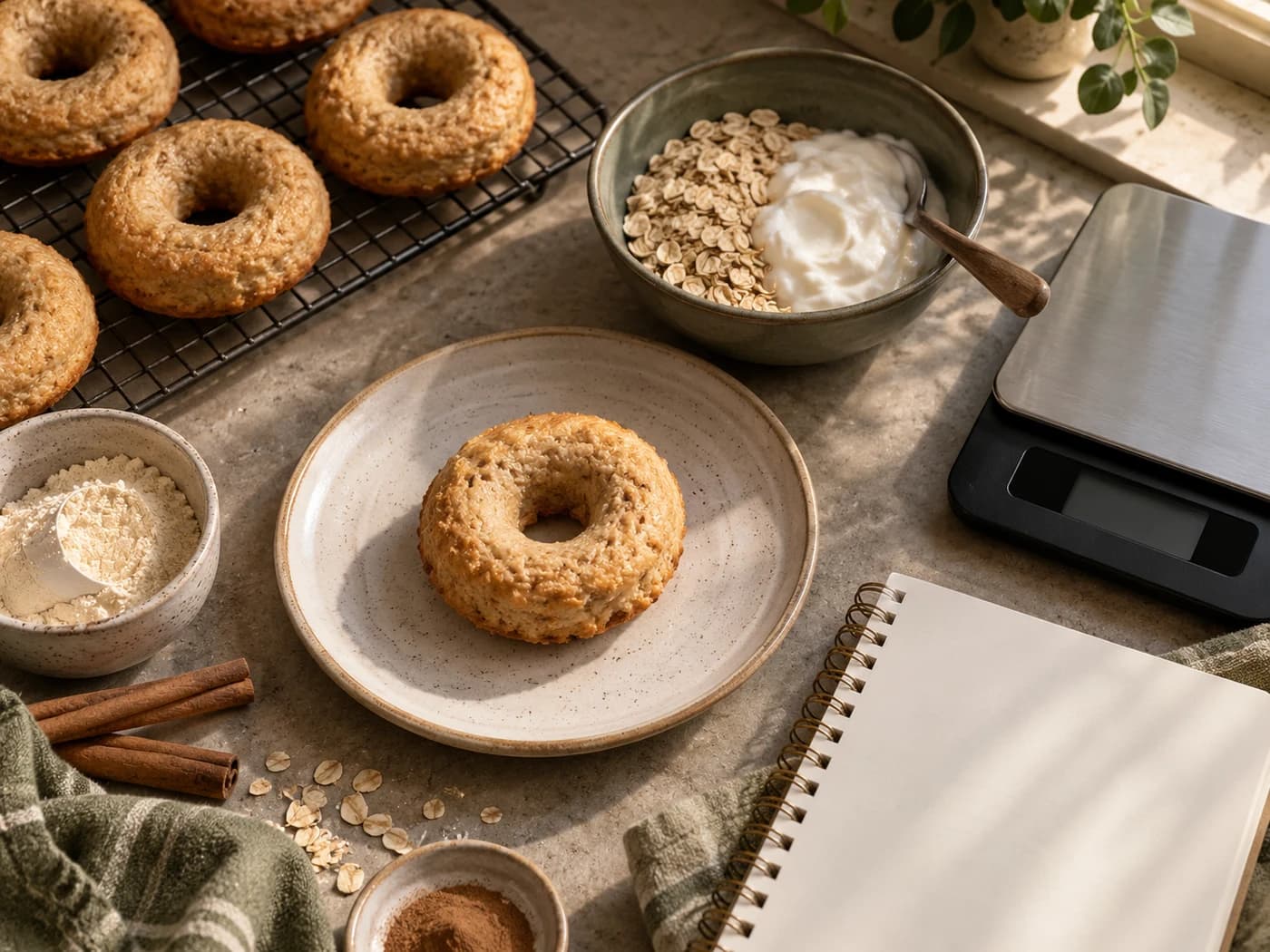
The nutrition table starts with each ingredient’s reference composition per 100g and multiplies it by the weighed amount. Those contributions are added for the complete batch, then divided by twelve. This includes the oats, whey, yogurt, eggs, milk, sugar, all measured oil, baking powder, cinnamon, salt and vanilla. The result describes a plain standard donut made from an equal share of that mixture. It does not quietly omit the sugar or pan oil in order to make the number look smaller.
Beyond the four main numbers
One reference donut provides approximately 1.4g fibre, 5.3g total sugars, 0.6g saturated fat and 116mg sodium. Total sugars include dairy sugars, the measured granulated sugar and the whey label’s sugars. Added sugars are not separately calculated. The 50g sugar in the batter contributes about 4.2g per twelfth by simple division, but that is not a complete added-sugars declaration for all ingredients. Cholesterol and a complete vitamin-and-mineral panel are not calculated because the powder reference does not provide every relevant value.
The two reference sources
Most ingredients use historical USDA SR28 generic food composition values. The vanilla whey uses the linked manufacturer’s French Vanilla label: 376 calories and 79g protein per 100g, alongside its listed fat, carbohydrates, sugars, saturated fat and salt. Sodium is estimated from salt using the usual salt-to-sodium conversion of 2.5. Powder fibre is undeclared, so the fibre estimate counts the other ingredients only. Another flavour, region or reformulation can have different values and should be calculated with its own current label.
Rounding and baking losses
The exact ingredient calculation gives about 122.4 calories, 8.51g protein, 14.12g carbohydrates and 3.56g fat per donut before rounding. A little batter may remain in a bowl, and some oil may remain on the brush or pan. The reference conservatively counts the full listed amounts rather than inventing a fixed retention percentage. Baking also removes water, so the finished donut weight need not equal the raw batter portion. That water change does not justify deleting ingredient energy from the complete batch.
Calculate your actual version
Use your package labels if you want a brand-specific estimate. Keep the whole-batch total separate from the number of servings, then divide by the rings you actually make. Equal batter portions improve consistency, while uneven rings are better estimated by their share of the batch. The food calculator can help total a chosen ingredient list. Treat the result as a practical recipe estimate rather than a laboratory analysis, especially when several labels are rounded or a topping is only loosely measured.
| Ingredient | Amount | Calories | Protein | Carbs | Fat |
|---|---|---|---|---|---|
| Rolled oats | 150g | 569 kcal | 19.7g | 101.5g | 9.8g |
| Vanilla whey protein blend | 60g | 226 kcal | 47.4g | 3.1g | 2.5g |
| Plain nonfat Greek yogurt | 200g | 118 kcal | 20.4g | 7.2g | 0.8g |
| Whole egg | 100g | 143 kcal | 12.6g | 0.7g | 9.5g |
| Skim milk | 60g | 20 kcal | 2.0g | 3.0g | 0.0g |
| Granulated sugar | 50g | 194 kcal | 0.0g | 50.0g | 0.0g |
| Canola oil | 20g | 177 kcal | 0.0g | 0.0g | 20.0g |
| Baking powder | 6g | 3 kcal | 0.0g | 1.7g | 0.0g |
| Ground cinnamon | 2g | 5 kcal | 0.1g | 1.6g | 0.0g |
| Fine salt | 1g | 0 kcal | 0.0g | 0.0g | 0.0g |
| Vanilla extract | 5g | 14 kcal | 0.0g | 0.6g | 0.0g |
| Whole batch | 12 standard donuts | 1468 kcal | 102.2g | 169.5g | 42.7g |
| One reference serving | Batch ÷ 12 | 122 kcal | 8.5g | 14g | 4g |
| Dietary fiber | 1.4g |
|---|---|
| Total sugars | 5.3g |
| Saturated fat | 0.6g |
| Sodium | 116mg |
Estimated recipe nutrition, not a laboratory analysis. Includes all weighed batter ingredients and the complete measured oil, including pan greasing. Glaze, toppings and sides are additional. Powder fibre is undeclared; its contribution is not calculated. Cholesterol, added sugars and complete micronutrients are not calculated.
How This Fits Your Daily Protein Goal
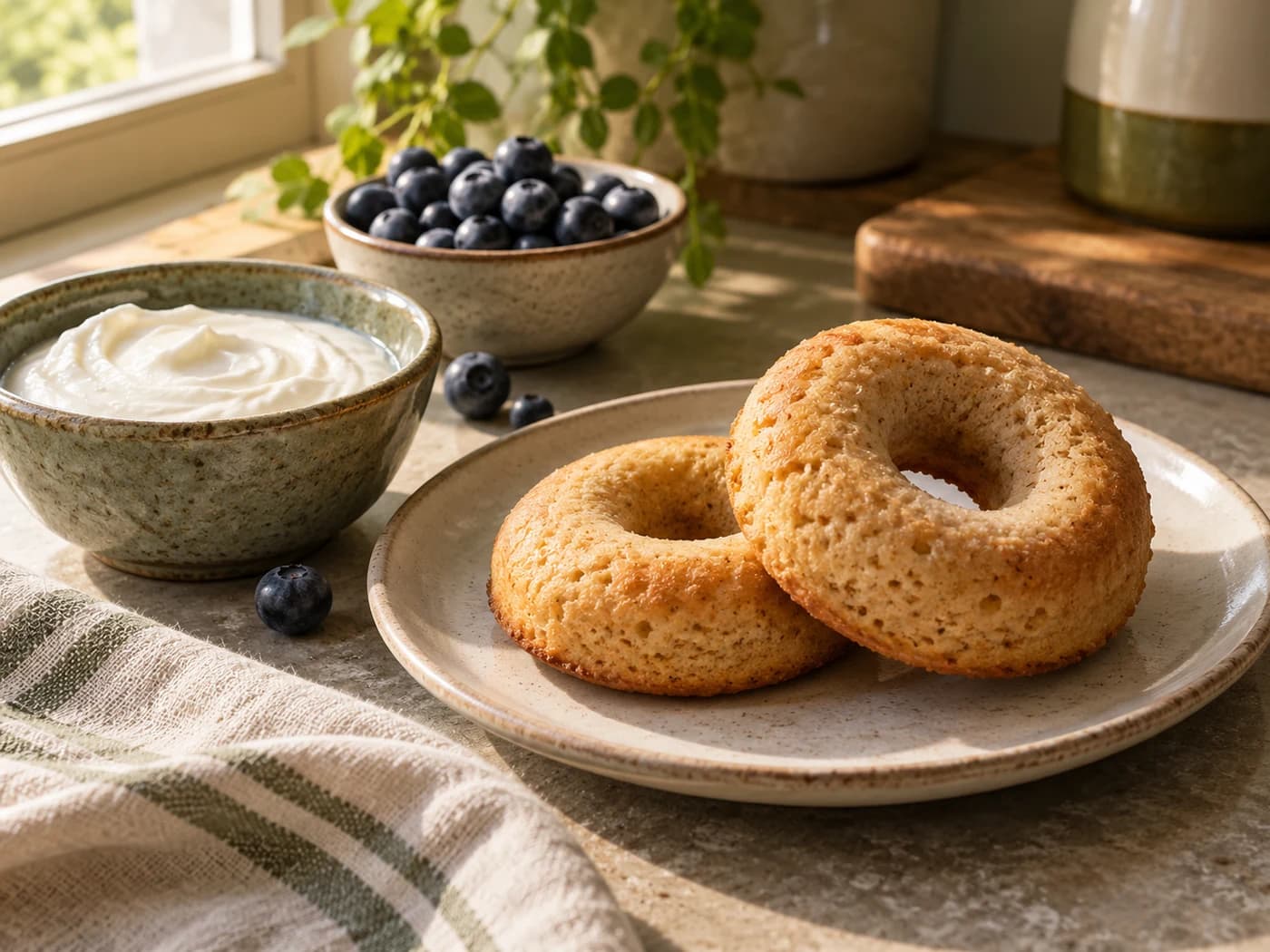
One reference donut contributes about 8.5g protein, and two contribute about 17g. For an example daily target of 100g, two rings account for roughly 17%; for 120g, about 14%; and for 150g, about 11%. These are arithmetic comparisons, not universal recommended targets. Your own target depends on your circumstances and the planning approach you use. The protein calculator can provide a starting point, with its assumptions explained on the tool page.
Start with ordinary meals
Breakfast, lunch, dinner and your usual snacks may already supply most of the protein you planned. A donut can add to that total, but it does not need to carry the whole plan. Look at foods you regularly enjoy and can prepare consistently. Dairy, eggs, beans, tofu, fish and other suitable staples can contribute across the day. A small homemade bake can fit alongside those foods without becoming the only reason you meet a numerical target.
A worked snack example
Suppose your chosen target is 120g and your meals so far total around 95g. Two reference donuts add about 17g, taking the arithmetic total to roughly 112g. A separate 100g serving of the reference Greek yogurt adds another 10.2g, bringing the example to approximately 122g. That is an illustration of adding measured foods, not an instruction to eat the combination. You would still consider hunger, the complete energy intake and the foods you plan for the rest of the day.
The portion still matters
A third donut adds protein, but it also adds the calories, carbohydrates and fat of another complete portion. A half donut gives less protein and less food. Choose the amount that suits your appetite and occasion instead of automatically maximising one nutrient. If you already enjoy yogurt, a measured side may be an easier way to change the snack than adding more whey to the batter. The useful distinction is between changing the plate and reformulating the whole recipe.
Keep the plan personal
A general recipe cannot define a suitable diet for every medical condition or individual need. If you use a specific nutrition plan, follow its own guidance for ingredients and portions. For everyday tracking, consistency in the labels and serving definitions matters more than excessive decimal precision. Enjoying a donut does not require hitting the same protein number at every snack. The calculation is there to help you organise food you want to eat, with enough context to understand its contribution.
Make it personal
Where does a donut fit in your day?
Estimate your daily protein target, then plan meals you enjoy.
Recipe Card
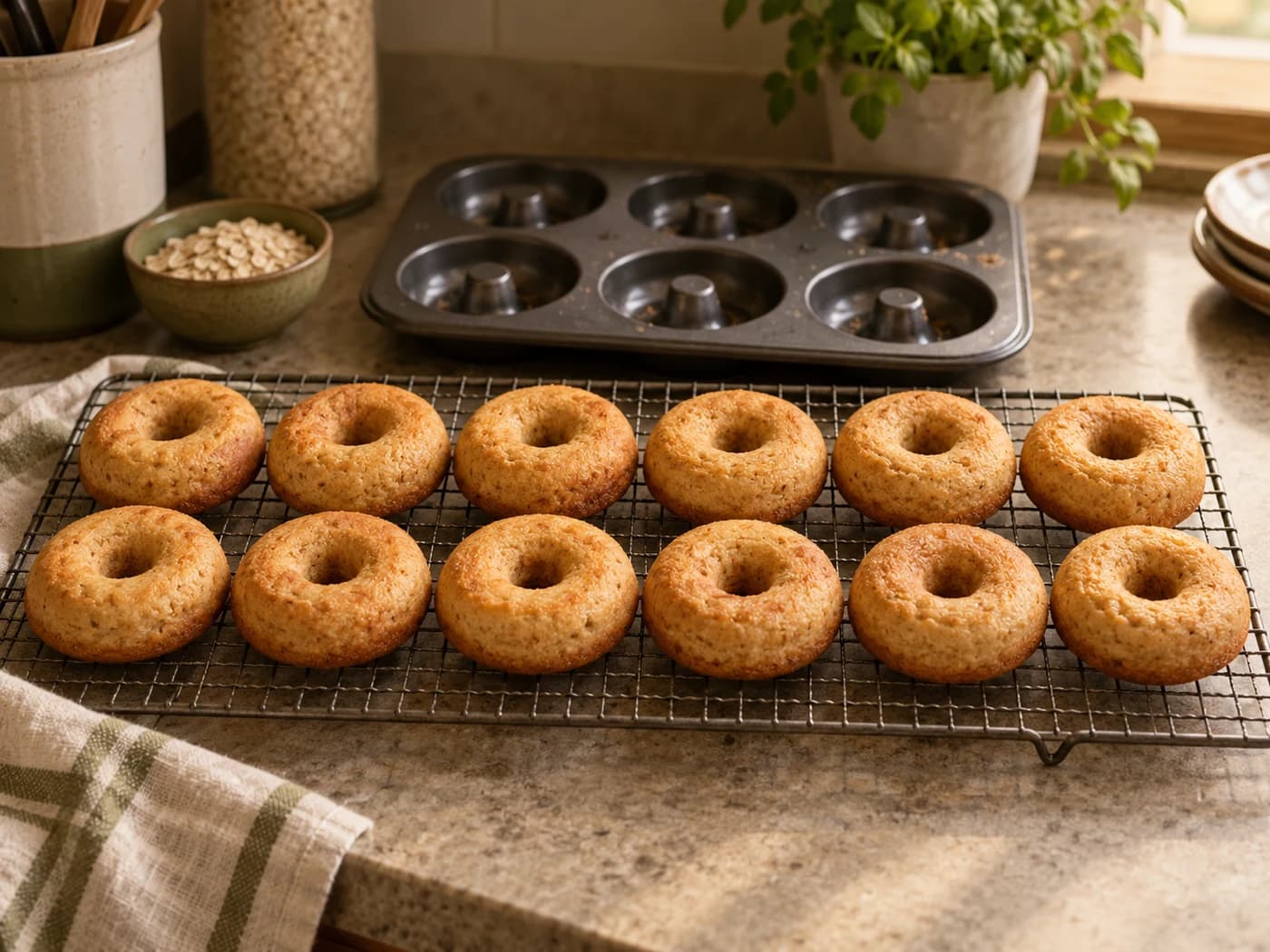
The recipe card brings the eleven ingredients and six main steps together for cooking. Its twelve-donut setting is one base batch, twenty-four is two base batches and thirty-six is three. Each setting keeps the planned reference donut size the same and multiplies all ingredient weights. The oil allocation scales as well: 4g pan oil and 16g batter oil per twelve rings. The card’s higher-yield settings therefore need more standard wells, extra pans or additional oven rounds.
Choose equipment before choosing a large batch
A pan’s number of wells tells you how many rings it can shape at once. Its cavity size tells you how much batter each ring can reasonably hold. Both matter. Confirm that your wells suit the reference portion and leave space below the rim. When scaling, check the mixing-bowl and refrigerator capacity too. There is no need to make thirty-six donuts in one enormous mixture if three manageable batches suit your equipment better.
Use the ingredient checklist
Check an ingredient after weighing it into the correct place. The oil is one listed total but is split between pan preparation and the batter in the method. The checkboxes do not change nutrition or remove ingredients from the recipe. Changing the serving setting clears them so you can review the new amounts without assuming an earlier weight still applies. Weigh the eggs without shells, and use the product-specific weight for powder rather than the scoop’s apparent volume.
Print the batch you intend to make
The Print recipe button produces a compact cooking copy focused on ingredients, method, times and portion notes. Select the planned yield before printing. Keep the full article available if you need the powder-substitution explanation, a portion variation or storage detail. The card is designed to reduce scrolling while mixing, while the longer sections explain the decisions that matter when your ingredient labels or pan size differ from the reference.
Time and nutrition after scaling
The displayed roughly fifty-minute total describes a base-batch planning estimate, including a short rest and cooling. More oven rounds mean more elapsed time. Check each tray independently and keep waiting raw batter refrigerated. The macro line remains approximately 122 calories and 8.5g protein, rounded to 9g, for each equal standard donut. Glaze, fruit, yogurt and drinks are additional. Choose a clear serving definition before comparing this card with another recipe that uses a much larger ring.
Your golden rings, ready to make
High-Protein Donuts
Oats, Greek yogurt, vanilla whey and cinnamon.
*Base-batch estimates, including a five-minute batter rest and cooling. Additional oven rounds need more elapsed time. Keep waiting raw batter refrigerated. These settings make standard donuts, not smaller mini rings.
Ingredients
Method
- Prepare the pan and oats
Preheat to 350°F / 175°C conventional. Brush 4g of the total oil across 12 standard ring wells, including posts. Reserve pan oil for additional rounds if needed. Grind 150g oats finely.
- Mix dry and wet ingredients
Whisk oats, 60g whey, 6g baking powder, 2g cinnamon and 1g salt. Separately whisk 200g yogurt, 100g egg without shells, 60g milk, 50g sugar, 5g vanilla and the remaining 16g oil.
- Fold and rest briefly
Fold dry ingredients into wet until no dry pockets remain, scraping the bowl. Rest about five minutes. Batter should be thick but pipeable or spoonable. Do not taste raw batter; keep egg-contact utensils away from ready-to-eat foods.
- Portion into the wells
Divide the entire batter into 12 equal portions in suitable standard ring wells, roughly 54g each before bowl losses. Pipe around posts, keeping holes clear and leaving space below the rim, roughly two thirds to three quarters full. Use extra pans or rounds; do not overfill small wells.
- Bake until set
Bake roughly 12–16 minutes, checking from ten. Tops should be set, lightly coloured and spring gently; a toothpick should have no raw batter. Egg-containing batter should reach at least 160°F / 71°C internally, checked away from the pan. Use texture and temperature cues together.
- Release, cool and store
Rest about five minutes in the pan, then ease onto a rack and cool at least another ten minutes for serving. Cool fully before packing. Refrigerate at 40°F / 4°C or below; use within 3–4 days with proper handling. Keep waiting raw batter refrigerated between rounds. Toppings are additional.
Fill equal ring wells below the rim and check each round. Timing varies with pan and powder; cool fully before packing.
Protein before rounding: 8.5g. Includes all batter ingredients and the full measured oil, including greasing. Glaze and sides are additional. Contains egg and milk; reference whey contains soy. Check labels and oat cross-contact. Refrigerate cooled donuts and use within 3–4 days with proper handling.
Frequently Asked Questions
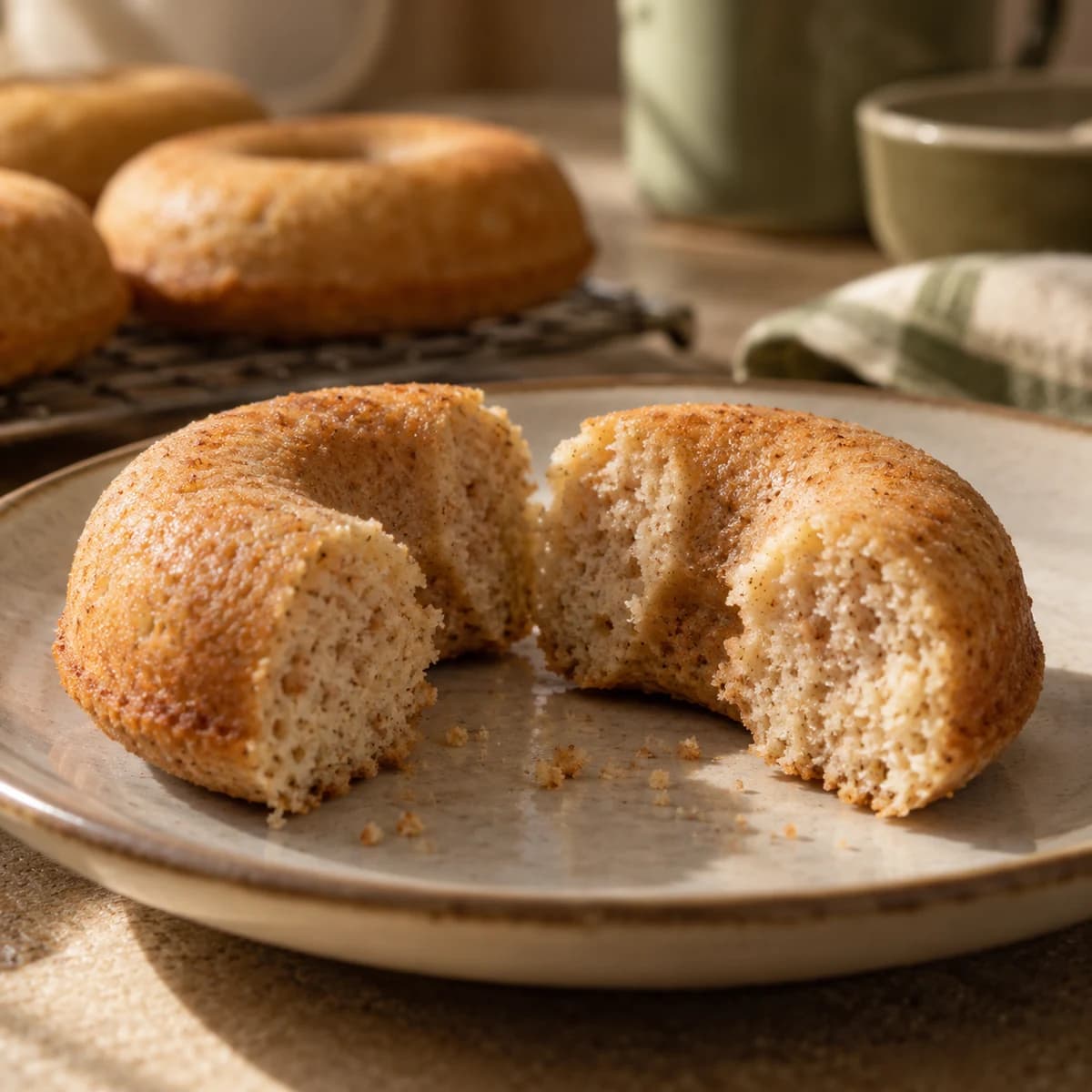
Most questions about a protein donut happen when a familiar ingredient has changed: a different powder is on offer, the yogurt is thinner, or the only available mould has smaller wells. The answers below relate those choices to the published reference. They explain which changes mainly affect the serving calculation and which changes can affect the batter itself. That context is more useful than promising that every product will give the same shape, texture and baking time.
When the batter behaves differently
Check the weighed amounts and the ingredient types before adjusting the mixture. A forgotten milk portion, a very absorbent powder or coarse oat flakes can each change how the batter pipes. Rest it briefly as described, then assess it. If you make a change, write down what you added and use the resulting amounts for nutrition. A thicker batter is not automatically better, and a looser batter does not automatically need another scoop of whey.
When the yield changes
The reference uses twelve equal shares of the measured batch. A smaller pan may produce more rings, and a deeper large pan may produce fewer. The complete batch nutrition stays tied to the ingredients, while the per-ring amount changes with the yield. The baking check changes with cavity depth too. Keep these two questions separate: how much of the batch each ring receives, and how long that shaped portion needs to bake properly.
After the oven
Let the rings rest briefly in the pan and then cool on a rack. A warm ring may tear more easily than a cooled one, and sealing it too soon can leave the container damp. A dry crumb can reflect a long bake or a changed powder, while a gummy centre needs a closer look at doneness and ingredient balance. The FAQ answers work best alongside the method, with your actual batter and pan in mind rather than a timer alone.
How much protein is in one donut?
One twelfth of the complete reference batch provides approximately 8.5g protein, rounded to 9g in the quick summary. Two provide about 17g. All listed ingredients and pan oil are counted; toppings and sides are extra. A larger ring carries a larger share, so use equal batter portions and your actual yield.
Are these baked or fried?
They are baked cake-style rings in a standard donut pan at 350°F / 175°C conventional. Baking powder gives lift, with no yeast proofing or deep-frying step. Their oat, whey and yogurt crumb is intended as a modest cake-style bake. Frying needs a separately developed dough and oil calculation.
Which protein powder should I use?
Start with 60g vanilla whey blend, weighed rather than measured by scoops. The reference uses the linked French Vanilla label with 79g protein per 100g. Flavours and thickeners vary. Casein, plant powders and meal-replacement blends can absorb moisture differently and are not established direct swaps.
Can I make them without powder?
The 60g whey contributes dry ingredients and protein. Removing it or replacing it with more oats changes the moisture balance and crumb. A powder-free version has not been established as identical here. Use a recipe developed without powder rather than removing the whey and keeping these nutrition figures or timings.
Can I use oat flour?
Plain finely milled oat flour can be explored at the same 150g starting weight, judging the batter after its short rest. The reference composition uses rolled oats. Wheat, almond and coconut flour behave differently. Gluten avoidance requires suitable labelled oats, compatible other ingredients and appropriate preparation conditions.
Why are my donuts dry?
Too much powder, incorrect liquid amounts, small shallow wells or a long bake can dry the crumb. Weigh ingredients, rest briefly and begin checking around ten minutes. Stop when the doneness checks are met instead of waiting for dark colour. Judge a cooled sample and review any powder change.
Why is the batter too thick or loose?
Powder type, yogurt thickness, oat grind and measurement errors affect consistency. Complete the five-minute rest, then review the weights before adjusting. Record any added milk or powder and recalculate. Repeated unweighed additions make a different mixture whose texture and timing are no longer described by the reference alone.
How full should the wells be?
Use twelve equal shares in suitable standard ring wells, roughly two thirds to three quarters full with space below the rim and the centre posts clear. The reference gives roughly 650g batter before bowl losses, around 54g each. If wells are too small, change the yield instead of overfilling.
How do I check doneness?
Look for set tops, lightly coloured edges and a gentle spring. A toothpick should have no raw batter; moist crumbs are acceptable. Egg-containing batter should reach at least 160°F / 71°C internally, checked away from the pan. Use the texture checks too, because a minimum temperature alone does not establish the ideal crumb.
Can I use a muffin pan?
A muffin pan makes deeper portions and needs a separate baking assessment. That alternative has not been timed or physically verified here. Ring wells are the reference equipment because they determine shape and depth. Recalculate the serving amount if the batter makes a different number of pieces.
Can I add icing or cinnamon sugar?
Yes, as a separate measured serving choice. The plain reference has no glaze, coating, chocolate or sprinkles. Count what actually goes onto the rings. Yogurt-based toppings need chilled handling. Keeping stored donuts plain and adding toppings near serving can make portioning clearer and avoid extra surface moisture.
Are they gluten-free, dairy-free or vegan?
The reference contains milk and eggs, and the example whey contains soy. Oats may have gluten cross-contact. Suitable labelled oats and compatible preparation are required if avoiding gluten. Replacing whey, yogurt, milk and eggs for a vegan version is a larger reformulation requiring its own method, not an established identical swap.
What do 12, 24 and 36 mean?
The card makes twelve, twenty-four or thirty-six standard reference rings by multiplying all ingredients. Each twelve uses 4g oil for wells and 16g in batter. Per-donut nutrition stays constant with equal portions. Use extra pans or rounds and refrigerate waiting batter. Twenty-four standard donuts differ from twenty-four mini rings made from the original batch.
How do I store or freeze them?
Cool fully, pack plain and refrigerate at 40°F / 4°C or below. Use within three to four days with proper handling as a conservative window. Freeze cooled rings for about one month as a practical quality target, with possible texture changes; thaw in the refrigerator. These are planning guidelines, not measured shelf-life guarantees.
More High-Protein Recipes
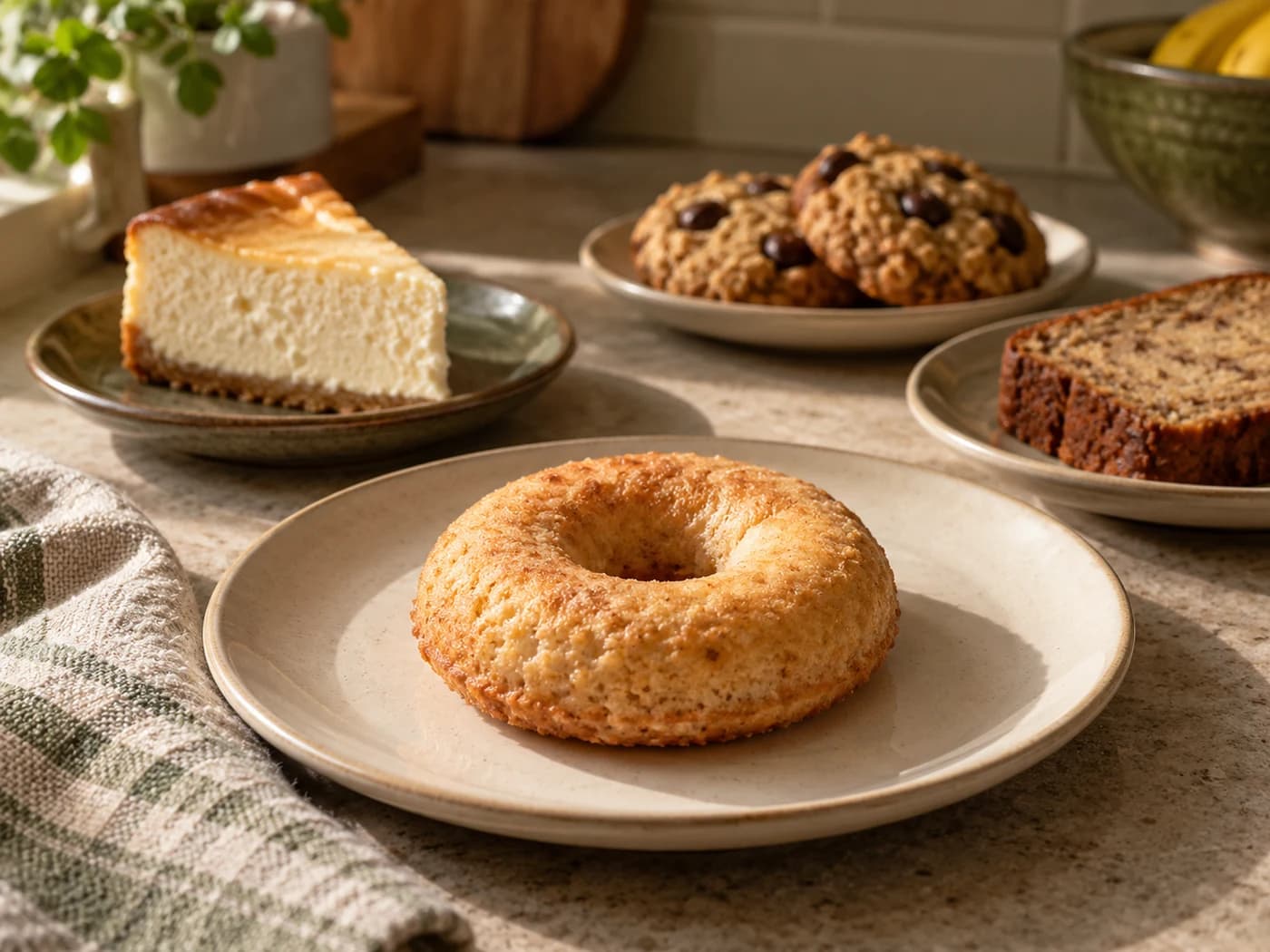
If you enjoy a small homemade bake, the recipe collection offers several different preparation styles. Cookies make individual portions without a ring pan. Banana bread gives a sliceable loaf. Cheesecake needs a long chill and suits making the day before. French toast is cooked fresh in a pan. Those differences matter as much as the headline protein number when choosing what you will actually have time and equipment to make.
Other sweet recipes
The high-protein cookies guide uses peanut butter, oats, vanilla whey and chocolate chips in measured portions. The banana bread guide uses a ripe-banana loaf with yogurt, oats and whey. The cheesecake page combines cottage cheese, Greek yogurt and Neufchatel with a biscuit base. Each has its own serving definition, ingredient assumptions and method. Read those details before comparing the macros, because one cookie, one loaf slice and one cheesecake wedge are different amounts of food.
Breakfast and savoury choices
Bagels, French toast and oatmeal provide other breakfast options, while pizza and mac and cheese offer familiar savoury meals. Their measured ingredients include the relevant crust, sauce and dairy, rather than only the protein-rich parts. If you are organising meals for the week, a mix of ordinary meals and a few bakes may be more convenient than making several desserts at once. Pick recipes that suit the time, appetite and ingredients you already have.
Use the collection as a practical menu
The recipe hub makes it easier to move between the guides without guessing their routes. Look for the preparation style you need: a short bake, a chilled dessert, a pan-cooked breakfast or a meal ready to eat after cooking. Check the serving size before comparing protein amounts and count any extras you plan to add. A useful next recipe is one you want to make again, with a method that feels manageable and a portion that makes sense at your table.