
Browse the 15 recipe sections
One reference serving: one quarter of the whole recipe, about 434 calories and 51.8g protein. Chicken is weighed raw; white beans fully cooked and drained. All yogurt, oil and salt are counted. Sides are additional; timings are estimates. See the breakdown.
Recipe Overview
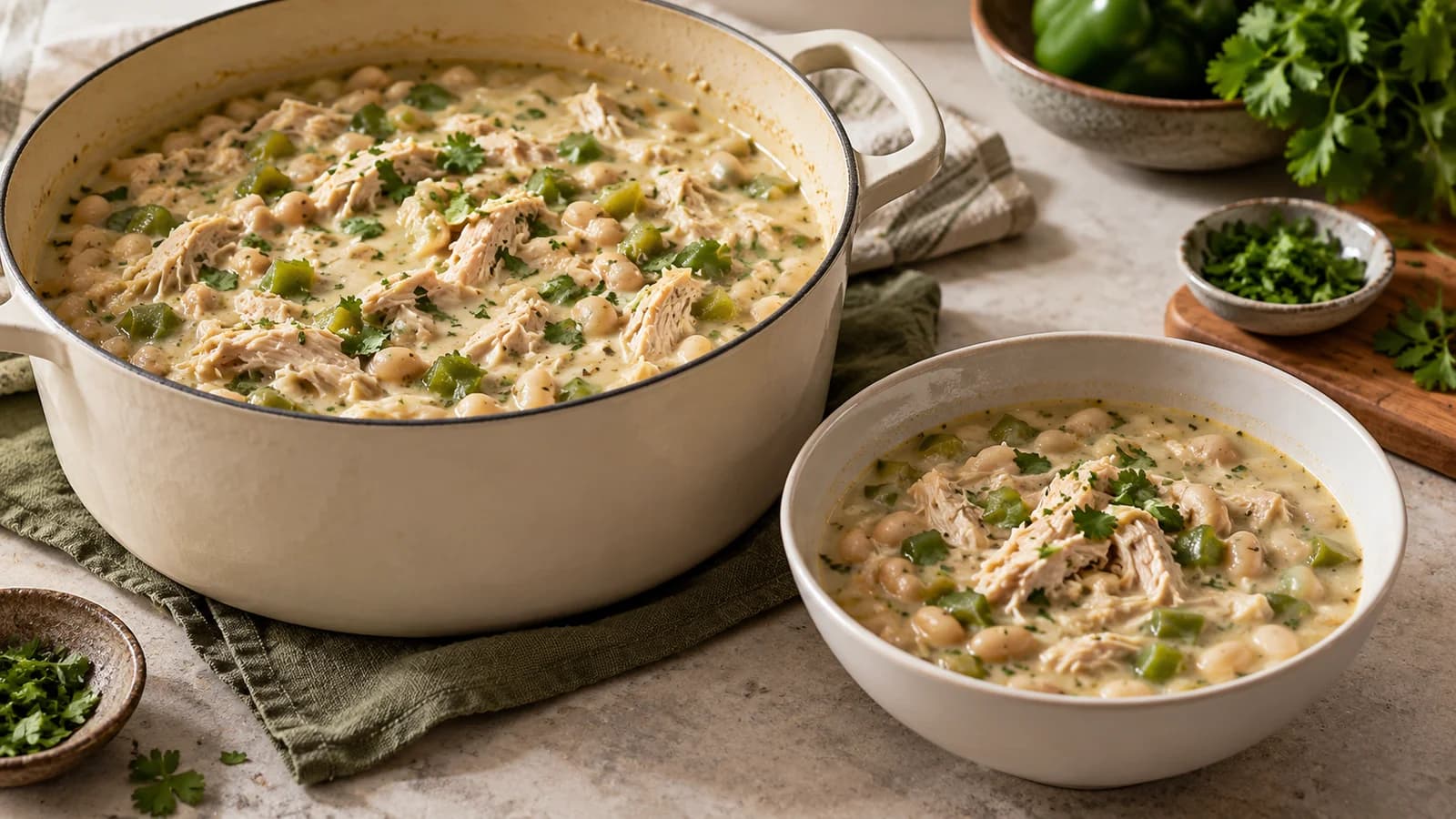
A generous bowl with a bright finish
This high protein white chicken chili combines tender shredded chicken, soft white beans and green peppers in a lightly creamy base. Cumin and oregano bring warmth, lime lifts the finish, and a small handful of cilantro adds freshness. Greek yogurt is stirred through at the end, while some of the beans are mashed to give the liquid body. The result is intended to be a spoonable, substantial dinner with visible chicken and beans in every portion.
The reference makes four complete servings. Each receives chicken starting at 150g raw weight, 120g fully cooked drained white beans, 50g plain nonfat Greek yogurt and one quarter of all vegetables, seasonings, oil and chili liquid. The estimate is approximately 434 calories and 51.8g protein per serving. Chips, bread, cheese, avocado and extra yogurt are optional additions with their own quantities; none is silently included in those numbers.
A practical stovetop approach
Allow about 15 minutes for preparation and 30 minutes for cooking, or roughly 45 minutes altogether, with fully cooked beans already available. You will need a heavy pot of at least five litres, a scale, a food thermometer, a ladle, a small bowl and clean tools for shredding cooked chicken. This is a stovetop method with a short simmer, rather than a slow-cooker or pressure-cooker formula with assumed equivalent timing.
The chicken cooks in the seasoned liquid before being lifted out and shredded. A measured portion of the cooked beans is mashed into the pot, then the chicken returns. Yogurt is loosened with a little hot liquid and added after the heat is switched off and bubbling subsides. That sequence keeps the creamy ingredient away from the main simmer and lets you assess thickness before making a texture adjustment.
What the recipe evidence can establish
The exact weighed formula has not been physically kitchen-tested. Timings are planning estimates, variations are calculated suggestions, and generated photographs are illustrative. Nutrition uses historical generic USDA values and assumes plain water rather than packaged broth. Actual labels and observed cooking behaviour take priority. The article explains those choices so that a convenient substitution can still be made deliberately, with a fresh calculation when the ingredient form or quantity changes.
Why You’ll Love This Recipe
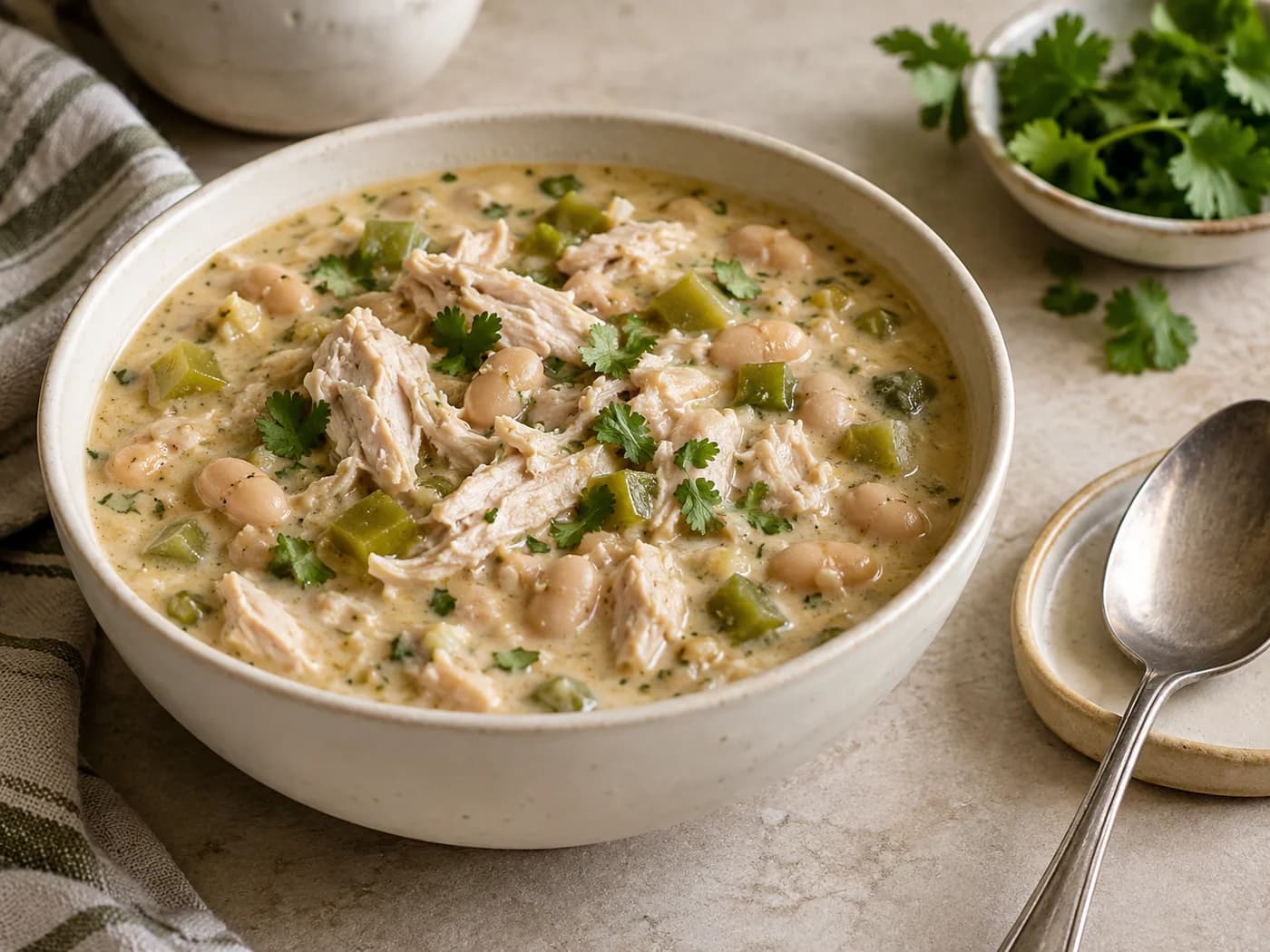
Creaminess comes from more than dairy
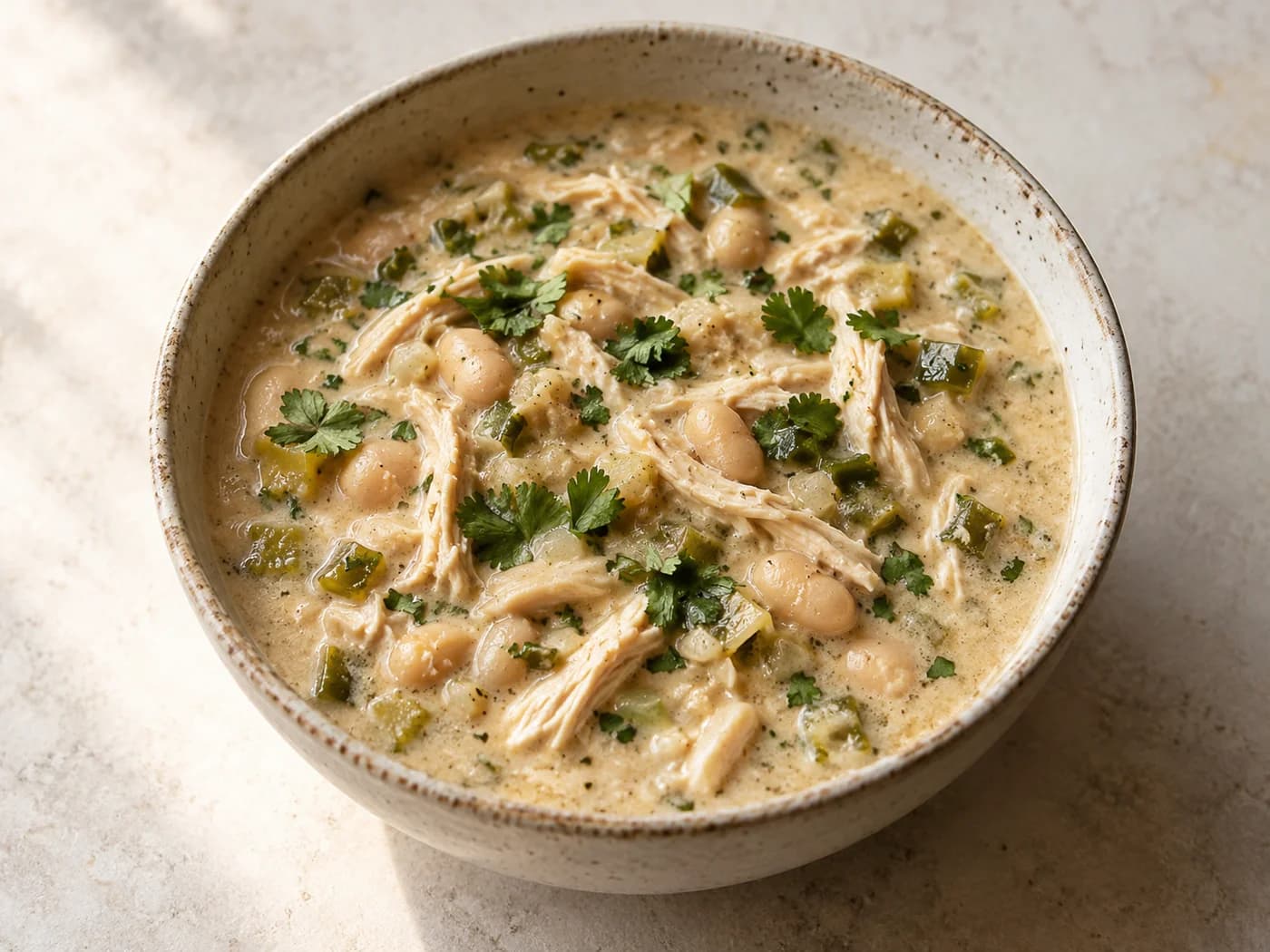
Mashing some of the beans gives the chili body before yogurt enters the pot. That matters because the yogurt can then provide a gentle tang and a lighter creamy finish without being asked to turn a thin soup into a thick stew by itself. Some beans remain whole, so each spoonful has a soft, distinct bite. You can see the main ingredients rather than eating a completely blended mixture with a few chicken strands scattered on top.
The flavour also develops in stages. Onion and green pepper soften in a measured amount of oil, garlic and spices warm briefly, and chicken cooks in the same pot. Lime and cilantro arrive at the end. Those small changes in timing help keep the finished bowl from tasting like every ingredient was boiled together until it lost its character. You still need to taste your own ingredients, especially the peppers and yogurt, which can vary considerably.
Familiar ingredients with useful flexibility
There is no protein powder in the reference. Chicken supplies most of the protein, white beans add more along with carbohydrate and fiber, and Greek yogurt contributes its own portion. The ingredient list is longer than a three-item shortcut, but most of the work is weighing, chopping and a controlled simmer. Keeping beans already cooked makes the main dinner sequence much more manageable than trying to cook dry beans during the chicken stage.
The meal also lends itself to ordinary portioning. Stir the pot well and divide the solids and liquid together, instead of trying to build four elaborate plates with different toppings. If people enjoy different heat levels, they can add an appropriate condiment to their own bowl and count it separately when needed. The base contains a modest measured jalapeño amount, but that is not a guarantee of mildness; individual peppers differ.
A useful dinner to return to
This is the kind of recipe that can sit alongside a pasta bake, a tortilla dinner or a noodle bowl in a varied weekly collection. It offers a different texture without requiring a completely unfamiliar shopping list. It can also be portioned for later with safe handling, although the yogurt finish needs some care during reheating. Choose it because a warm chicken-and-bean bowl sounds appealing, with protein as one useful feature of the complete meal.
Nutrition at a Glance
- Calories
- 434kcal
- Protein
- 52g
- Carbs
- 40g
- Fat
- 7g
Calories and protein in a complete serving
One complete serving provides approximately 434 calories and 51.8g protein, shown as 52g on the rounded macro cards. The reference has four equivalent portions, with every component shared evenly. That makes a serving more specific than a ladleful, a mug or any bowl that happens to be available. Bowl sizes vary, and a serving that contains mostly chicken will not have the same composition as one containing mostly liquid.
Chicken is the largest protein contributor. Per serving, its 150g raw starting portion contributes about 33.8g protein under the generic reference. The 120g cooked white beans add about 11.7g, and 50g Greek yogurt adds about 5.1g. Vegetables and seasonings make smaller contributions. These ingredient values explain the total without implying that every brand or every cooked chicken portion will reproduce precisely the same result.
Carbs, fat and fiber belong in the picture
Carbohydrate is approximately 39.9g per serving, largely from white beans, with smaller amounts from vegetables and yogurt. Fat is about 7.4g, including all the measured olive oil and the natural fat in the ingredients. No finishing drizzle is built into the reference. A spoonful of extra oil, a cheese topping or an avocado side may be enjoyable, but it would change the complete meal you are tracking.
Fiber is estimated at approximately 9.4g per serving. Reducing the beans changes that figure as well as calories and protein, so a smaller bean share is not simply the same chili with less energy. The beans provide texture and thickness too. A useful comparison looks at how the adapted bowl eats, not just whether one number becomes smaller. The variation section gives measured examples to make that tradeoff clear.
Sodium depends heavily on what goes into the pot
The estimate is about 293mg sodium per serving using unsalted cooked beans, plain chicken, plain yogurt, water and exactly 2g added salt across the batch. Canned beans, rotisserie chicken, broth or bouillon can change it substantially. This is a description of the reference assumptions rather than a claim that all white chicken chili is low in sodium. Use your actual labels if sodium is relevant to your own eating plan.
Ingredients
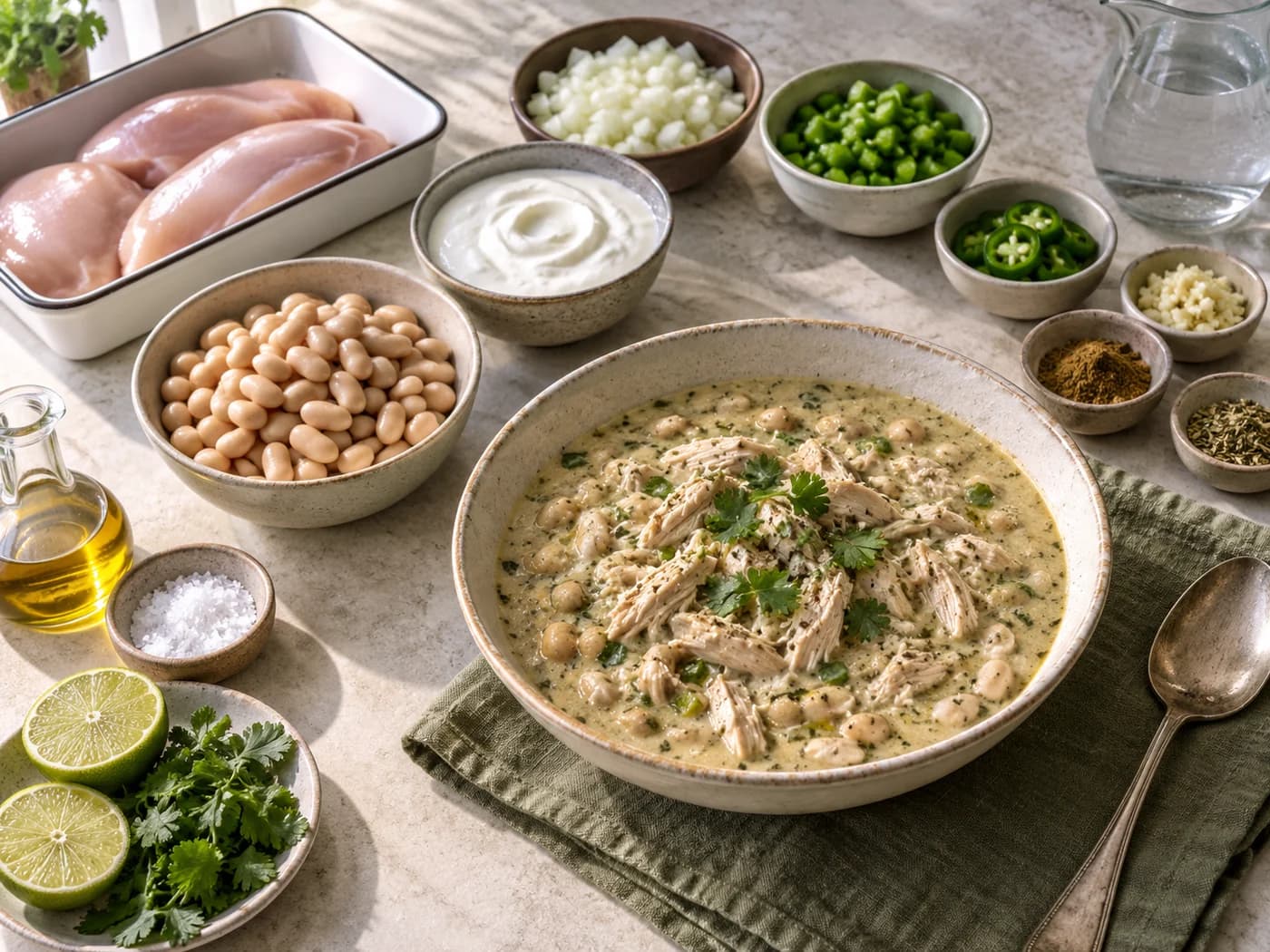
Start with the correct food forms
Use 600g raw skinless boneless chicken breast, divided into four cutlets of about 150g each and approximately 1.5cm thickness. The reference is plain chicken without an added solution or pre-seasoning. Thickness matters for cooking even when the total weight is correct. A single thick breast and a thin cutlet can weigh the same amount while behaving very differently in a short simmer; shape the pieces before they go into the pot.
Weigh 480g fully cooked, unsalted white beans after draining. This is edible cooked weight, not the amount of dry beans to begin with and not the gross weight printed on a can. The recipe does not cook dry beans during its thirty-minute cooking sequence. If using canned beans for convenience, check whether the label describes drained beans or beans with their liquid, and recalculate with suitable information rather than treating every white-bean product as identical.
Vegetables, aromatics and the creamy ingredient
Prepare 160g peeled onion, 120g trimmed green bell pepper and 20g trimmed fresh jalapeño, all diced. Removing jalapeño seeds and membranes may suit your heat preference, but it does not make every pepper equally gentle. Avoid rubbing your eyes and clean hands and tools afterwards. Add 12g peeled chopped garlic, 4g ground cumin and 2g dried oregano. The cumin is plain ground seed rather than a salted chili seasoning mix.
The creamy finish uses 200g plain nonfat Greek yogurt. Choose an unsweetened product and check its actual label; ordinary yogurt and plant-based alternatives can have very different protein and texture. All 200g is stirred into the recipe rather than held back as an uncounted garnish. You also need 30g freshly squeezed lime juice and 12g washed chopped cilantro, with leaves and tender stems weighed as the edible portion.
Keep the liquid and oil explicit
Measure 10g olive oil, 2g fine salt and 700g plain water, approximately 700ml. The oil is the full cooking allocation. Packaged broth, stock cubes and bouillon are outside the reference. Clean boards, a clean shredding plate and utensils should be ready before raw chicken is handled. The reference contains milk from yogurt; check all actual products for allergens and suitability rather than relying on the appearance of a pale chili to establish a dietary claim.
Your ingredient checklist
- Raw skinless boneless chicken breastFour 150g raw cutlets, about 1.5cm thick; plain, no added solution600g
- Cooked white beansFully cooked, unsalted, drained edible weight; not dry beans or can gross weight480g
- Plain nonfat Greek yogurtUnsweetened; stir all into the chili off the heat200g
- Olive oilAll measured oil counted10g
- OnionRaw peeled edible weight, diced160g
- Green bell pepperRaw trimmed edible weight, diced120g
- Fresh jalapeñoRaw trimmed edible weight; remove seeds and membranes as preferred, heat varies20g
- GarlicRaw peeled edible weight, finely chopped12g
- Ground cuminGround cumin seed, not a seasoning mix4g
- Dried oreganoPlain dried herb2g
- Lime juiceFresh squeezed juice; no extra wedges included30g
- CilantroRaw washed trimmed leaves and tender stems, chopped12g
- Fine saltAll added salt counted; not stock or bouillon2g
- WaterPlain water, approximately 700ml; no stock cube or packaged broth700g
Contains milk; check all actual labels. Chicken is weighed raw. Beans are fully cooked, unsalted and drained before weighing; these are not dry beans. All yogurt, oil, measured salt and chili liquid are counted. No packaged broth or bouillon is included; extras are additional.
Ingredient Substitutions
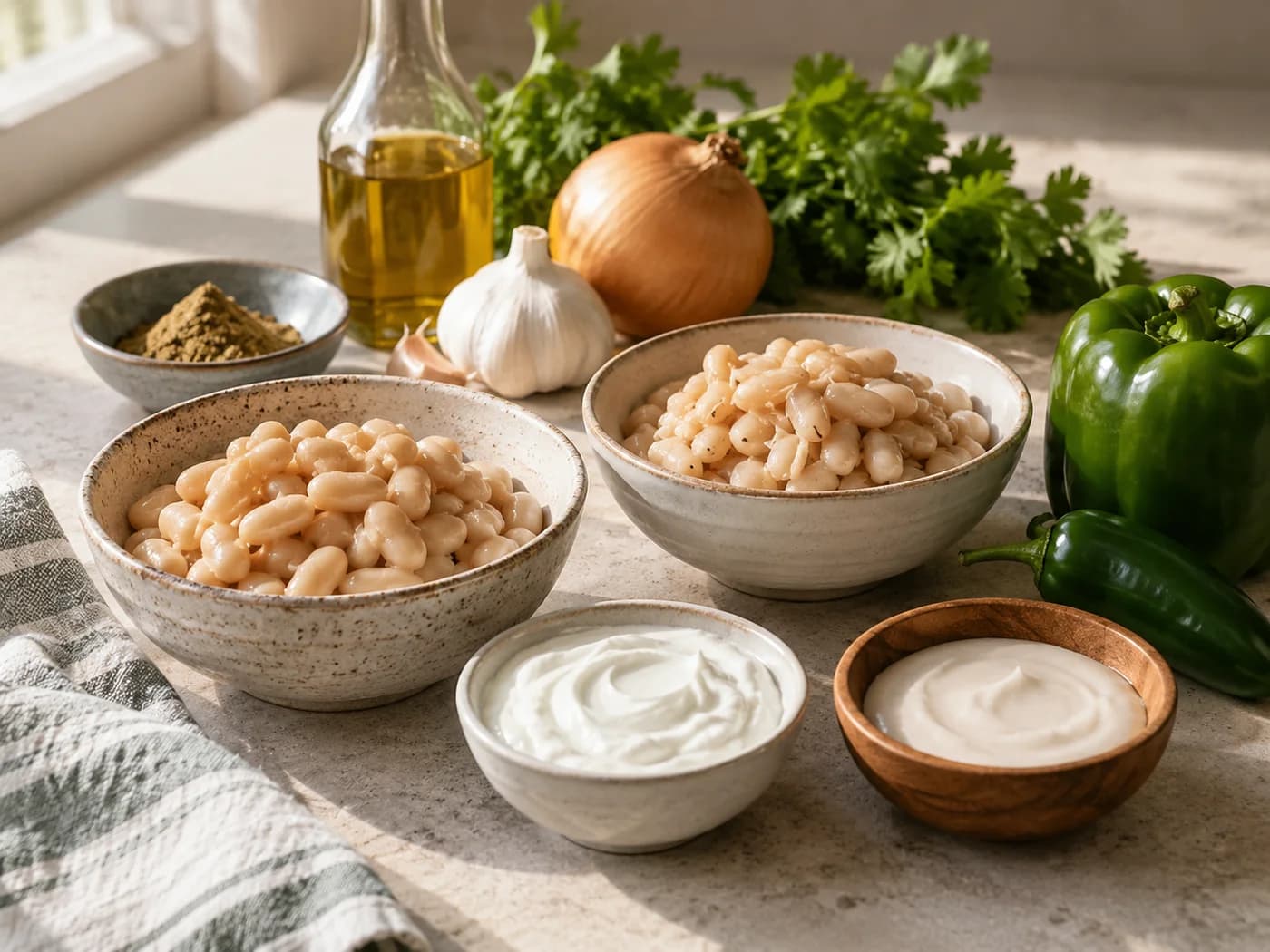
White beans are a family of options
Cannellini, navy and great northern beans can all suggest a similar style of dinner, but their size, softness and reference nutrition are not identical. Choose beans that are fully cooked and pleasant to eat before adding them. Very soft beans may break down with little effort, while firmer beans may need more deliberate mashing. The generic cooked white-bean entry provides a transparent reference rather than a promise about every variety or canned product.
Canned beans are a practical adaptation when time is short. Drain them, use the amount needed for the meal, and inspect the label basis before calculating. Rinsing may change sodium, but an unmeasured rinse does not justify subtracting an exact percentage from a label. Dry beans need their own suitable preparation before this recipe starts. Do not put uncooked dry beans straight into the chicken simmer and expect them to become safe, soft and ready on the same schedule.
Chicken and yogurt need separate decisions
Ready-cooked chicken changes the weight basis and cooking sequence. Record its cooked amount, original cooking date and actual nutrients, then heat it appropriately rather than giving it the raw-chicken simmer by habit. Rotisserie chicken may include skin, seasoning or added solution. Turkey and chicken thigh are other possible adaptations, but they change the reference and may require a different texture approach. Every poultry choice still needs suitable temperature checks.
Full-fat Greek yogurt can give a different finish, with a different fat and calorie contribution. Ordinary plain yogurt may be looser and lower in protein. A dairy-free alternative needs its own label check, and some products bring coconut flavour, sweetness or very little protein. None inherits the original numbers automatically. If dairy avoidance is required, check the full ingredient list and preparation conditions, not only whether a yogurt substitute has been chosen.
Broth, heat and herbs can change the character
Broth can replace water as a deliberate adaptation, but its sodium and seasonings join everything already in the pot. A canned green-chile product differs from raw jalapeño in both liquid and salt. Parsley can provide a different fresh finish if cilantro is not appealing. Make one or two changes at a time so you can understand what they do to the bowl. These are practical suggestions, not separately kitchen-tested versions of the exact formula.
Use actual labels and the appropriate raw or cooked food form when adapting.
| Reference | Alternative | What to check |
|---|---|---|
| Cooked unsalted white beans | Canned white beans | Drained weight, label basis and sodium |
| Raw chicken breast | Ready-cooked chicken | Cooked weight, seasoning and heating sequence |
| Nonfat Greek yogurt | Other plain yogurt | Protein, fat, moisture and heat behaviour |
| Fresh jalapeño | Canned green chilies | Heat, sodium and liquid |
| Plain water | Prepared broth | Seasoning, allergens and sodium |
| Cilantro | Parsley or omission | Different flavour; adaptation untested |
How to Make It
Prepare and soften the aromatics
Have the 480g fully cooked drained beans and 200g yogurt measured before starting. Dice onion, bell pepper and jalapeño; chop garlic and cilantro; squeeze the lime. Prepare four raw chicken cutlets of about 150g each and 1.5cm thickness, using separate raw-poultry tools. Measure the spices, oil and salt. This small amount of organisation matters because the garlic and spices need only a brief warming stage once the vegetables have softened.
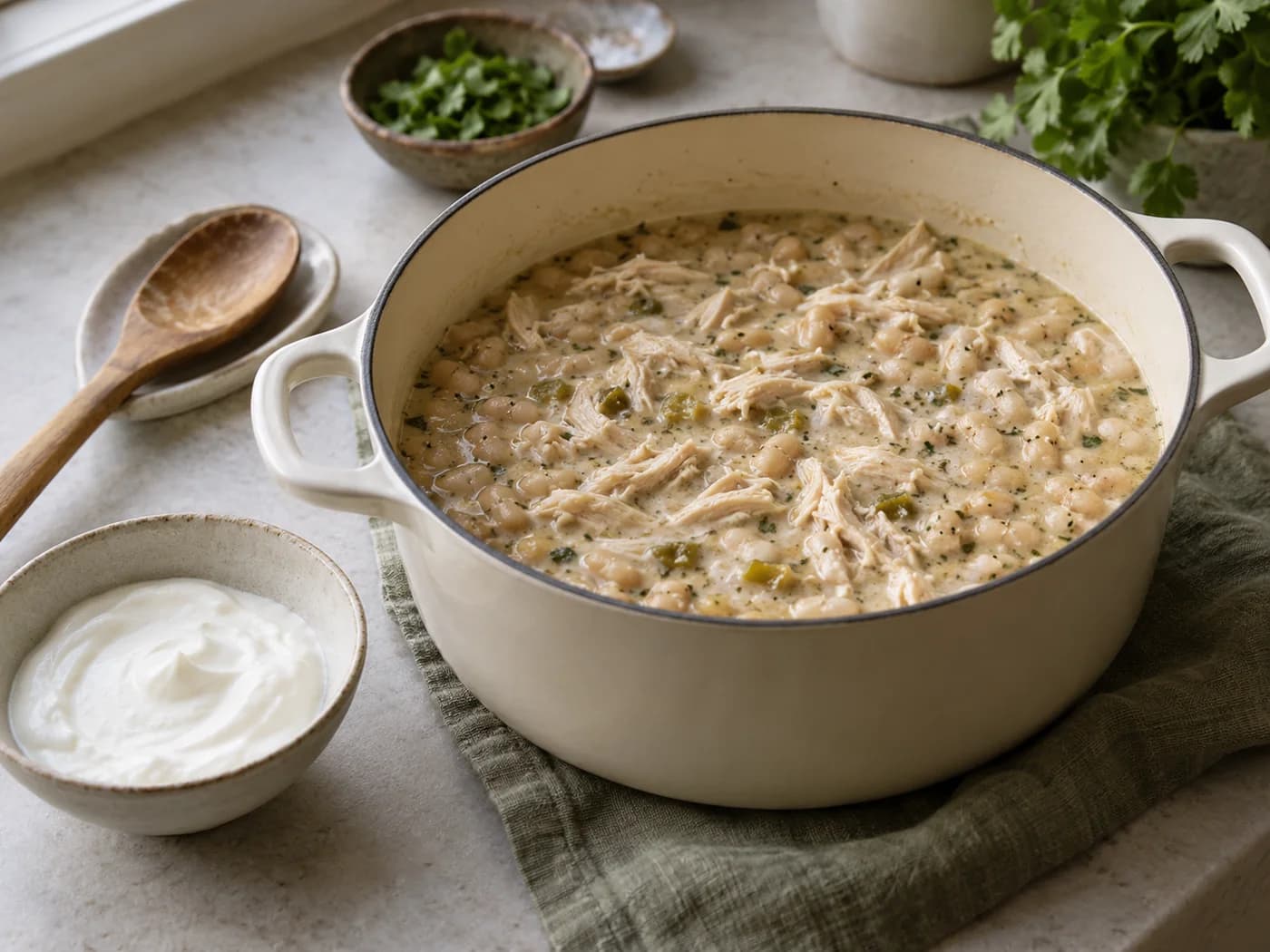
In a heavy pot of at least five litres, heat 10g olive oil over moderate heat. Add 160g onion, 120g bell pepper and 20g jalapeño. Cook for approximately 5–7 minutes, stirring, until the onion softens without scorching. Add 12g garlic, 4g cumin and 2g oregano and stir for about 30 seconds. If the pot is running too hot, lower the heat rather than letting the garlic darken while searching for the next ingredient.
Simmer, check and shred the chicken
Add 700g water, 2g salt, all 480g cooked beans and the four chicken cutlets. Bring to a gentle simmer. Allow roughly 12–18 minutes for the chicken, checking from around 12 minutes, but treat this as an estimate. Every cutlet must reach 165°F / 74°C at its thickest point. Position the pieces so liquid can circulate, and turn or rearrange them carefully if necessary rather than assuming the uppermost piece heats like the others.
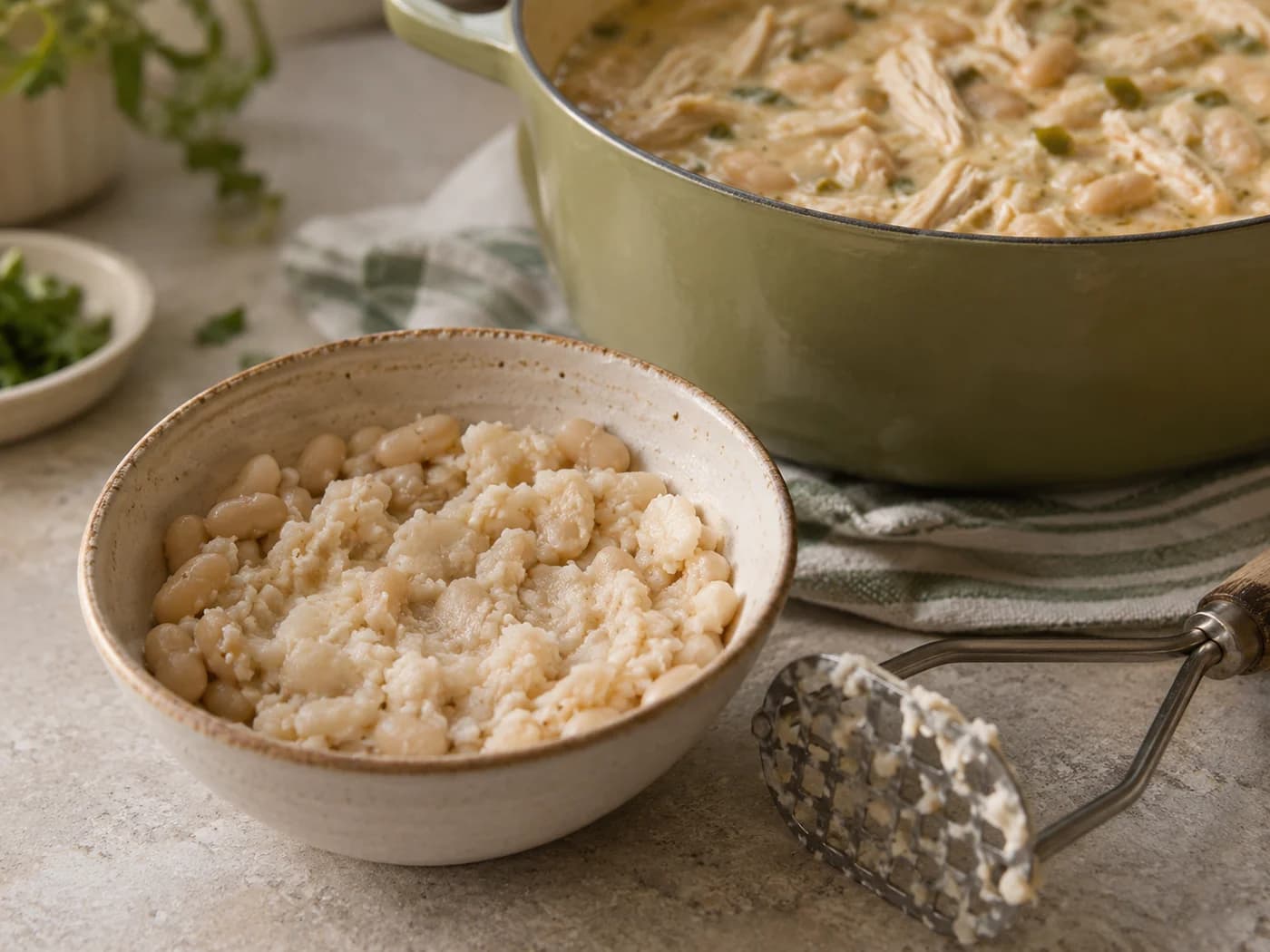
Lift checked chicken onto a clean plate and shred using clean utensils. Spoon approximately 160g of the cooked beans from the pot into a bowl, mash with a little chili liquid, and return the mixture. Simmer the bean base for another 2–3 minutes, then return the shredded chicken. The remaining beans should stay mostly intact. This creates a thicker liquid without blending the whole pot or adding an unmeasured flour or cream mixture.
Add yogurt, lime and cilantro at the finish
Switch off the heat and wait for bubbling to subside. Loosen the 200g yogurt with several spoonfuls of hot chili liquid, adding the liquid gradually and stirring. Stir that mixture into the pot, followed by 30g lime juice and 12g cilantro. Avoid a rolling boil after the yogurt is added; this reduces the chance of a grainy finish without guaranteeing identical results from every product. Stir well and divide all solids and liquid into four complete portions.
Tips for the Best Results
Match the texture to the bowl you want
A white chicken chili should be easy to spoon, with enough body to carry shredded chicken and beans together. The reference mashes one third of the cooked beans, approximately 160g from the four-serving batch. That gives you a clear starting point instead of an instruction to blend until it looks right without saying how much has changed. Mash in a separate bowl with a little liquid so you can see the texture and return it evenly.
If the chili is thicker than you enjoy, add a small measured amount of plain hot water and stir. Water changes dilution and finished weight, but under the reference assumption it does not remove calories or protein from the total batch. If it seems thin before yogurt is added, give the mashed beans time to disperse and assess the simmer. Do not compensate automatically with extra cheese, cream or starch while keeping the original nutrition figures.
Gentle heat protects the finish
Yogurt is easier to incorporate when loosened gradually with warm liquid. Adding a cold dense spoonful directly into a vigorously boiling pot can leave uneven white flecks or a grainy appearance. Turn off the heat, let active bubbling stop and stir as you combine. Different yogurts contain different solids and behave differently, so tempering is a useful technique rather than a guarantee that any product will remain perfectly smooth under any conditions.
Keep the chicken in practical shreds rather than reducing it to a fine dry tangle. Pieces should be small enough to fit comfortably on a spoon, while still feeling like chicken. Check each cutlet before shredding and use a clean plate and forks. If one piece needs more time, leave that piece cooking rather than keeping all the others in the simmer indefinitely. The thermometer resolves doneness more reliably than whether the fibres appear white.
Taste the final balance carefully
The lime is there to brighten the creamy base, not make it sour enough to hide the spices. Stir in the measured amount and taste a safely cooled spoonful. Pepper heat can become more noticeable after the ingredients have mingled, and yogurt tang varies too. Let the bowl tell you whether you want an additional condiment at the table. Record extras if tracking, and remember that adding more liquid dilutes saltiness without reducing the total sodium already in the pot.
High-Protein / Lower-Calorie Variations
More chicken means more protein and more food
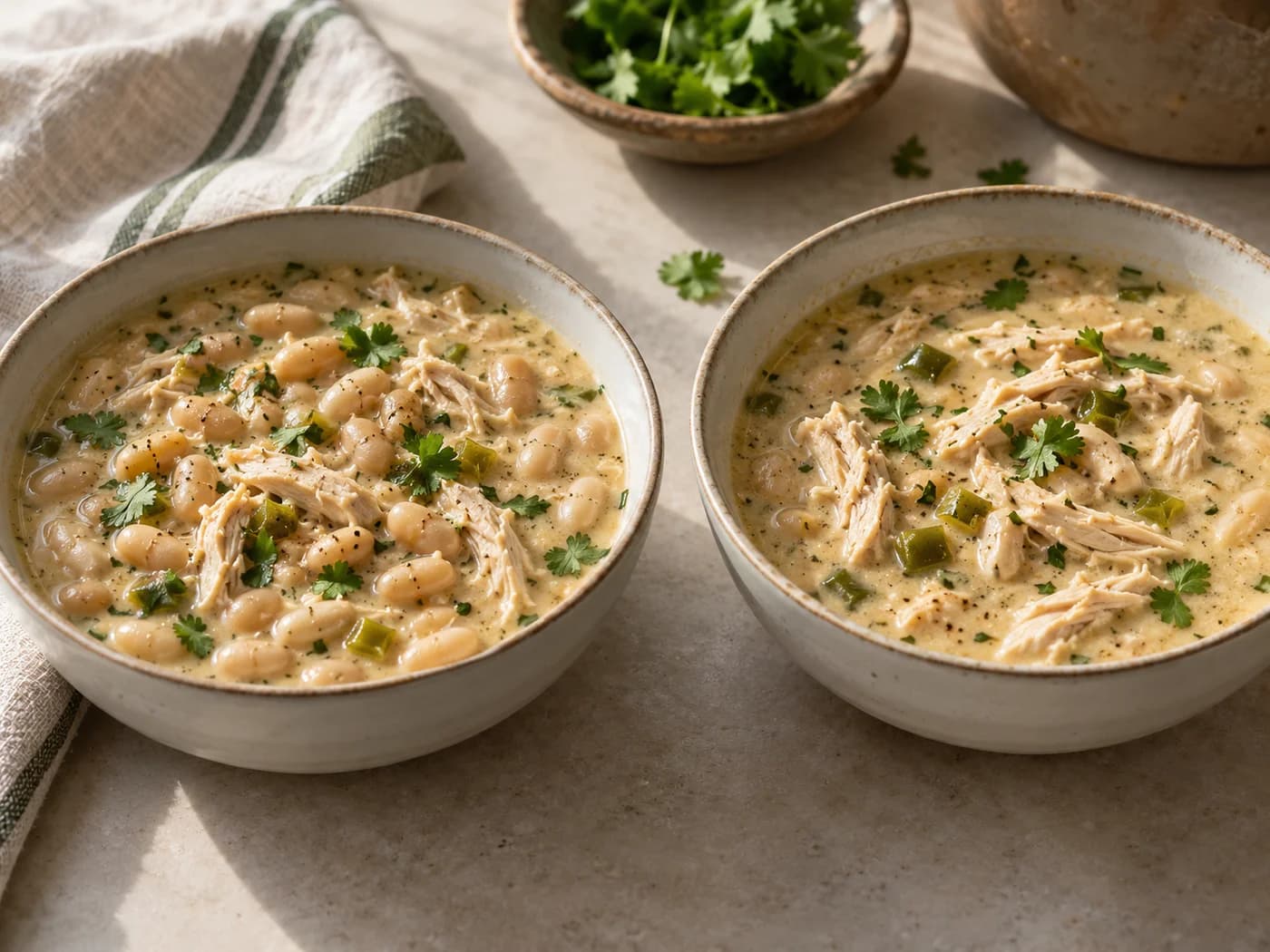
Adding 200g raw chicken across the four-serving batch raises the starting chicken share from 150g to 200g per person. With everything else unchanged, the estimate becomes approximately 494 calories and 63.0g protein per serving. Use additional or wider pieces while keeping a practical thickness, and give them room in the pot. A larger chicken quantity is not permission to skip checks or assume that the original simmer time still applies.
This change also affects how the chili feels. More chicken can make the mixture denser and leave less liquid around each spoonful. You may prefer the original balance of beans, chicken and creamy base, or you may enjoy the larger protein portion. If you add water for texture, measure it and keep the complete batch division clear. The higher protein number describes a larger ingredient contribution, not an automatically better dinner for every appetite.
Reduce beans with the thickness in mind
Using 320g cooked beans per batch gives 80g per serving instead of 120g. The calculated result is approximately 378 calories and 47.9g protein, with about 6.9g fiber. Keep all other ingredients unchanged for that comparison. Mash around one third of the new bean amount, roughly 107g across the batch, rather than removing most of the remaining whole beans. Less bean starch may leave a thinner finish even though the yogurt quantity stays the same.
Omitting the 200g yogurt gives approximately 404 calories and 46.7g protein per serving. The base then depends more on mashed beans for its texture and loses the yogurt’s tang. That is a different bowl rather than the same creamy finish with an invisible subtraction. For someone avoiding dairy, suitability still depends on all actual products and preparation conditions. Removing one ingredient is useful arithmetic, but it is not a comprehensive allergen assessment.
Smaller portions and substantial reformulations
Half of a complete reference serving provides approximately 217 calories and 25.9g protein when every ingredient and liquid share is halved together. That can leave room for a side or a smaller meal, depending on appetite. A vegetarian or vegan version needs a deliberate replacement for chicken and, where relevant, yogurt, along with a new calculation. Make substantial changes as a separate recipe experiment, rather than stacking several swaps and expecting the original timing and nutrition to survive unchanged.
Each comparison changes only the stated component. Adaptations are calculated, not separately kitchen-tested.
| Version | Calories, approximately | Protein, approximately |
|---|---|---|
| Reference complete serving | 434 kcal | 51.8g |
| 50g extra raw chicken per serving | 494 kcal | 63.0g |
| 80g cooked beans per serving | 378 kcal | 47.9g |
| Omit the 50g yogurt per serving | 404 kcal | 46.7g |
| Half a complete reference serving | 217 kcal | 25.9g |
Serving Suggestions
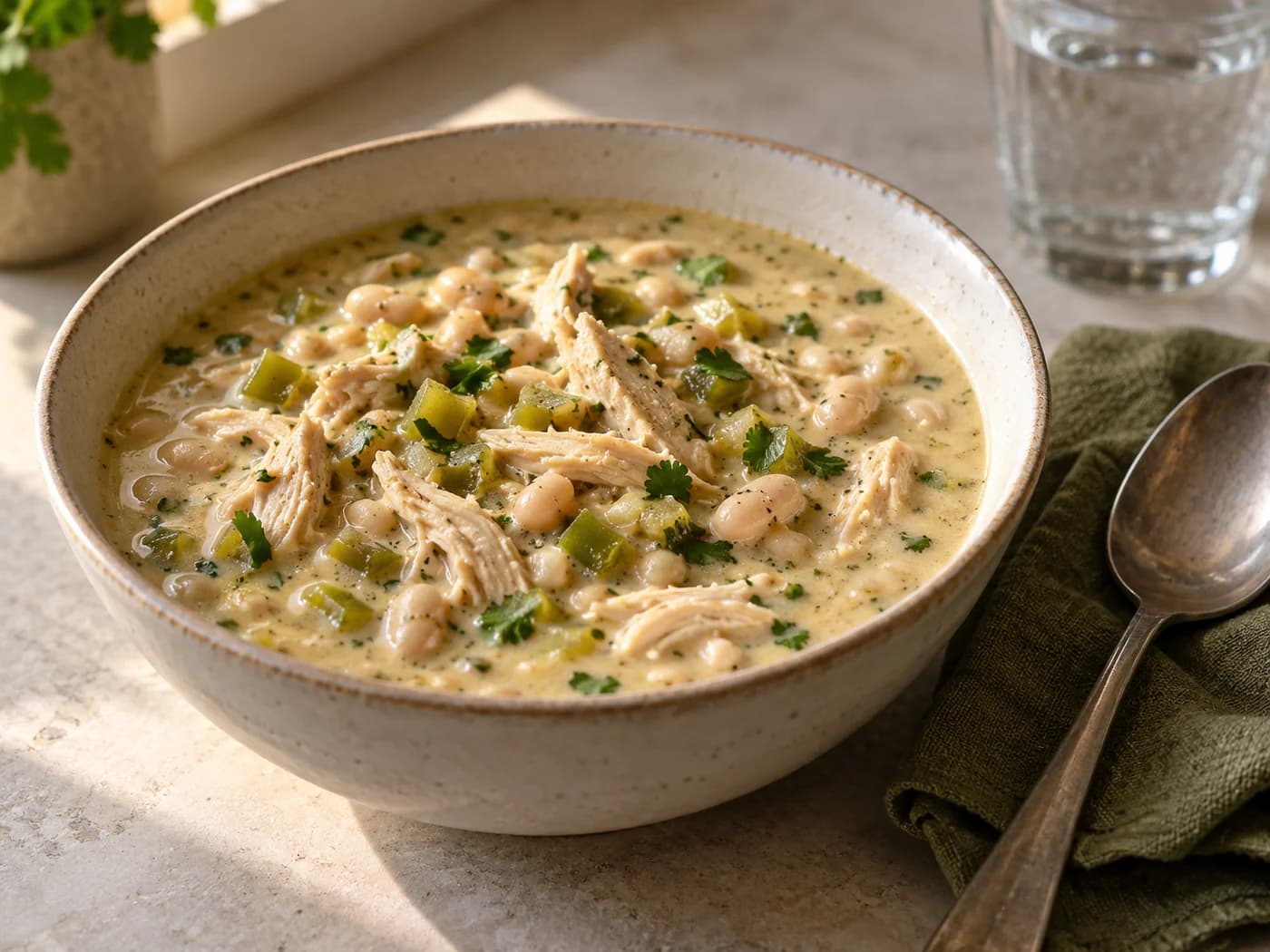
Serve the whole mixture in each portion
Stir the pot thoroughly before portioning so that the first bowl is not mostly creamy liquid and the last bowl carries most of the beans. A ladle that reaches through the mixture helps distribute solids. Divide into four suitable bowls or containers, then adjust the shares if one clearly has more chicken. The goal is an equivalent portion of the meal, not four bowls that look full because their shapes happen to disguise different contents.
There is no fixed cooked gram weight promised here, because evaporation and texture adjustments change the finished yield. If you track by weight, weigh the finished edible batch after accounting for the pot and divide that measured total by four. Mix well first. This gives a practical portion weight for your own batch without pretending that a calculated starting-water amount establishes how many grams of finished chili every kitchen will produce.
Choose extras according to appetite
Bread, rice, tortilla chips, avocado or cheese can sit alongside the chili if that is how you want to eat it. They are additional foods with their own amounts. A crunchy topping can be a pleasant contrast to soft beans and chicken, but the reference photo styling does not require one. If tracking, weigh or record the extras you actually use rather than assigning a generic topping allowance that may bear little relation to your bowl.
Extra yogurt, lime and hot sauce can be offered separately. The recipe already counts yogurt stirred into the entire pot; an additional spoon on top is a new addition. The same applies to another oil drizzle or a handful of cheese. Keeping optional items separate makes the base easier to share with people who enjoy different flavours, while making it easier to see what each person has added to their complete meal.
Let the meal fit the occasion
A simple bowl, spoon and water glass are enough for an everyday dinner. If serving several people, set out everything before the yogurt finish so the chili can be portioned promptly. If someone is eating later, cool and refrigerate their portion safely rather than leaving the whole pot on the stove. Practical serving choices protect both texture and handling, and they matter more than arranging every cilantro leaf into a picture-perfect pattern.
Meal Prep & Storage
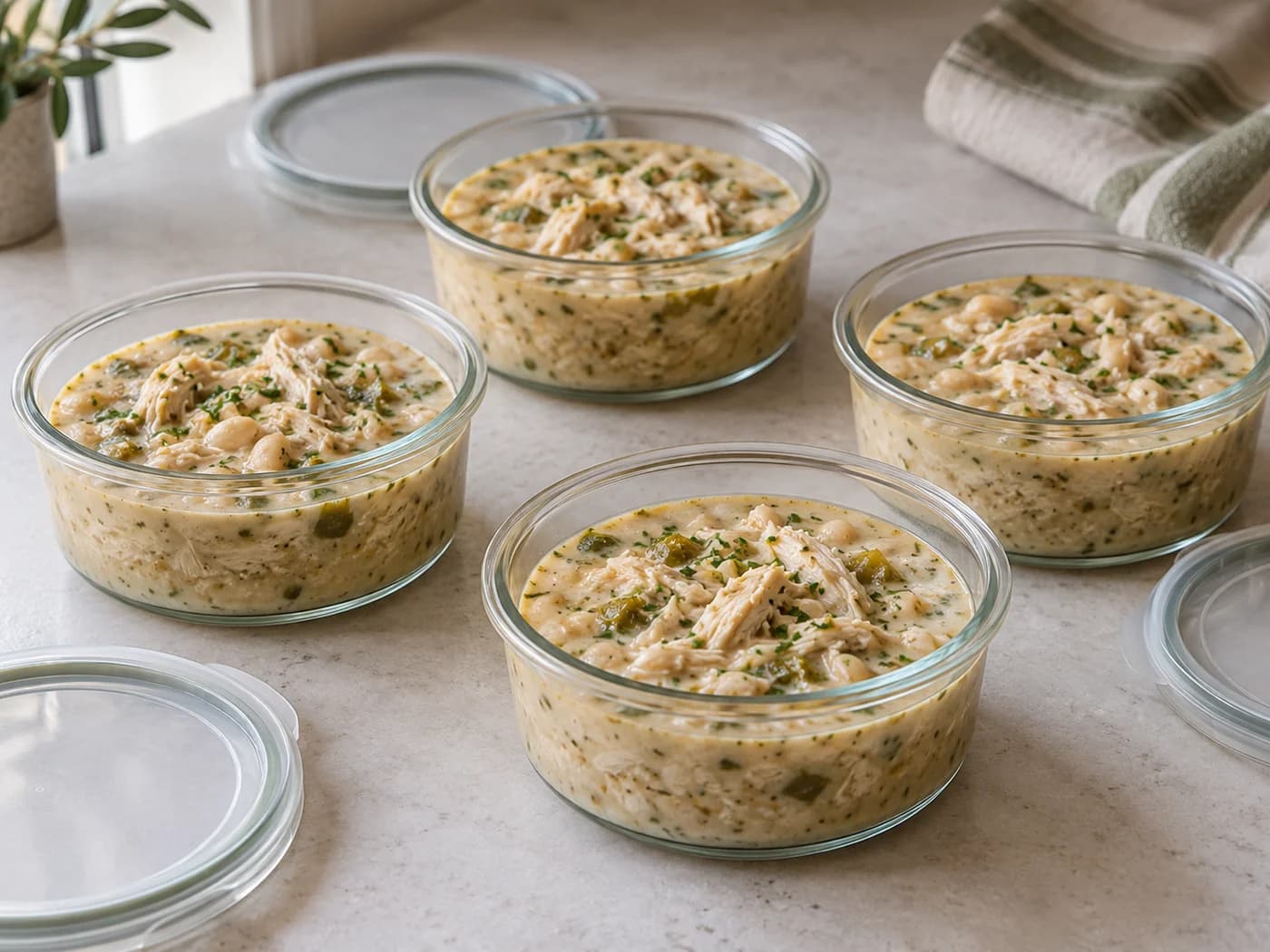
Plan the finish around when you will eat
For a planned make-ahead batch, you may prefer to keep the measured yogurt, lime and cilantro separate and add each portion’s share near serving. That is a handling adaptation, not the exact same sequence as finishing the whole pot at once. Keep every component safely chilled and account for all quantities. Each reference portion still receives 50g yogurt, 7.5g lime juice and 3g cilantro when the ingredients are divided into four.
If the yogurt is already stirred through, the chili can still be portioned for later with appropriate cooling and refrigeration. Its appearance may change during storage or reheating; a little separation does not establish either safety or danger by itself. Do not rely on smell, a smooth surface or a tidy container to decide whether leftovers were handled correctly. Use the cooking date, earlier ingredient history and the time spent outside refrigeration.
Cool in shallow portions rather than a deep pot
Refrigerate in shallow containers at 40°F / 4°C or below within two hours, or within one hour above 90°F / 32°C. Suitably handled cooked chicken and soup leftovers generally have a three-to-four-day refrigerated window. Divide a large batch promptly instead of leaving a deep pot cooling on the counter. The storage clock does not restart when yesterday’s cooked beans or chicken are mixed into a new meal; earlier preparation history still matters.
For freezing, the chicken-and-bean base before the yogurt finish is a practical candidate. Freeze suitable portions promptly in containers with expansion space. One month at 0°F / −18°C or below is a conservative quality suggestion for this untested formula, not a measured shelf-life result. Thaw in the refrigerator. Beans may soften further, and yogurt-containing portions may separate, so expect a different texture from a freshly finished bowl even when handling has been appropriate.
Reheat thoroughly and stir well
Reheat leftovers throughout to 165°F / 74°C, stirring and checking more than the liquid at the pot’s edge. A gentle heat may protect texture, but it must still achieve the required temperature in the coldest parts. Remove from the heat once properly reheated and stir before serving. If adding separately stored yogurt, finish carefully with clean utensils and serve promptly. Reheating cannot repair unsafe storage, and avoiding curdling is never a reason to accept a cold centre.
Full Nutrition Information
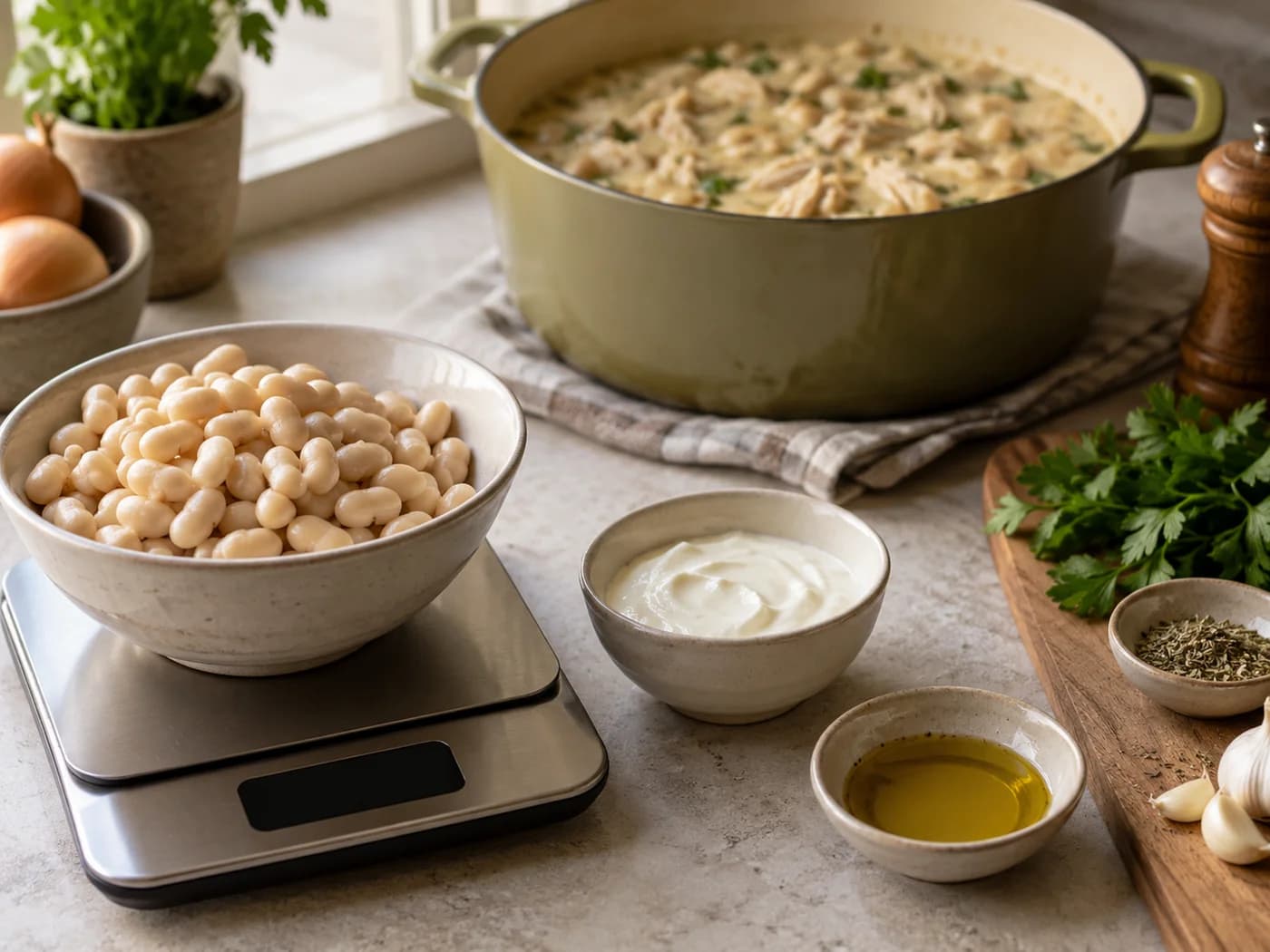
How the reference is calculated
For each ingredient, multiply its per-100g nutrient values by the grams used and divide by 100. Add the contributions of all fourteen ingredients, including the plain-water entry, then divide by four complete servings. Thirteen food entries use historical USDA SR28 generic values. Water is assumed to add no counted energy or nutrients. The arithmetic includes every gram of yogurt, oil and salt and all of the served chili liquid, with no discarded cooking broth to estimate.
Food forms are deliberate. Chicken is raw skinless boneless breast; white beans are mature beans already boiled without salt and weighed cooked and drained. Yogurt is plain nonfat Greek yogurt, and vegetables are raw trimmed edible starting weights. A dry-bean entry would be inappropriate for the 480g cooked bean amount. Equally, a cooked-chicken entry cannot be paired with the raw starting weight simply because that is the chicken you eventually eat.
The batch estimate is approximately 1,736 calories, 207.1g protein, 159.5g carbohydrate and 29.7g fat. One quarter is approximately 434 calories, 51.8g protein, 39.9g carbohydrate and 7.4g fat. Additional per-serving estimates are 9.4g fiber, 4.9g total sugars, 1.4g saturated fat and 293mg sodium. Generic food data describe a reference, not the exact composition of your ingredients after cooking or a laboratory analysis of the finished bowl.
Use the food calculator to record your actual products and optional extras. For canned beans, establish whether label values refer to drained beans or the contents with liquid; for broth, record the amount actually added. Plain chicken without added solution is a different assumption from a pre-seasoned product. These checks matter more than preserving a tidy-looking macro total when the foods in your kitchen are not the same as the reference.
Understand the practical limits
Rounded ingredient rows may not sum exactly to rounded totals because the arithmetic uses unrounded values first. Cholesterol, separate added sugars and complete micronutrients are not calculated. Evaporation changes finished weight, while dividing the complete batch into four still divides its nutrient estimate into four. Adding water dilutes the chili but does not erase its salt. Taking mostly liquid into one portion, or leaving much of the chicken behind, breaks the equivalent-serving assumption and needs a different assessment.
| Ingredient | Amount | Calories | Protein | Carbs | Fat |
|---|---|---|---|---|---|
| Raw skinless boneless chicken breast | 600g | 720 kcal | 135.0g | 0.0g | 15.7g |
| Cooked white beans | 480g | 667 kcal | 46.7g | 120.4g | 1.7g |
| Plain nonfat Greek yogurt | 200g | 118 kcal | 20.4g | 7.2g | 0.8g |
| Olive oil | 10g | 88 kcal | 0.0g | 0.0g | 10.0g |
| Onion | 160g | 64 kcal | 1.8g | 14.9g | 0.2g |
| Green bell pepper | 120g | 24 kcal | 1.0g | 5.6g | 0.2g |
| Fresh jalapeño | 20g | 6 kcal | 0.2g | 1.3g | 0.1g |
| Garlic | 12g | 18 kcal | 0.8g | 4.0g | 0.1g |
| Ground cumin | 4g | 15 kcal | 0.7g | 1.8g | 0.9g |
| Dried oregano | 2g | 5 kcal | 0.2g | 1.4g | 0.1g |
| Lime juice | 30g | 8 kcal | 0.1g | 2.5g | 0.0g |
| Cilantro | 12g | 3 kcal | 0.3g | 0.4g | 0.1g |
| Fine salt | 2g | 0 kcal | 0.0g | 0.0g | 0.0g |
| Water | 700g | 0 kcal | 0.0g | 0.0g | 0.0g |
| Whole batch | 4 complete servings · all chili liquid included | 1736 kcal | 207.1g | 159.5g | 29.7g |
| One reference serving | Batch ÷ 4 | 434 kcal | 51.8g | 40g | 7g |
| Dietary fiber | 9.4g |
|---|---|
| Total sugars | 4.9g |
| Saturated fat | 1.4g |
| Sodium | 293mg |
Estimated recipe nutrition, not laboratory analysis. Includes raw chicken, fully cooked unsalted drained white beans, all yogurt, vegetables, oil, salt, seasonings and chili liquid. Extras are additional. Uses historical generic USDA SR28 values and a zero-counted-nutrient plain-water assumption. Canned beans, broth or seasoned chicken can change sodium substantially; actual labels take priority. Cholesterol, separate added sugars and complete micronutrients are not calculated.
How This Fits Your Daily Protein Goal
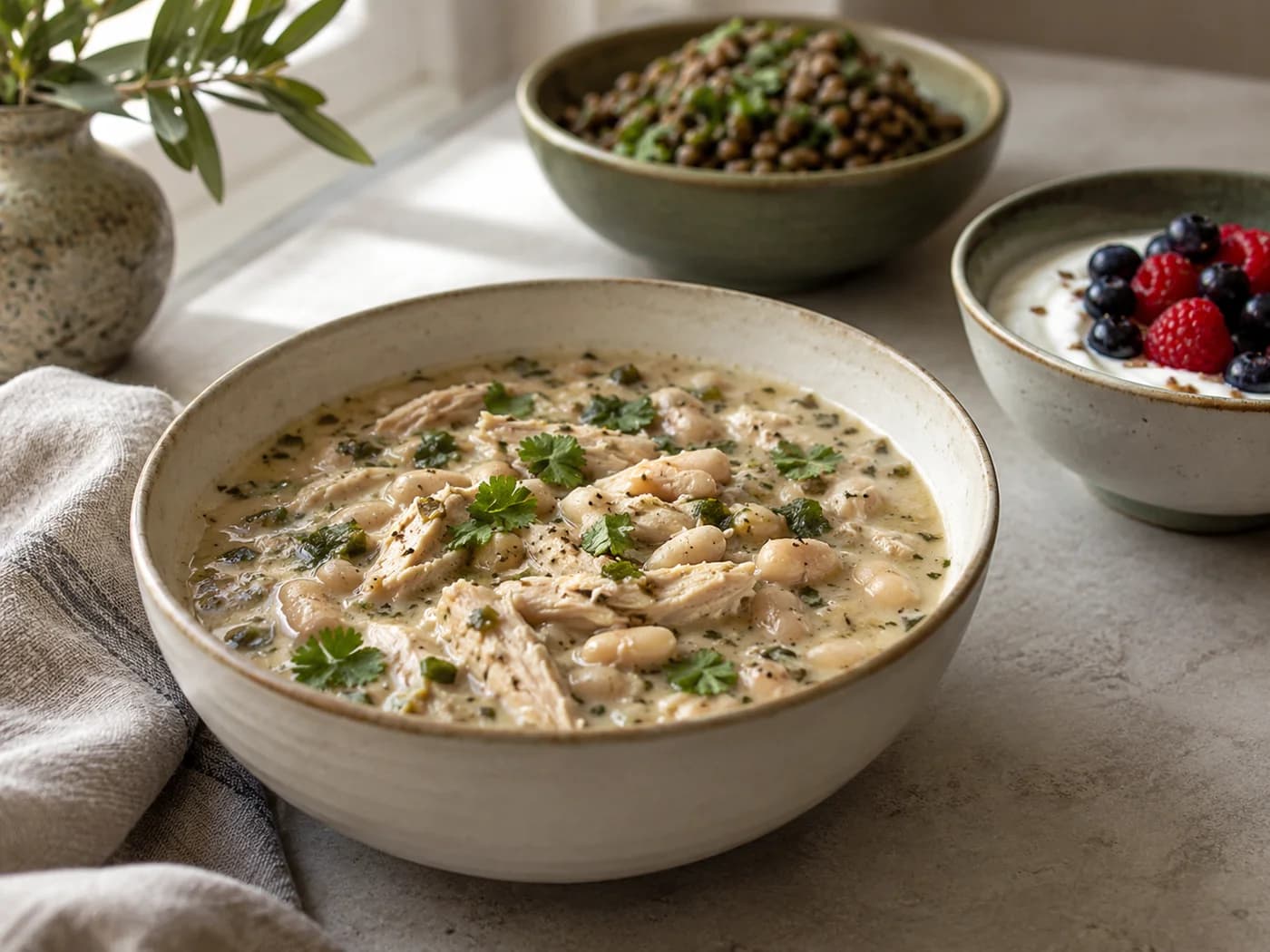
Make the serving part of your own plan
The protein calculator can help estimate a daily target using the information you provide. One complete reference serving of this chili contributes approximately 51.8g toward that total. The appropriate target depends on your circumstances, and a recipe cannot set it for everyone. If you have an individual nutrition prescription or medical condition, use qualified professional guidance rather than treating a general meal example as a personalised recommendation.
For illustration, 51.8g is about 52% of a 100g daily target, 41% of a 125g target and 35% of a 150g target. These percentages compare the same bowl with different example totals; they do not suggest that everyone should choose one of those totals. Protein from breakfast, lunch, snacks and other foods also counts. There is no requirement for dinner to provide a specific percentage if another meal pattern suits you better.
Consider the whole meal, not one nutrient
The chili also contributes energy, carbohydrate, fat and fiber, alongside flavour and a practical amount of food. Beans are doing more than adding protein: they help the texture and supply much of the carbohydrate and fiber. Yogurt changes both the protein total and the finish. When choosing a variation, consider those roles together rather than judging the recipe by whichever version displays the biggest protein number or the smallest calorie total.
A half portion provides about 25.9g protein when half of every component and its liquid share is included. You could combine that with a side or choose a different meal size according to appetite. If the full bowl is satisfying on its own, you do not need another large protein addition simply because the page discusses protein planning. The useful portion is the one that works within your overall day and can be prepared and eaten comfortably.
Make the routine realistic
Think about which parts of this recipe fit your evenings. Cooked beans and measured seasonings can make the stovetop sequence simpler, while raw chicken handling and a careful yogurt finish still deserve attention. On a very rushed day, another recipe from the collection may be easier. A workable plan allows different meals, cooking methods and textures. Repeating enjoyable meals is often more practical than chasing a different set of perfect-looking numbers every night.
Make it personal
Where does this meal fit in your day?
Estimate your daily protein target, then plan meals you enjoy.
Recipe Card
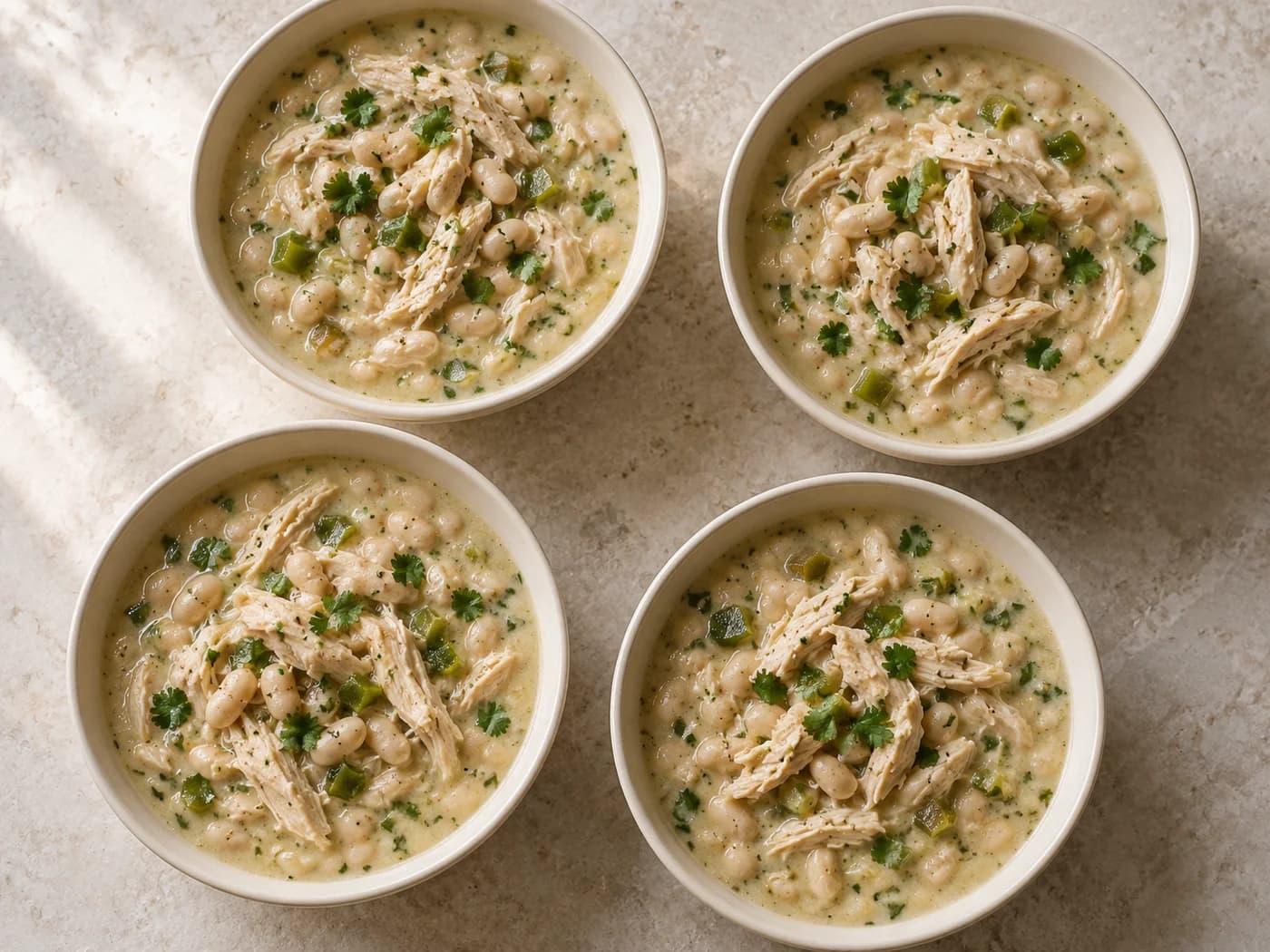
Set the portion count before weighing
The card gathers fourteen ingredients and six method stages into one place. Select four, eight or twelve complete servings before measuring. Each equivalent portion still begins with 150g raw chicken, 120g cooked drained white beans and 50g yogurt, plus its share of vegetables, seasonings and liquid. Scaling makes more portions of the same reference. It does not change a raw starting weight into a cooked serving weight or make extra toppings part of the calculation.
The method is organised around a four-serving batch in a pot of at least five litres. Eight servings require two matching batches and twelve require three, unless you deliberately adapt to appropriately larger equipment. You can cook sequentially with one suitable pot, allowing extra time. Multiplying the ingredients does not establish that a crowded vessel heats evenly or that the original forty-five-minute planning estimate applies to every quantity.
Use the checklist as a cooking aid
Tick an ingredient when it has been weighed or added, according to the system that helps you cook. The reset button clears the list for a new batch. Changing the serving count also clears the ticks so a check beside an old quantity cannot be mistaken for completion of a larger one. Prepare clean vegetables and measuring bowls before handling raw chicken, and use clean hands before returning to a device during cooking.
Print the card after choosing the quantity you intend to make. The print includes selected ingredient amounts, the method, temperature checks, portion information and storage reminders. It is designed to remain useful beside the stove without requiring the rest of the article. Your thermometer and product directions still determine what the actual food needs; the printed timings are planning guidance, not proof that every chicken piece has reached a safe centre temperature.
Read the nutrition line as a serving estimate
The reference remains approximately 434 calories and 52g protein per complete serving when doubled or tripled, because the number of equivalent portions increases with the ingredients. Batch totals grow while the serving stays the same. Stir and distribute solids and liquid fairly when portioning. The card also states that the exact formula is not physically kitchen-tested and that extras are additional, so the essential context travels with the quantities rather than being lost when you print.
A creamy bowl, ready for the table
High-Protein White Chicken Chili
Shredded chicken and white beans with green peppers, Greek yogurt, cumin and lime.
*Four-serving planning estimates with fully cooked beans ready. Larger quantities need matching batches in pots of at least 5 litres, sequentially if needed, with extra time. Exact weighed formula not physically kitchen-tested.
Ingredients
Method
- Prepare the cooked beans and raw chicken
Have 480g fully cooked unsalted drained white beans ready; these are not dry beans. Weigh 200g plain nonfat Greek yogurt. Prepare 160g onion, 120g green bell pepper, 20g jalapeño, 12g garlic, 30g lime juice and 12g cilantro. Weigh 600g raw chicken as 4 cutlets, 150g each, about 1.5cm thick. Keep raw-poultry tools separate.
- Soften the vegetables and warm the spices
Use 1 matching four-serving batch, each in a heavy pot of at least 5 litres; cook sequentially if needed. Per batch, heat 10g olive oil and cook the allocated onion, bell pepper and jalapeño for about 5–7 minutes over moderate heat. Add 12g garlic, 4g cumin and 2g oregano for about 30 seconds (10g oil, 4g cumin and 2g oregano total). Avoid scorching.
- Simmer and check every chicken cutlet
Per batch, add 700g water, 2g salt, 480g cooked beans and four raw cutlets (700g water and 2g salt total). Simmer gently for roughly 12–18 minutes, checking from about 12 minutes. Each cutlet must reach 165°F / 74°C at its thickest point; time is only a guide. Move checked chicken to a clean plate and shred with clean utensils.
- Mash some beans for body
Across the batches, spoon approximately 160g cooked beans into a bowl, working with 160g per four-serving batch. Mash with a little chili liquid and return it. Simmer about 2–3 minutes, leaving the remaining beans mostly intact. Return all shredded chicken. If needed, a small measured addition of plain hot water can adjust thickness; it does not subtract nutrients from the batch.
- Finish gently and portion evenly
Switch off the heat and let bubbling subside. Per four-serving batch, loosen 200g yogurt with several spoonfuls of hot chili liquid, adding the liquid gradually, then stir it into that pot. Add 30g lime juice and 12g cilantro per batch (200g yogurt, 30g lime juice and 12g cilantro total). Avoid a rolling boil after yogurt is added. Stir well and divide all chicken, beans and liquid into 4 equivalent servings; each contains the share from 150g raw chicken, 120g cooked beans and 50g yogurt. Extras are additional.
- Serve or store safely
Serve promptly. Refrigerate in shallow containers at 40°F / 4°C or below within 2 hours, or 1 hour above 90°F / 32°C. Use within 3–4 days with safe handling, respecting earlier ingredient cooking dates. Reheat throughout to 165°F / 74°C, stirring and checking cold spots; safe temperature takes priority over avoiding yogurt separation. Larger batches need extra preparation and cooking rounds.
Contains milk; check actual labels. Chicken raw, white beans fully cooked unsalted drained. All yogurt, oil, salt and chili liquid counted. Extras additional. Refrigerate within 2 hours, or 1 hour above 90°F / 32°C. Keep chilled; reheat throughout to 165°F / 74°C.
Frequently Asked Questions
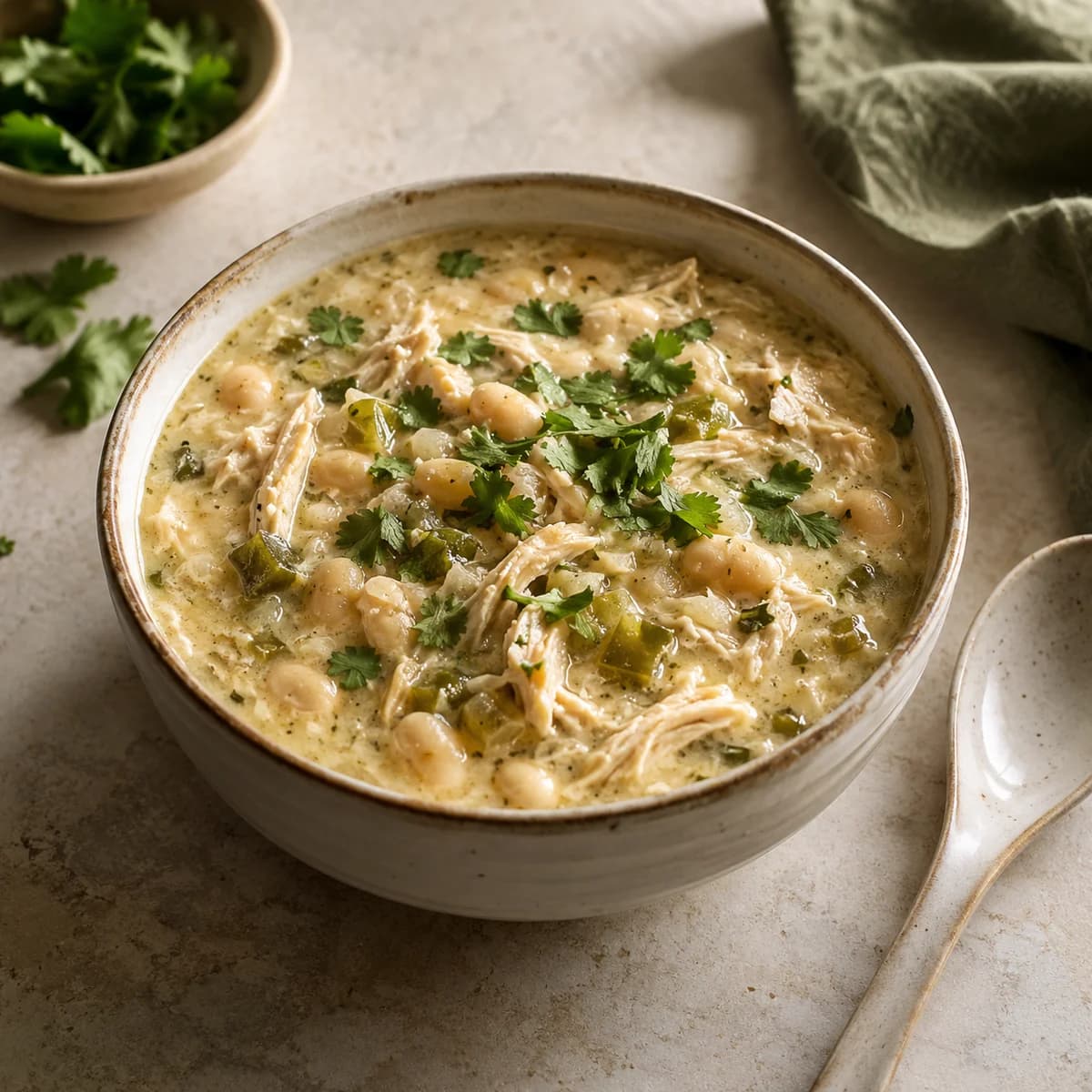
Clear up the details before starting
White chicken chili can look like a simple one-pot meal while still involving ingredients with different weight bases and cooking needs. The answers below explain the cooked beans, raw chicken, yogurt finish and complete-serving definition. Read the questions that apply to your ingredients before beginning, then keep the recipe card nearby for the sequence. A clear understanding of what is already cooked makes this meal easier to organise.
If adapting a product or quantity, record the change and use an appropriate nutrition entry or label. The reference offers a starting point for the meal rather than a guarantee about every canned bean, chicken product or dairy substitute. Taste, texture, timing and safe handling still need attention in your kitchen, especially if several changes are made together.
How much protein is in one serving?
One complete reference serving provides approximately 51.8g protein and 434 calories. It is one quarter of the entire recipe, including chicken starting at 150g raw, 120g cooked drained white beans, 50g plain nonfat Greek yogurt and its share of all vegetables, seasonings and liquid. Extra toppings and sides are additional. Actual products and portion composition can change the estimate.
Are the beans weighed dry or cooked?
The 480g batch amount is fully cooked, unsalted, drained edible white beans. It is not dry weight or the gross contents of a can. Have the beans cooked before beginning the recipe. If using canned beans, check the label basis and weigh the portion after draining; a canned product may have different sodium and other nutrient values from this generic reference.
Can I use cannellini or great northern beans?
Both can make a useful adaptation, as can other suitable white beans, provided they are fully cooked before adding them. Bean size and softness affect how readily the mixture thickens. The nutrition table uses a generic cooked white-bean entry rather than a specific canned variety. Use your actual product information and retain a mix of mashed and intact beans for texture.
Should the chicken be weighed raw?
Yes. Use 600g raw skinless boneless chicken breast for four servings, shaped as four cutlets about 150g each and 1.5cm thick. Cooked chicken loses water, so 150g cooked is a different amount. Ready-cooked or rotisserie chicken also needs its own nutrition and handling assumptions, particularly if it contains skin, added solution or seasoning.
How do I stop Greek yogurt from splitting?
Turn off the heat and let active bubbling subside. Stir hot chili liquid gradually into the measured yogurt to loosen it, then stir the mixture into the pot. Avoid a rolling boil afterwards. This reduces temperature shock but does not guarantee identical results from every yogurt. During reheating, safe temperature throughout still takes priority over keeping the finish perfectly smooth.
How can I make the chili thicker?
Mash approximately 160g of the 480g cooked beans with a little chili liquid and return that mixture to the pot before the yogurt finish. Leave the rest mostly intact. Give the mashed beans time to disperse, then assess the texture. Extra cream, cheese, flour or other thickeners would be additions with their own ingredients and nutrition, rather than invisible adjustments.
Is this chili very spicy?
Heat depends on the actual jalapeño, the amount used and personal tolerance. The reference contains 20g trimmed fresh jalapeño across four servings alongside green bell pepper. Removing seeds and membranes can suit a gentler preference, but it does not guarantee mildness. Offer extra heat separately for people who want it, and recalculate if changing a substantial ingredient quantity.
Can I use broth or canned green chilies?
Either is an adaptation rather than the unchanged reference. The original uses plain water, measured salt and fresh jalapeño. Broth, bouillon and canned chile products can introduce sodium, liquid and additional seasonings. Record the amount used and check the label. An unmeasured rinse or dilution does not establish an exact reduction in sodium already added to the meal.
Can I make it dairy-free or vegetarian?
The reference contains chicken and milk from Greek yogurt. Omitting yogurt gives approximately 404 calories and 46.7g protein per serving with the other ingredients unchanged, but changes the creamy finish. A dairy-free substitute or vegetarian protein needs its own label and calculation. Check all products and preparation conditions for the relevant dietary requirements; one substitution does not establish suitability by itself.
Can I make this in a slow cooker or pressure cooker?
This exact formula is written for a stovetop pot, with fully cooked beans already available. Slow-cooker and pressure-cooker timings have not been developed or tested here. Do not transfer the short simmer time to another appliance or add uncooked dry beans on that assumption. Follow a suitable appliance-specific recipe and guidance if you prefer that cooking method.
How long can I store leftovers?
For suitably handled chicken and soup leftovers, use a three-to-four-day refrigerated window at 40°F / 4°C or below. Refrigerate promptly in shallow containers within two hours, or one hour above 90°F / 32°C. Respect the earlier cooking date of any prepared ingredients. Reheat throughout to 165°F / 74°C; safe storage cannot be judged from appearance alone.
Can I freeze white chicken chili?
The chicken-and-bean base before the yogurt finish is a practical freezing option. Freeze promptly in suitable portions with expansion space and thaw in the refrigerator. One month is a conservative quality suggestion for this untested formula, not a measured shelf-life claim. Yogurt-containing portions may separate and beans may soften. Reheat safely and finish with any separately stored ingredients using clean utensils.
How do I make eight or twelve servings?
Choose the quantity on the card to multiply all ingredients and method totals. Keep equivalent four-serving batches in pots of at least five litres, cooking sequentially if needed. Each portion retains 150g raw chicken, 120g cooked beans and 50g yogurt under the reference. Larger quantities require extra preparation and possibly more cooking rounds; the original time estimate does not multiply predictably.
Has the exact weighed recipe been kitchen-tested?
The exact formula has not been physically kitchen-tested. Timings are planning estimates, photographs illustrate the dish and variations are calculated suggestions. Nutrition uses historical generic USDA food values and a plain-water assumption, rather than laboratory analysis. Check every chicken cutlet with a food thermometer, follow suitable product directions and assess the yogurt finish and thickness in your own kitchen.
More High-Protein Recipes
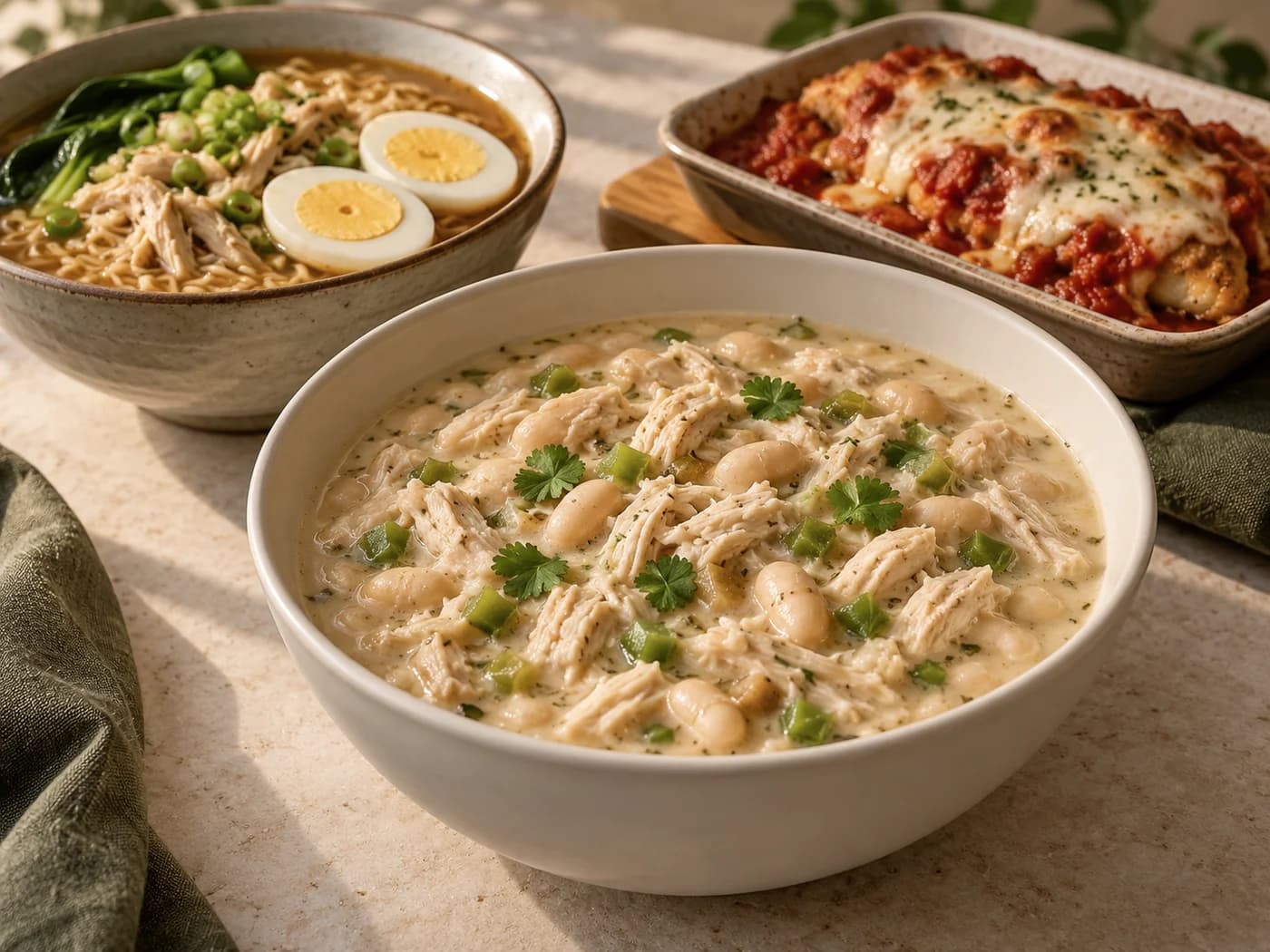
Choose the next dinner by texture and effort
If you enjoy a warm bowl but want noodles, high-protein ramen combines chicken, egg and edamame with a ginger-miso broth. If you want an oven dinner, chicken Parmesan brings a crumb coating, tomato sauce and melted mozzarella. Chicken enchiladas offer tender tortilla rolls in red sauce, while a quesadilla gives you a crisp skillet finish. Each is a distinct recipe with its own portion, cooking sequence and nutrition assumptions.
Lasagna and mac and cheese provide pasta-based alternatives when a bake or creamy sauce sounds appealing. Their serving figures should not be compared with this chili as though every serving contains the same amount of food. Look at ingredients, effort, appetite and reheating as well as protein. A layered bake may be convenient to portion later, while a noodle soup benefits from finishing some components close to the moment you eat.
Build a collection for ordinary days
The broader recipe hub includes breakfasts, dinners and homemade bakes. A small group of meals with different textures can keep a recurring shopping list interesting without requiring a new recipe every day. Chicken might become chili one evening, a tortilla filling another, and an oven-baked cutlet when you want a different result. The goal is a useful collection of meals you enjoy and can prepare with the time and equipment available.
Follow the links to read each recipe’s portion definition and handling guidance before choosing it for meal prep. Familiar ingredients do not automatically mean identical nutrition or storage needs, particularly when dairy, sauces and cooked components are involved. Save the options that fit your routine, and let variety come from changing flavour and method as well as from adjusting a protein total on a calculator.