
Browse the 15 recipe sections
One reference serving: one cutlet with coating, cheese and one quarter of all sauce, about 462 calories and 50.0g protein. All allocated egg, crumbs, oil and salt are included. Sides are additional; timings are estimates. See the breakdown.
Recipe Overview
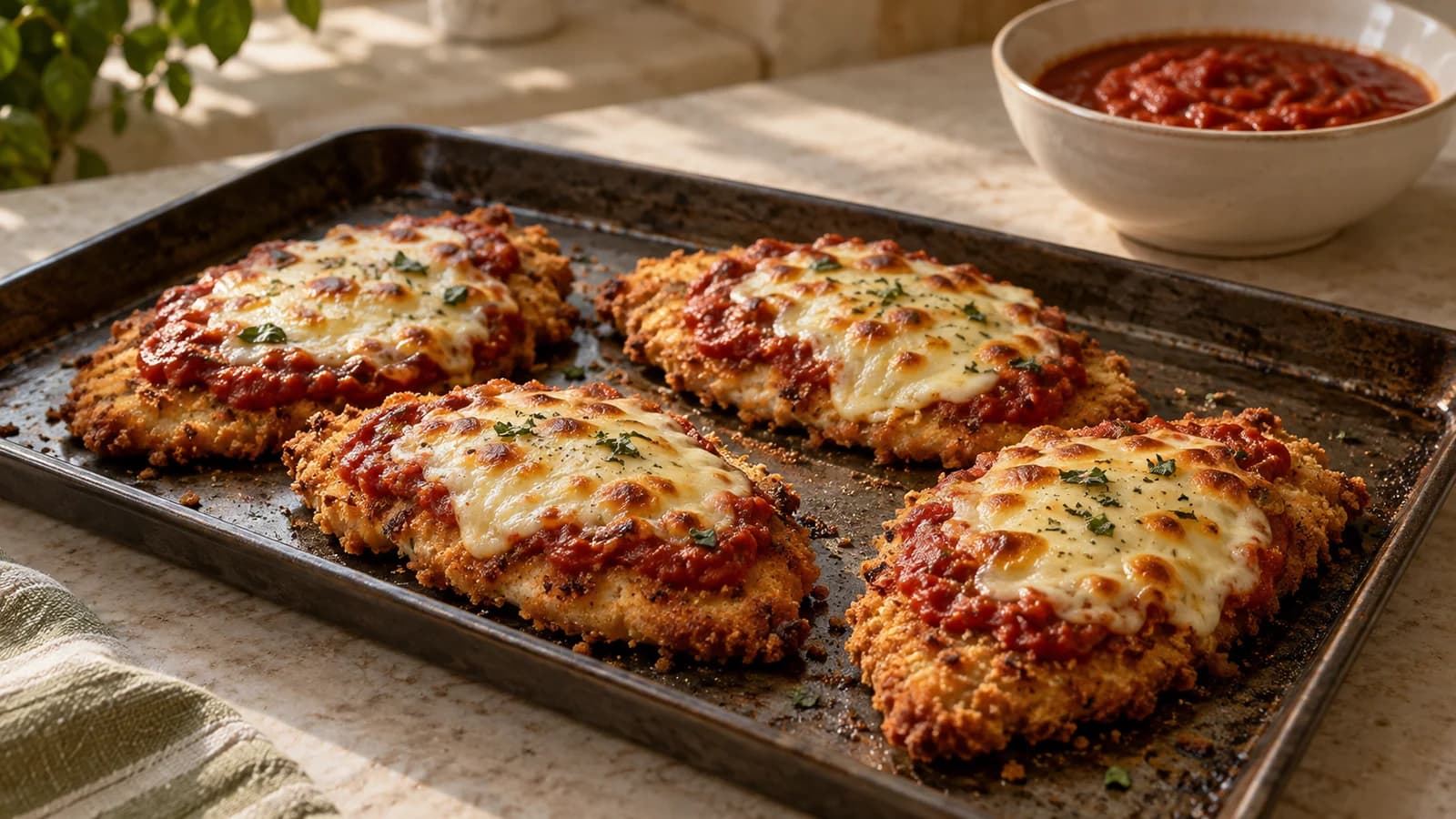
A familiar dinner with a clear portion
Chicken Parmesan earns its place at the table through contrast: a savoury crumb coating, a tender piece of chicken, bright tomato sauce and mozzarella that melts into the centre. This high protein chicken Parmesan recipe keeps those elements recognisable. The chicken is oven-baked on a lightly oiled metal sheet, and the sauce goes on near the end so the uncovered edges have a chance to stay firm.
The reference makes four complete servings. Each starts with one 150g raw, skinless, boneless chicken breast cutlet and includes its allocated breadcrumbs, Parmesan, egg coating, mozzarella, oil and one quarter of the entire tomato sauce. That gives approximately 462 calories and 50g protein per serving before pasta, vegetables, bread or other sides. Those numbers describe a measured recipe, not every restaurant or packaged version of chicken Parmesan.
What to expect before you start
Allow roughly 20 minutes to prepare and coat the cutlets, around 25 minutes for their initial bake and final cheese melting, and 3 minutes to rest. The sauce takes about 15 minutes and can simmer during the initial chicken bake; a practical total estimate is about 50 minutes with that overlap. Thick meat, a slow oven or multiple trays will need a different schedule. A food thermometer determines doneness.
The starting chicken weight is raw throughout this page. Choose plain breast meat without an added solution, then make four similarly sized thin cutlets, about 1cm thick. The breadcrumb layer is deliberately modest rather than a thick restaurant crust. The oil is measured and divided between the sheet, coating and sauce. A frying method would require different handling and a separate oil estimate.
A useful note on confidence
The exact weighed formula has not been physically kitchen-tested. Cooking times are planning estimates, ingredient substitutions are proposed adaptations, and photographs are illustrative. Nutrition uses historical generic USDA ingredient values, with the calculation shown below. This gives you an honest starting point and specific things to check: thickness, coating coverage, sauce consistency and the temperature inside each piece. Use your own ingredient labels when they differ.
Why You’ll Love This Recipe
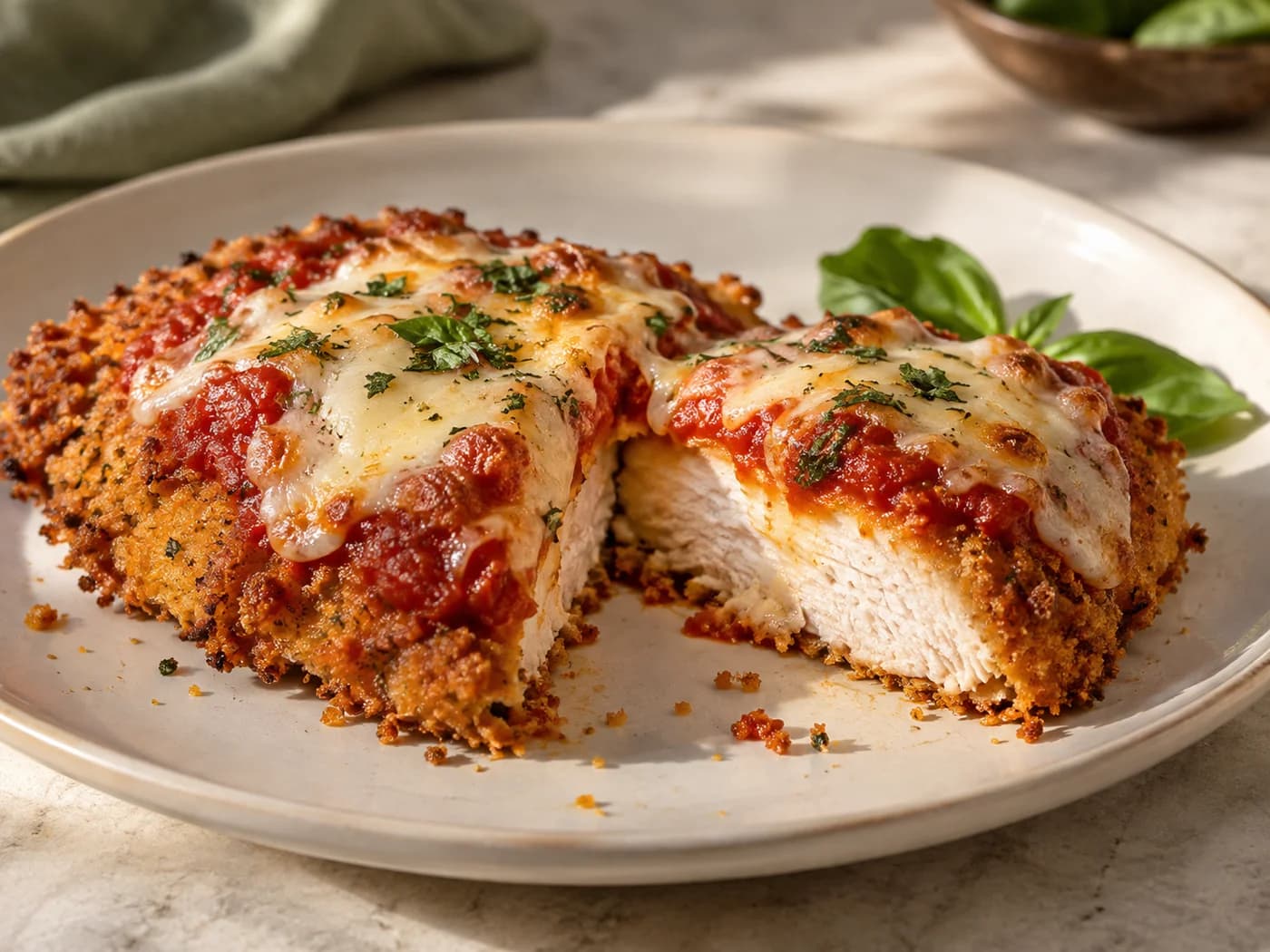
It still feels like chicken Parmesan
The Parmesan belongs in the coating, where a small amount can season a wide area of chicken. Mozzarella does a different job: it melts over the tomato centre and brings the familiar soft, milky finish. Keeping those roles separate makes the dish more interesting than simply adding a large blanket of cheese. A forkful can catch the golden perimeter and the softer middle together.
There is no protein powder to dissolve and no blended dairy sauce to manage. Most of the protein comes from ordinary chicken breast, with smaller contributions from the two cheeses, egg and breadcrumbs. That makes the ingredient list easy to understand. You can shop for a dinner rather than a collection of supplements, and use the remaining tomatoes or cheese in another meal later in the week.
The oven gives you room to work
Once the coated cutlets are on the sheet, you can turn your attention to the sauce and any sides. There is no need to stand over a deep pan of oil or judge when to flip a delicate coating. You still need to check the meat and watch the final topping, but the cooking sequence leaves a useful stretch of hands-free time. Keep a timer nearby so the sauce does not reduce unattended.
A four-serving batch is also straightforward to divide. There are four pieces of chicken, four cheese portions and four sauce shares. You do not have to guess how a large casserole should be cut to match the nutrition estimate. If one person wants pasta and another prefers vegetables, the main portion stays the same while the sides can be chosen separately to suit each appetite.
Enough detail to solve common problems
Dry chicken, pale crumbs and soggy bases usually need different fixes. This guide addresses each one instead of promising that one trick solves everything. Even thickness helps with cooking; measured oil and a hot oven help the crumbs colour; adding sauce late protects the edges. These are practical reasons for the method, while the thermometer gives the safety check. The result should be a dinner you understand well enough to adjust thoughtfully.
Nutrition at a Glance
- Calories
- 462kcal
- Protein
- 50g
- Carbs
- 23g
- Fat
- 19g
The four headline numbers
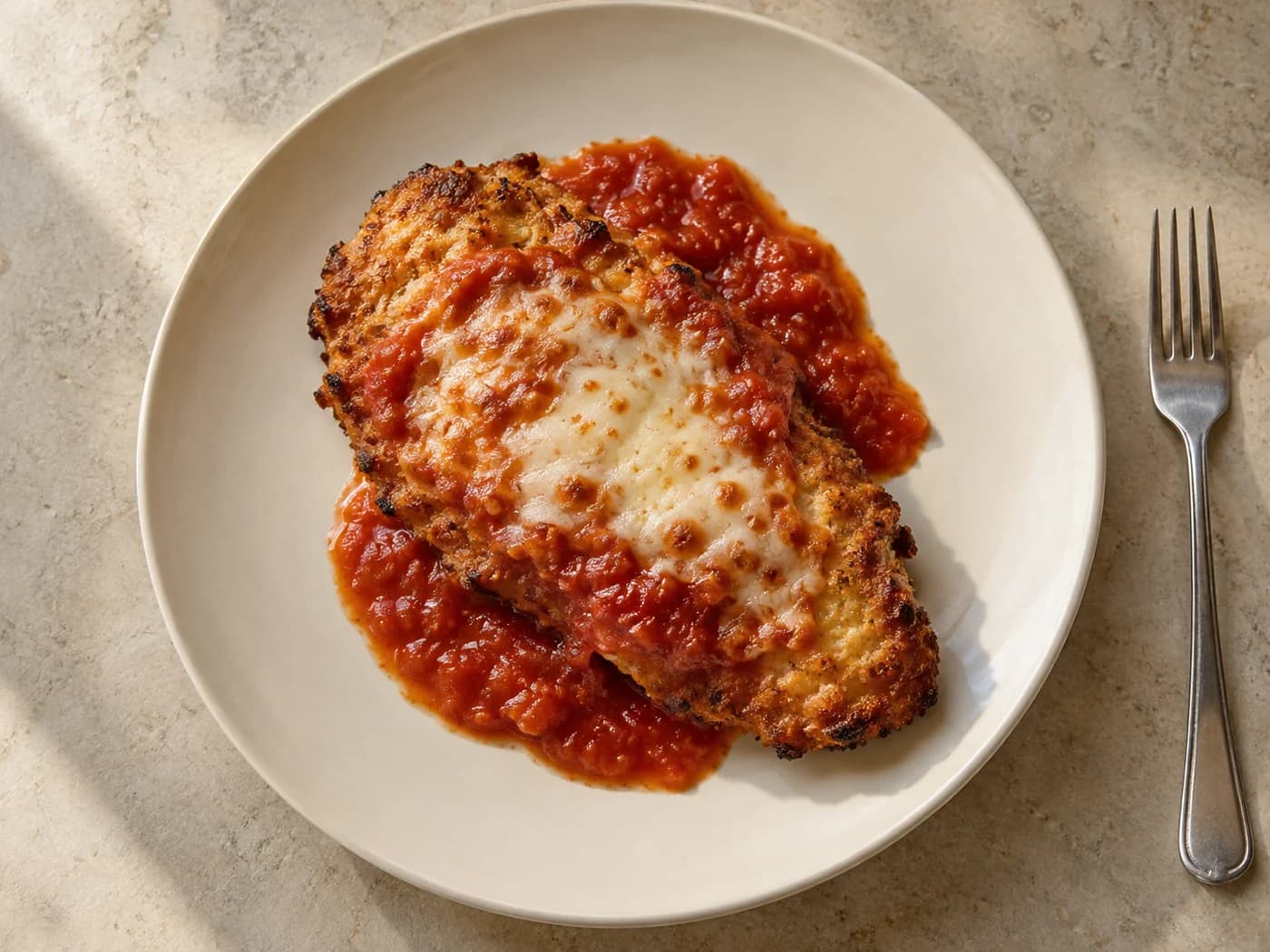
One reference serving provides approximately 462 calories, 50g protein, 23g carbohydrate and 19g fat. The figures above are rounded from the complete ingredient calculation. They include all 16g oil allocated to the four-serving recipe, not just the oil in the saucepan. They also include the entire measured egg and crumb mixture, even if a little remains in the coating dishes and must be discarded.
The chicken contributes about 33.8g protein per serving before any coating or cheese is added. Hard Parmesan, low-moisture part-skim mozzarella, egg and breadcrumbs supply much of the remainder. This is why the recipe can reach approximately 50g without a protein-fortified breading. The actual number can change with the chicken product, cheese variety or ingredient amounts, so treat the estimate as a reference rather than a guaranteed label.
Carbohydrate comes with flavour and texture
Most of the carbohydrate comes from the fine dry breadcrumbs and tomato sauce, with smaller amounts from onion, garlic and the cheeses. The recipe is not presented as carbohydrate-free. The crumbs are part of what makes it chicken Parmesan rather than plain baked chicken with sauce. If you reduce them, expect a thinner and possibly patchier crust, and calculate that version instead of keeping the reference number.
Fat comes from both cheeses, the measured olive oil, egg and chicken. Part-skim mozzarella still contains fat, and Parmesan is not a calorie-free seasoning. The recipe includes roughly 7.1g saturated fat per serving. Someone watching saturated fat can consider a smaller mozzarella topping, but the resulting meal should be judged by its whole ingredient list and personal needs rather than by the high-protein name alone.
Sodium deserves a separate look
The generic estimate is approximately 816mg sodium per serving. Canned tomatoes, breadcrumbs and cheeses contribute sodium before the 1g measured salt is added to the batch. A salted seasoning blend, brined chicken or different cheese can raise it. Compare labels when sodium matters to you. Pasta sauce, bread and dressings served alongside also count toward the meal, even though they are outside this reference calculation.
Ingredients
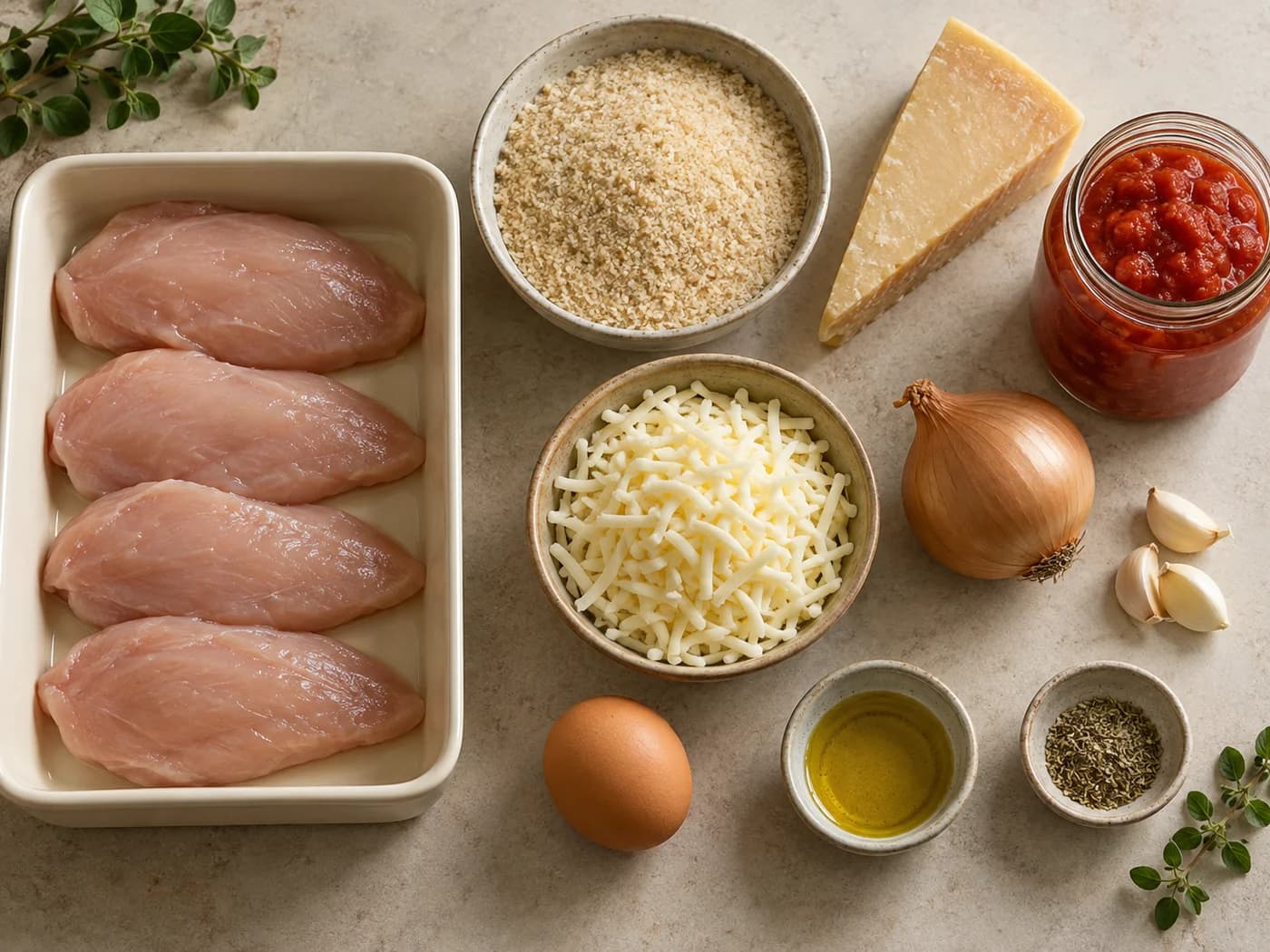
Start with thin, evenly sized chicken
Use 600g raw skinless boneless chicken breast, divided into four 150g cutlets. Buy thin cutlets or carefully split thick breasts horizontally on a dedicated board, then gently even their thickness between suitable food-safe coverings. Aim for about 1cm across each piece rather than a thick centre with paper-thin tips. Different breast sizes may require trimming; weigh the edible meat that actually goes into this recipe.
The coating uses 60g plain fine dry breadcrumbs, 40g finely grated hard Parmesan, 50g beaten whole egg without shell, 6g olive oil, 1g dried oregano and 0.5g fine salt. Mix the dry crumbs, cheese, oil and seasonings thoroughly before dividing. This produces a restrained layer: 15g breadcrumbs and 10g Parmesan per cutlet. Fine grating helps the cheese distribute rather than collect in a few heavy clumps.
Two cheeses, two textures
For the topping, weigh 120g low-moisture part-skim mozzarella and divide it into four 30g portions. A low-moisture product is useful because it does not bring the same pool of liquid as fresh mozzarella packed in water. Grate it before working with the raw chicken so your clean cheese and grater remain away from the coating station. Keep the topping refrigerated until you need it.
The sauce starts with 400g canned crushed tomatoes including their juice, 60g peeled finely diced onion, 8g peeled chopped garlic, 6g olive oil, 1g dried oregano and 0.5g fine salt. The tomatoes in the generic calculation already contain sodium. Choose plain ingredients rather than a seasoned pasta sauce if following the reference. You will use some sauce on the chicken and serve the rest beside it.
A few tools make the sequence easier
Use a rimmed metal baking sheet around 18 by 13 inches / 46 by 33cm, a saucepan, a scale, shallow coating dishes, clean tongs, a broad spatula and a food thermometer. The remaining 4g olive oil coats the sheet. Four cutlets should fit in a single layer with space between them. If your pieces are too wide, use another sheet; overlapping them changes how the coating cooks.
Your ingredient checklist
- Raw skinless boneless chicken breastFour 150g raw cutlets, about 1cm thick; plain, no added solution600g
- Plain dry breadcrumbsFine dry crumbs, 15g allocated per cutlet; all counted60g
- Hard ParmesanFinely grate from a block, 10g per cutlet; not dry shaker topping40g
- Low-moisture part-skim mozzarellaGrated, 30g per cutlet120g
- Whole eggRaw beaten edible weight, without shell; all allocated coating counted50g
- Canned crushed tomatoesIncluding juice; generic reference contains salt400g
- OnionPeeled raw edible weight, finely diced60g
- GarlicPeeled raw cloves, finely chopped8g
- Olive oil4g for sheet, 6g mixed into crumbs, 6g for sauce; all counted16g
- Dried oregano1g in coating and 1g in sauce2g
- Fine salt0.5g in coating and 0.5g in sauce1g
Contains wheat, egg and milk; check all actual labels. Chicken is weighed raw, skinless and boneless. All allocated coating, both cheeses, sauce, oil and salt are counted, even if a little coating is discarded. Sides are additional.
Ingredient Substitutions
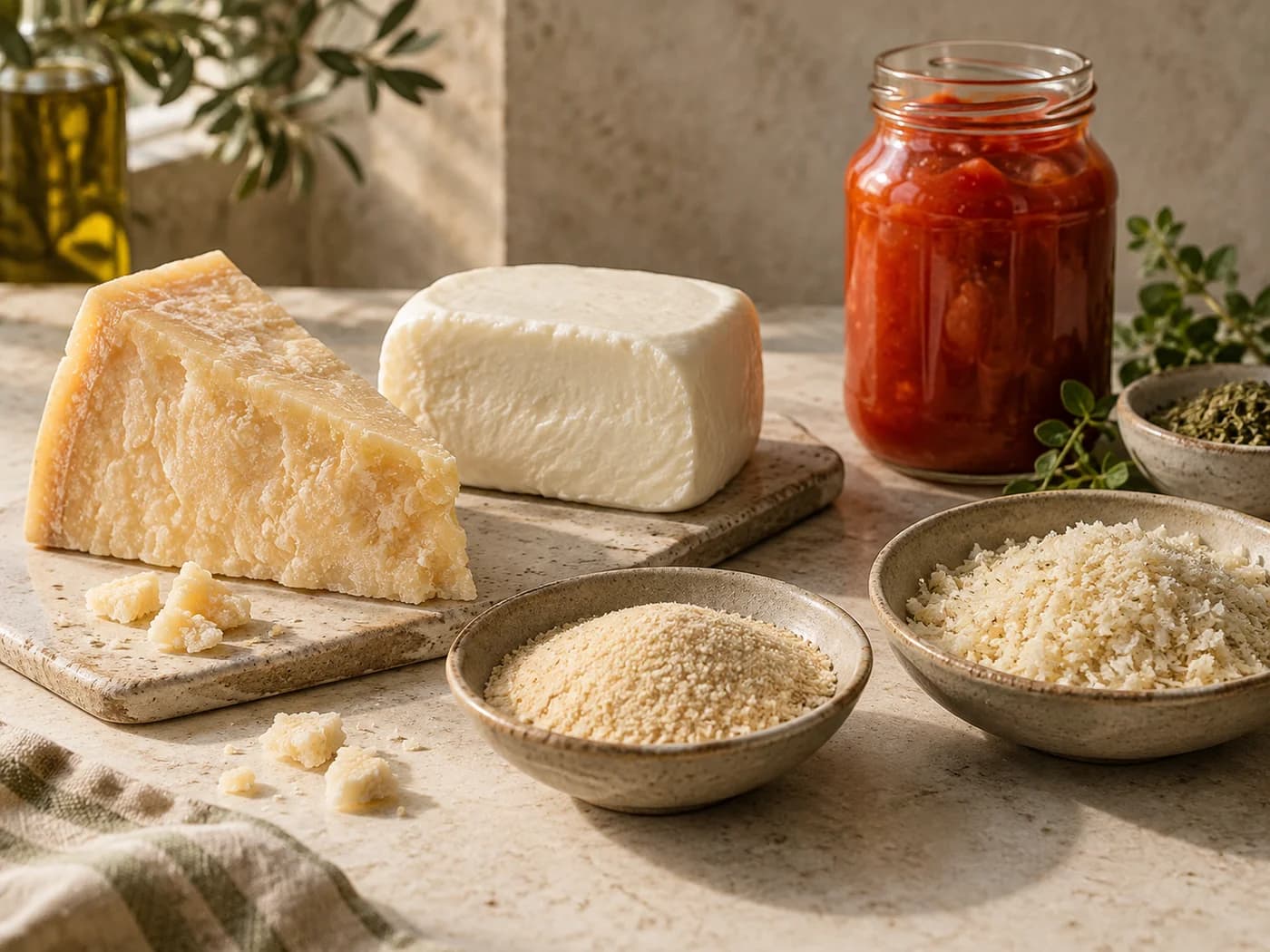
Breadcrumb swaps need a texture decision
Panko can give a coarser, more open coating than fine dry breadcrumbs. It may not cover the same surface as neatly at the same weight. Crush it slightly if you want a finer layer, and use the actual product label for its nutrition. Fresh soft breadcrumbs contain a different amount of water and are not interchangeable with the dry reference simply because both are called breadcrumbs.
For a gluten-free adaptation, choose suitable gluten-free crumbs and check every other ingredient for your needs, including seasonings and cheese processing. The original recipe contains wheat, egg and milk. Replacing only the crumbs does not remove the egg or dairy. An allergy-aware adaptation also needs clean equipment and appropriate handling; the title of a substitute does not establish that the completed meal is safe for every person.
Cheese changes can alter the centre
Fresh mozzarella can be delicious, but its moisture changes the finish. Drain it well, use a measured amount and expect softer breading beneath it. A different low-moisture mozzarella is closer to the reference in behaviour, though its fat and sodium can still differ. Do not replace hard block Parmesan with a dry shaker topping and assume the same nutrition: those are distinct products in the underlying food data.
Chicken thigh meat or turkey cutlets would make another poultry version. Match the raw weight and practical thickness, use the right nutrient entry for that meat, and check its safe internal temperature. Fat, flavour and timing can change. Already cooked chicken is a poor direct swap for the raw cutlets because the full baking stage would heat it again and could dry it before the coating develops.
Sauce and egg alternatives are separate versions
A prepared marinara can replace the homemade sauce for convenience, but that removes several reference ingredients at once. Record the sauce quantity, follow its handling instructions and recalculate its contribution. An egg-free coating might use another suitable binder, yet adhesion and allergens would need separate checking. Neither that adaptation nor a dairy-free topping has been tested here. Keep the unchanged recipe figures attached only to the unchanged reference ingredients.
Choose the ingredient form first, then use its actual label values.
| Reference | Alternative | What to check |
|---|---|---|
| Fine dry breadcrumbs | Panko or gluten-free crumbs | Coverage, allergens and label values |
| Hard Parmesan | Another hard cheese | Salt, fat and flavour |
| Low-moisture mozzarella | Drained fresh mozzarella | Extra moisture and melting |
| Raw chicken breast | Raw turkey or thigh cutlets | Raw weight, thickness and nutrients |
| Homemade tomato sauce | Prepared marinara | Quantity, thickness and sodium |
| Egg coating | Suitable egg-free binder | Adhesion and allergens; untested |
How to Make It
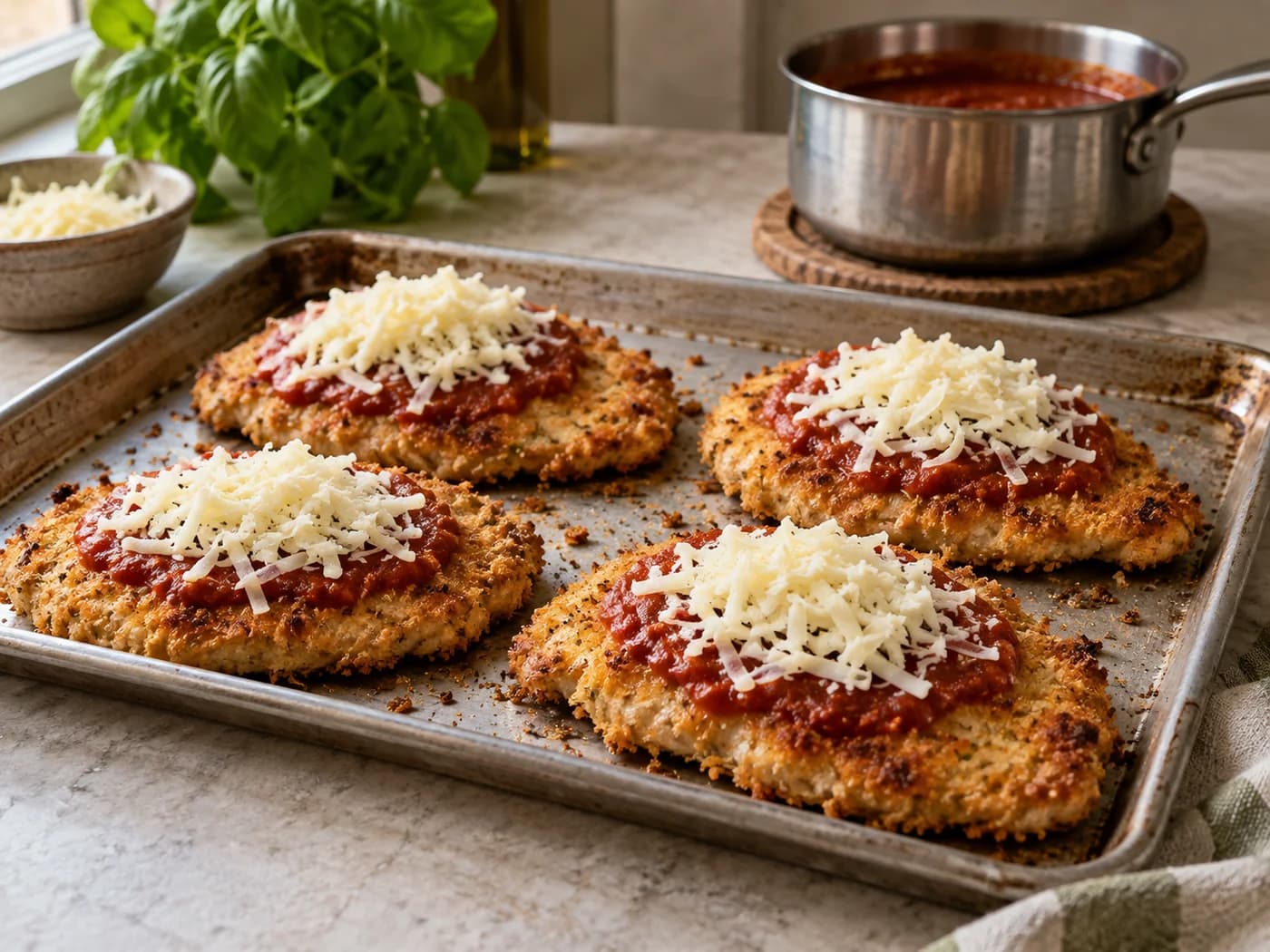
Prepare before handling the raw chicken
Heat a conventional oven to 425°F / 220°C. Coat the rimmed metal sheet with 4g oil. Chop the onion and garlic, grate both cheeses, measure the sauce ingredients and put the mozzarella aside in the refrigerator. Prepare four 150g raw cutlets of roughly 1cm thickness. Pat the surfaces dry with disposable kitchen paper, then discard it. Do not wash poultry; keep the raw preparation area separate from ready-to-eat food.
Beat 50g edible egg in a shallow dish. In another dish, mix 60g fine dry breadcrumbs, 40g grated hard Parmesan, 6g oil, 1g oregano and 0.5g salt. Divide that mixture into four portions before coating so the first piece does not collect most of the cheese. Dip each cutlet in egg, let excess fall back, then gently press its allocated crumbs onto both sides. Place on the sheet without overlap.
Bake while the sauce simmers
Start checking the chicken around 16 minutes; about 16–20 minutes is an initial estimate for thin cutlets, not a guarantee. Meanwhile, soften 60g onion in 6g oil for about 4 minutes. Add 8g garlic briefly, then stir in 400g crushed tomatoes, 1g oregano and 0.5g salt. Simmer gently about 10 minutes, stirring, until spoonable. Keep the sauce utensils away from the raw-chicken station.
Check the thickest part of every cutlet with a food thermometer, entering from the side when necessary. The chicken must reach 165°F / 74°C before the topping stage. If the coating is colouring before the meat is ready, loosely shield it and continue checking. Discard leftover egg and crumbs that contacted raw poultry; do not stir them into the sauce or sprinkle them over the cooked pieces.
Finish with a modest topping
Stir the finished sauce and divide it into four equal shares. Put about half of each share onto the centre of its cooked cutlet and keep the remainder separately for that plate. Add 30g mozzarella to each centre. Bake about 3–5 minutes more until melted, watching the exposed coating. Rest about 3 minutes, lift with a broad clean spatula and serve each cutlet with its reserved sauce. The printable method below scales these quantities together.
Tips for the Best Results
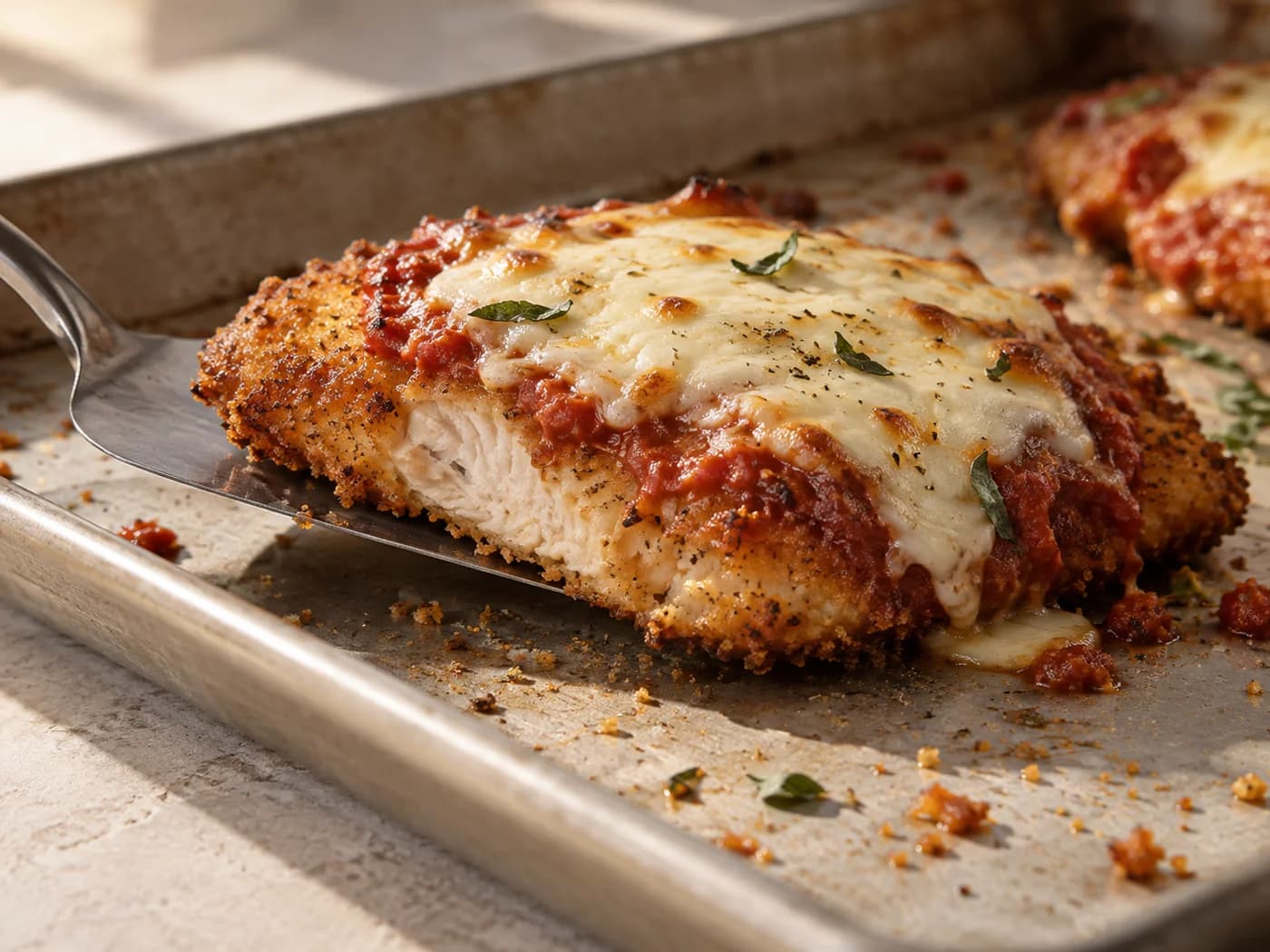
Thickness matters more than a perfect outline
A cutlet does not have to be an elegant oval. It does need a reasonably even thickness so the narrow end is not overcooking while the centre remains underdone. Work gently when evening the meat; aggressive pounding can tear thin edges. If one piece ends up noticeably thicker, treat it separately at the temperature check. Do not extend every cutlet’s cooking simply because the largest one needs another few minutes.
A damp surface can make the coating slide. Patting the chicken dry helps the egg form a thin film rather than a slippery puddle. Let extra egg drip off before pressing on the crumbs. With only 60g breadcrumbs in the whole recipe, this is a fine layer, not a thick shell. Use gentle pressure and accept small irregular patches instead of adding unmeasured extra breading to make every piece look identical.
Help the crumbs colour evenly
Mix the 6g coating oil through the crumbs thoroughly, breaking up oily clumps with a fork before the raw chicken comes near them. That distribution matters more than pouring oil over one corner of the finished tray. A very pale coating might reflect a cool oven, wet chicken, crowded pieces or a different crumb product. First check those factors; turning the heat up sharply can burn the Parmesan before solving the underlying problem.
Use the middle oven area and a metal sheet with room around the cutlets. A crowded deep dish traps more moisture around the coating. Keep an eye on the tips and exposed crumbs during the final cheese stage, since those parts have already baked. The recipe does not require broiling. If your oven runs hot, the visible browning may arrive sooner, but it still cannot replace a temperature reading inside the meat.
Give sauce its own space
Sauce is supposed to soften the centre slightly; that is part of the dish. Trouble starts when thin sauce spreads under the entire cutlet and soaks the base. Simmer it until it sits on a spoon, keep the topping near the centre and offer the remaining share beside the chicken. Serve soon after the short rest. A long covered wait encourages steam and softer crumbs even when the chicken was baked carefully.
High-Protein / Lower-Calorie Variations
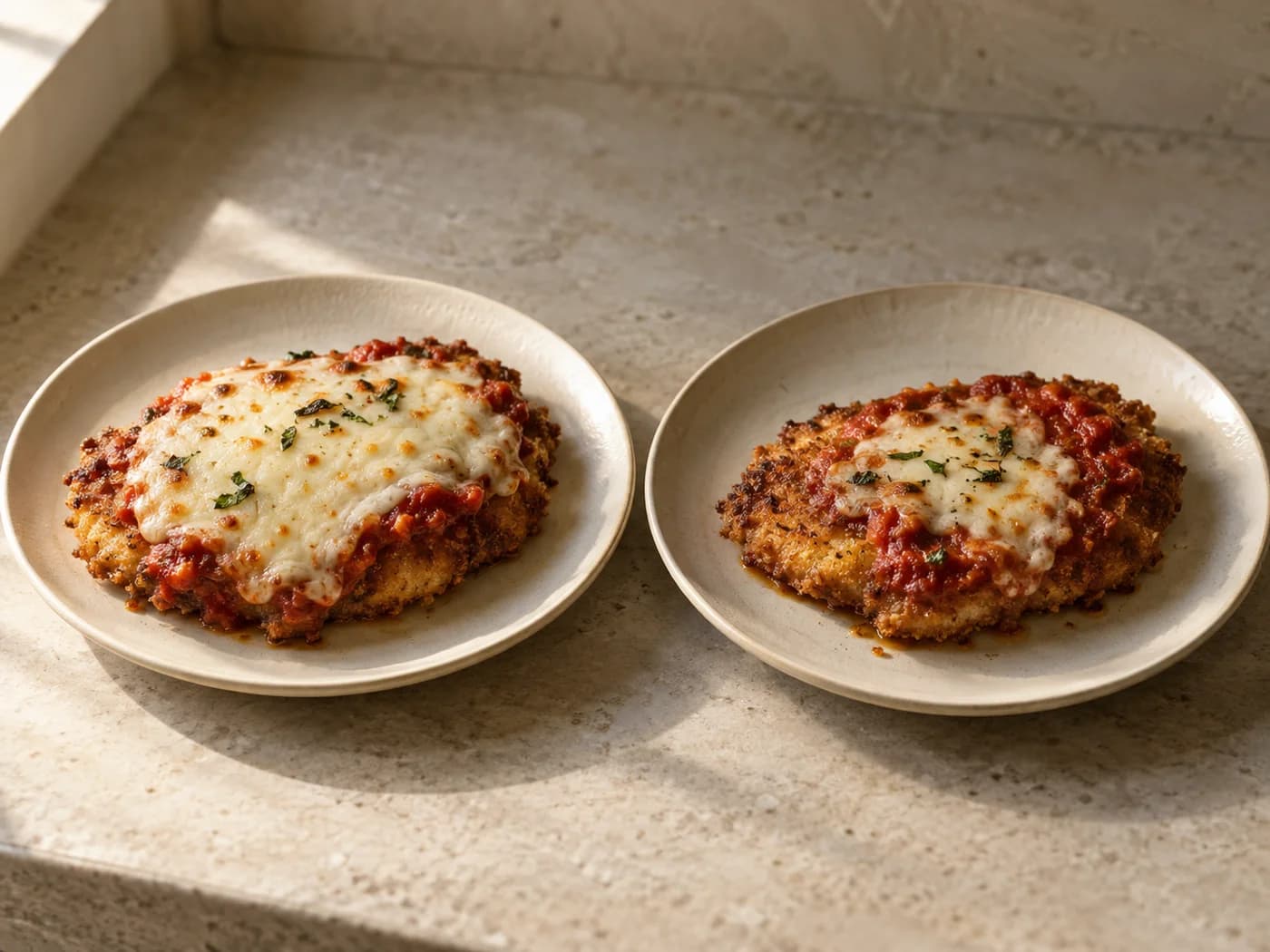
A smaller mozzarella topping
Reducing mozzarella from 120g to 80g across four servings gives 20g per cutlet. Keeping everything else unchanged, the estimate becomes about 433 calories and 47.6g protein per serving. The cheese layer will be thinner and may leave more tomato visible. Spread those small portions over a compact sauce centre instead of trying to cover the whole piece. This preserves some melted cheese without making the rest of the recipe harder to follow.
Using 40g breadcrumbs instead of 60g makes another measured version, approximately 443 calories and 49.3g protein per serving with the remaining ingredients unchanged. That leaves only 10g crumbs per cutlet, so expect a lighter, less complete bread coating. It may appeal if you prefer the chicken to dominate, but it will not have the same crust as the reference. Do not compensate with extra oil without recording it.
More chicken changes the cooking geometry
Adding 100g raw chicken to the batch, divided evenly, increases each cutlet’s raw weight from 150g to 175g. With all other ingredients unchanged, the estimate is around 492 calories and 55.6g protein per serving. Keep the thickness similar by using wider pieces, allow more sheet space and expect less coating per unit of surface. If instead you make thicker pieces, the initial baking time will need reassessment.
Half a completed reference serving, including half its sauce share, provides approximately 231 calories and 25g protein. That is a smaller portion, not a reformulated lower-calorie cutlet. It can work as part of a meal with other foods if it suits your appetite. The distinction matters when comparing portions: halving the chicken while keeping all the cheese and sauce would produce a different nutritional balance from halving everything evenly.
Change one thing when learning the recipe
Choose the adaptation that addresses your actual preference, rather than reducing every component on the first attempt. Less cheese affects the centre; less breadcrumb affects the exterior; more chicken affects coverage and cooking. Keep notes on amounts and observed results so a future batch can build on what happened in your kitchen. None of these estimates establishes a weight-loss outcome, and sides still belong in the total meal calculation.
Comparisons keep all other ingredients unchanged; these adaptations are calculated, not separately kitchen-tested.
| Version | Calories, approximately | Protein, approximately |
|---|---|---|
| Reference complete serving | 462 kcal | 50.0g |
| 80g mozzarella per four-serving batch | 433 kcal | 47.6g |
| 40g breadcrumbs per four-serving batch | 443 kcal | 49.3g |
| 100g extra raw chicken per batch | 492 kcal | 55.6g |
| Half of a complete reference portion | 231 kcal | 25.0g |
Serving Suggestions
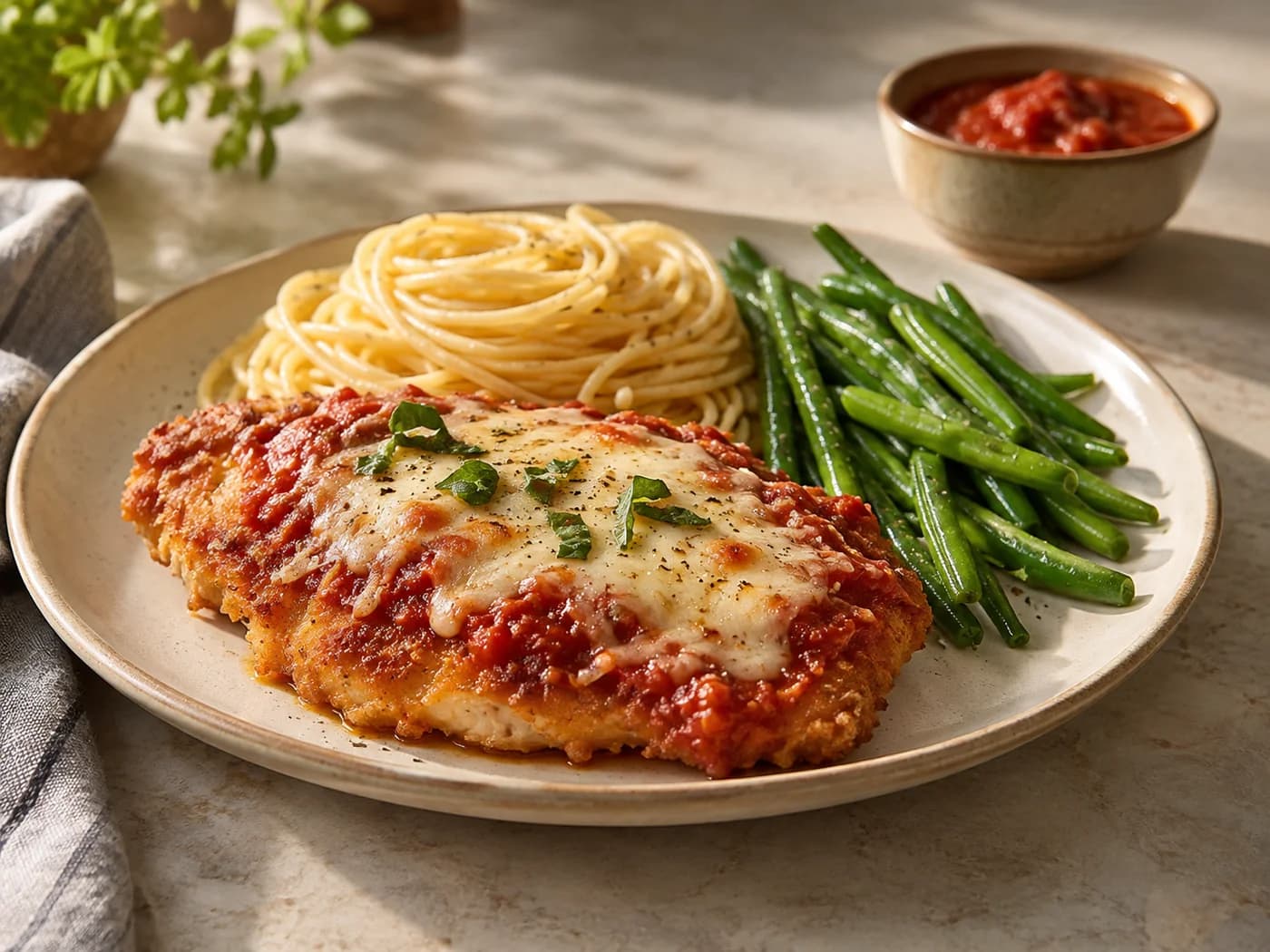
Pasta is welcome when you want it
A small nest of spaghetti is a familiar partner for chicken Parmesan. Cook and portion it separately so you can match it to appetite instead of automatically serving a large bed underneath the chicken. The reserved sauce share can go beside the cutlet or onto the pasta; moving that same sauce does not add ingredients. Extra sauce, butter, oil or Parmesan beyond the reference does need its own entry.
Keep the breaded chicken on a dry part of the plate if preserving its underside matters to you. Setting it directly over wet pasta or a deep pool of sauce softens the coating quickly. This is a texture choice, not a rule about how a dinner must look. A wide plate gives the cutlet, sauce and side enough room, and makes the intended serving easier to recognise.
Add vegetables for colour and variety
Green beans, broccoli, a simple leafy salad or roasted courgette can sit comfortably alongside the tomato and cheese. Prepare them with the seasoning and fat you actually enjoy, then count those ingredients when tracking the meal. A large splash of dressing or generous oil coating may contribute more energy than the vegetables themselves. The recipe’s headline calories do not cover those additions just because they share the same plate.
For a shared table, put the four cutlets on a warmed platter and keep the reserved sauce divided or clearly apportioned. Offer pasta and vegetables in separate bowls. That lets people build different dinners around the same main. If someone wants a smaller portion, cut a cooked cutlet and divide its cheese and sauce fairly rather than giving one person a mostly plain edge and another the entire topped centre.
Think about the rest of the evening
This meal already has a savoury, cheesy centre, so a fresh side can be especially pleasant. A crisp salad brings contrast; warm vegetables keep the plate cosy. Neither option has to turn into a complicated second recipe. Choose a side you can prepare while the chicken bakes, leave space to check the oven, and serve when the cutlets are ready. Dinner planning works better when the timing of the whole plate feels manageable.
Meal Prep & Storage
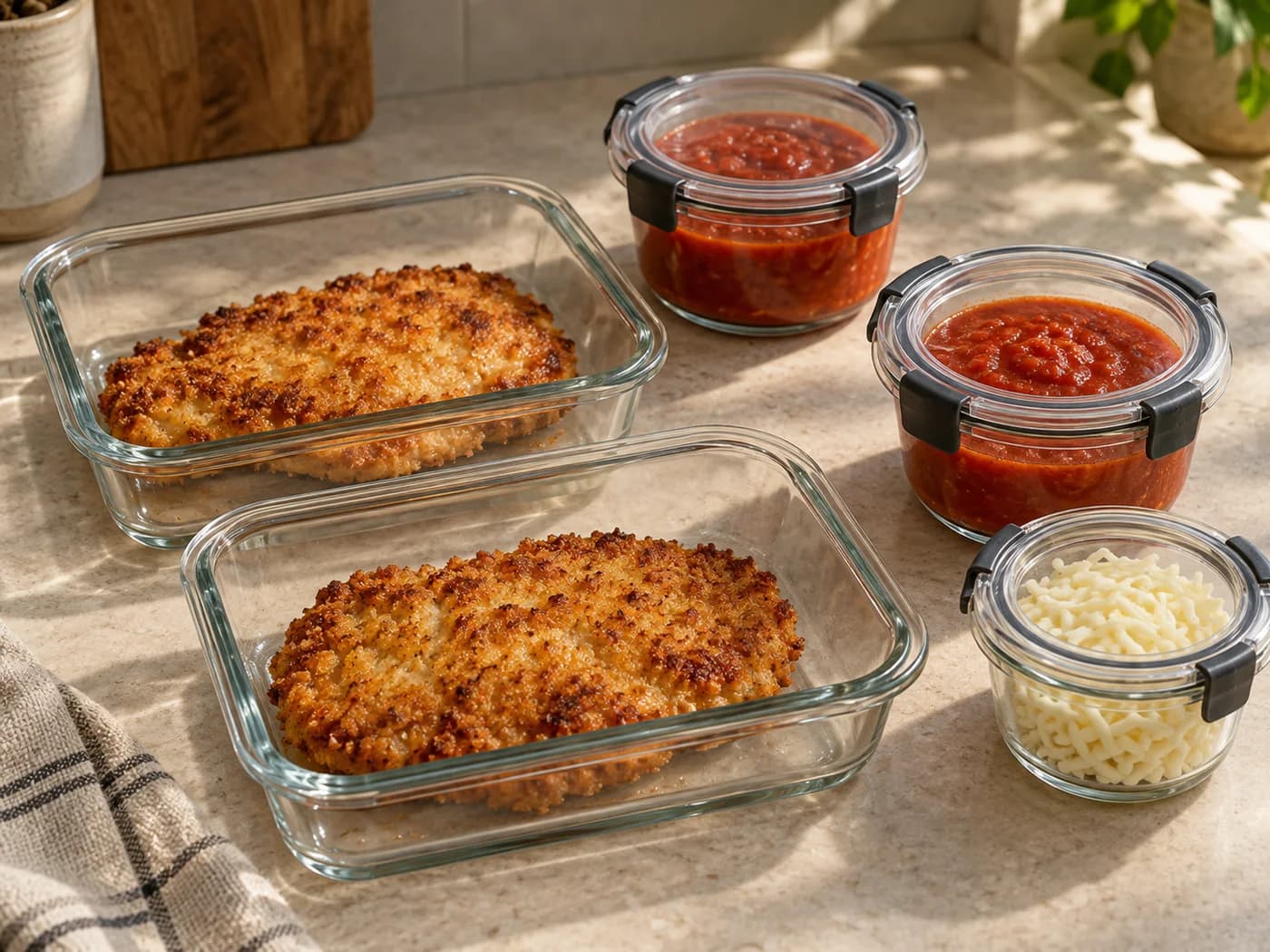
Prepare components without soaking the coating
For a future dinner, you can grate the cheeses, measure dry ingredients and cook the tomato sauce ahead with appropriate refrigeration. Keep the raw chicken separate and follow its original storage instructions. Mixing an entire tray with sauce hours before cooking lets liquid absorb into the crumbs, so it is a different texture plan. The reference coats and bakes the cutlets close to serving, then adds sauce after the chicken is cooked.
If cooking specifically for later meals, a practical adaptation is to bake the breaded chicken fully, cool it safely and store the sauce and mozzarella separately. Add the topping while reheating. That approach may give the coating a better chance than storing every piece under sauce, although the exact reheated texture has not been tested for this formula. Keep track of the same measured ingredients so the intended serving remains consistent.
Cool promptly and label the portions
Refrigerate cooked components promptly in shallow containers rather than leaving a full hot tray on the counter until completely cold. Keep the refrigerator at 40°F / 4°C or below. General cooked-poultry guidance is to use suitably handled leftovers within 3–4 days. Refrigerate within 2 hours, or within 1 hour when temperatures are above 90°F / 32°C. Label the cooking date so the last portion does not become a guessing game.
Freeze portions you will not use within that refrigerated window. One month at 0°F / −18°C or below is a conservative quality plan for this particular untested dish, not a measured shelf-life claim. Wrap or contain portions well to limit drying, and keep sauce in a suitable separate container with expansion space. Thaw in the refrigerator. Freezing cannot rescue food that was already handled unsafely before it entered the freezer.
Reheat with the thermometer, not the topping
An oven can help the coating firm up more than a covered microwave, but both can dry the chicken if heating continues too long. Put the cutlet in a suitable ovenproof container, warm it, then add the sauce and cheese near the end if stored separately. Check that reheated leftovers reach 165°F / 74°C throughout. Melted mozzarella alone does not show that the cold centre is hot enough. Reheat only the portions you need.
Full Nutrition Information
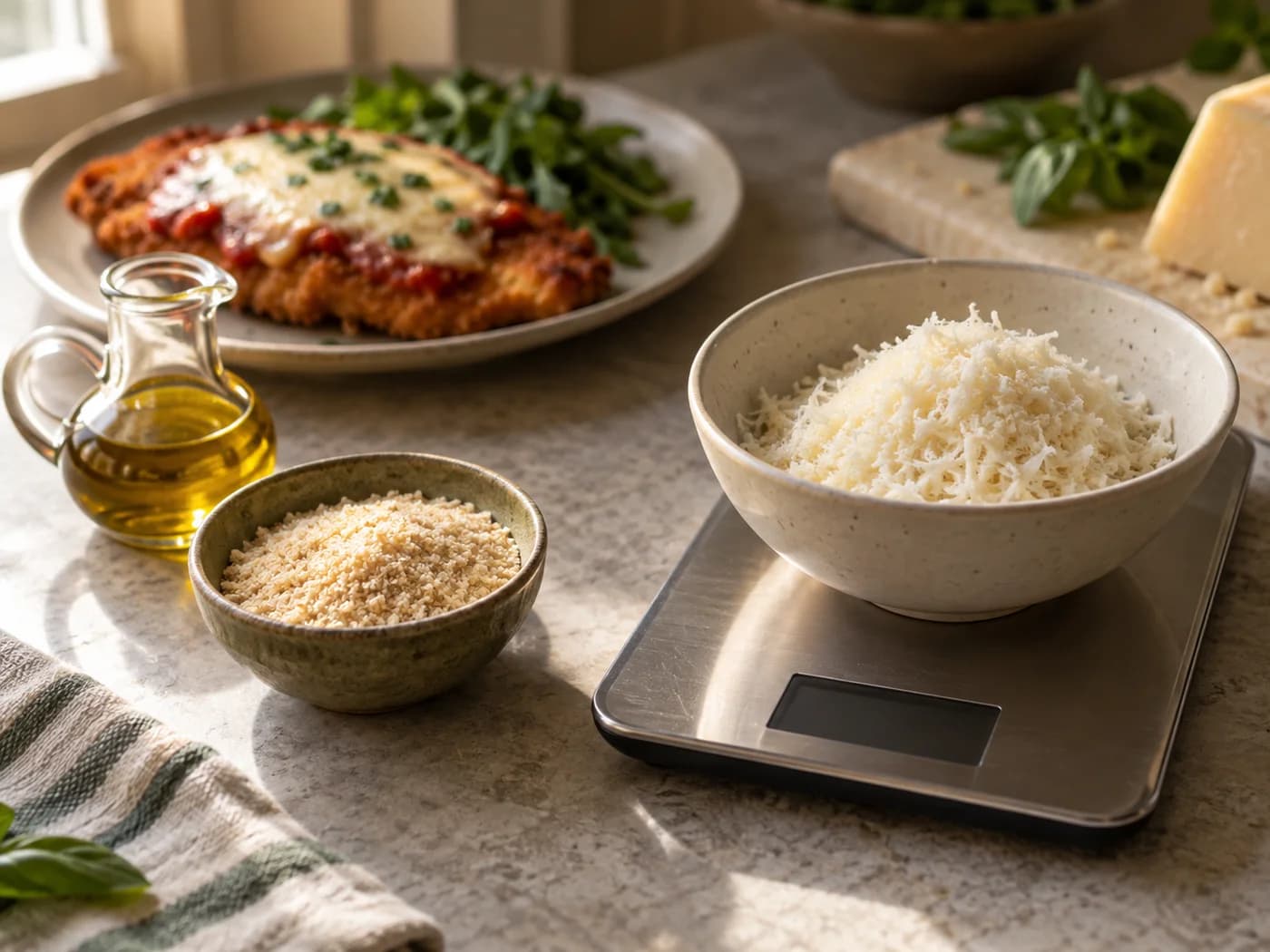
How the estimate is built
The calculation multiplies each ingredient’s per-100g nutrient values by the grams used, divides by 100, adds the results for the batch, then divides by four. For example, 600g raw chicken at 22.5g protein per 100g contributes 135g protein to the whole recipe, or 33.75g to each serving. Keeping this arithmetic visible makes it possible to change a cheese or breadcrumb brand without guessing where the number came from.
Chicken and egg are entered in their raw edible forms. Onion and garlic are raw, peeled weights; crushed tomatoes include their juice. The Parmesan entry is hard cheese from a block, and the mozzarella entry is low-moisture part-skim. Those distinctions matter: a dry grated Parmesan topping, fresh mozzarella or cooked chicken entry would describe different foods. The source rows are historical USDA SR28 values, rather than current laboratory testing of this finished meal.
The whole batch is approximately 1,850 calories, 200.0g protein, 90.3g carbohydrate and 75.0g fat. Each quarter is approximately 462 calories, 50.0g protein, 22.6g carbohydrate and 18.8g fat. Small differences between rounded ingredient rows and rounded totals are expected because the calculation adds the unrounded values first. The four macro cards use whole-number rounding for easier reading; the table keeps more detail where useful.
Use the food calculator to record the products you actually buy and any sides you serve. Enter the chicken as raw weight if you are following this formula, and use the mozzarella and breadcrumb labels from your own packages. If a product lists values per serving, convert them using the serving’s gram weight. A scoop, handful or slice without a known weight is harder to compare consistently.
What the estimate cannot tell you
The table includes fiber, total sugars, saturated fat and sodium, but does not calculate cholesterol, separate added sugars or a complete micronutrient profile. Cooking changes water content and finished weight, so no per-100g cooked-dish claim is made. All allocated coating is counted conservatively even when a little is discarded; oil left on the sheet is also counted. These limits are more useful than presenting uncertain decimals as a precise nutrition label.
| Ingredient | Amount | Calories | Protein | Carbs | Fat |
|---|---|---|---|---|---|
| Raw skinless boneless chicken breast | 600g | 720 kcal | 135.0g | 0.0g | 15.7g |
| Plain dry breadcrumbs | 60g | 237 kcal | 8.0g | 43.2g | 3.2g |
| Hard Parmesan | 40g | 157 kcal | 14.3g | 1.3g | 10.3g |
| Low-moisture part-skim mozzarella | 120g | 354 kcal | 28.5g | 6.7g | 23.7g |
| Whole egg | 50g | 72 kcal | 6.3g | 0.4g | 4.8g |
| Canned crushed tomatoes | 400g | 128 kcal | 6.6g | 29.2g | 1.1g |
| Onion | 60g | 24 kcal | 0.7g | 5.6g | 0.1g |
| Garlic | 8g | 12 kcal | 0.5g | 2.6g | 0.0g |
| Olive oil | 16g | 141 kcal | 0.0g | 0.0g | 16.0g |
| Dried oregano | 2g | 5 kcal | 0.2g | 1.4g | 0.1g |
| Fine salt | 1g | 0 kcal | 0.0g | 0.0g | 0.0g |
| Whole batch | 4 cutlets · 4 complete servings | 1850 kcal | 200.0g | 90.3g | 75.0g |
| One reference serving | Batch ÷ 4 | 462 kcal | 50.0g | 23g | 19g |
| Dietary fiber | 3.1g |
|---|---|
| Total sugars | 6.7g |
| Saturated fat | 7.1g |
| Sodium | 816mg |
Estimated recipe nutrition, not laboratory analysis. Includes raw-weight chicken, all allocated egg and crumb coating, both cheeses, all tomato sauce, oil, oregano and salt. Sides and extra toppings are additional. Uses historical generic USDA SR28 values; actual labels take priority. Cholesterol, separate added sugars and complete micronutrients are not calculated.
How This Fits Your Daily Protein Goal
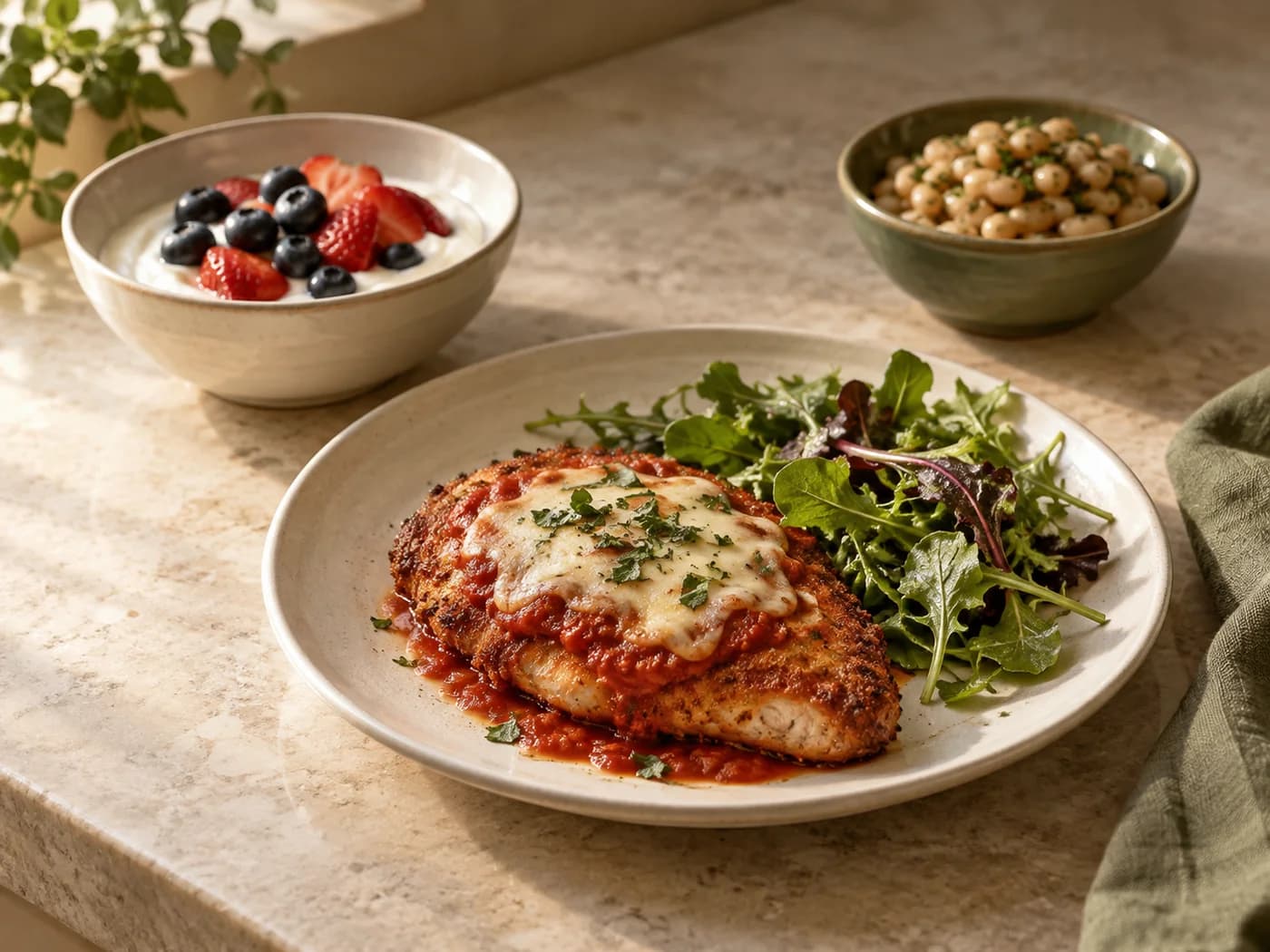
Start with your own day
The protein calculator can help estimate a daily target from the information you provide. This dinner can then occupy one part of that plan. A reference serving supplies about 50g protein, but the right daily total depends on your circumstances; the dish does not establish a universal target. If you have a medical condition or prescribed nutrition needs, use professional advice rather than treating a recipe or calculator as individual medical guidance.
For a simple arithmetic example, someone working with a 100g daily target would get about half of it from one reference serving. Against a 125g target, the same dinner contributes about 40%; against 150g, about one third. These are examples of division, not suggested targets for everyone. The remaining meals still need to fit appetite, total energy, food preferences and whatever daily target is actually appropriate.
Protein is one useful part of the meal
A high protein number does not describe the whole plate. This recipe also contains energy, saturated fat and sodium, and the sides can add carbohydrate, fiber and other nutrients. Planning around only one nutrient can make meals unnecessarily narrow. You can enjoy the cheesy chicken while choosing vegetables, grains, fruit and other foods elsewhere in the day. A varied pattern is easier to live with than asking one dinner to do everything.
If you prefer less chicken at dinner, half a complete reference portion gives about 25g protein before any other foods. Divide the finished cutlet, topping and sauce share together to keep that estimate meaningful. You might pair it with beans or another food you enjoy, but add that contribution separately. There is no requirement to eat a large portion just because the recipe page describes it as one reference serving.
Make the plan practical enough to repeat
Think about the nights when you will actually have time to coat chicken and simmer sauce. A busy day might suit safely prepared components or a simpler meal from the recipe collection. Keep your protein plan flexible enough to accommodate those choices. Consistency usually depends on enjoyable, manageable meals rather than perfect-looking totals on every plate. This recipe is one option within that routine, with its portion and assumptions stated clearly.
Make it personal
Where does this meal fit in your day?
Estimate your daily protein target, then plan meals you enjoy.
Recipe Card
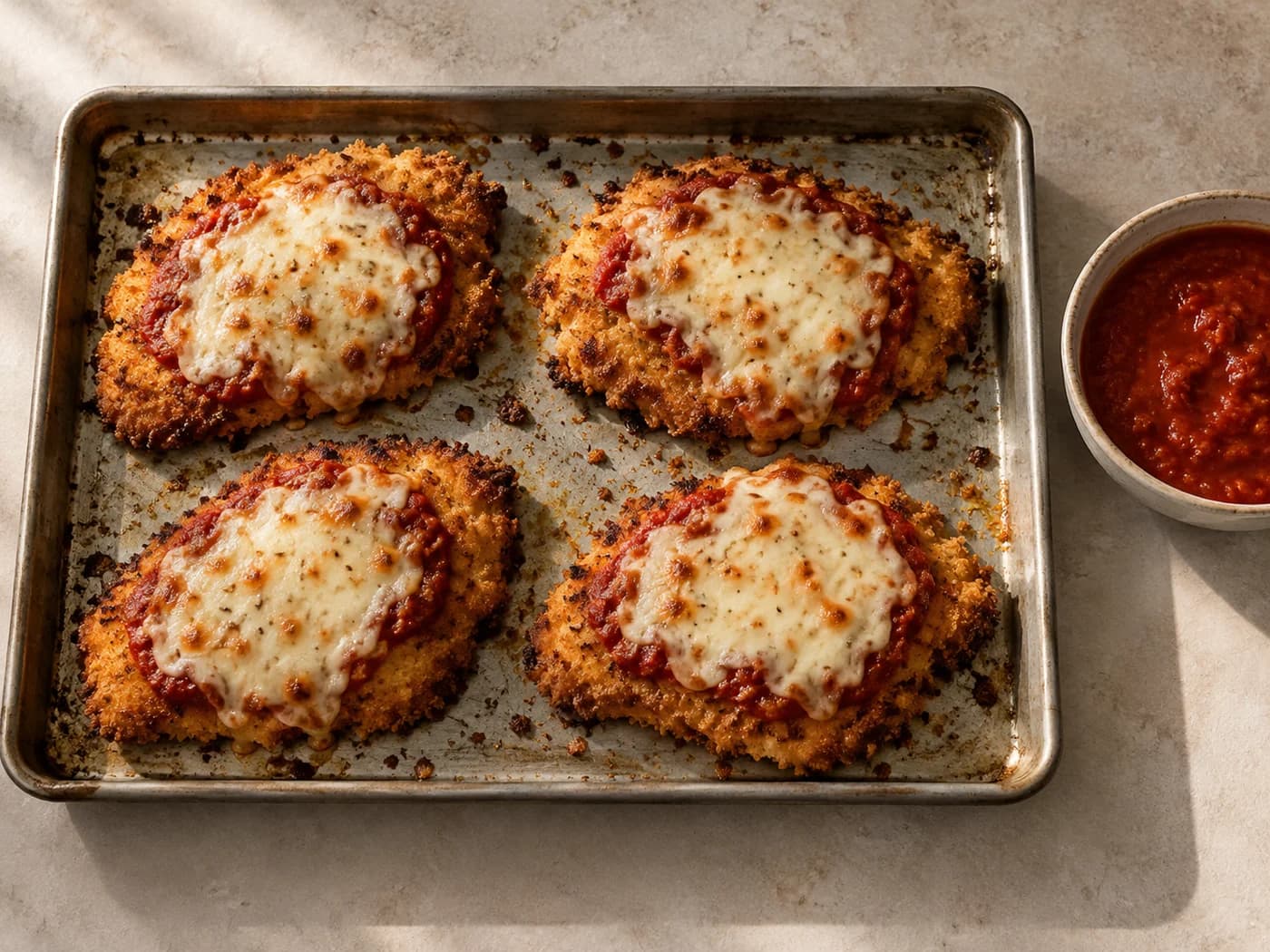
Use the card while you cook
The recipe card gathers the ingredient amounts and six method stages in one place. Choose four, eight or twelve complete servings before starting. Ingredients and batch quantities in the method scale together, while the intended cutlet size, coating allocation and mozzarella per piece stay the same. Doubling the food does not double the thickness: make more 150g cutlets rather than replacing them with a few much larger breasts.
The four-serving reference uses one suitably sized sheet with four pieces in a single layer. Eight servings call for two matching sheets, and twelve for three. That describes the planned space, not a promise that every oven can cook all trays evenly at once. Use separate rounds if your oven is crowded, allow extra preparation time and check each piece independently. The timing labels remain estimates for the original four-serving batch.
Check off ingredients without losing your place
The checkboxes can track what you have weighed or added. Reset the checklist when you need a clean start; changing the serving count also clears it so ticks from an earlier quantity do not carry over. Keep raw-poultry handling away from your device. It is easier to set the portion count, prepare the clean ingredients and print the method before beginning the coating stage than to touch the screen with contaminated hands.
Printing uses the selected quantities in the card. Check that the chosen serving count is correct before sending it to your printer, especially if you changed it while comparing options. The detailed article remains useful for the reasons behind the method, but the printable steps include the temperature checks and storage reminders needed to follow the reference. A printed timer estimate still does not override what the thermometer reads in your actual cutlets.
Keep the portion definition with the numbers
The nutrition line is per complete serving, not for the whole selected batch. It remains approximately 462 calories and 50g protein when you scale the recipe because each serving keeps the same ingredients. Each plate receives one cutlet and one equal share of all sauce. Pasta, vegetables, extra cheese and additional cooking oil belong outside those figures. The exact formula is untested in a physical kitchen, so use the method as a carefully specified starting point.
Golden cutlets, ready for the table
High-Protein Chicken Parmesan
Oven-baked cutlets with Parmesan crumbs, tomato sauce and melted mozzarella.
*Four-serving planning estimates with sauce simmering during the initial bake. Larger batches need extra prep and possibly separate oven rounds. Keep cutlets about 1cm thick and check each thickest point. Exact weighed formula not physically kitchen-tested.
Ingredients
Method
- Prepare cutlets and sheet
Heat a conventional oven to 425°F / 220°C. Coat 1 matching rimmed metal sheet, about 18x13 inch / 46x33cm, with 4g oil total. Prepare 600g raw skinless boneless chicken as 4 cutlets, 150g each and about 1cm thick. Pat dry; do not wash poultry. Keep raw utensils separate. Grate 40g hard Parmesan and 120g low-moisture part-skim mozzarella; set mozzarella aside chilled.
- Coat the chicken
Beat 50g whole egg without shell. Mix 60g fine dry breadcrumbs, the Parmesan, 6g oil, 1g oregano and 0.5g salt. Divide crumbs into 4 portions (15g breadcrumbs plus 10g Parmesan per cutlet). Dip chicken in egg, let excess drip off and press on its crumb portion. Arrange four cutlets per sheet in one spaced layer; use extra sheets if needed. All allocated egg and crumbs are counted.
- Bake and simmer sauce
Bake chicken initially about 16–20 minutes, checking from 16 minutes. Meanwhile soften 60g peeled diced onion in 6g oil about 4 minutes. Add 8g chopped garlic briefly, then 400g crushed tomatoes with juice, 1g oregano and 0.5g salt. Simmer gently about 10 minutes until spoonable. Larger batches may need separate oven rounds and more sauce time.
- Check each cutlet and divide sauce
Check the thickest point of every cutlet with a food thermometer, entering from the side: each must reach 165°F / 74°C before topping. Loosely shield if coating colours early and continue cooking as needed. Discard raw-contact egg and crumbs. Stir sauce and divide into 4 equal shares. Put about half of each share on its cutlet’s centre; reserve the rest for that plate.
- Melt cheese and serve
Top each cooked cutlet with 30g mozzarella (120g total). Bake about 3–5 minutes more until melted; watch the exposed crumbs. Rest about 3 minutes. Serve one cutlet with its reserved sauce per person, 4 complete servings total. Sides are additional. The ~50-minute total is a four-serving estimate with sauce cooked during the initial bake.
- Cool and reheat safely
Refrigerate leftovers promptly in shallow containers at 40°F / 4°C or below; with suitable handling, use within 3–4 days. Refrigerate within 2 hours, or 1 hour above 90°F / 32°C. Sauce and topping can be stored separately. Reheat throughout to 165°F / 74°C. Larger batches need extra prep and possibly separate oven rounds; check every cutlet.
Contains wheat, egg and milk; check actual labels. Chicken is weighed raw. All allocated coating, cheeses, sauce, oil and salt counted; sides are additional. Refrigerate within 2 hours, or 1 hour above 90°F / 32°C. Keep chilled; reheat throughout to 165°F / 74°C.
Frequently Asked Questions
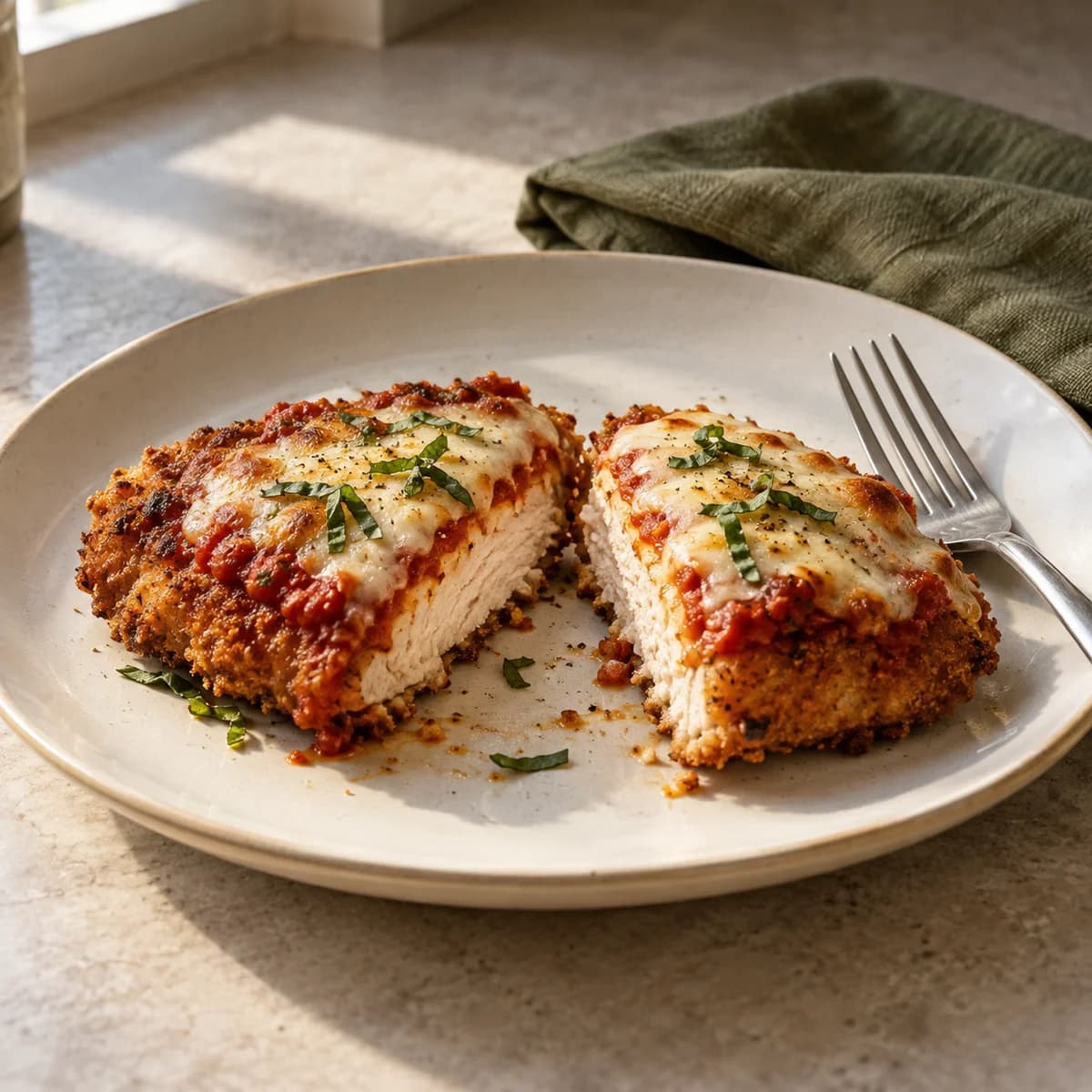
The questions that matter at the stove
Chicken Parmesan can look finished before the thickest meat is ready, and it can taste different when a cheese or crumb product changes. The answers below address those practical details. Start with the raw-weight definition and thermometer check, then choose any substitutions with their texture and nutrition effects in mind. There is no need to make every variation at once to enjoy the reference dinner.
If your package instructions or personal dietary requirements differ from the generic reference, use the information appropriate to your product and circumstances. Photographs show the intended style of the dish, not a guaranteed outcome for every oven. A clear ingredient record and a note about what happened during cooking will help you make the next batch more predictable.
How much protein is in this chicken Parmesan?
One reference serving provides approximately 50g protein and 462 calories. That includes one cutlet starting at 150g raw chicken, its allocated egg and breadcrumb coating, Parmesan, mozzarella, oil and one quarter of the full sauce batch. Pasta, vegetables and extra toppings are additional. Changing the ingredient labels or portion changes the estimate.
Is the chicken weighed raw or cooked?
Raw. Use 600g edible skinless boneless breast meat for four 150g cutlets before cooking. The nutrient entry is also for raw chicken. Cooked chicken loses water and weighs differently, so 600g cooked meat is not equivalent. This method begins with raw cutlets; already cooked chicken would need a different cooking approach to avoid unnecessary drying.
Do I need to use protein powder?
No. Chicken supplies most of the protein, with contributions from the cheeses, egg and breadcrumbs. Protein powder is not an ingredient or a suggested breadcrumb replacement in this recipe. It would change the coating texture and calculation. Ordinary fine dry crumbs and finely grated hard Parmesan make the reference coating; weigh them rather than adding an unmeasured handful.
How thin should the chicken cutlets be?
Aim for about 1cm with reasonably even thickness, keeping each raw piece around 150g. Thin tips and a thick centre cook at different rates. Carefully split thick breasts on a dedicated board and gently even the pieces if needed. The 16–20 minute initial bake is only an estimate; check every cutlet at its thickest point for 165°F / 74°C.
Can I use panko instead of fine breadcrumbs?
Yes, as an adaptation with its own label values. Coarse panko creates a different texture and may give less even coverage at the same 60g batch weight. Crushing it slightly can make a finer layer. Fresh soft crumbs are another ingredient again because of their water content. The original estimates and coating instructions use plain fine dry breadcrumbs.
Can I use fresh mozzarella?
You can try drained fresh mozzarella, but it brings more moisture and may soften the breading under the topping. Weigh the amount and recalculate using that product. Low-moisture part-skim mozzarella is the reference because it gives a more controlled melted centre. Keep any cheese portion modest and add it only after the chicken has reached its safe internal temperature.
Can I use a jar of marinara sauce?
Yes, as a convenience version. Replace the homemade sauce ingredients deliberately rather than adding a jar on top of them. Record the quantity used, check the label for sodium and other nutrients, and follow its handling directions. A watery product may need gentle reduction. Divide the finished sauce fairly between servings, with some on the chicken and the remainder beside it.
Why is my breading falling off?
Wet chicken, a heavy egg layer or rough handling can loosen the coating. Pat the chicken dry, let extra egg drip off and press the allocated crumb mixture gently onto both sides. Lift the cooked cutlet with a broad spatula. A small amount of loose coating is normal with a fine layer; adding extra crumbs changes the reference quantities and nutrition.
Why did the underside turn soggy?
A crowded tray, excess surface moisture, thin sauce or a long covered wait can soften the base. Use a rimmed metal sheet with space between cutlets, bake them before adding sauce, and keep the sauce near the centre. Serve the reserved share beside the chicken. Reheated breading may still be softer than freshly baked; the exact formula has not been kitchen-tested.
Can I make this in an air fryer?
An air fryer would be a separate method. Basket capacity, airflow and the appliance instructions determine the practical batch size and cooking time. Do not assume the oven timings transfer. Keep the raw cutlets separate, check every thickest point for 165°F / 74°C, and count any additional oil. No air-fryer timing or result has been verified for this exact formula.
Can I double or triple the recipe?
Select eight or twelve servings in the card to scale ingredients and method together. Keep 150g raw chicken and 30g mozzarella per serving, and plan four spaced cutlets per suitably sized sheet. Two or three sheets may require separate oven rounds. The displayed time is the four-serving estimate, and larger batches need more preparation and individual temperature checks.
How can I reduce the calories?
One measured option uses 80g mozzarella per four-serving batch instead of 120g, giving approximately 433 calories and 47.6g protein per serving with everything else unchanged. Reducing breadcrumbs from 60g to 40g gives about 443 calories and 49.3g protein, but changes coverage. These are calculated adaptations, not separate kitchen tests. Sides and extra oil still count.
How do I store and reheat it?
Refrigerate promptly in shallow containers at 40°F / 4°C or below and use suitably handled cooked-poultry leftovers within 3–4 days. Reheat throughout to 165°F / 74°C. Sauce and mozzarella can be stored separately for a possible texture advantage. One month frozen is a conservative quality plan for this untested dish, not a measured shelf-life claim; thaw in the refrigerator.
Is this recipe gluten-free or kitchen-tested?
The reference contains wheat in the breadcrumbs, egg and milk in both cheeses. A gluten-free adaptation needs suitable crumbs and verification of all actual ingredients and handling. The exact weighed formula has not been physically kitchen-tested. Timings are estimates, photographs are illustrative, and nutrition is calculated from historical generic USDA values rather than laboratory analysis of the finished dish.
More High-Protein Recipes
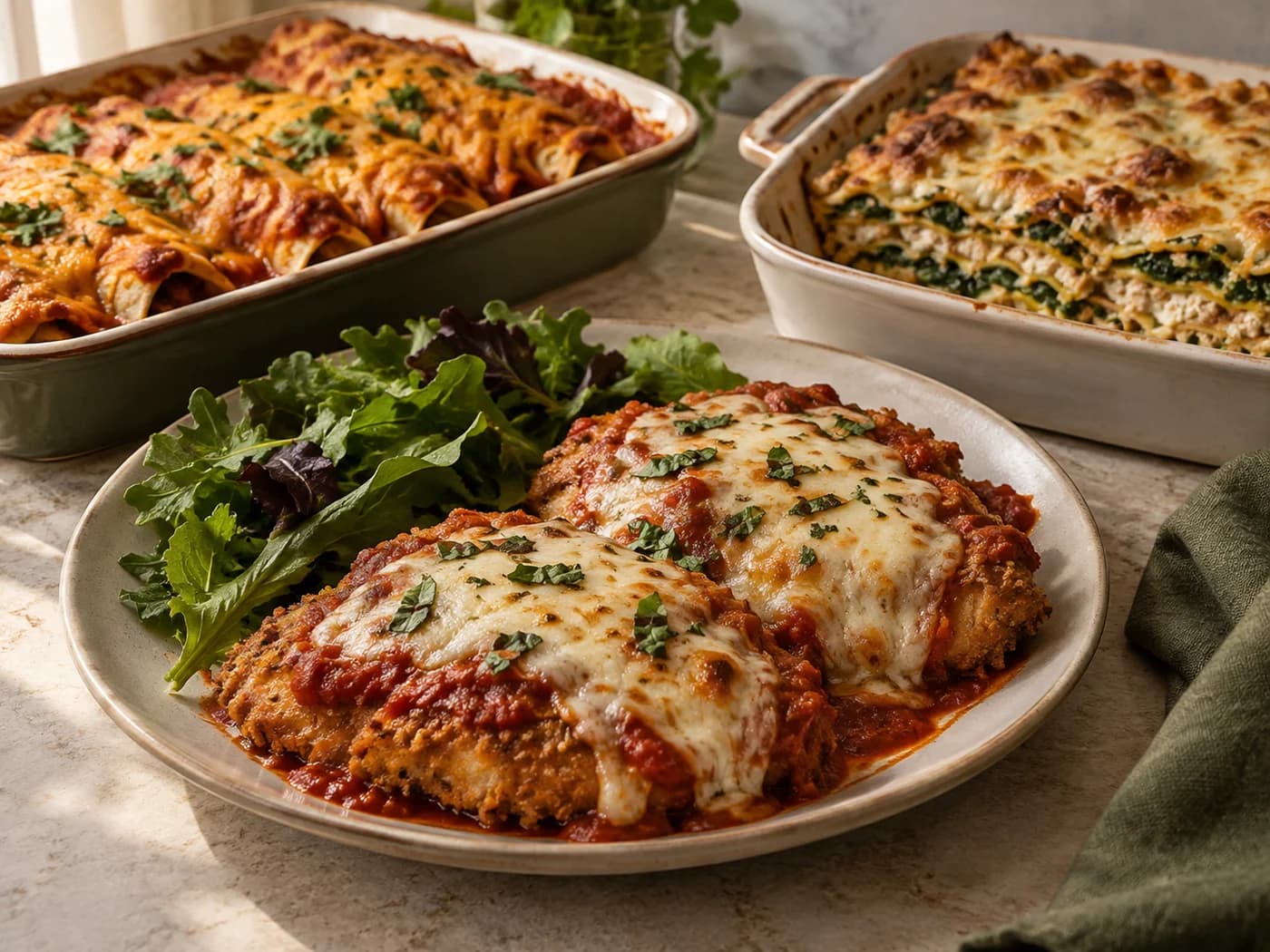
Keep the flavours you like, change the format
If chicken and cheese are a useful combination in your kitchen, the chicken enchiladas offer a saucier oven dinner with corn tortillas and a mild tomato-based sauce. The quesadilla takes a different direction with a toasted tortilla and a quicker skillet finish. Those recipes have their own portions and calculations. A serving from one page is not automatically comparable to a serving from another simply because both contain chicken.
For pasta nights, high-protein lasagna gives you layered turkey, spinach and cheese, while mac and cheese concentrates on a creamy pasta bowl. Either can be a better fit when you want a softer, spoonable meal rather than a breaded cutlet. Choose by the cooking time and ingredients you have, then read that recipe’s serving definition before using its nutrition in your daily plan.
Build a small collection you will actually use
The wider recipe collection includes pizza, breakfast options and bakes as well as these savoury dinners. You do not need to cook something new every night. Keeping a few meals with different textures can make repeat ingredients feel less repetitive: chicken in a crisp coating one evening, tender tortilla rolls another, and a pasta bake when you have more preparation time. Save the recipes you enjoy and adapt your shopping list around them.
When comparing options, consider the full plate and the effort required. An estimated protein number is useful, but so are reheating quality, portions, appetite and what else is in the fridge. These links lead to complete guides so you can check those details. Pick the meal that suits tonight, and leave room for ordinary preferences rather than trying to maximise a single nutrient at every dinner.