
Browse the 15 recipe sections
One reference serving: two rolls with one quarter of the sauce and topping, about 509 calories and 48.1g protein. All tortillas, chicken, dairy, oil and salt are included. Sides are additional; timings are estimates. See the breakdown.
Recipe Overview
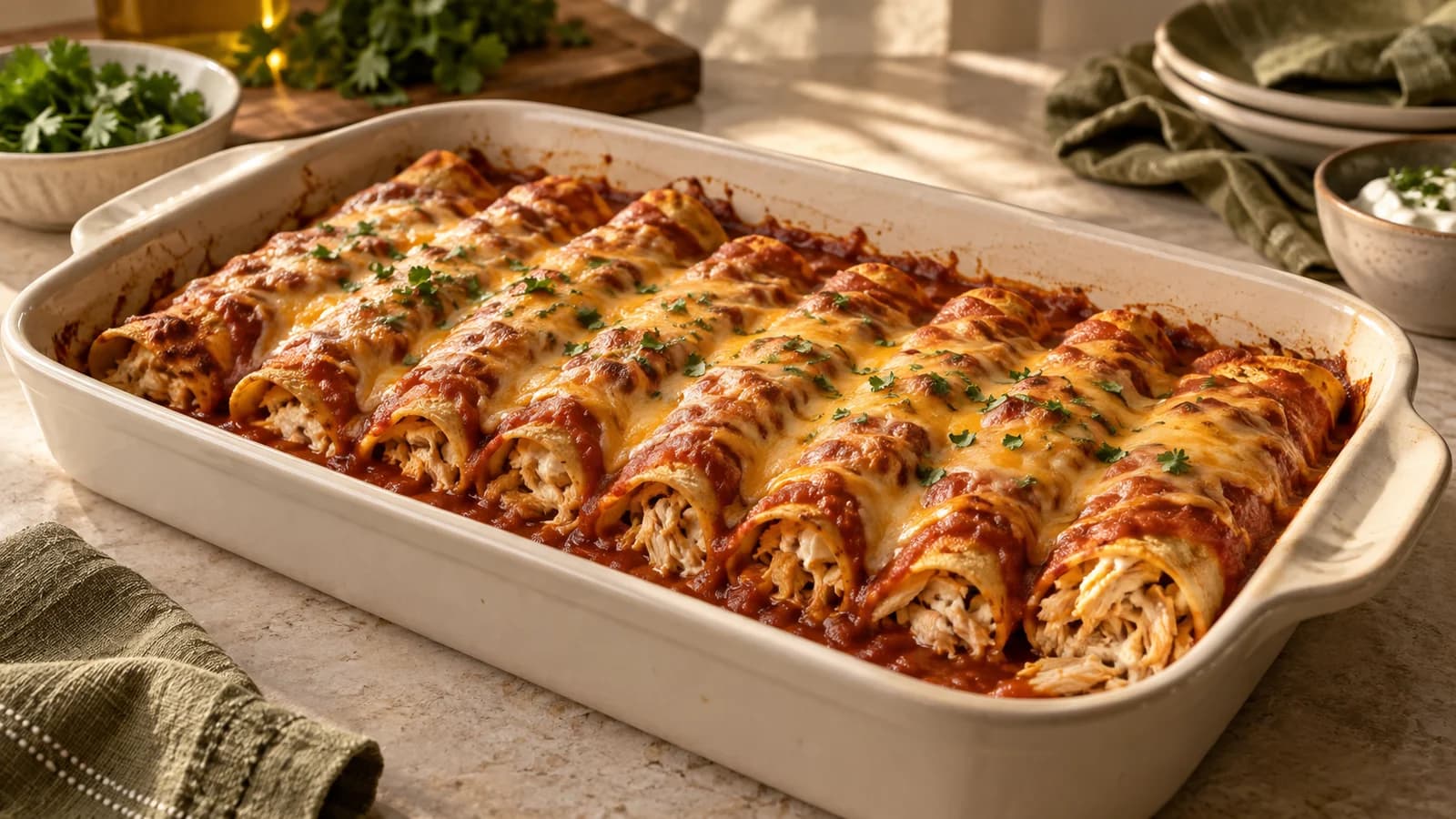
A generous dinner from a simple tray
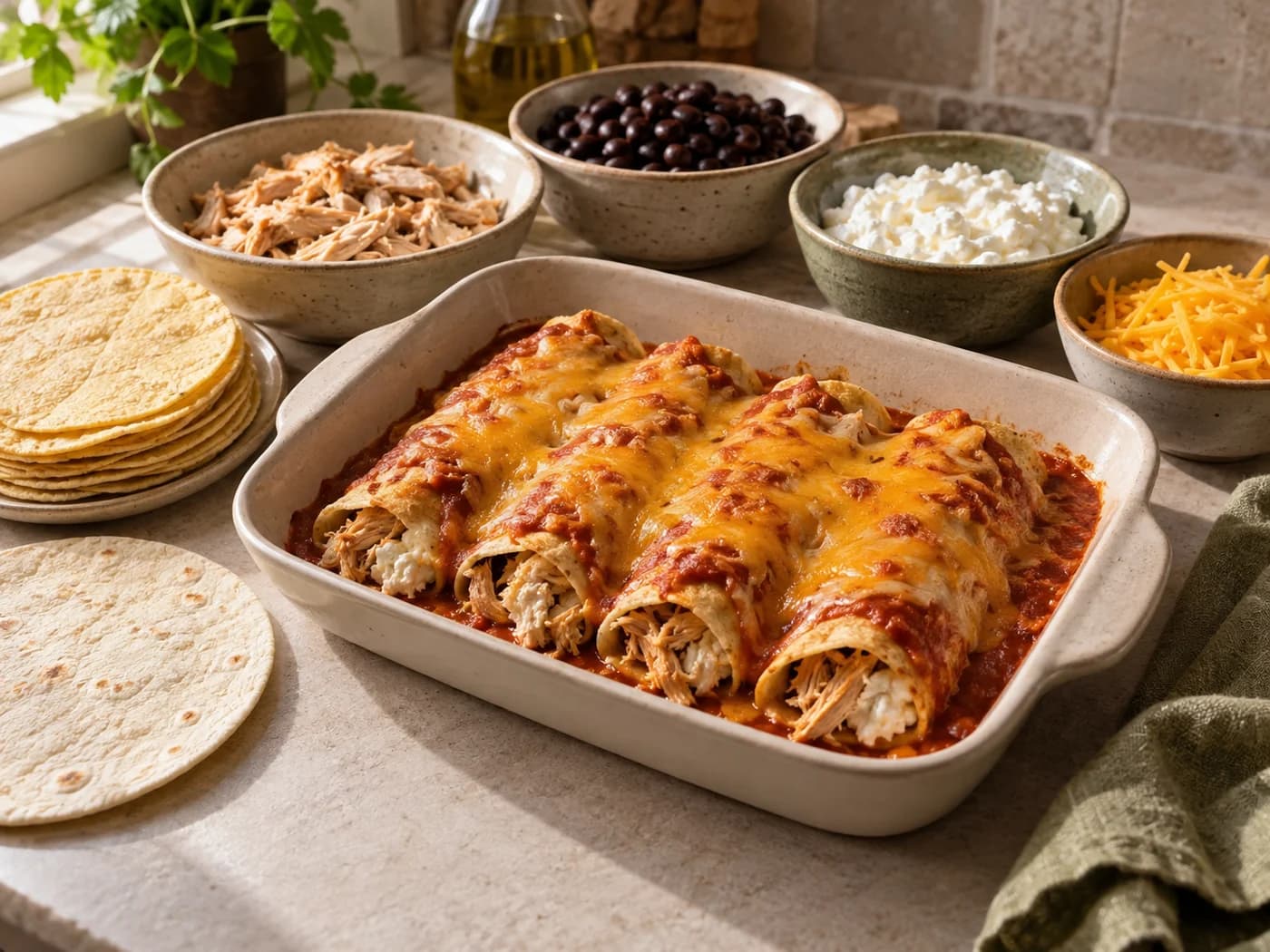
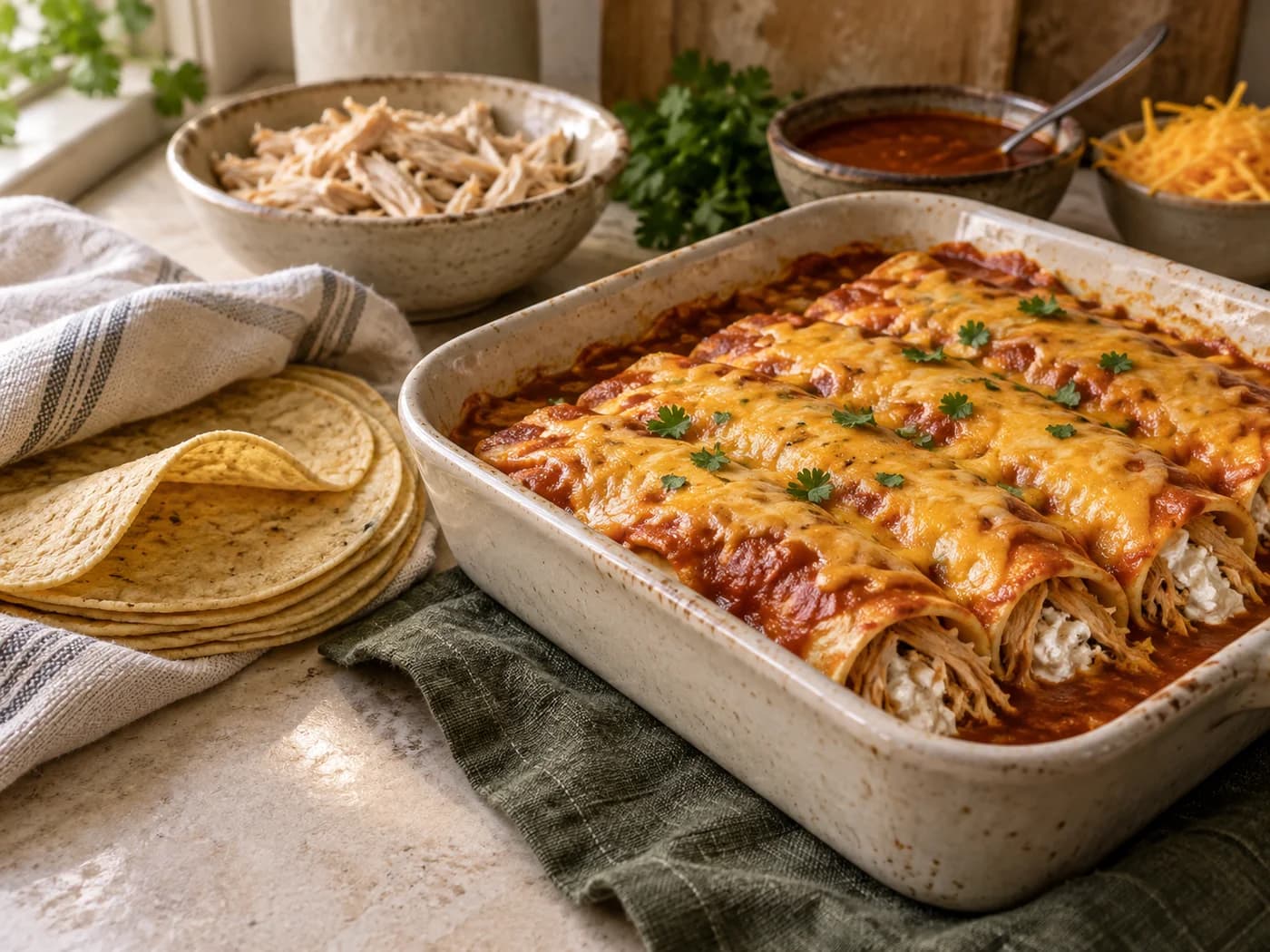
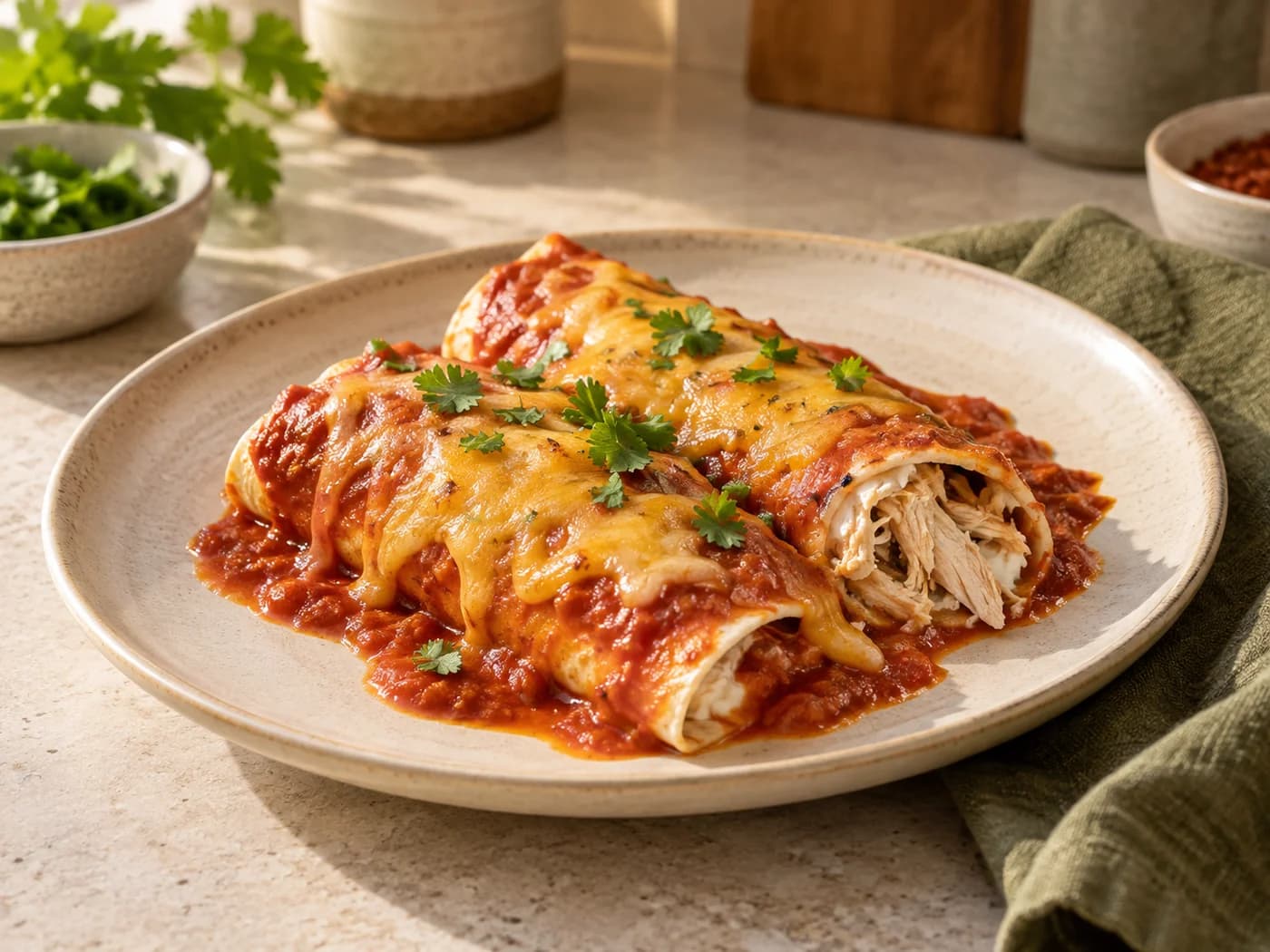
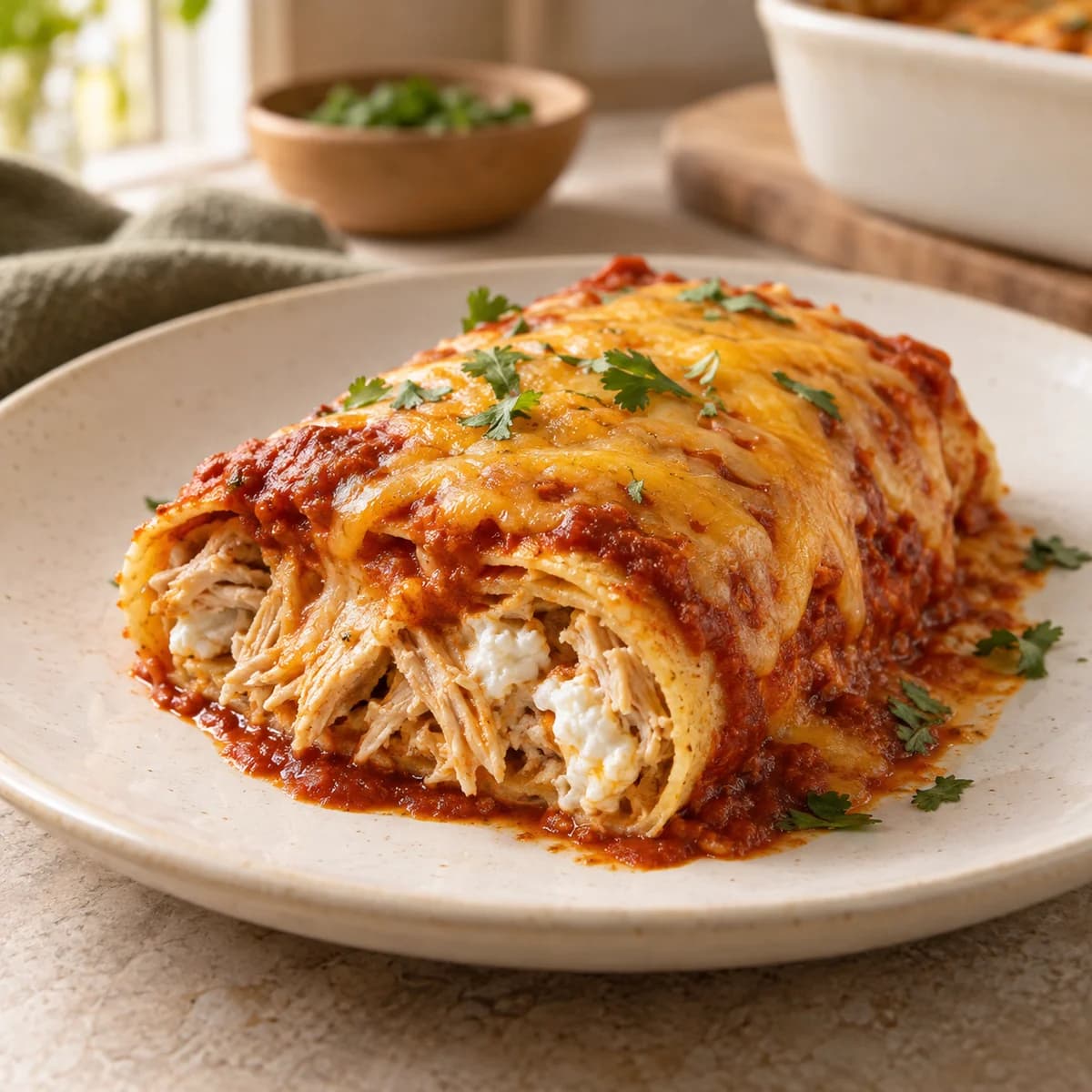
These high protein chicken enchiladas start with small corn tortillas wrapped around finely shredded chicken and blended cottage cheese. They sit in a mild tomato-based red sauce, with a measured cheddar topping that melts into the ridges of the rolls. The result is intended to be soft, saucy and easy to cut with a fork, with little browned patches of cheese on top. It is a home-kitchen adaptation using familiar ingredients, rather than a claim to represent every traditional enchilada style.
The reference dish holds eight individual enchiladas and makes four complete servings. Each serving is two rolls, with one quarter of all the sauce and topping in the pan. That definition matters: the estimated 509 calories and 48.1g protein refer to the pair, not a single tortilla or a roll with its sauce scraped away. The calculation includes chicken, both cheeses, tortillas, vegetables, spices, salt and every measured gram of oil. Salad, yogurt, avocado and other additions belong to their own calculation.
Plan the cooking before the oven goes on
You will need a 9x13 inch / 23x33cm ovenproof baking dish of at least three litres, a saucepan or deep skillet, a scale, a grater and a food thermometer. Allow about 20 minutes for preparation and rolling, roughly 20 minutes for the sauce, around 30 minutes in the oven and five minutes of resting. Seventy-five minutes is a planning estimate with plain cooked chicken already available. Cooking chicken from raw is a separate stage, and a cold filling or a crowded oven can change the bake time.
The exact weighed formula has not been physically kitchen-tested, so use the method's handling and temperature cues alongside the timer. The photographs show the intended food rather than a documented test batch. The guide explains how to warm corn tortillas before rolling, keep the sauce loose enough to coat them, and divide the filling evenly. Those small details make this more approachable than an instruction to fill, roll and bake with no explanation of what the components should look like.
Why You’ll Love This Recipe
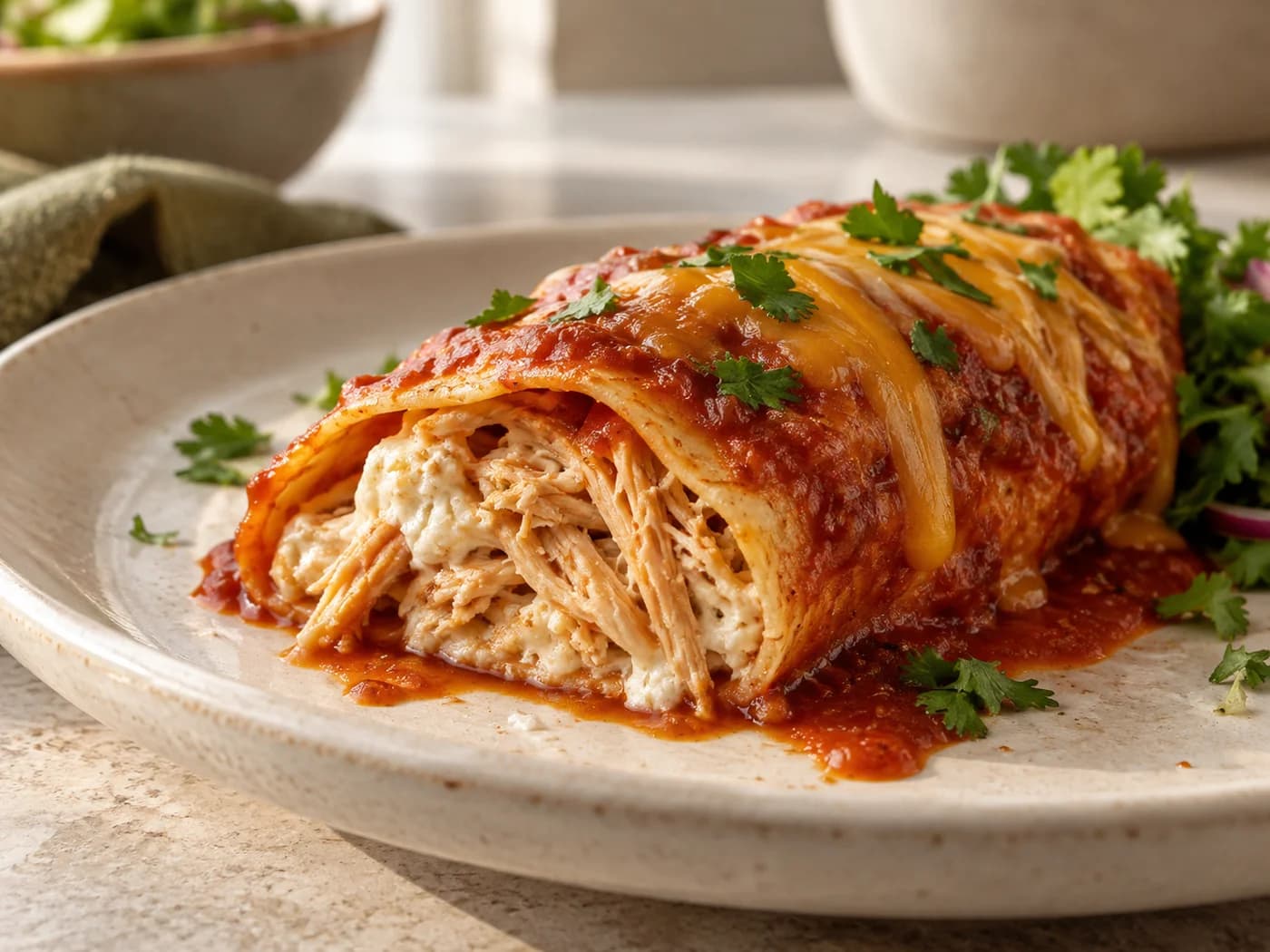
Plenty of filling, without a mountain of cheese
The protein comes mainly from cooked chicken breast, supported by cottage cheese and cheddar. Each pair of enchiladas contains 100g cooked chicken, 50g cottage cheese and 25g cheddar, plus the contribution from the other ingredients. The cheeses do different work. Blended cottage cheese coats the chicken shreds and helps them sit together inside each tortilla. Cheddar stays on the surface, where its flavour is easy to notice. That arrangement gives you a cheesy dinner without needing to hide the entire tray beneath an unmeasured layer.
The tomato sauce brings a little acidity and the gentle sweetness of cooked onion. Paprika gives it colour and a mild pepper flavour, cumin adds warmth and oregano rounds it out. There is no need for protein powder or a special high-protein tortilla in this version. You can keep the base mild and offer chilli sauce at the table, which is useful when the people sharing the dish have different ideas about how spicy dinner should be.
The oven does the final work
Once the rolls are in the dish, you have time to clear the board and put together a cool vegetable side. There is no last-minute sequence of individually frying four meals. The reference is one shallow pan, so it is also easy to see how you will portion it: two adjacent rolls for each person, with sauce shared evenly. A broad serving spatula helps lift the pair without tearing the softened tortillas away from the chicken.
The ingredients overlap with several everyday meals. Safely cooked chicken can be used here, cheddar is familiar in sandwiches and bakes, and the remaining cottage cheese can go into another recipe while it is within its storage guidance. The dish rewards a little preparation rather than unusual equipment. If you enjoy dinners with a warm sauce and a soft filling, the texture will be a good change from a crisp quesadilla or a toasted sandwich, even though some ingredients are shared.
Nutrition at a Glance
- Calories
- 509kcal
- Protein
- 48g
- Carbs
- 41g
- Fat
- 18g
The headline values
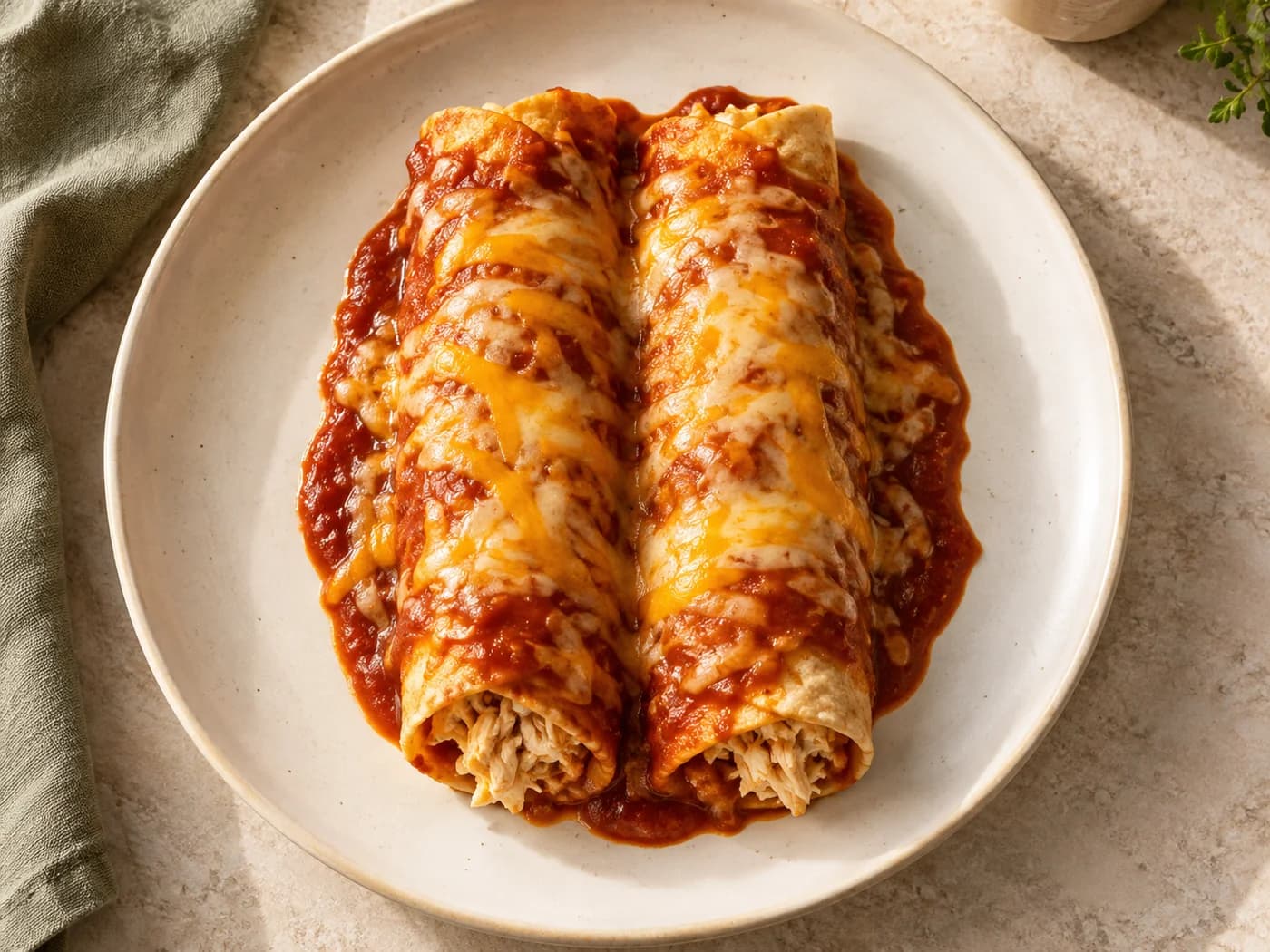
A two-enchilada serving calculates to approximately 509 calories, 48.1g protein, 41.2g carbohydrate and 17.9g fat. The quick cards round that to 509 calories, 48g protein, 41g carbs and 18g fat. These are estimates from the listed ingredient weights, not measurements of a finished plate. If you make four equal servings from the reference dish, each receives the same planned share of all the ingredients. A larger or smaller plateful needs its own portion adjustment.
Chicken is the largest protein contributor. Corn tortillas supply much of the carbohydrate and some fibre, while cheddar contributes both protein and fat. Cottage cheese adds protein as well as moisture to the filling. The red sauce also counts: tomatoes, onion, garlic, oil and seasonings are part of the meal, even when they collect around the rolls instead of staying on top. Include that sauce when you serve and when you think about the portion.
Beyond protein and calories
The reference estimate includes about 7.3g fibre, 10.4g total sugars, 7.0g saturated fat and 794mg sodium per two-roll serving. Total sugars include those naturally present in the tomatoes, onion and dairy; separate added sugars have not been calculated. The canned-tomato reference contains salt, and cottage cheese and cheddar contribute sodium too. Adding only 1g salt to the whole sauce does not make the finished dish a low-sodium meal by definition.
High protein describes one feature of this recipe, rather than deciding whether it is right for every appetite or daily plan. Around 509 calories can be useful for comparing meals, but it is not a promise about weight change or a requirement to finish the whole portion. The measured variations later in the guide show what happens when the cheese quantity or chicken amount changes. Your actual labels, especially for tortillas, dairy and prepared chicken, will give a more relevant estimate for the food you buy.
Ingredients
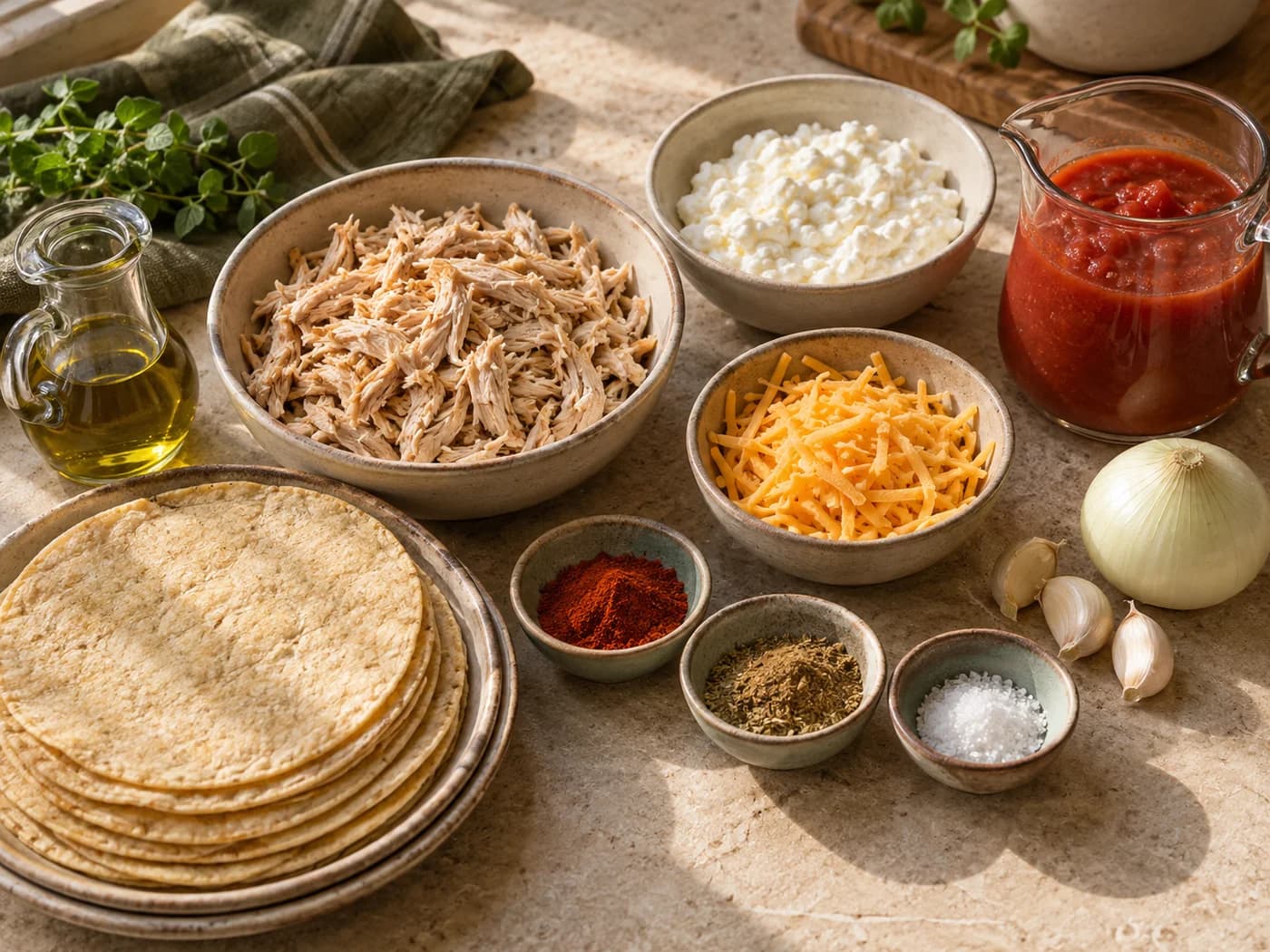
Small tortillas and finely shredded chicken
Use eight corn tortillas weighing 25g each, approximately six inches or 15cm across. Choose a product that becomes flexible when warmed according to its packet directions. Weight is the nutrition reference, while diameter helps the rolls fit the dish. A thicker or heavier tortilla can change both the nutrition and the amount of sauce it absorbs. Keep the package nearby so you can follow its heating guidance rather than treating every corn tortilla as identical.
The chicken amount is 400g cooked skinless breast meat, weighed after bones, skin and any inedible pieces are removed. Shred it finely, cutting across very long strands so the filling can spread in a narrow line. Plain roasted breast is the reference food. If you use rotisserie chicken or seasoned leftovers, their oil, brine or sauces may change the estimate. The recipe does not use raw chicken inside the tortillas, and 400g raw meat is not an interchangeable measurement.
A creamy filling and a modest topping
Stir a tub of 2% cottage cheese, then weigh 200g and blend it without adding liquid. You want a thick cream that coats the chicken. Small curds are also acceptable if you prefer to skip blending. Finely grate 100g cheddar for the top. The whole cheese amount belongs to the batch; each individual roll receives an average of 12.5g cheddar once the topping is spread evenly. There is no extra cheese hidden inside the reference filling.
For the sauce, measure 600g canned crushed tomatoes including their juice, 100g peeled onion and 10g peeled garlic. Dice the onion finely so it softens within the planned simmer. Measure 10g olive oil, with 4g reserved for the baking dish and 6g for the sauce. Finish with 4g ground cumin, 6g plain sweet paprika, 2g dried oregano and 1g fine salt. Use plain spices rather than a salted taco seasoning blend if you want to follow the reference calculation. Any extra chilli, garnish, cooking spray or dip is an addition to that list.
Your ingredient checklist
- Corn tortillasEight pliable tortillas, 25g each, about 6 inch / 15cm; verify actual label200g
- Cooked skinless chicken breastCooked edible weight, plain roasted, finely shredded; not raw weight400g
- Low-fat cottage cheese (2%)Stir the tub, then blend without added liquid; 25g per roll200g
- CheddarFinely grated; all on top, 12.5g per roll100g
- Canned crushed tomatoesPlain crushed tomatoes including juice; generic reference contains salt600g
- OnionPeeled raw edible weight; finely diced for sauce100g
- GarlicPeeled cloves, finely chopped10g
- Olive oil4g for dish; 6g for sauce; all counted10g
- Ground cuminPlain cumin, ground from cumin seed4g
- PaprikaPlain sweet paprika; no salted seasoning blend6g
- Dried oreganoFor the tomato-based red sauce2g
- Fine saltFor the sauce; other ingredients already contribute sodium1g
Contains milk. Check tortillas and all other labels for allergens and gluten-free suitability. Chicken weight is cooked, not raw. Each serving includes two 25g corn tortillas; all sauce, oil and salt are counted. Sides are additional.
Ingredient Substitutions
Meat and meat-free changes
Cooked turkey breast can be used in place of the chicken as a modified filling. Match the cooked edible weight and use turkey values when calculating the meal. Cooked thigh meat is another option, with a different fat content and a richer flavour. Whichever meat you choose, shred it into small pieces and remove skin, bones and tough bits before weighing. A filling with large chunks can make the small tortillas difficult to close without splitting.
For a vegetarian version, beans or a suitable meat-free filling need their own quantities and nutrition calculation. Equal weights of cooked chicken and beans do not contribute equal protein. Drained beans also change the texture: lightly mashing some can help hold the filling together, but they should not bring a pool of liquid into the tortilla. Check the cheeses for vegetarian suitability if relevant. Simply deleting the chicken does not leave the 48g protein claim intact.
Tortilla, cheese and sauce choices
Small flour tortillas may roll more easily, but they tend to soften differently in a sauced bake. Their weight and nutrient profile also differ from corn tortillas. A gluten-free label is worth checking if you need one: corn as an ingredient does not automatically establish that a packaged tortilla is suitable for someone avoiding gluten. Look at the full ingredient list and relevant cross-contact statements. A larger wrap will need a different filling arrangement and is not the same two-roll serving.
A thick ricotta can replace cottage cheese by weight with a new nutrition estimate and a different filling texture. Low-moisture mozzarella can replace cheddar for a milder topping. Thin yogurt is a less predictable filling substitute because it brings more free liquid and behaves differently when heated. A ready-made enchilada sauce is convenient, but its seasoning, thickness and sodium may be quite different from this tomato-paprika sauce. Use a product whose cooking instructions suit the bake, count the quantity you add, and do not retain the homemade sauce numbers without recalculating.
Recheck the ingredient form, label values and cooking behaviour for each change.
| Reference | Possible alternative | What changes |
|---|---|---|
| Cooked chicken breast | Cooked turkey or thigh meat | Protein, fat and flavour |
| Small corn tortillas | Small flour tortillas | Weight, gluten and softness |
| 2% cottage cheese | Thick ricotta | Moisture and nutrition |
| Cheddar topping | Low-moisture mozzarella | Flavour and melting |
| Homemade tomato sauce | Prepared enchilada sauce | Ingredients, sodium and thickness |
| Chicken filling | Beans or tofu | Separate recipe and protein calculation |
How to Make It
Make a spoonable red sauce
Heat a conventional oven to 375°F / 190°C. Lightly coat the baking dish with the reserved 4g olive oil. In a saucepan or deep skillet, soften the finely diced onion in the remaining 6g oil over moderate heat, about five minutes. Add the garlic and cook briefly, then stir in the cumin, paprika and oregano for about 30 seconds. Keep the spices moving so they become fragrant without scorching against the pan.
Add the crushed tomatoes and measured salt, stir well and simmer gently for about 10–12 minutes. The sauce should coat a spoon but still spread across the dish. It should not be reduced to a stiff paste or left as a watery pool. Scrape the pan as you stir to prevent catching. If your tomatoes are unusually thick, a small measured splash of water can loosen the texture without adding nutrients, but it changes the exact sauce consistency and may affect the bake. Do not dilute it heavily.
Fill, roll and arrange
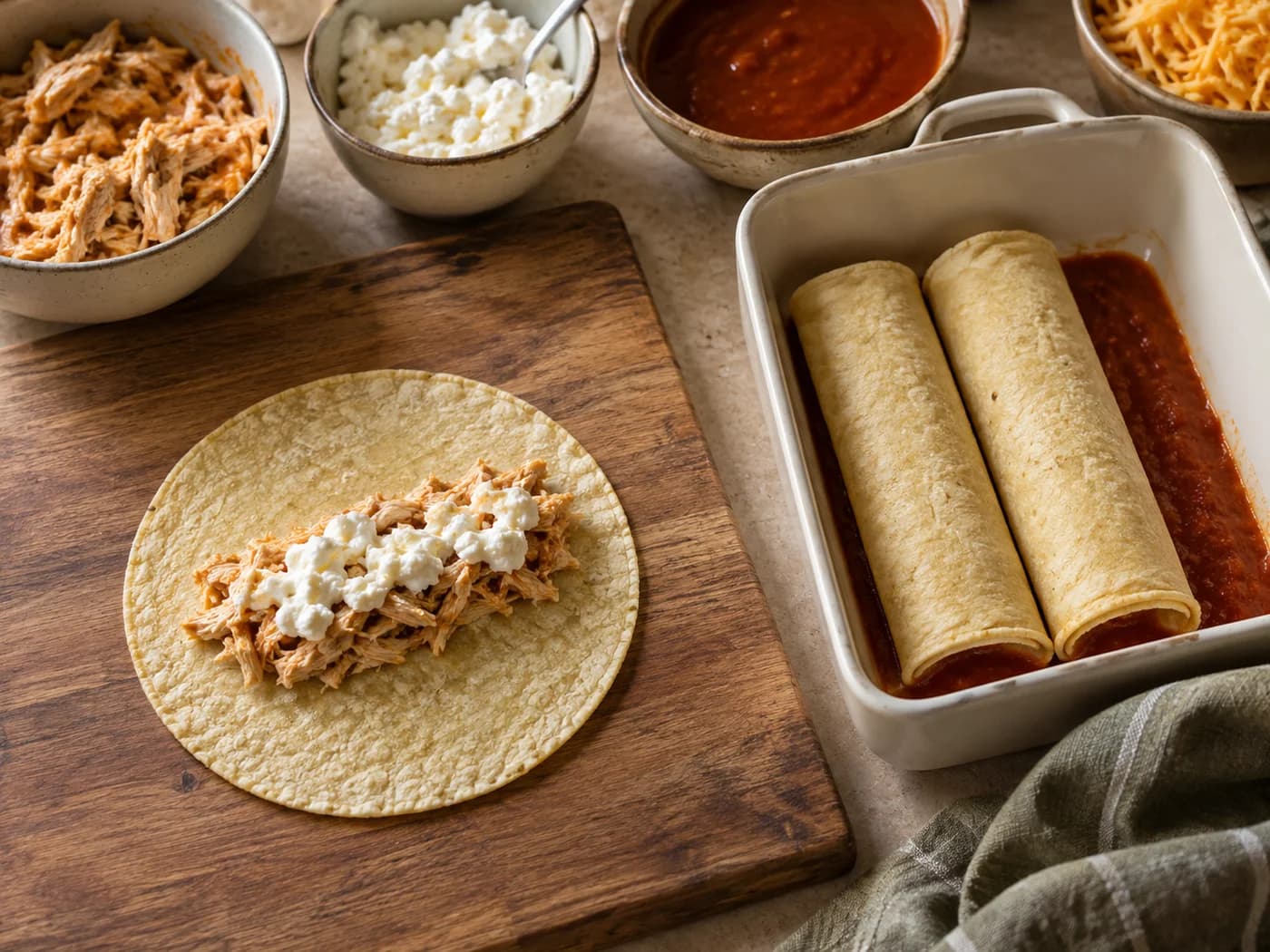
Combine the shredded cooked chicken and blended cottage cheese, then divide the filling into eight equal portions. Each roll receives 50g chicken and 25g cottage cheese before any water loss during baking. Spread one quarter of the finished sauce over the dish base and reserve the remaining three quarters for the top. Warm the tortillas in small batches following their package directions, keeping the waiting tortillas covered. They need to bend comfortably before you add filling; cold brittle tortillas are likely to crack.
Place one filling portion in a narrow line on each warm tortilla, leaving a little space at both ends. Roll gently around the filling and place seam-side down in the dish. Arrange all eight rolls snugly in one layer rather than stacking them. Spoon the remaining sauce over them, covering exposed tortilla surfaces, and scatter all 100g cheddar evenly on top. Cover with tented foil, bake about 20 minutes, then uncover and bake about 10–15 minutes more. Check that the centre and other thick areas reach 165°F / 74°C. Rest five minutes, then serve two rolls with one quarter of the sauce and topping.
Tips for the Best Results
Warm only as many as you can roll
Corn tortillas can cool and stiffen while you work, especially when the kitchen is cool or the package is already open. Warm a small batch, keep it covered and roll those pieces before moving to the next batch. Follow the packet directions for a skillet or microwave method. The reference does not fry the tortillas in additional oil. If you choose a frying method, account for that oil separately instead of assuming the original nutrition still applies.
If a tortilla begins to split, stop pulling it tightly around the filling. Check whether it needs more warming or whether the chicken is piled too high. A small surface crack may still be manageable once the roll sits seam-side down under sauce, but a tortilla that breaks apart is better replaced with a suitable warmed piece. For the next roll, spread the chicken more evenly and keep the line away from the edges. Forcing a larger mound inside rarely produces a tidier result.
Protect the filling from drying out
Shred the chicken finely and mix the cottage cheese through it before dividing. A stripe of cottage cheese on top of dry chicken will not coat the meat as evenly. The tomato sauce should cover the rolls, including their exposed ends, while the initial foil cover helps retain moisture during heating. Tent the foil so it does not sit directly on the cheddar. Uncover toward the end for the topping rather than leaving the whole dish exposed from the start.
Use the thermometer in more than one place, especially in the middle rolls. A bubbling corner or a browned patch of cheese tells you about the surface, not necessarily the centre. If the topping is ready before the filling is hot, cover again and continue heating. Give the dish a brief rest before lifting portions; the sauce settles slightly and the rolls are easier to move. These enchiladas are meant to be soft, so use a broad spatula rather than expecting the tortilla to behave like a firm toasted shell.
High-Protein / Lower-Calorie Variations
Adjust the topping before changing everything
For a somewhat lighter topping, reduce the cheddar from 100g to 75g in the four-serving dish. The calculated serving becomes approximately 483 calories and 46.7g protein for two rolls. Grate the cheese finely so the smaller amount covers the ridges more evenly. You will still see more red sauce between the shreds, which is expected. It is a straightforward measured adjustment rather than a promise that a loosely described handful has a fixed calorie value.
Reducing cheddar further to 50g for the dish gives approximately 458 calories and 45.3g protein per two-roll serving. This is a noticeably thinner cheese finish and may appeal more if you enjoy the sauce itself. Keep the other ingredients and serving count unchanged for that comparison. A different reduced-fat cheese has its own label and melting behaviour; it cannot be assigned the same figures simply because the package describes it as lighter.
Increase chicken or change the portion
Adding 100g extra cooked chicken to the whole dish gives 125g cooked chicken per serving and an estimate of approximately 550 calories and 55.9g protein. That is more filling in each tortilla, so check the fit carefully and expect that rolling may be less forgiving. If the tortillas will not close comfortably, use a separately planned arrangement rather than cramming them. The extra-chicken version has not been kitchen-tested, and the original time is not a verified heating time for its thicker rolls.
One reference enchilada with one eighth of the sauce and topping provides about 254 calories and 24.1g protein. That is half the standard serving, which may suit a smaller appetite or a plate with more sides. It does not become a full 48g-protein meal unless the other foods supply the difference. Decide how many rolls you want, then count the accompaniments honestly. These comparisons give choices for portioning and ingredients, not a universal prescription for weight loss or a reason to remove all the flavour from dinner.
Each full serving contains two rolls and its share of sauce and topping. Ingredient adaptations are calculated, not separately kitchen-tested.
| Version | Calories, approximately | Protein, approximately |
|---|---|---|
| Reference two-roll serving | 509 kcal | 48.1g |
| 75g cheddar per four-serving dish | 483 kcal | 46.7g |
| 50g cheddar per four-serving dish | 458 kcal | 45.3g |
| 100g extra cooked chicken per dish | 550 kcal | 55.9g |
| One roll, half a reference serving | 254 kcal | 24.1g |
Serving Suggestions
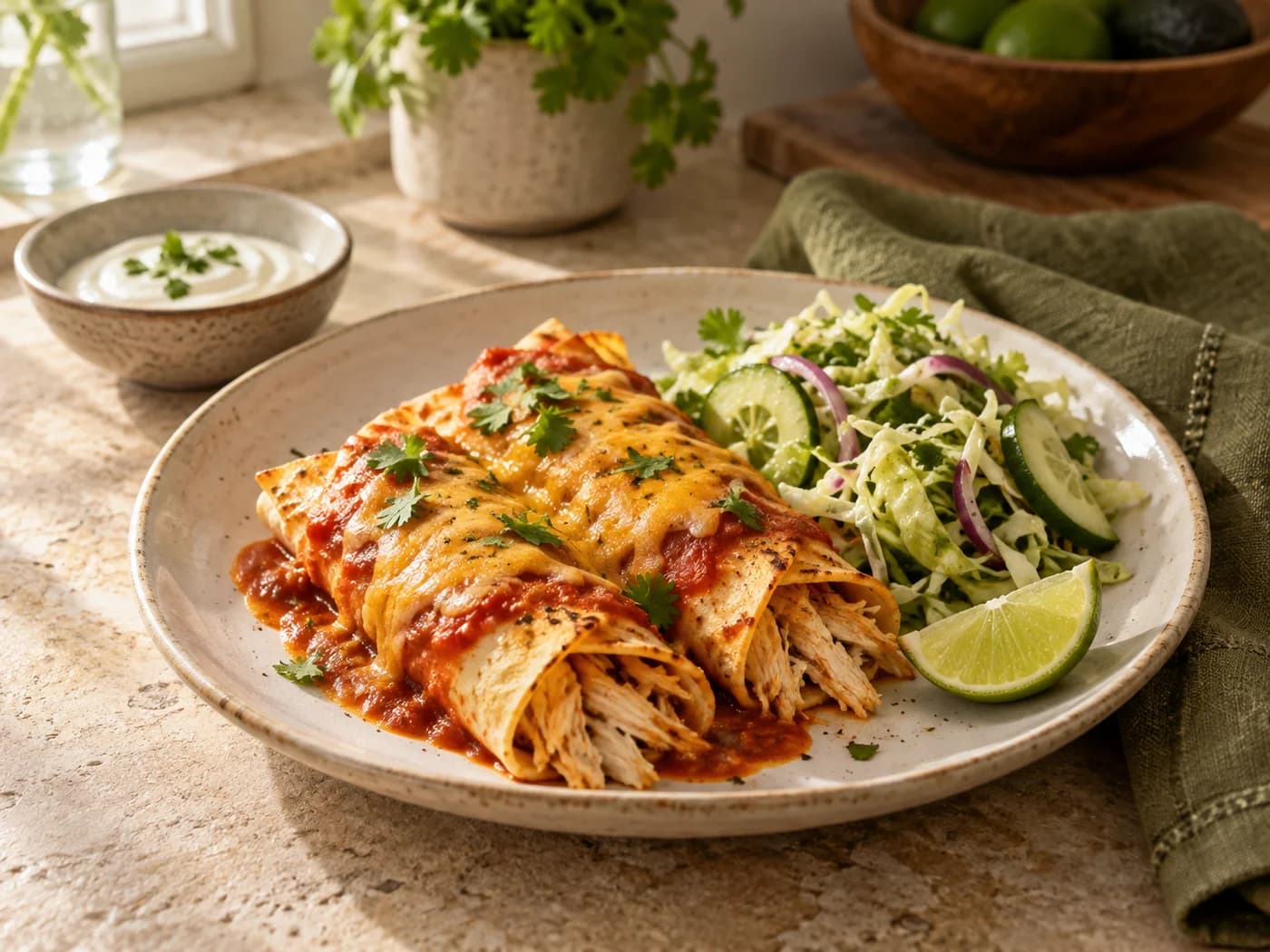
Let the sauce stay with the portion
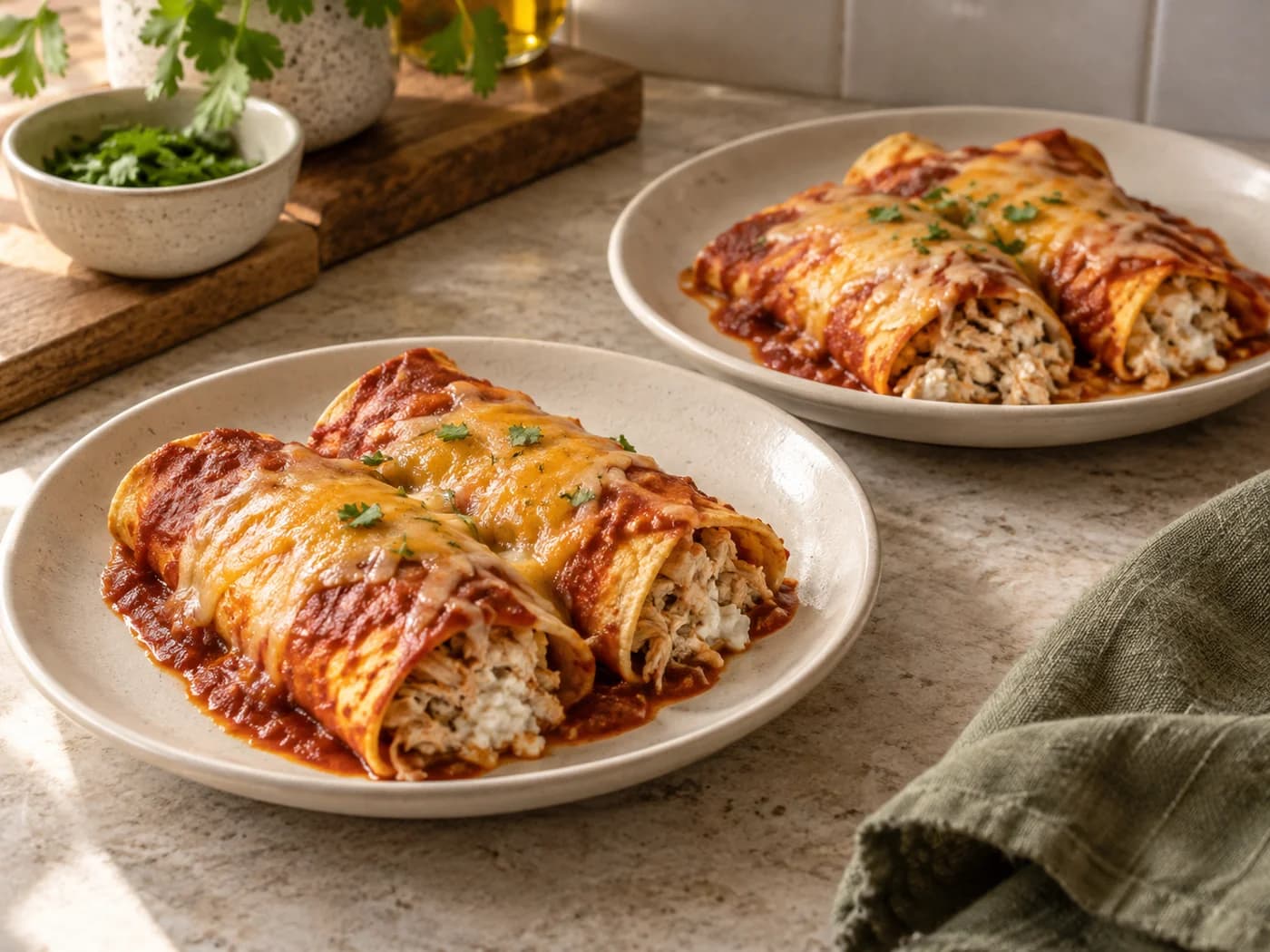
Use a broad spatula to lift two adjacent rolls and spoon their share of sauce over or beside them. Some sauce will remain at the bottom of the dish, and it belongs to the planned meal rather than becoming a calorie-free leftover by default. If you are dividing the tray for meal prep, portion the sauce evenly at the same time. A neat pair of rolls can look smaller than a mound of food, so let the serving definition guide the comparison instead of judging only the plate's appearance.
A crisp cabbage and cucumber salad suits the soft tortillas and creamy chicken. Dress it shortly before eating so it keeps some bite. Lettuce, radishes or a simple tomato salad can offer a similar fresh contrast. If the tomatoes in the main sauce already feel quite sharp, keep the side dressing gentle. You do not need a complicated second recipe: a bowl of well-prepared vegetables can make the warm main dish feel complete without competing with it.
Put optional finishes on the table
A spoonful of plain yogurt, a lime wedge or a little chopped coriander can change the finish of each bite. Avocado adds a softer, richer contrast, and chilli sauce lets people adjust heat for themselves. Those additions are optional and outside the reference nutrition. Weigh a dip or topping if you want to include it in your meal total, using its actual label rather than treating every white dairy topping as interchangeable.
Rice and beans can turn the serving into a larger dinner, while one enchilada with a substantial side may suit someone who wants less of the main dish. Neither arrangement is inherently better for every person. Choose according to hunger, preference and the rest of your day's food. If serving a shared table, offer a clean serving utensil and make the two-roll portion easy to recognise. The headline protein value is most useful when everyone can see what amount of food it describes.
Meal Prep & Storage
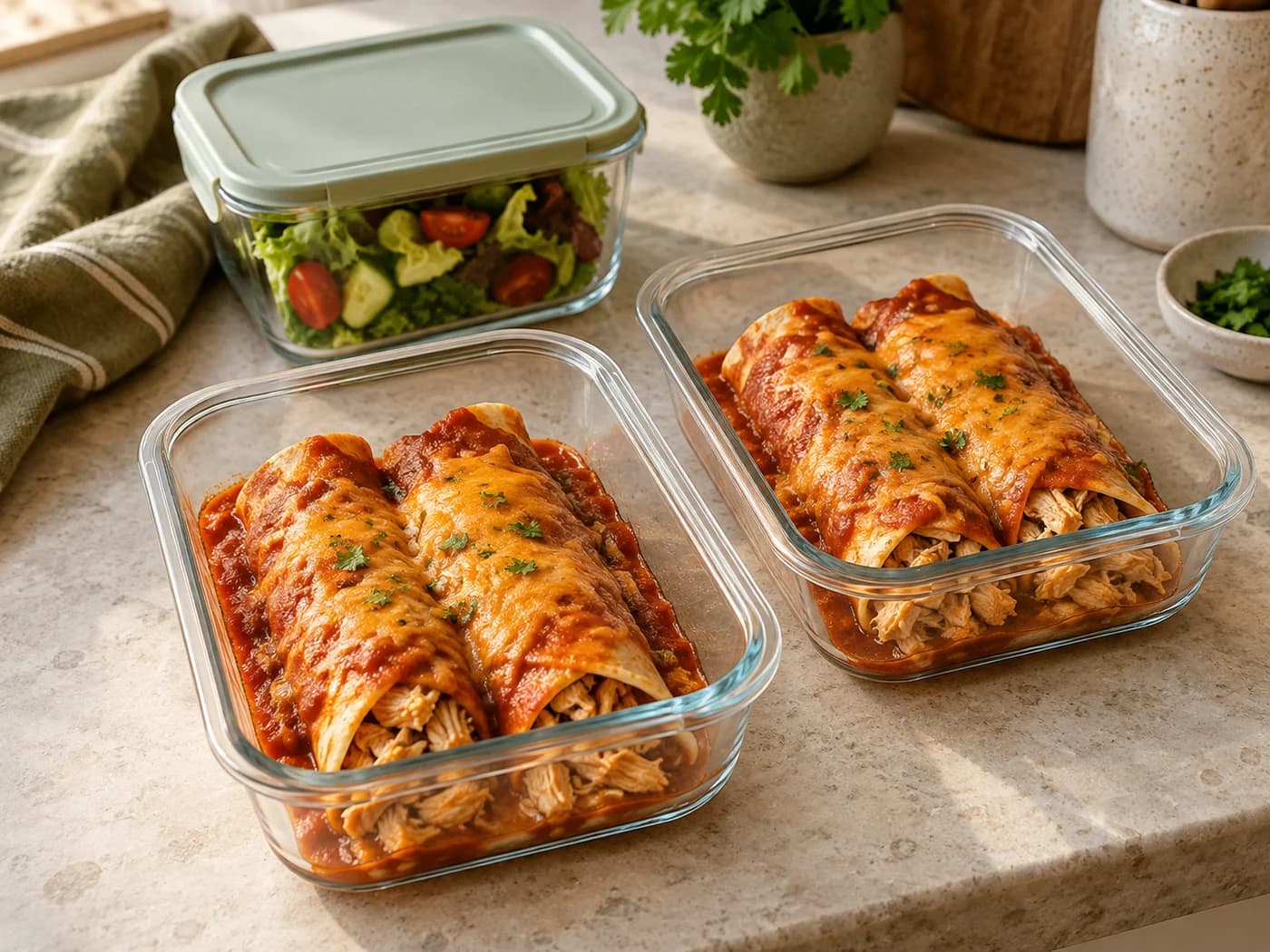
Prepare components with the clock in mind
You can make the sauce and filling in advance and refrigerate them separately, then warm tortillas and assemble closer to baking. This limits the time the tortillas spend absorbing sauce before they reach the oven. Cool cooked components promptly in shallow containers and keep them chilled. If the filling begins cold, allow more oven time and check the centre rather than assuming the reference bake is enough. The chilled-assembly timing has not been separately tested.
The storage clock follows the oldest cooked ingredient. If the chicken was prepared two days before the enchiladas, assembling and baking it does not create a fresh four-day storage window. Record the chicken's cooking date and follow the shortest applicable storage guidance for the ingredients used. Under suitable cooking and handling, cooked poultry leftovers are generally used within 3–4 days at 40°F / 4°C or below. Product instructions may require a shorter period.
Chill, freeze and reheat portions
Refrigerate cooked leftovers promptly, within two hours of cooking or within one hour when the surroundings are hotter than 90°F / 32°C. Divide the tray into shallow containers rather than leaving a deep hot dish standing while it cools completely. Include the planned sauce with each portion and store salad and cold toppings separately. The tortillas will continue to soften, so refrigerated leftovers are likely to be more tender than the freshly rested bake.
Freeze safely cooled portions you will not use in time. One month at 0°F / −18°C or below is a conservative, untested quality suggestion for this formula, not a measured shelf-life result. Thaw in the refrigerator. Reheat covered in a suitable oven or microwave container, rearranging as needed, until the centre and other cold spots reach 165°F / 74°C. Follow appliance standing-time guidance. A small splash of water can help a dry-looking sauce, but check the texture first; adding liquid automatically can make an already soft portion wetter.
Full Nutrition Information
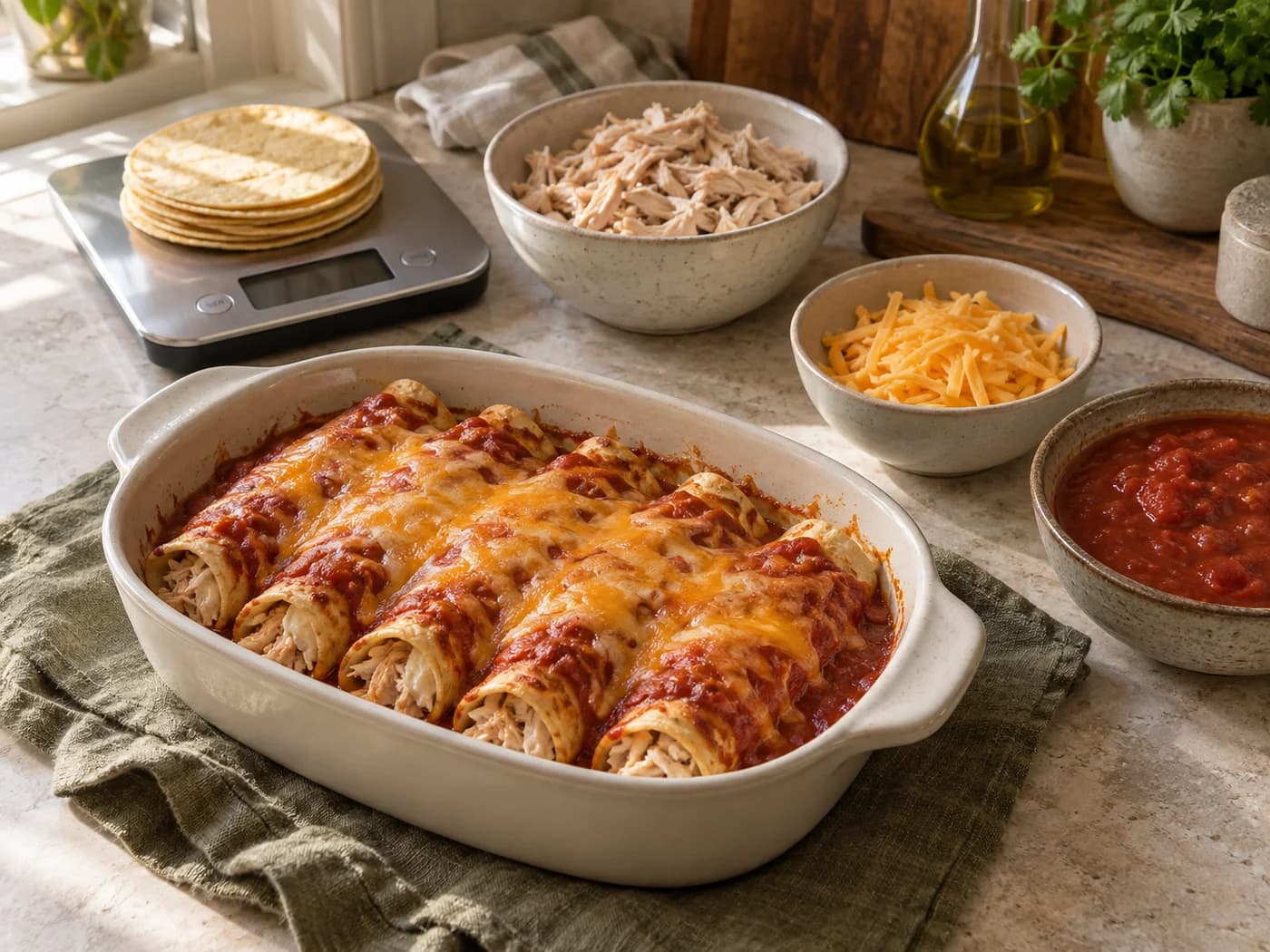
A calculation you can inspect
The reference uses historical USDA SR28 generic nutrient values per 100g. Each ingredient's value is multiplied by its weighed quantity and divided by 100, then all ingredient contributions are added. Dividing that batch total by four gives the two-enchilada serving. The table shows the main contributions for the full pan, followed by the serving total and additional nutrients. It does not claim to be laboratory analysis of a finished meal or a current branded-food label.
The ingredient forms are deliberate. Chicken is weighed cooked, while onion and garlic are weighed raw after peeling. Corn tortillas use their packaged weight. Canned crushed tomatoes include their liquid, cottage cheese includes its normal curds and dressing, and cheddar is counted before it melts. All the oil is counted, including the amount used to coat the dish, and all the measured salt remains in the calculation. There is no guessed deduction for oil left behind or water evaporating from the sauce.
Use precision where it helps
Before rounding, one serving calculates to 508.63 calories, 48.1417g protein, 41.16585g carbohydrate and 17.85245g fat. Those extra decimal places describe the arithmetic, not the real-world accuracy of a particular tortilla or piece of chicken. Ingredient rows displayed with whole calories may not add to exactly the visible whole-batch number because the batch is summed before rounding. Water loss changes the final cooked weight and nutrient concentration per gram; it does not justify inventing a cooked yield weight that was never measured.
Use the food calculator with your actual labels and amounts when you want a personal estimate. Canned tomatoes, cottage cheese, cheese and seasoned chicken can change sodium considerably. The reference supplies about 794mg sodium per serving, even though only 1g salt is added to the whole sauce. Fibre, total sugars and saturated fat are calculated because the selected entries contain those fields. Separate added sugars, cholesterol and complete micronutrients are not reported. If you serve only part of the tray, count the actual fraction of rolls, sauce and cheese rather than automatically assigning a quarter of every ingredient to your plate.
| Ingredient | Amount | Calories | Protein | Carbs | Fat |
|---|---|---|---|---|---|
| Corn tortillas | 200g | 436 kcal | 11.4g | 89.3g | 5.7g |
| Cooked skinless chicken breast | 400g | 660 kcal | 124.1g | 0.0g | 14.3g |
| Low-fat cottage cheese (2%) | 200g | 162 kcal | 20.9g | 9.5g | 4.5g |
| Cheddar | 100g | 404 kcal | 22.9g | 3.1g | 33.3g |
| Canned crushed tomatoes | 600g | 192 kcal | 9.8g | 43.7g | 1.7g |
| Onion | 100g | 40 kcal | 1.1g | 9.3g | 0.1g |
| Garlic | 10g | 15 kcal | 0.6g | 3.3g | 0.1g |
| Olive oil | 10g | 88 kcal | 0.0g | 0.0g | 10.0g |
| Ground cumin | 4g | 15 kcal | 0.7g | 1.8g | 0.9g |
| Paprika | 6g | 17 kcal | 0.8g | 3.2g | 0.8g |
| Dried oregano | 2g | 5 kcal | 0.2g | 1.4g | 0.1g |
| Fine salt | 1g | 0 kcal | 0.0g | 0.0g | 0.0g |
| Whole batch | 8 rolls · 4 complete servings | 2035 kcal | 192.6g | 164.7g | 71.4g |
| One reference serving | Batch ÷ 4 | 509 kcal | 48.1g | 41g | 18g |
| Dietary fiber | 7.3g |
|---|---|
| Total sugars | 10.4g |
| Saturated fat | 7.0g |
| Sodium | 794mg |
Estimated recipe nutrition, not laboratory analysis. Includes corn tortillas, cooked chicken, both cheeses, all red sauce, oil, spices and measured salt. Sides and extra toppings are additional. Uses historical generic USDA SR28 values; actual labels take priority. Cholesterol, separate added sugars and complete micronutrients are not calculated.
How This Fits Your Daily Protein Goal
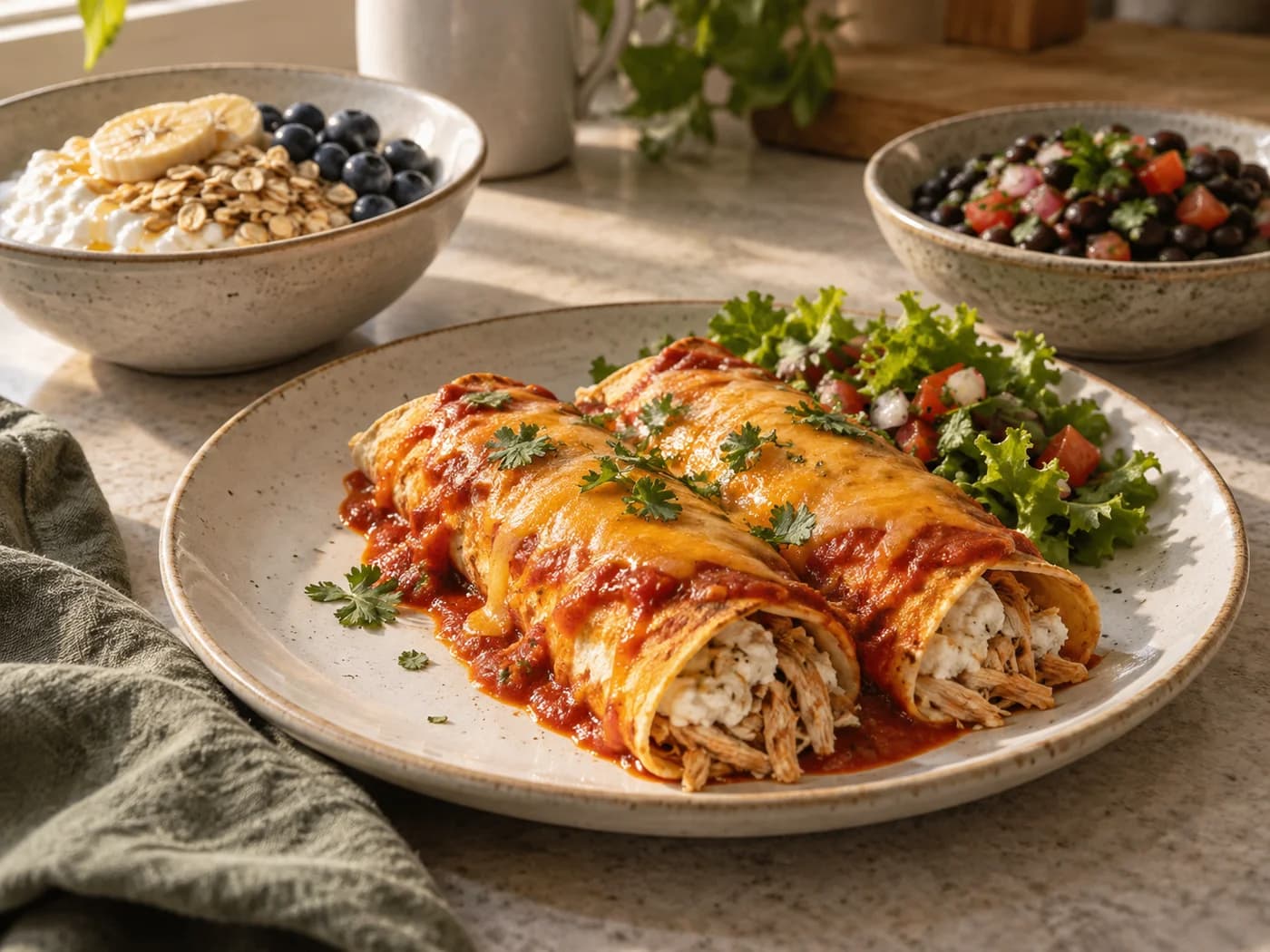
Put the serving beside your own plan
A protein calculator can help estimate a daily target from the information and goal you enter. That estimate is a planning starting point, not a personalised medical instruction. Your usual meals, appetite, activity and any individual professional guidance still matter. This recipe contributes approximately 48.1g protein per standard serving, with about 509 calories and the other nutrients shown alongside it. It is one meal option rather than a daily requirement for everyone who reads the page.
For arithmetic examples, 48.1g would provide about 48% of a 100g daily target, 40% of a 120g target or 32% of a 150g target. Those targets are examples only. They show why defining the serving is useful: two complete enchiladas contribute twice the reference protein of one enchilada. Your actual product labels may shift those percentages a little, so there is no benefit in treating the final decimal place as a personal nutrition rule.
Think about the whole day
You might already get protein from eggs, yogurt, fish, beans, tofu or other foods before dinner. Add those contributions before deciding whether this dish needs extra chicken or a supplementary drink. The reference serving is already a substantial source of protein. Increasing the filling is an option when it suits your meal, but it also increases the food volume and changes the rolling and heating. A larger number is not automatically a better dinner.
If two rolls feel like more than you want, one roll contributes about 24.1g protein before sides. If the standard portion is not enough food for you, add an accompaniment you enjoy and count it separately. Keeping the meal pleasant and practical helps it fit a repeatable routine. You can alternate this saucy oven dinner with a crisp skillet lunch or a breakfast recipe without trying to make every plate reach the same protein figure. The useful habit is knowing your portions and looking at the overall day.
Make it personal
Where does this meal fit in your day?
Estimate your daily protein target, then plan meals you enjoy.
Recipe Card
Choose the batch size before weighing
The card starts at four servings, which means eight small enchiladas in one reference dish. The eight- and twelve-serving settings make sixteen and twenty-four rolls, using two or three matching dishes. They keep the same roll size, filling per tortilla and sauce depth. Increasing the serving count does not mean piling extra rolls into one pan or making each tortilla hold a larger mound of chicken. That distinction makes the scaling useful for a shared meal.
Ingredient totals change with the serving setting, and the method changes the tortilla count, filling total and number of dishes to match. The amounts for each individual roll stay fixed: a 25g tortilla with 50g cooked chicken and 25g cottage cheese, plus its share of sauce and cheddar. A larger batch needs more preparation time and may need separate oven rounds. The printed timing remains a reference estimate for one four-serving dish, with that larger-batch limitation stated beside it.
Keep the practical checks close
Use the ingredient checkboxes while weighing and preparing the components. Reset checklist clears them for another batch, and changing the serving count also clears the old ticks so they do not imply that a new larger quantity is already ready. Print recipe uses the selected quantities and matching method. Return to four servings if you want the reference batch on paper, and check your browser's print preview before sending it to the printer.
Keep the tortilla packet and the thermometer nearby even when following the short card. Warming directions depend on the product, while the final centre temperature matters more than the appearance of the cheddar. The card is designed to keep the essentials together at the stove; the longer guide explains why those steps help. Use cooked chicken for the listed weight, follow safe handling for all components, and let the texture and temperature cues guide any extra oven time your dish needs.
Tender rolls, ready for the table
High-Protein Chicken Enchiladas
Corn tortillas with chicken and cottage cheese, mild red tomato sauce and a golden cheddar topping.
*Planning estimates for one four-serving dish with cooked chicken ready. Larger batches need more prep and possibly separate oven rounds. Keep eight rolls per dish and check every centre. Exact weighed formula not physically kitchen-tested.
Ingredients
Method
- Prepare the ingredients and dishes
Heat a conventional oven to 375°F / 190°C. Coat 1 matching 9x13 inch / 23x33cm ovenproof dish of at least 3 litres each with 4g oil total. Shred 400g cooked skinless chicken breast. Blend 200g 2% cottage cheese without added liquid. Grate 100g cheddar. Finely dice 100g peeled onion and chop 10g peeled garlic.
- Simmer the red sauce
Soften the onion in 6g oil about 5 minutes. Add garlic briefly, then 4g cumin, 6g plain sweet paprika and 2g oregano for 30 seconds. Stir in 600g canned crushed tomatoes and 1g salt. Simmer gently about 10–12 minutes until spoonable and spreadable, not a stiff paste. Use uncrowded rounds if needed.
- Prepare filling and warm tortillas
Mix the chicken with cottage cheese and divide into 8 equal portions (50g chicken plus 25g cottage cheese per roll). Use 8 corn tortillas, 200g total, 25g each and about 6 inch / 15cm. Warm small batches to packet directions until pliable; keep covered and roll promptly. No extra frying oil is included.
- Roll and cover
Divide sauce evenly between 1 dish. Use one quarter of each dish’s sauce on its base. Fill each warm tortilla with one filling portion, roll gently and place seam-side down. Arrange eight rolls per dish in one layer, 8 rolls total. Cover with remaining sauce and 100g cheddar per dish (100g total). Tent with foil.
- Bake and check every dish
Bake covered about 20 minutes, then uncover for about 10–15 minutes more. Check each dish from 30 minutes total: tortillas should be tender and the centre rolls and other thick areas must reach 165°F / 74°C, away from the dish. Re-cover if topping colours too quickly. Cold filling and extra dishes can need longer or separate oven rounds.
- Rest, serve and store
Rest about 5 minutes. Serve two rolls with one quarter of a dish’s sauce and topping per person, 4 complete servings total. Refrigerate leftovers promptly in shallow containers at 40°F / 4°C or below; use within 3–4 days of the chicken’s original cooking with suitable handling. Reheat throughout to 165°F / 74°C. Sides are additional.
Contains milk; check all actual labels, including corn tortillas. Chicken is weighed cooked. Includes all sauce, oil, cheese and salt; sides are additional. Refrigerate within 2 hours, or 1 hour above 90°F / 32°C. Keep chilled; reheat throughout to 165°F / 74°C.
Frequently Asked Questions
Check the component that is causing trouble
A split tortilla and a watery sauce are different problems, even when they happen in the same dish. For the tortilla, look at warming, flexibility and filling depth. For the sauce, look at the tomatoes and simmering before adding it to the rolls. If the centre is not hot while the top is already coloured, protect the topping and continue gentle heating. Changing every ingredient at once makes it harder to work out what helped.
The questions below cover the choices most likely to affect this particular reference: cooked versus raw chicken weight, corn versus flour tortillas, cottage-cheese texture, meal prep and portion size. They also distinguish a convenient ingredient swap from a version that needs its own nutrition estimate. A different sauce or tortilla can be perfectly useful in your kitchen while still being a different recipe calculation.
Keep a note for the next batch
If you make an adaptation, record the product weight and the change you made. A tortilla that warms and rolls well is useful information to keep, and so is a sauce that needed a little less simmering than expected. Record the actual oven time only after checking the finished centre, rather than treating a golden surface as proof that the whole dish was ready. Those notes help you repeat your own result with your own equipment.
The reference is intentionally specific about what is included and what is uncertain. It contains milk, uses corn tortillas that still need a label check, and assumes safely cooked chicken is ready before assembly. The exact formula has not been tested in a physical kitchen. These boundaries do not prevent you from adapting it; they make it easier to understand which parts are weighed calculations and which parts need practical judgement when you cook.
How much protein is in these chicken enchiladas?
Two reference enchiladas, with one quarter of the pan’s sauce and topping, provide approximately 48.1g protein and 509 calories. One roll with one eighth of the sauce and cheese provides about 24.1g protein and 254 calories. Sides and extra toppings are additional. Actual tortilla, cheese and chicken labels can change those estimates.
Is the chicken weight raw or cooked?
Cooked. Weigh 400g edible cooked skinless breast meat for the four-serving reference dish, after removing skin and bones. Raw chicken loses water during cooking, so 400g raw is not the same ingredient amount. If starting from raw poultry, cook it separately to 165°F / 74°C and then weigh the cooked meat required. That cooking stage adds time.
Can I use rotisserie chicken?
Yes, as a modified ingredient. Remove skin and bones, shred the meat finely and use the cooked weight actually added. A rotisserie product may contain brine, oil, seasoning or a mix of breast and thigh meat, so it may not match plain roasted breast nutrition. Its original cooking and storage history still determines how long leftovers can be kept.
Why do my corn tortillas crack when I roll them?
They may be too cold, too dry or overloaded. Warm small batches according to the packet directions, keep them covered and roll while flexible. Spread the filling in a narrow line instead of a tall mound. If a tortilla remains brittle after suitable warming, choose a different pliable product rather than forcing it around the filling.
Do I need to fry the tortillas first?
The reference warms them according to their packet directions and does not add frying oil. Some products and enchilada styles use a different preparation. If you choose to fry, count the added oil and expect a different texture. The listed nutrition includes only the 10g oil allocated between the sauce and baking dish.
Can I use flour tortillas instead?
A suitably sized soft flour tortilla can roll, but it changes the recipe. Flour tortillas have different weights and nutrition and may become softer or gummier in a sauced bake. Use their actual label values, watch the sauce balance and do not assume the corn-tortilla reference figures still apply. A large wrap also needs a different filling and serving plan.
Does cottage cheese need blending?
No, if you are happy with small curds. Blending gives a smoother coating around the chicken without changing nutrition when the same ingredients are used. Stir the tub before weighing and blend without extra milk or water. A thick filling is easier to portion and less likely to bring unnecessary liquid into the rolls.
Can I use store-bought enchilada sauce?
Yes, as a separately calculated sauce version. Check its seasoning, thickness, sodium and baking instructions, and record the amount you use. The homemade reference includes crushed tomatoes, onion, garlic, oil and spices; replacing that mixture with a jar changes several ingredients at once. The resulting version has not been separately kitchen-tested here.
Are these enchiladas very spicy?
The reference uses plain sweet paprika, cumin and oregano, so it is intended to be mild. Hot paprika, chilli powder and salted seasoning blends are different products. Read the label before measuring. If the table includes people with different heat preferences, keep the base mild and offer chilli sauce separately, counting it if relevant to your meal estimate.
Can I make them vegetarian or dairy-free?
Those versions need separate ingredients and calculations. Beans or tofu do not replace cooked chicken gram for gram in protein or moisture. A dairy-free version must replace both cottage cheese and cheddar, and alternatives vary widely in protein and melting. Check all labels for suitability. The reference contains chicken and milk and makes no vegetarian or dairy-free claim.
Can I assemble the dish ahead of time?
You can refrigerate safely prepared components separately and assemble closer to baking for less sauce absorption. A fully assembled cold dish may soften more and take longer to heat. Follow the baking-dish manufacturer’s guidance for temperature changes. The exact chilled-assembly timing is untested; verify 165°F / 74°C in the centre and other thick areas.
How do I know the enchiladas are ready?
The tortillas should be tender, the sauce hot and the cheese melted, but appearance alone is insufficient. Use a food thermometer to check at least 165°F / 74°C in the centre rolls and other thick areas, away from the dish. If the topping colours before the filling is hot, cover again and continue baking. Check every dish in a larger batch.
How long can I store and reheat leftovers?
With suitable handling, use cooked poultry leftovers within 3–4 days at 40°F / 4°C or below, counting from the chicken’s original cooking date. Refrigerate promptly in shallow containers and reheat throughout to 165°F / 74°C. Freeze portions you will not use soon. One month frozen is an untested quality suggestion for this exact formula, not a measured shelf-life claim.
Is this gluten-free or a kitchen-tested recipe?
The reference uses corn tortillas, but you still need to verify the actual product’s ingredients and gluten-free suitability; corn alone is not enough to establish that. Milk is present in both cheeses. The exact weighed formula has not been physically kitchen-tested. Timings are estimates, photos are illustrative and nutrition comes from historical generic ingredient values rather than laboratory analysis.
More High-Protein Recipes
More ways to use familiar ingredients
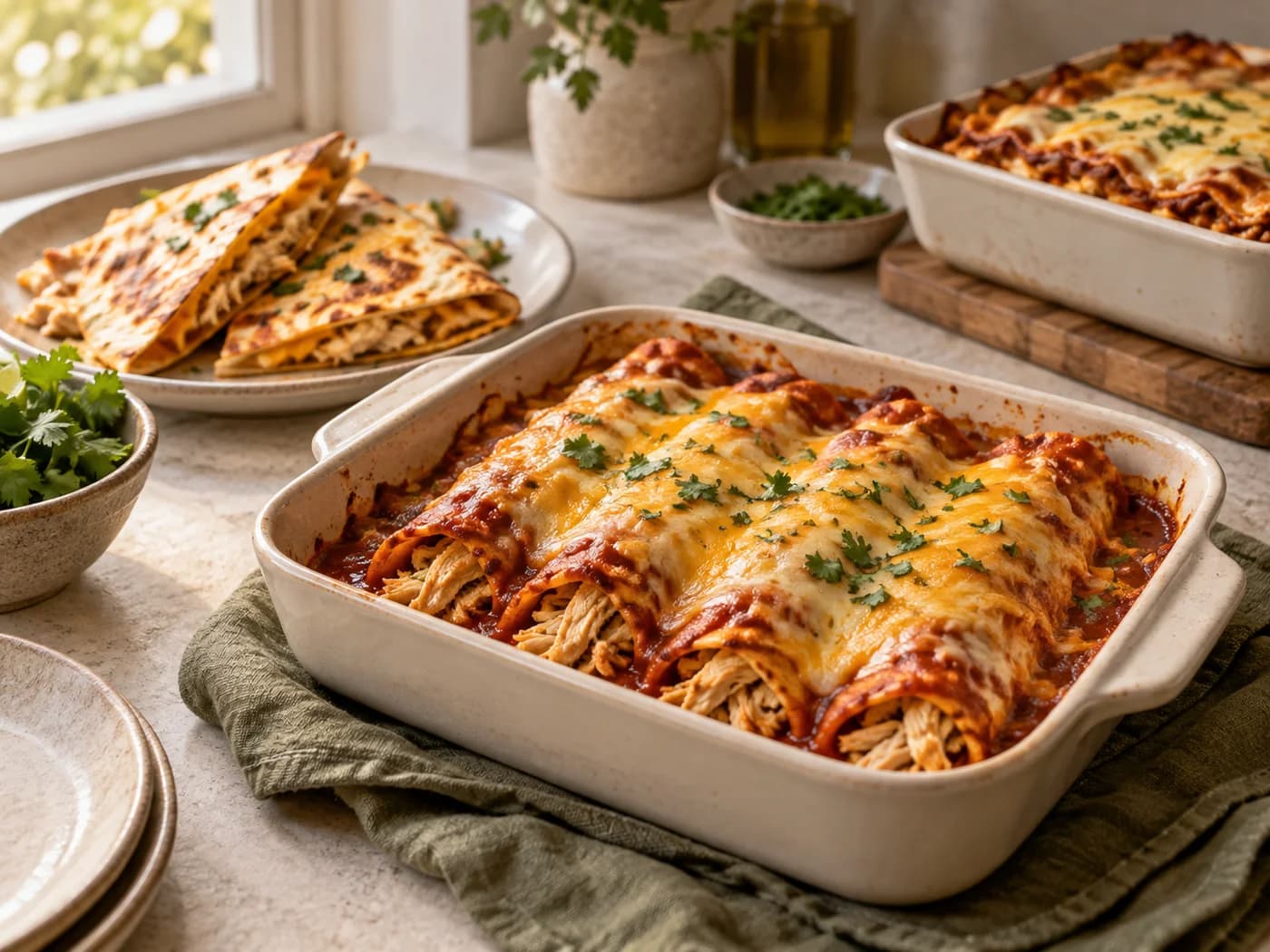
The high-protein quesadilla is a natural next choice if you enjoy the chicken and cheese combination but want a crisp tortilla instead of a sauced bake. Its flour wrap, oil allocation and serving definition differ from these enchiladas, so follow that recipe's own quantities. For another oven dinner, the turkey lasagna uses cottage cheese in layered pasta. It takes a different route to a warm shared dish and suits an evening when you want to portion a larger pan.
Mac and cheese offers a softer, creamy pasta meal with a different flavour and texture. High-protein pizza gives you a base to slice and share, while the breakfast sandwich and breakfast casserole bring eggs into a savoury morning meal. These options are not interchangeable nutrient portions just because they belong to the same collection. Look at the complete serving, toppings and cooking effort before choosing what fits the day.
Plan around what you already have
If you bought cottage cheese for this filling, check its storage instructions and choose another use for the remainder while it is still suitable. If you are using a batch of cooked chicken, plan from its original cooking date and freeze portions you will not use within the recommended period. A meal plan works better when it accounts for ingredient age and realistic appetites, rather than simply assigning the same dinner to several days because it has a convenient protein number.
Browse the recipe collection when you want a change, and use the dinner guide when the main question is what to cook tonight. Some days a tray of tender enchiladas is appealing; on others, a quick toasted meal makes more sense. Keep the nutrition portion clear, choose ingredients you enjoy and allow the cooking method to suit your time. These enchiladas can sit alongside plenty of different meals in a routine that feels comfortable rather than rigid.