
Browse the 15 recipe sections
One reference serving: one complete bowl with half of all ingredients and broth, about 581 calories and 51.3g protein. Chicken is weighed raw; noodles dry; egg and edamame cooked. Sides are additional; timings are estimates. See the breakdown.
Recipe Overview
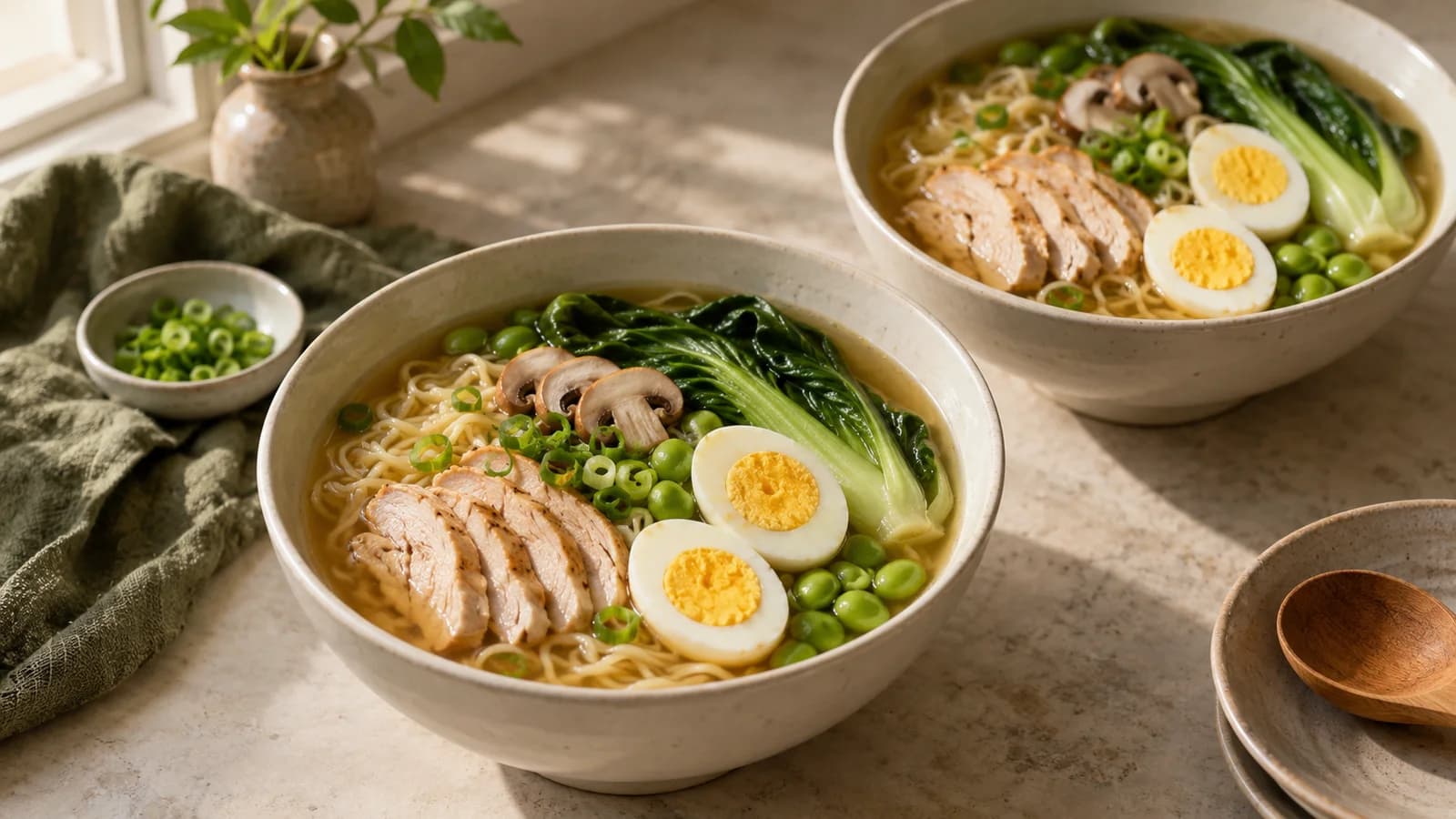
A warming bowl with a clear recipe
This high protein ramen brings thin wheat noodles, sliced chicken, a firm egg and green edamame together in a ginger-miso broth. Mushrooms add a savoury note, bok choy brings a little crunch, and scallions freshen the finish. It is a practical home version built around measured ingredients, rather than a promise to reproduce a particular ramen shop’s long-simmered stock or regional style.
The reference makes two complete bowls. Each includes chicken starting at 120g raw weight, 60g dry ramen noodles, 50g cooked shelled edamame, 50g peeled hard-boiled egg and half of every vegetable, seasoning and drop of broth. That works out to approximately 581 calories and 51.3g protein per bowl. Extra chilli oil, sesame seeds, nori, side dishes or other toppings are outside the calculation.
Plan the components before the noodles
Allow about 15 minutes for preparation and roughly 25 minutes for the main cooking sequence, with eggs and edamame prepared alongside the early work. The total is a planning estimate of about 40 minutes. You will use a broth pot of at least 3 litres, a separate saucepan for eggs and noodles, a strainer, a scale and a food thermometer. The noodles are cooked separately near the end.
The broth begins with water, measured sesame oil, chicken, mushrooms, ginger and garlic; miso and reduced-sodium soy sauce season it at the finish. No stock cube or instant seasoning packet is included. This matters for flavour as well as tracking: a salty broth powder would change the recipe substantially. The result is intended to taste savoury and aromatic without pretending that a quick saucepan produces an all-day restaurant broth.
A note on the evidence behind the bowl
The exact weighed formula has not been physically kitchen-tested. Timings are estimates, variations are calculated suggestions, and photos are illustrative. Generic ingredient nutrition comes from historical USDA values; the dry ramen uses a specific manufacturer’s US label reference. The whole dry-noodle sodium value is counted conservatively even though the noodles are boiled and drained separately. Your actual package values and observed cooking results take priority over assumptions in this guide.
Why You’ll Love This Recipe
Protein comes from several ordinary ingredients
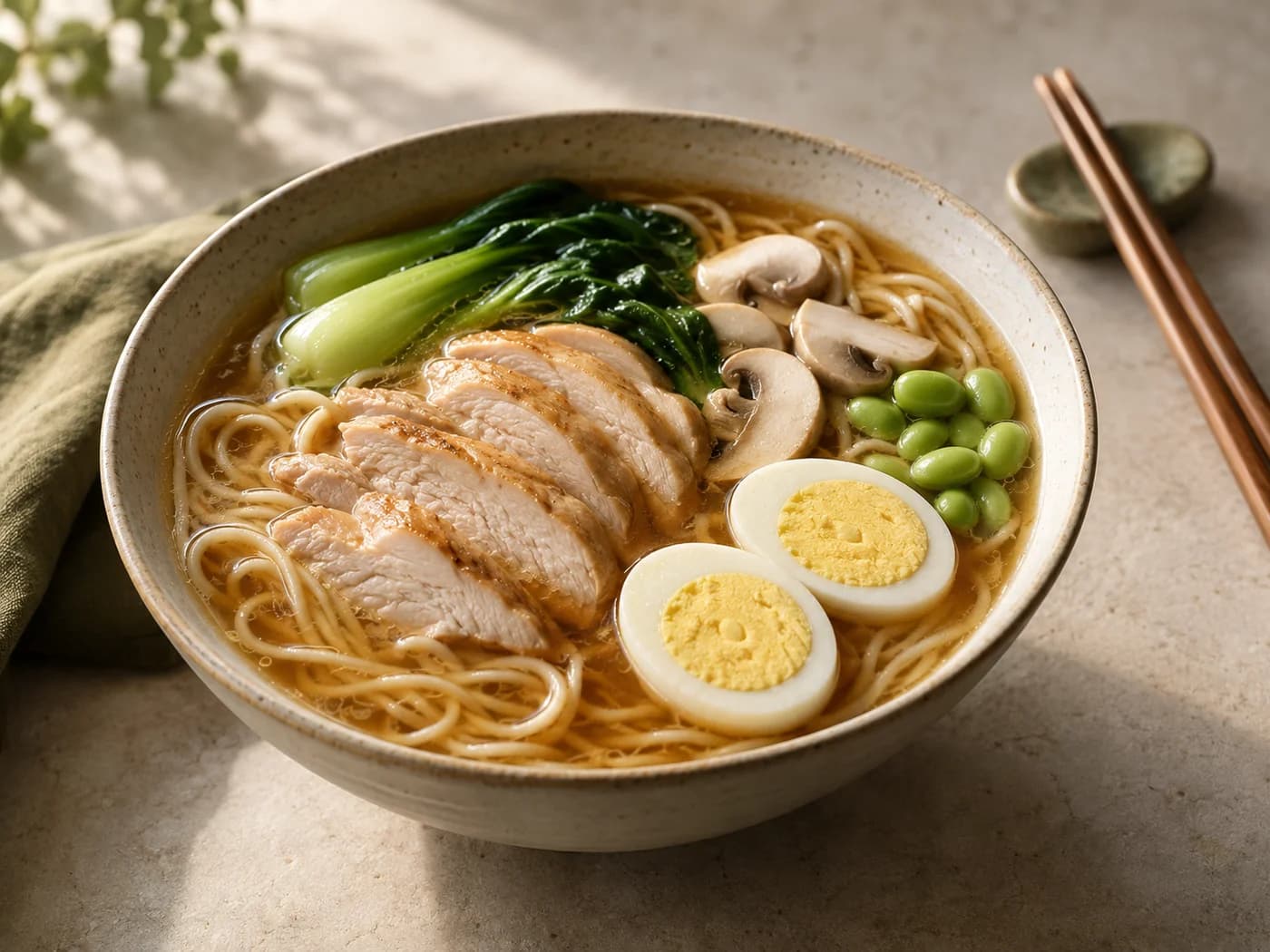
Chicken is the main protein source, but it does not have to do all the work. Edamame and egg add their own texture and contribution, while the noodles and vegetables provide smaller amounts. That combination makes the bowl feel like a complete dinner instead of a plain chicken portion sitting in a very large soup. There is no protein powder to blend into the broth or specialised fortified noodle required.
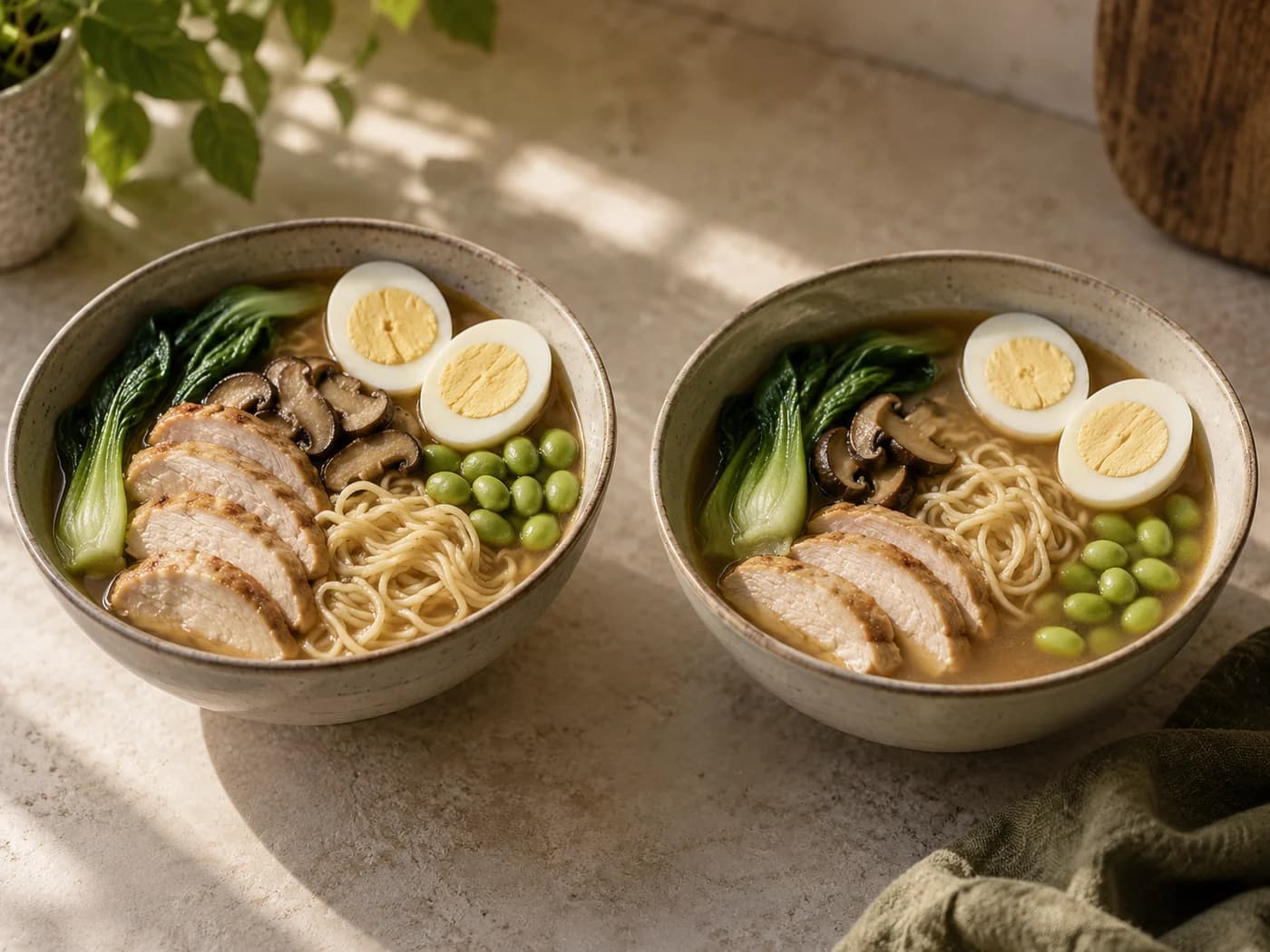
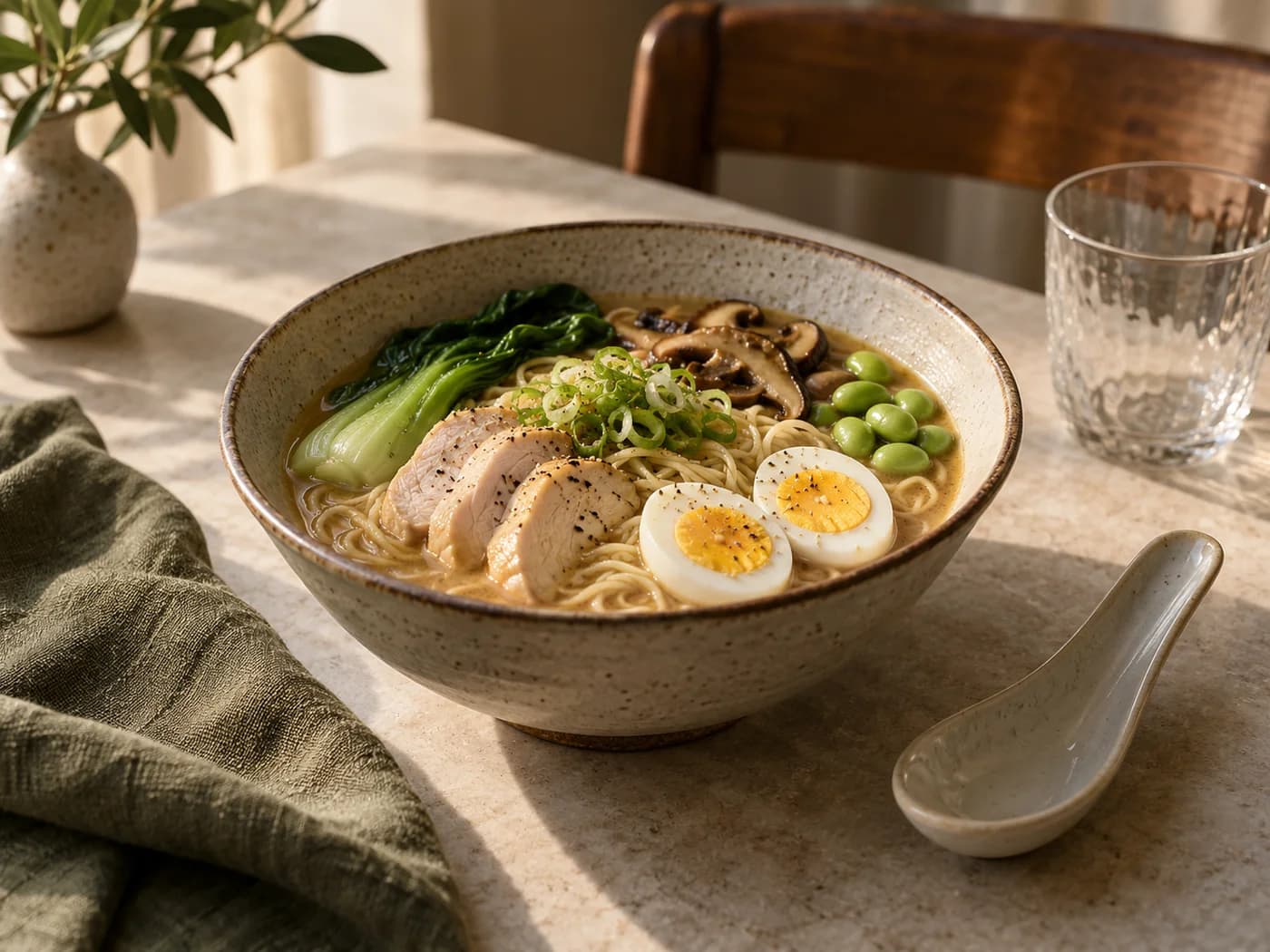
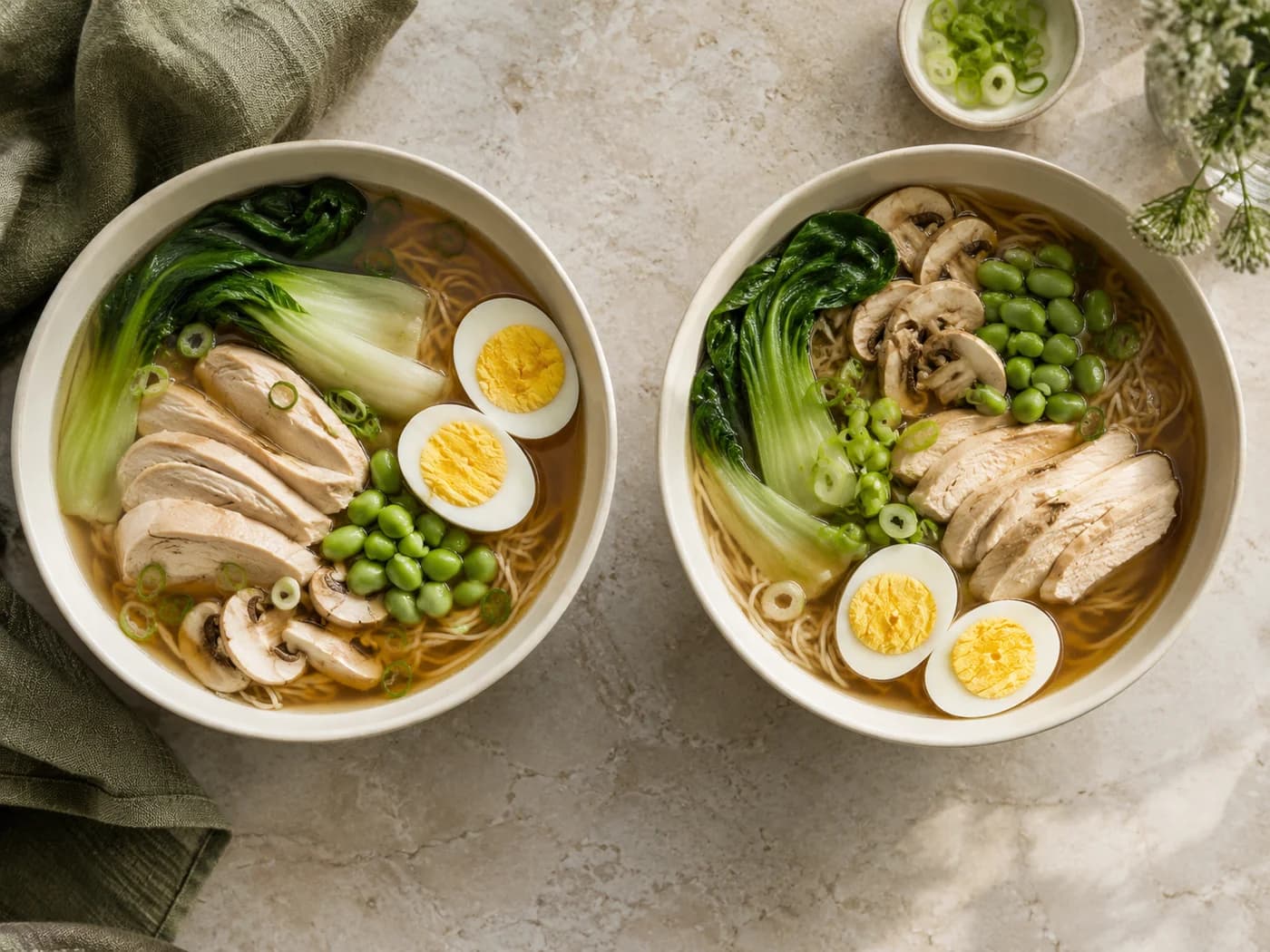
The ingredients are easy to recognise when you look into the bowl. You can see the chicken slices, the two egg halves and the green beans of the shelled edamame. Those visible portions make dividing dinner more straightforward than estimating what is hidden in a thick sauce. For two people, divide the components evenly before ladling the broth; each person gets the intended share rather than whichever toppings reach the ladle first.
Broth gives the meal its comfortable rhythm
Ginger and garlic wake up as they warm in the pan, mushrooms bring a gentle savoury depth, and miso rounds out the final liquid. A spoonful of broth between bites changes the pace of the meal. This is especially welcome on an evening when you want something warm and substantial, but would rather eat from one bowl than organise a main dish and several separate sides.
The vegetables have different jobs. Bok choy stems can keep a little bite while the leaves soften quickly; mushrooms give a tender, juicy contrast; scallions stay fresh because they go on last. These differences help the bowl avoid feeling uniformly soft. They also explain why the cooking sequence separates stems from leaves instead of putting every vegetable in at the beginning and hoping they finish together.
You can understand and adjust each part
Keeping noodles separate from broth gives you control over their texture and makes leftovers easier to organise. Measured miso and soy sauce let you start with a known seasoning level. The egg can be omitted as a separately calculated variation, and the noodle portion can be reduced without pretending the whole recipe is unchanged. These practical choices are useful because a repeatable dinner should fit your appetite and available time as well as your protein plan.
Nutrition at a Glance
- Calories
- 581kcal
- Protein
- 51g
- Carbs
- 58g
- Fat
- 16g
What the headline numbers describe
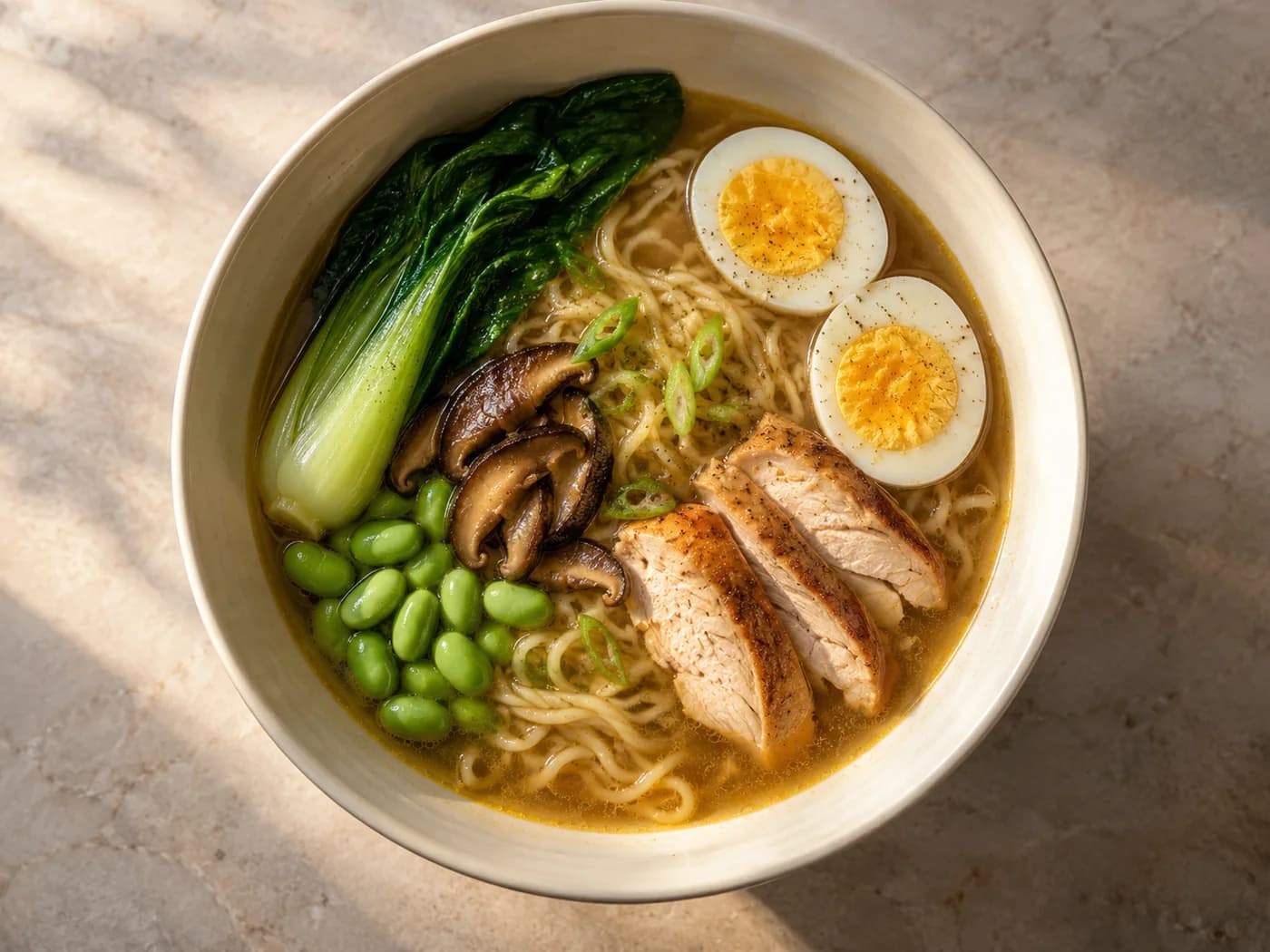
One complete reference bowl contains approximately 581 calories, 51g protein, 58g carbohydrate and 16g fat when rounded to whole numbers. Those figures include the noodles, chicken, firm egg, cooked edamame, all vegetables, miso, soy sauce and the measured sesame oil. They do not describe a bowl of instant ramen with toppings added to an unchanged seasoning packet, nor do they apply to every noodle product sold under the ramen name.
The raw chicken contributes about 27g protein per bowl. The cooked egg contributes roughly 6.3g, edamame about 6g, and the dry noodle reference adds another 6g, with smaller contributions from the rest of the ingredients. That distribution is useful when choosing a variation. Removing the egg does not erase the protein in the chicken, but it does change the meal’s energy, fat and final protein total.
Carbohydrate gives the noodle portion its place
The reference uses 60g dry noodles per person. Water absorbed during cooking increases their weight without turning them into a different starting portion. Most of the carbohydrate comes from those noodles; edamame, miso and vegetables provide the remainder. There is no reason to treat the noodles as a mistake in the recipe. They are part of the texture and eating experience, and the measured amount makes them easier to plan around.
Fat comes mostly from the egg, chicken, edamame and sesame oil. Only 6g oil is included in the whole two-bowl recipe, and every gram is counted. A finishing drizzle is therefore an addition, even if it looks small against a large bowl of broth. The reference also provides about 7.4g fiber per bowl, although actual noodles and edamame products can shift that estimate.
The sodium figure needs context
The conservative estimate is approximately 1,334mg sodium per bowl. It counts the complete sodium listed for the dry noodles, plus miso, soy sauce and the other ingredients. Separate boiling and draining may remove some noodle sodium, but the amount is not measured here. This is not a low-sodium recipe claim. If sodium matters for your needs, compare your actual labels and consider a deliberately reformulated version rather than simply assuming drained noodles contribute none.
Ingredients
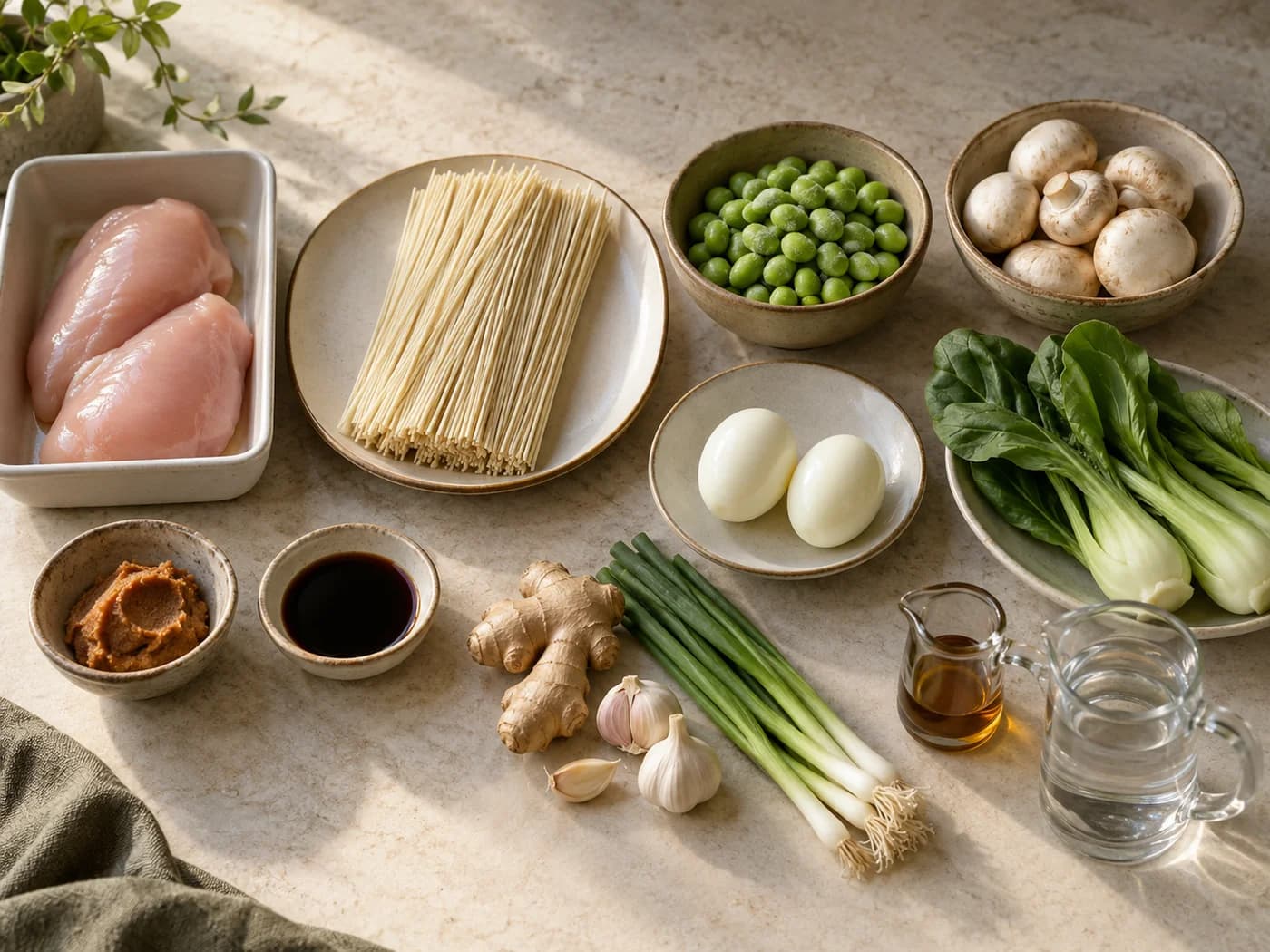
The main components and their weight forms
Use 240g raw skinless boneless chicken breast as two 120g cutlets about 1.5cm thick. The plain reference has no added solution or seasoning. Weigh 120g dry ramen noodles for the two bowls. Fresh noodles and fried instant blocks have different water or oil contents, so the same gram weight would not represent the same ingredient. Remove any ties or portion ribbons before cooking, following your packet instructions.
The recipe includes 100g peeled hard-boiled egg and 100g cooked, drained, shelled edamame. Two large eggs are a practical starting point, but verify the edible weight after peeling. Cook the eggs until whites and yolks are firm. Prepare the edamame according to its packet directions before weighing the amount used; do not weigh pods or silently substitute 100g frozen uncooked beans for the cooked reference.
Vegetables and aromatics
Weigh 150g raw trimmed white mushrooms and 200g raw trimmed bok choy. Slice the mushrooms and separate the bok choy stems from its leaves so you can cook each appropriately. Wash the greens thoroughly, including between the stems where soil can collect. Add 12g peeled grated ginger, 8g peeled chopped garlic and 20g washed trimmed scallions. The scallions are sliced for the final bowl, rather than simmered into the broth from the start.
The seasonings are 20g miso paste, 10g reduced-sodium soy sauce and 6g sesame oil. Reduced-sodium soy sauce still contains sodium; it is not the same as an unsalted liquid. The generic miso reference does not establish the salt content of every tub. Check both labels, particularly if you choose a darker miso, a seasoned soup concentrate or a soy sauce with a different formulation.
Water keeps the broth assumptions clear
Use 900g plain water, approximately 900ml, as the starting broth liquid. Separate cooking water for eggs, edamame and noodles is not part of the served broth and is not included in the nutrient calculation. A stock cube, packaged broth or seasoning sachet would introduce additional ingredients. Keep clean serving utensils and a clean board ready before handling chicken, so the cooked components can be assembled without returning to a raw-poultry surface.
Your ingredient checklist
- Raw skinless boneless chicken breastTwo 120g raw cutlets, about 1.5cm thick; plain, no added solution240g
- Dry ramen noodles60g dry per bowl; Hakubaku Organic Ramen US 90g label reference; no seasoning packet120g
- Hard-boiled eggsTwo eggs, cooked firm, peeled; 50g cooked edible weight per bowl100g
- Cooked shelled edamameCook from frozen to packet directions, then weigh drained; no pods100g
- White mushroomsRaw trimmed edible weight, sliced150g
- Bok choyRaw trimmed edible weight; wash, separate stems and leaves200g
- Miso pastePlain reference miso; check label for salt and allergens20g
- Reduced-sodium soy sauceSoy-and-wheat reference; still contributes sodium10g
- Sesame oilAll measured oil counted; not an additional finishing drizzle6g
- Fresh gingerRaw peeled edible weight, finely grated12g
- GarlicRaw peeled cloves, finely chopped8g
- ScallionsWashed and trimmed edible weight, thinly sliced20g
- WaterPlain water, approximately 900ml; no stock cube or extra salt900g
Contains wheat, soy, egg and sesame; check all actual labels. Chicken is weighed raw, noodles dry, egg cooked and peeled, edamame cooked and drained. All broth, miso, soy sauce and oil are counted. No seasoning packet or stock cube is included; extras are additional.
Ingredient Substitutions
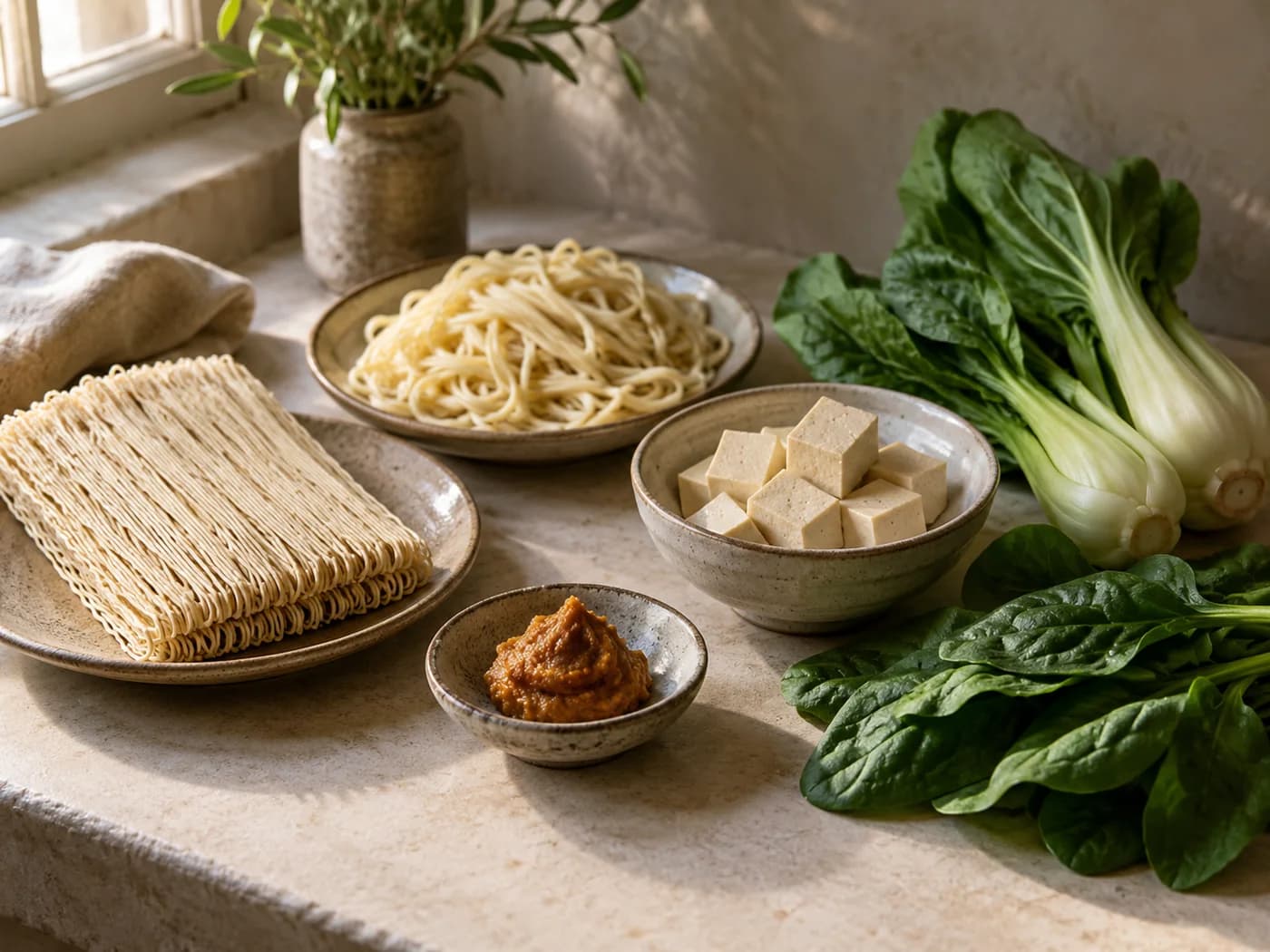
Choose noodles by product, not just shape
Fresh ramen often weighs more than dry ramen for an equivalent amount of flour because it contains more water. Fried instant noodles also contain oil that a plain dried product may not. Neither is a direct gram-for-gram match to this reference. Use the package nutrition and cooking instructions, then decide on a serving that suits the bowl. The goal is a pleasant noodle texture, not forcing an unfamiliar product into another product’s timing.
Rice noodles, soba or other wheat noodles can make a different soup, but they should be named and calculated accordingly. Gluten-free noodles alone do not make this entire recipe gluten-free: the reference soy sauce contains wheat, and miso and other products need checking. The original contains wheat, soy, egg and sesame. Follow your own allergen requirements and package information rather than assuming a broad category such as miso is always suitable.
Poultry and plant-based options
Cooked chicken can be convenient, but it needs a different weight entry and heating sequence. Keep it chilled, count its original cooking date for storage, and reheat safely without simmering it for the raw-chicken cooking time. Raw turkey or chicken thigh would also change the reference nutrition and possibly the cooking behaviour. Whatever poultry you choose, use a thermometer rather than relying on the colour of the broth or surface.
Firm tofu is an option for a separately planned plant-based adaptation. Its protein, moisture and portion size differ from chicken, and leaving out the egg changes the recipe again. Choose a tofu product you enjoy, check its label and decide whether to brown it separately or warm it in the soup. The chicken-and-egg figures do not carry over just because the rest of the vegetables and noodles stay the same.
Vegetables and broth can be flexible
Spinach can replace some bok choy leaves, but it will not supply the same crisp stems. Another mushroom changes flavour and may need different preparation. Prepared stock can replace water as a deliberate convenience version; count its nutrients and adjust seasonings only after tasting. These substitutions are suggestions rather than tested variations. Keep the first adaptation simple enough that you can tell which change improved the bowl and which one needs a different approach next time.
Check the actual product form and label before keeping the reference quantities.
| Reference | Alternative | What changes |
|---|---|---|
| Dry wheat ramen | Fresh or instant noodles | Water content, fat, sodium and cooking time |
| Raw chicken breast | Ready-cooked chicken | Weight basis, seasoning and safe reheating |
| Bok choy | Spinach or cabbage | Texture and cooking sequence |
| Water, miso and soy | Prepared stock | Sodium, ingredients and allergens |
| Egg and edamame | Tofu adaptation | Different protein, texture and nutrients; untested |
| Wheat and soy ingredients | Special-diet products | Check every label; no automatic allergy claim |
How to Make It
Prepare the egg, beans and vegetables
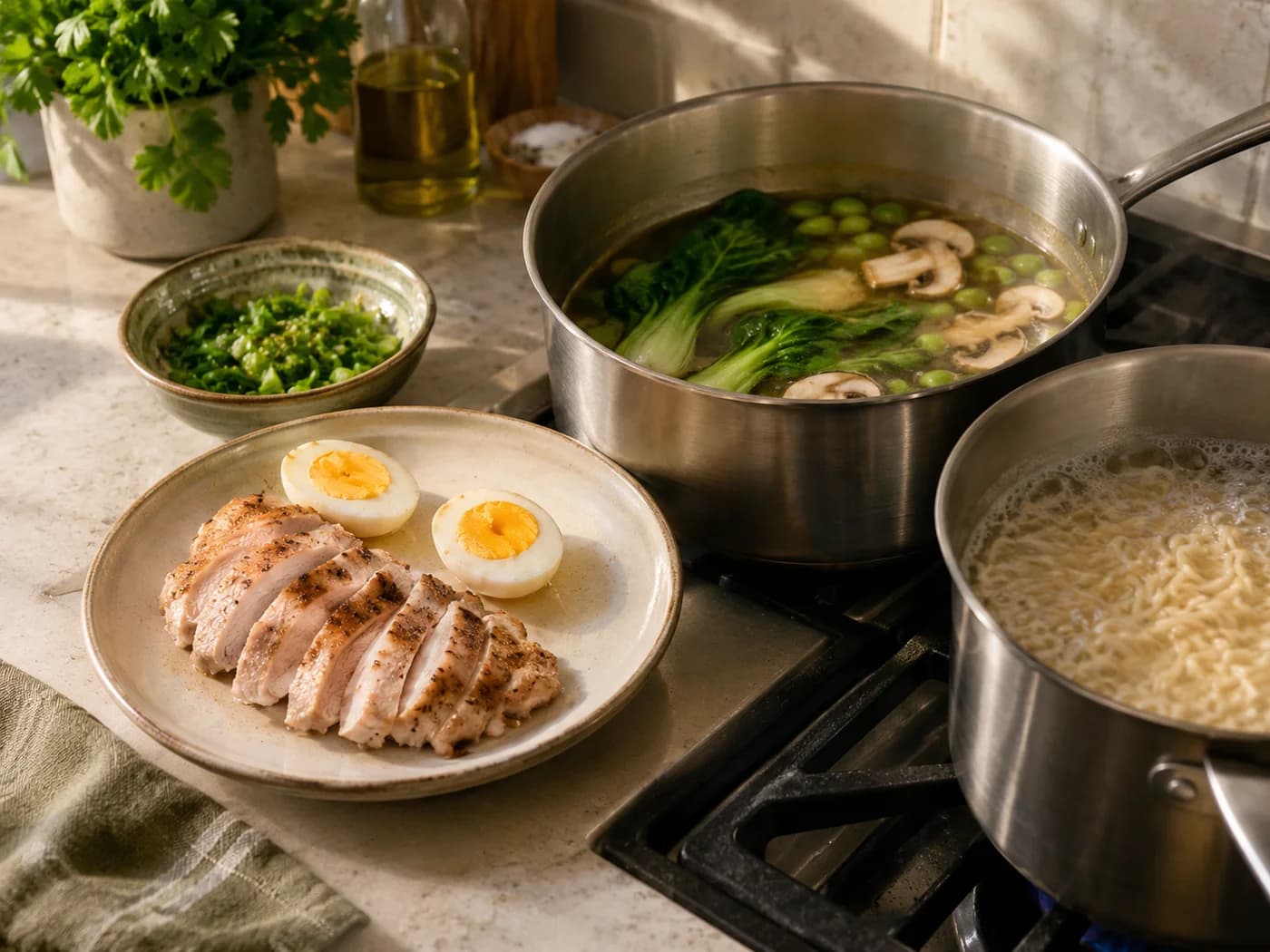
Cook two eggs in a separate saucepan until both white and yolk are firm; roughly 10–12 minutes at a gentle boil is a planning estimate that depends on egg size and starting conditions. Cool enough to handle, peel and weigh 100g edible egg. Prepare edamame to its packet directions and weigh 100g cooked drained beans. Slice mushrooms, separate bok choy stems and leaves, grate ginger, chop garlic and slice scallions.
Pat the two raw 120g chicken cutlets dry and keep them about 1.5cm thick. Heat 6g sesame oil in a broth pot of at least 3 litres over moderate heat. Lightly brown the chicken for about 1–2 minutes per side; this is a flavour stage, not the doneness check. Add mushrooms, ginger and garlic around the pieces and stir briefly, taking care not to scorch the garlic.
Build and check the chicken broth
Add 900g water and bring the liquid to a simmer. Cook gently rather than boiling violently, checking the chicken from around 10 minutes; approximately 10–14 minutes of simmering is only a guide. Check both cutlets at their thickest point for 165°F / 74°C with a food thermometer. Transfer cooked meat to a clean plate or board with clean utensils, then slice when ready to assemble.
Add the bok choy stems to the simmering broth for about 2–3 minutes, then add the leaves and cooked edamame for another 1–2 minutes, until the greens suit your preference and the beans are hot. Meanwhile, cook the measured dry noodles in a separate pot of fresh water to their packet directions, then drain. Do not use the egg cooking water or add a seasoning packet to the broth.
Finish and assemble without a long wait
Take the broth off the heat. Loosen 20g miso with a little hot broth in a clean bowl, then stir it back with 10g reduced-sodium soy sauce. Divide noodles, sliced chicken, vegetables and all broth between two deep bowls. Top each with 50g hard-boiled egg, halved, and 10g scallions. Serve promptly. Taste before adding anything extra; the printable card below scales the ingredient amounts while keeping the same bowl definition.
Tips for the Best Results
Protect the noodle texture
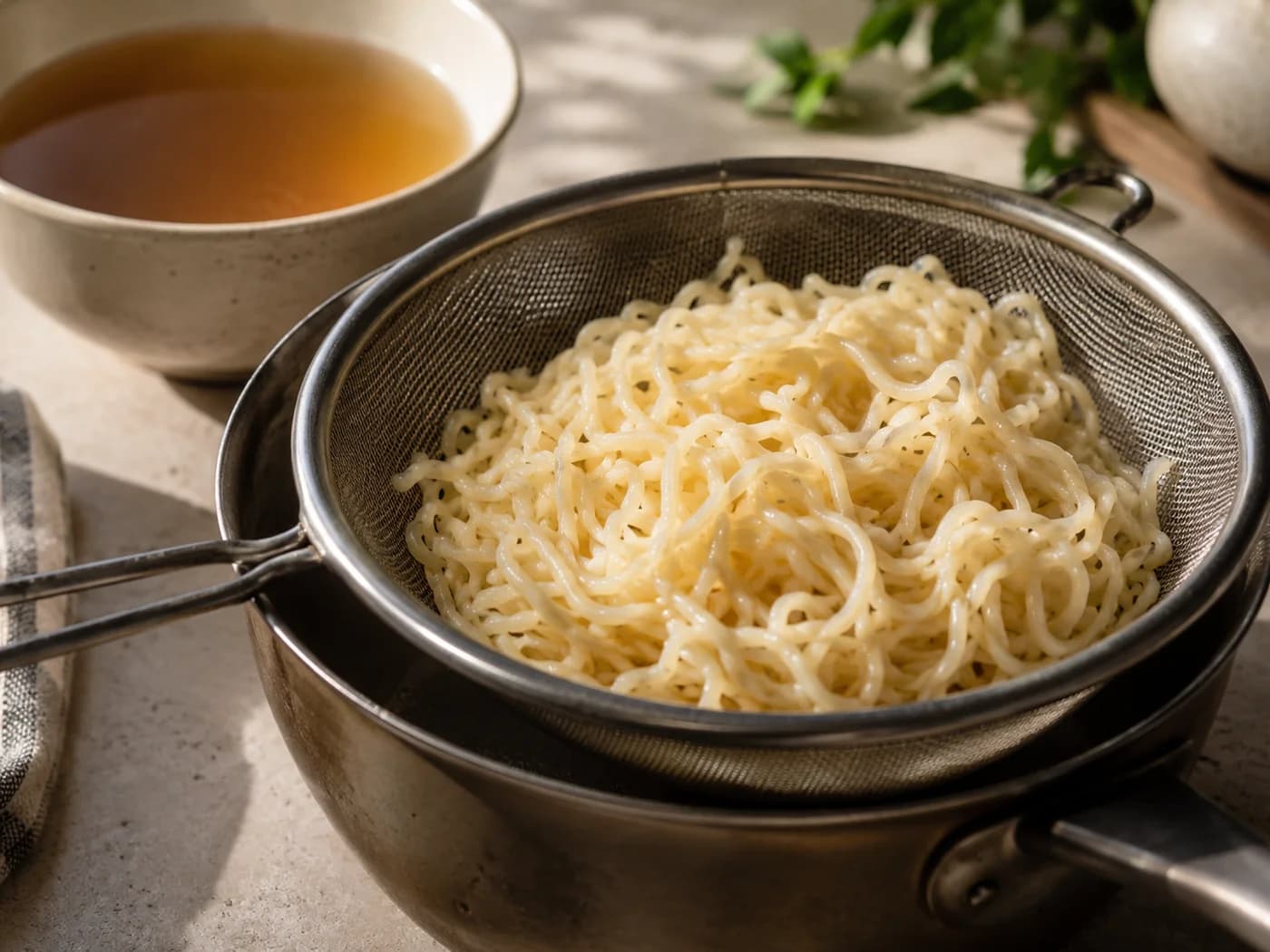
Have the broth and toppings almost ready before the noodles go into their cooking water. A noodle that is pleasant when drained can soften noticeably while waiting in hot soup. Separate cooking also keeps the served broth from taking on all the starch released into the noodle pot. Follow the actual product’s directions and taste a strand for texture; a timer for another noodle is not a reliable substitute.
Drain thoroughly but do not leave a compact mound sitting unattended for a long time. If the noodles begin to stick, use the reheating or loosening method recommended for your product rather than automatically pouring over extra oil. Oil would alter the reference recipe, and it may not solve the underlying delay. Warm bowls and a prepared serving area make it easier to move from drained noodles to dinner without interruption.
Gentle heat helps the chicken
Light browning adds flavour, but the simmer finishes the meat. Keep the chicken pieces similar in thickness so one is not drying out while the other remains underdone. Lift each piece only after its own temperature check. A rolling boil can jostle the ingredients and reduce the liquid quickly; a steady gentle simmer is easier to control. Clean utensils are essential when moving from raw handling to cooked slicing and serving.
Pay attention to how much liquid remains. Wide pots, strong heat and a lengthy simmer can reduce the 900g starting water more than expected. If needed for a usable broth, add a measured splash of plain hot water and record it as a texture adjustment. It does not add meaningful energy under the water assumption, but it does change dilution. Never infer a lower total sodium amount merely because the soup tastes less concentrated.
Season at the end and taste carefully
Miso disperses more smoothly when first mixed with a little hot broth. Adding it after the simmer also gives you a chance to assess the finished liquid rather than seasoning before evaporation. Stir thoroughly so the first bowl is not mostly plain broth and the second gets a lump of paste. Taste a safely cooled spoonful before adding anything beyond the reference. Salt, soy sauce and chilli oil are easy to add in amounts that become hard to remember later.
High-Protein / Lower-Calorie Variations
Reduce the noodles, keep the other components
Using 80g dry noodles for the two-bowl batch gives 40g per person instead of 60g. With everything else unchanged, the calculated estimate is approximately 512 calories and 49.3g protein per bowl. That is a smaller noodle nest with more visible broth, chicken and vegetables. It is a useful option if that balance matches your appetite, but it should not be described as the same portion of noodles with fewer calories.
This adjustment also lowers the conservative sodium estimate because fewer dry noodles are entered in the calculation. It does not establish the exact sodium remaining after boiling and draining. The noodle label still matters, and miso and soy sauce remain meaningful contributors. Keep the vegetables and protein components properly divided; simply ladling less soup into one bowl would not reproduce the measured variation.
Add chicken or omit the egg
An additional 100g raw chicken across the batch raises each starting chicken portion to 170g and gives approximately 641 calories and 62.6g protein per bowl. Keep the thickness practical by using wider or additional pieces, give them room in the pot and check each one. More chicken may need a larger cooking vessel or separate rounds. It is a protein increase with additional energy, not a reason to assume the original cooking time still applies.
Omitting the 100g cooked egg from the batch gives approximately 504 calories and 45.1g protein per bowl, with all other ingredients unchanged. The topping loses the firm white and yolk contrast, but chicken and edamame still provide substantial protein. This is not necessarily an egg-free recipe for someone with an allergy: the actual noodle and other labels, shared equipment information and preparation conditions still require checking.
Smaller portions and bigger changes
Half of a complete reference bowl, with half of every component and its broth share, provides approximately 291 calories and 25.7g protein. That is portion division, not a new formula. For a vegetarian, vegan or gluten-free version, change the relevant ingredients deliberately and make a fresh calculation. Avoid stacking several swaps on the first attempt if you want to learn how each ingredient affects flavour, fullness, noodle texture and the overall balance of the soup.
Each comparison changes only the stated ingredient; adaptations are calculated, not separately kitchen-tested.
| Version | Calories, approximately | Protein, approximately |
|---|---|---|
| Reference complete bowl | 581 kcal | 51.3g |
| 40g dry noodles per bowl | 512 kcal | 49.3g |
| 50g extra raw chicken per bowl | 641 kcal | 62.6g |
| Omit the 50g cooked egg | 504 kcal | 45.1g |
| Half a complete reference bowl | 291 kcal | 25.7g |
Serving Suggestions
Use a bowl with enough room
A deep bowl makes this meal easier to eat than a shallow plate filled to its rim. Allow space for noodles, vegetables, chicken, egg and broth without having to compress the toppings into a tight mound. Place noodles in first, then distribute the solids and ladle broth around them. This simple sequence lets you see whether the chicken and beans are divided fairly before the egg and scallions go on top.
A spoon is useful for the broth even if you prefer chopsticks for noodles. There is no need to arrange every slice perfectly before dinner can begin. A few visible groups of ingredients make the bowl inviting and help people recognise what they are eating. Keep the hard-boiled egg halves near the surface so they are easy to find, and bring the bowls to the table without a long covered wait.
Offer extras with a clear boundary
Someone who enjoys heat may want chilli sauce or chilli oil at the table. Those are optional additions, with their own ingredients and amounts. The same applies to sesame seeds, nori, corn, extra soy sauce or another egg. The reference deliberately keeps a short, measured set of toppings. If you track the meal, note what you actually add rather than assuming a spoonful of condiment disappears into the large volume of broth.
This bowl can stand on its own as a substantial meal. If you want a side, choose something that fits your appetite and the rest of your day, and count it separately when relevant. You do not need to add another large protein portion just because the page focuses on protein. Equally, you can choose a smaller soup portion and a side you enjoy without treating the reference serving as a compulsory amount.
Plan the table around the final few minutes
Set out bowls, spoons and drinks before cooking the noodles. That small preparation avoids leaving drained noodles on the counter while searching for serving dishes. If people are eating at different times, keep safely handled components separate and finish noodles close to each meal instead of holding a fully assembled bowl for hours. The pleasant texture of ramen depends as much on the moment of assembly as on what went into the pot.
Meal Prep & Storage
Prepare the broth, finish noodles later
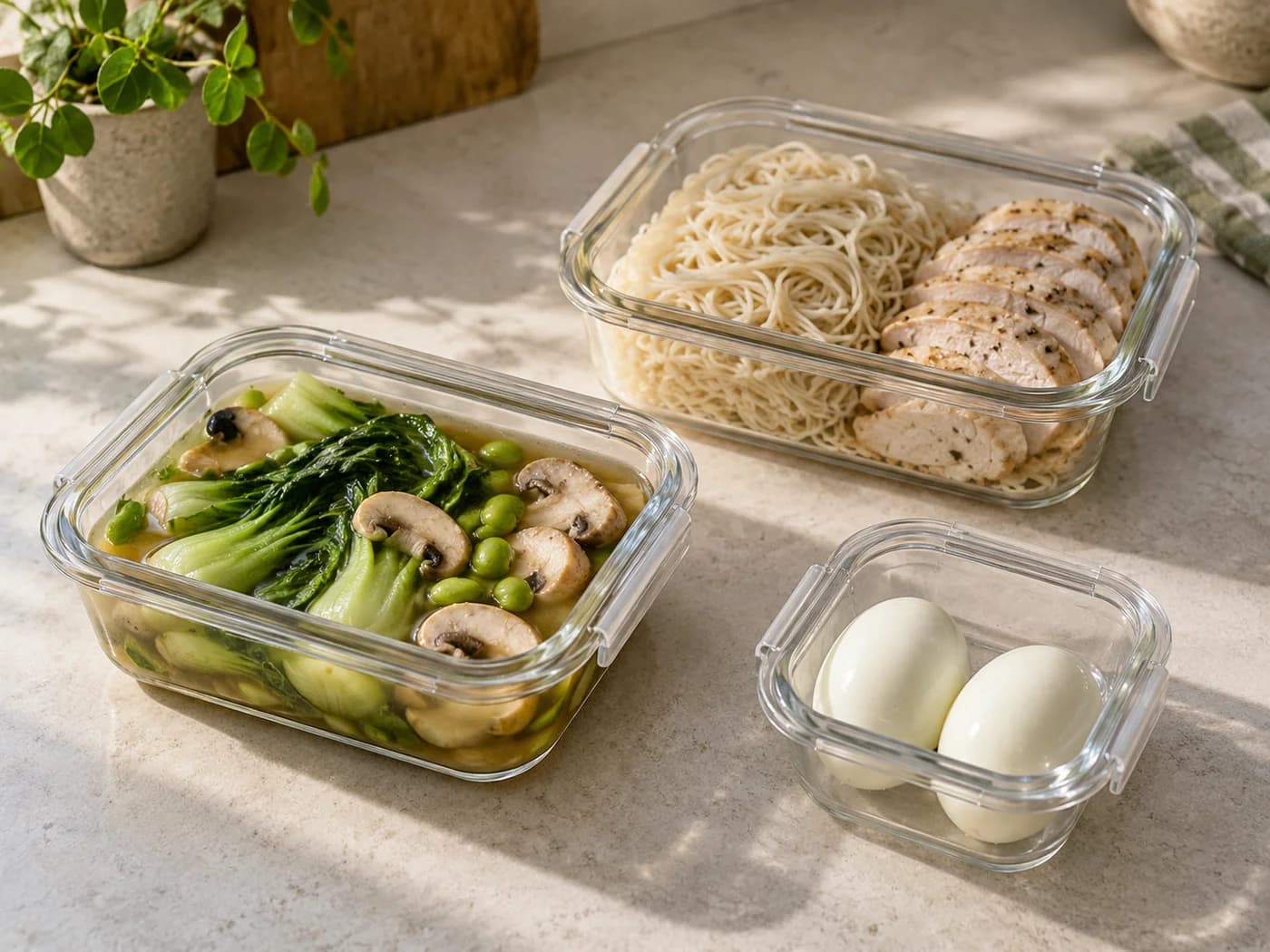
Ramen is easier to prepare ahead when you think in components. Safely cooked broth, chicken and vegetables can be portioned for later, while dry noodles stay in their original suitable storage until needed. Cooking fresh noodles at mealtime avoids a long soak and gives you a more controllable texture. If you do cook noodles ahead, cool and refrigerate them promptly in a separate container rather than leaving them submerged in the soup.
The egg can also be kept separate, following appropriate hard-boiled egg storage guidance and its original preparation date. Once an egg is assembled into a mixed meal, use the shortest applicable storage window for the meal’s components. Do not let a longer standalone egg storage period override the chicken-and-broth leftovers limit. A label with cooking dates is more useful than trying to judge safety from the appearance of a neat container.
Cool promptly in portions
Divide cooked food into shallow containers and refrigerate promptly at 40°F / 4°C or below. General guidance for suitably handled cooked poultry and soup leftovers is 3–4 days. Refrigerate within 2 hours, or within 1 hour when the surrounding temperature is above 90°F / 32°C. A large pot left cooling on the stove can stay warm for too long; portioning is part of the storage plan, not just a convenience for lunch.
For a freezer plan, the broth and chicken are more practical candidates than a fully assembled egg-and-noodle bowl. One month at 0°F / −18°C or below is a conservative quality suggestion for these untested components, not a measured shelf-life claim. Use suitable containers with expansion space and thaw in the refrigerator. Greens may soften and noodles can change texture after freezing, so keep your expectations different from a freshly assembled dinner.
Reheat the components throughout
Reheat stored broth, chicken and vegetables thoroughly to 165°F / 74°C, checking the solid portions as well as the liquid. Soup that bubbles at the edge does not prove a cold chicken piece is hot throughout. Reheat any cooked egg used with the leftovers appropriately as part of the served meal; do not assume hot broth instantly heats a refrigerator-cold topping. Cook or loosen noodles separately, assemble and eat promptly. Reheating cannot correct unsafe storage earlier in the week.
Full Nutrition Information
The calculation follows the ingredients
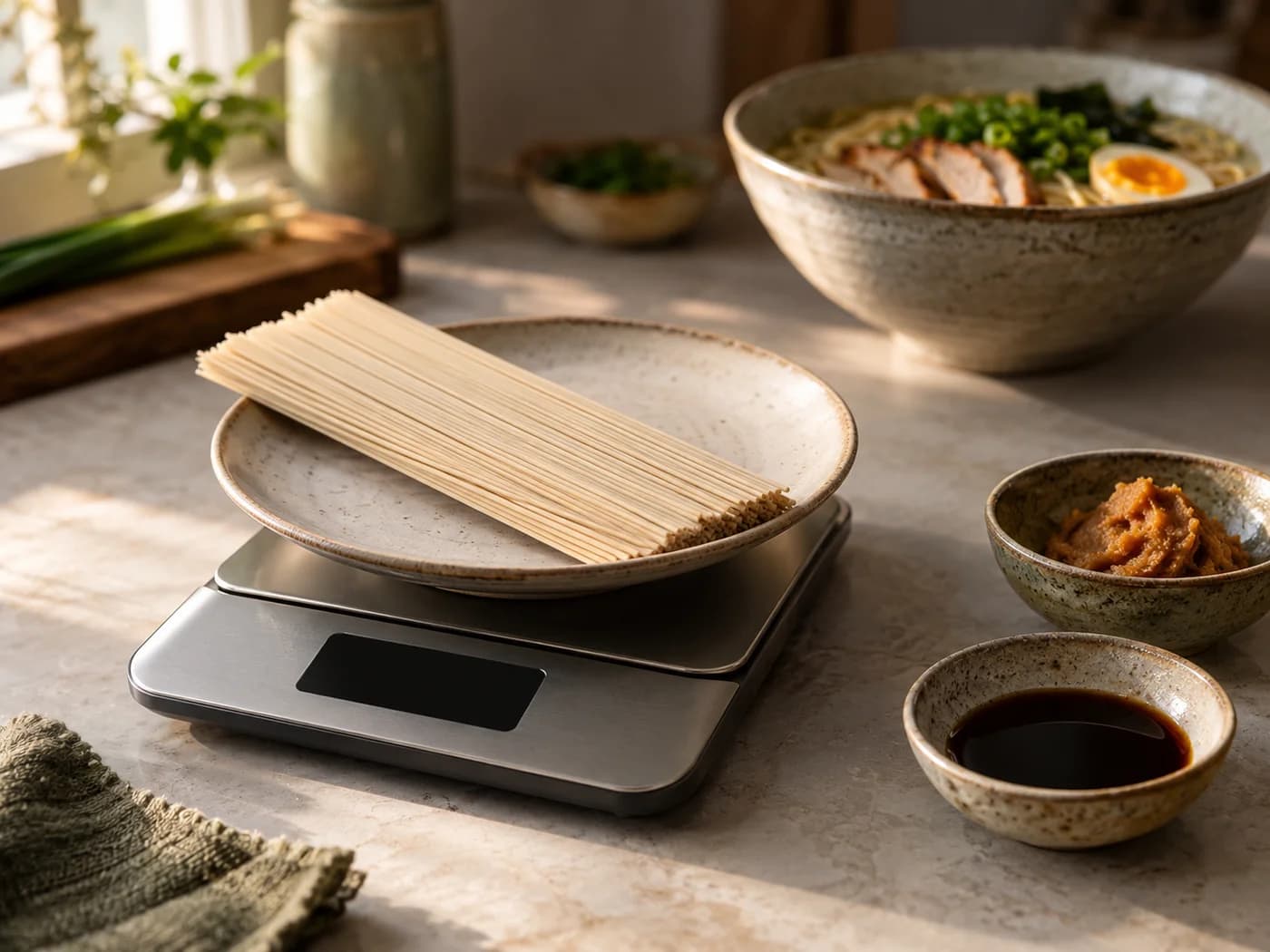
For each nutrient, multiply the per-100g reference value by the ingredient weight, divide by 100, then add every ingredient’s contribution. Divide the batch total by two to obtain one complete bowl. The same arithmetic covers chicken, noodles, eggs, beans, vegetables, seasonings and oil. Plain water is included as the broth quantity but assumed to add no counted energy or nutrients; cooking water that is discarded is outside the served recipe.
Eleven ingredients use historical USDA SR28 generic food values. Chicken is raw skinless boneless breast; eggs are hard-boiled and peeled; edamame is cooked and shelled; vegetables are raw trimmed starting weights. Those forms are deliberate. Using a cooked chicken entry with a raw chicken weight, or counting edamame pods as edible beans, would change the meaning of the calculation. Evaporation affects the finished soup weight without creating extra protein in the pot.
The dry noodles use the manufacturer’s US panel for Hakubaku Organic Ramen: 310 calories and 9g protein per 90g dry bundle. The recipe uses 120g dry for two bowls. Regional panels and other products differ. The full dry-noodle sodium is counted despite separate boiling and draining; its actual retention is unmeasured. The displayed sodium estimate is therefore conservative, not a laboratory result for the soup after cooking.
Use the food calculator to enter your own labels and any toppings you add. Convert package servings to their gram weights before comparing them with this recipe. If the label is for a whole noodle-and-seasoning kit, it may not tell you the noodle-only values needed here. Do not subtract a seasoning packet by guesswork. A different product can be a good dinner ingredient while still requiring a different nutrition estimate.
Read the detail without overreading the decimals
The complete batch is approximately 1,163 calories, 102.7g protein, 116.5g carbohydrate and 31.7g fat. One bowl is half: roughly 581 calories, 51.3g protein, 58.2g carbohydrate and 15.9g fat. Additional estimates are about 7.4g fiber, 5.3g total sugars, 3.2g saturated fat and 1,334mg sodium. Cholesterol, separate added sugars and a complete micronutrient profile are not calculated. Rounded rows may not add exactly to rounded totals because the arithmetic uses unrounded values first.
| Ingredient | Amount | Calories | Protein | Carbs | Fat |
|---|---|---|---|---|---|
| Raw skinless boneless chicken breast | 240g | 288 kcal | 54.0g | 0.0g | 6.3g |
| Dry ramen noodles | 120g | 413 kcal | 12.0g | 85.3g | 1.3g |
| Hard-boiled eggs | 100g | 155 kcal | 12.6g | 1.1g | 10.6g |
| Cooked shelled edamame | 100g | 121 kcal | 11.9g | 8.9g | 5.2g |
| White mushrooms | 150g | 33 kcal | 4.6g | 4.9g | 0.5g |
| Bok choy | 200g | 26 kcal | 3.0g | 4.4g | 0.4g |
| Miso paste | 20g | 40 kcal | 2.6g | 5.1g | 1.2g |
| Reduced-sodium soy sauce | 10g | 6 kcal | 0.9g | 0.6g | 0.0g |
| Sesame oil | 6g | 53 kcal | 0.0g | 0.0g | 6.0g |
| Fresh ginger | 12g | 10 kcal | 0.2g | 2.1g | 0.1g |
| Garlic | 8g | 12 kcal | 0.5g | 2.6g | 0.0g |
| Scallions | 20g | 6 kcal | 0.4g | 1.5g | 0.0g |
| Water | 900g | 0 kcal | 0.0g | 0.0g | 0.0g |
| Whole batch | 2 complete bowls · all broth included | 1163 kcal | 102.7g | 116.5g | 31.7g |
| One reference serving | Batch ÷ 2 | 581 kcal | 51.3g | 58g | 16g |
| Dietary fiber | 7.4g |
|---|---|
| Total sugars | 5.3g |
| Saturated fat | 3.2g |
| Sodium | 1334mg |
Estimated recipe nutrition, not laboratory analysis. Includes raw chicken, dry noodles, cooked egg and edamame, all vegetables, seasonings, oil and broth. Extras are additional. Uses historical generic USDA SR28 values, the specified US noodle label and a zero-nutrient plain-water assumption. Full dry-noodle sodium is conservatively counted despite draining; actual labels take priority. Cholesterol, separate added sugars and complete micronutrients are not calculated.
How This Fits Your Daily Protein Goal
Put the serving in the context of your day
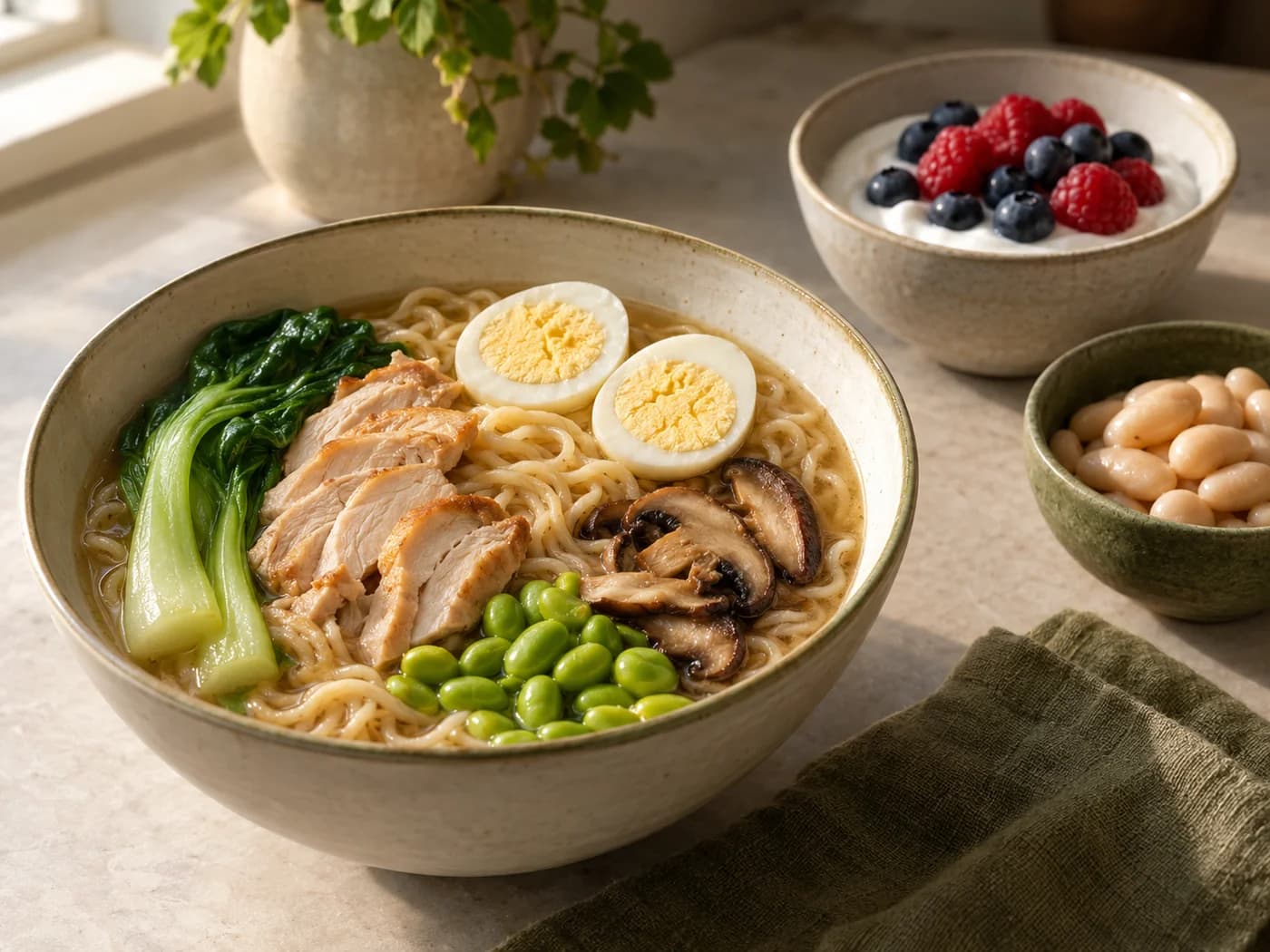
The protein calculator can help estimate a daily target using the information you provide. One reference ramen bowl then contributes approximately 51.3g toward that total. The right target depends on your circumstances, and a recipe cannot determine it for everyone. If you have a medical condition or an individual nutrition prescription, follow qualified professional advice rather than treating a meal example as personalised guidance.
Against an example target of 100g, this bowl supplies about 51%; against 125g, about 41%; against 150g, about 34%. These are simply calculations using different possible totals. They do not suggest that everyone needs one of those amounts. The same bowl may be a substantial part of one person’s day and a smaller share of another’s, depending on the actual target and other foods eaten.
Leave room for the rest of the meal pattern
Protein is useful to track, but it is not the only feature of dinner. This ramen also brings energy, carbohydrate, fat, fiber and a meaningful conservative sodium estimate. Its suitability depends on the whole pattern, not just the large protein number in the title. Choose breakfast, lunch, snacks and other dinners that give you variety rather than asking every meal to repeat the same ingredients or reach an identical protein total.
If a full deep bowl is more than you want at one sitting, divide every component proportionally. Half a reference bowl provides about 25.7g protein, and another food can contribute the rest of whatever meal you choose. Keep the egg, chicken, noodles, edamame and broth shares together when dividing. Giving away mostly broth while keeping all the chicken is a different portion, with a different nutrient distribution.
Make protein planning workable in an ordinary kitchen
Think about the steps you can realistically manage on a weeknight. This recipe benefits from a clean preparation area, several components and noodles finished near serving time. On a busier day, a simpler meal from the collection may be more useful than rushing through chicken handling and assembly. A practical protein plan allows that flexibility. Meals are easier to repeat when their flavour, effort and portion suit your routine, not merely when their totals look impressive.
Make it personal
Where does this meal fit in your day?
Estimate your daily protein target, then plan meals you enjoy.
Recipe Card
Choose the serving count before cooking
The card brings the complete ingredient list and six method stages together. Select two, four or six bowls before you begin weighing. The chicken remains 120g raw per bowl, noodles 60g dry, cooked edamame 50g and peeled cooked egg 50g. Scaling makes more equivalent portions; it does not turn two small cutlets into a few oversized pieces that need a different cooking approach.
The reference is organised around a two-bowl broth batch in a pot of at least 3 litres. Four bowls call for two matching batches, and six for three, unless you have appropriately larger equipment and understand the different heating and evaporation. You can cook batches sequentially. The card keeps the original time estimate visible with a reminder that extra portions need additional preparation and possibly more cooking rounds.
Keep the checklist useful
Check off an ingredient after it has been measured or added, according to whichever system helps you cook. Reset the list for a fresh start. Changing the serving count clears the ticks so a mark beside the old amount cannot be mistaken for completion of the new one. Set the device aside before handling raw poultry, and use clean hands when returning to it. Preparing the clean vegetables and seasonings first makes that separation easier.
Print the card after selecting the intended quantity. The printed method includes the temperature checks, portion definition and storage reminders, so the essential instructions stay with the amounts. It cannot guarantee that a particular egg, noodle or chicken product will cook in the estimated minutes. Your package directions and thermometer remain the useful checks when the actual food behaves differently from a planning example.
The nutrition line stays per bowl
Each equivalent bowl remains approximately 581 calories and 51g protein when the recipe is doubled or tripled. The selected batch total grows; the serving does not. Include each person’s share of all broth and seasonings, and count optional toppings separately. The card also carries the sodium assumption and the disclosure that the exact weighed formula is untested in a physical kitchen. That context matters just as much on a printed page as beside the longer article.
A warm bowl, ready for the table
High-Protein Ramen
Chicken miso broth with ramen noodles, firm egg, edamame and greens.
*Two-bowl planning estimates; egg and edamame preparation overlaps early work. Larger quantities need matching batches in pots of at least 3 litres, sequentially if needed, with extra time. Exact weighed formula not physically kitchen-tested.
Ingredients
Method
- Prepare the toppings and vegetables
Cook 2 eggs until whites and yolks are firm (roughly 10–12 minutes is a planning guide), cool, peel and weigh 100g. Cook frozen edamame to packet directions, then weigh 100g drained. Prepare 150g mushrooms, 200g bok choy with stems and leaves separate, 12g ginger, 8g garlic and 20g scallions. Weigh 240g raw chicken as 2 cutlets, 120g each, about 1.5cm thick.
- Lightly brown the chicken
Use 1 matching two-bowl broth batch, each in a pot of at least 3 litres; cook sequentially if needed. Per two-bowl batch, heat 6g sesame oil over moderate heat. Lightly brown two cutlets for about 1–2 minutes per side; this does not establish doneness. Briefly cook the allocated mushrooms, ginger and garlic around them without scorching.
- Simmer and check the chicken
Add 900g plain water per two-bowl batch (900g total). Simmer gently, checking from about 10 minutes; roughly 10–14 minutes is only a guide. Every cutlet must reach 165°F / 74°C at its thickest point. Transfer to a clean plate and slice with clean utensils. Keep raw-chicken equipment separate.
- Cook the greens and noodles
Per batch, simmer the bok choy stems about 2–3 minutes, then add leaves and prepared edamame for about 1–2 minutes until hot. In a separate pan of fresh water, cook 120g dry ramen to actual packet directions and drain. Use fresh water after egg preparation; add no seasoning packet, extra oil or salt.
- Finish the broth and assemble
Turn off the broth heat. Per batch, loosen 20g miso in a little hot broth and stir it back in with 10g reduced-sodium soy sauce (20g miso and 10g soy total). Divide noodles, chicken, vegetables and all broth into 2 bowls. Each gets 50g cooked egg cut into two halves, 50g cooked edamame and 10g scallions. Extra toppings are additional.
- Serve or chill promptly
Serve promptly. Refrigerate leftovers in shallow separate containers at 40°F / 4°C or below within 2 hours, or 1 hour above 90°F / 32°C. Use within 3–4 days with safe handling, respecting earlier ingredient storage history. Reheat throughout to 165°F / 74°C. Larger batches require extra preparation and cooking rounds; times do not scale linearly.
Contains wheat, soy, egg and sesame; check actual labels. Chicken raw, noodles dry, egg and edamame cooked. All broth counted; full dry-noodle sodium conservatively included. Extras additional. Refrigerate within 2 hours, or 1 hour above 90°F / 32°C. Keep chilled; reheat throughout to 165°F / 74°C.
Frequently Asked Questions
Practical answers before the noodles go in
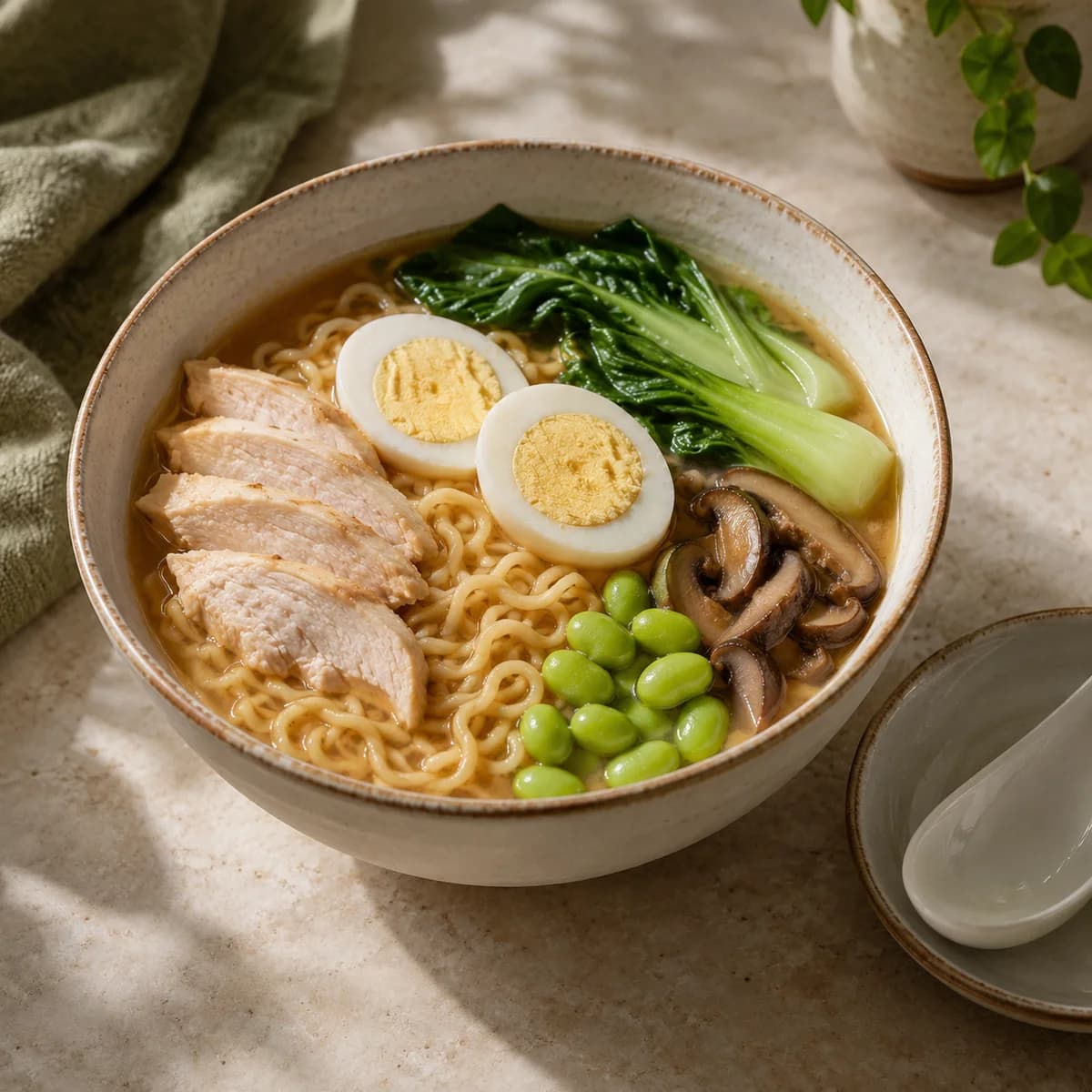
A ramen bowl can look simple while still containing several ingredients with different cooking and tracking needs. The questions below clarify the dry-noodle portion, raw chicken weight, cooked toppings and conservative sodium calculation. Read the ones that affect your ingredients before starting, then keep the method nearby for the sequence. A clear portion definition is more useful than assuming every bowl or packet is the same size.
If you change the noodle product, broth base or protein, record the new amounts and use the relevant labels. These answers explain the reference and possible adaptations; they do not claim that every variation has been tested. Taste and texture still need attention in your own kitchen.
How much protein is in one bowl?
One complete reference bowl provides approximately 51.3g protein and 581 calories. It includes chicken starting at 120g raw weight, 60g dry noodles, 50g cooked drained edamame, 50g peeled hard-boiled egg, and half of all vegetables, seasonings and broth. A smaller bowl or a different noodle product changes that estimate. The calculation is ingredient-based rather than laboratory analysis.
Should I weigh the chicken raw or cooked?
Weigh 240g raw skinless boneless chicken for the two-bowl recipe, using two cutlets of about 120g and 1.5cm thickness. Cooking changes its water content, so 120g cooked chicken is a different input. Use plain chicken without an added solution for the reference. If using ready-cooked chicken, record its cooked amount and actual nutrition separately.
Are the noodles weighed dry?
Yes. The reference uses 120g dry ramen for two bowls, or 60g dry per bowl. Water absorbed during cooking increases their weight without creating extra noodles. Follow your actual packet for cooking and drain separately. The calculation uses the manufacturer’s US Hakubaku Organic Ramen panel; other regional panels and brands can differ.
Can I use instant or fresh ramen?
You can adapt the bowl, but use the actual product’s label and its stated dry or fresh weight. Fried instant noodles may have different fat and sodium values; fresh noodles contain more water. Do not substitute gram for gram while keeping the reference nutrition. An instant seasoning packet is not included in this recipe and would add its own ingredients and sodium.
Can I add stock instead of water?
Stock is an optional adaptation. The reference starts with 900g plain water for two bowls, with chicken, mushrooms and aromatics contributing flavour before miso and soy sauce are added. Stock, bouillon and broth powders can substantially change sodium. Check the amount used and its label, then recalculate rather than assuming the existing table still applies.
Is this a low-sodium ramen recipe?
No. The estimate is about 1,334mg sodium per complete bowl. It counts the full sodium listed for the dry noodles, plus miso, reduced-sodium soy sauce and other ingredients. Some noodle sodium may be lost during separate boiling and draining, but the amount is unverified. Choose products with suitable labels if sodium matters for your own eating plan.
Why add the miso after turning off the heat?
Loosening miso with a little hot broth helps it disperse evenly instead of leaving salty lumps. Adding it off the heat also keeps the finish gentle and aromatic. This is a flavour and mixing step, not a claim about guaranteed probiotic benefits. Miso still contributes sodium, and the full measured 20g is counted for the two-bowl batch.
Can I use a soft-boiled egg?
The reference uses eggs with firm whites and yolks, weighed after cooking and peeling at 50g per bowl. FoodSafety.gov recommends cooking eggs until both white and yolk are firm. The photographs and card follow that guidance. If omitting the egg entirely, the calculated bowl is about 504 calories and 45.1g protein with other ingredients unchanged.
Is the recipe gluten-free or vegan?
The reference is neither. It contains chicken and egg, wheat ramen, soy ingredients and sesame oil. Soy sauce and some miso may also contain wheat or other allergens. A tofu and alternative-noodle version needs its own ingredient checks and calculation. Swapping one ingredient does not establish that the entire bowl is suitable for a particular allergy or diet.
How do I keep the noodles from turning soft?
Cook them separately near serving time and follow the actual packet’s timing. Drain promptly, portion into bowls, then add hot broth and toppings. Noodles continue absorbing liquid after assembly. For planned leftovers, keep them separate from the broth and expect some texture change after chilling and reheating; do not leave cooked food out to preserve its texture.
How long can I keep leftovers?
With prompt cooling and refrigeration at 40°F / 4°C or below, use the assembled meal components within three to four days. Refrigerate in shallow containers within two hours, or one hour above 90°F / 32°C. Reheat leftovers throughout to 165°F / 74°C. Use the shortest safe storage window of any previously cooked ingredient added to the meal.
How do I make four or six bowls?
Choose four or six on the card to multiply every ingredient by two or three. Keep the same per-bowl portions and use matching two-bowl broth batches in pots of at least three litres. You can cook sequentially with one suitable pot, allowing more time. A larger quantity does not make a crowded pot cook evenly or preserve the original total time.
How can I reduce calories or increase protein?
Reducing dry noodles to 40g per bowl gives approximately 512 calories and 49.3g protein with everything else unchanged. Adding 50g extra raw chicken per bowl gives about 641 calories and 62.6g protein. These are separate calculated adaptations, not tested versions. Choose the change that suits appetite and ingredients rather than treating a bigger protein number as automatically better.
Has the exact recipe been kitchen-tested?
The exact weighed formula has not been physically kitchen-tested. The cooking sequence is a practical proposed method, timings are planning estimates, and generated photographs illustrate the dish. Nutrition is calculated from historical generic food values and a stated manufacturer label. Check each chicken cutlet with a thermometer, follow actual product directions, and adjust texture and seasoning to your ingredients.
More High-Protein Recipes
Choose another dinner by how you want to cook
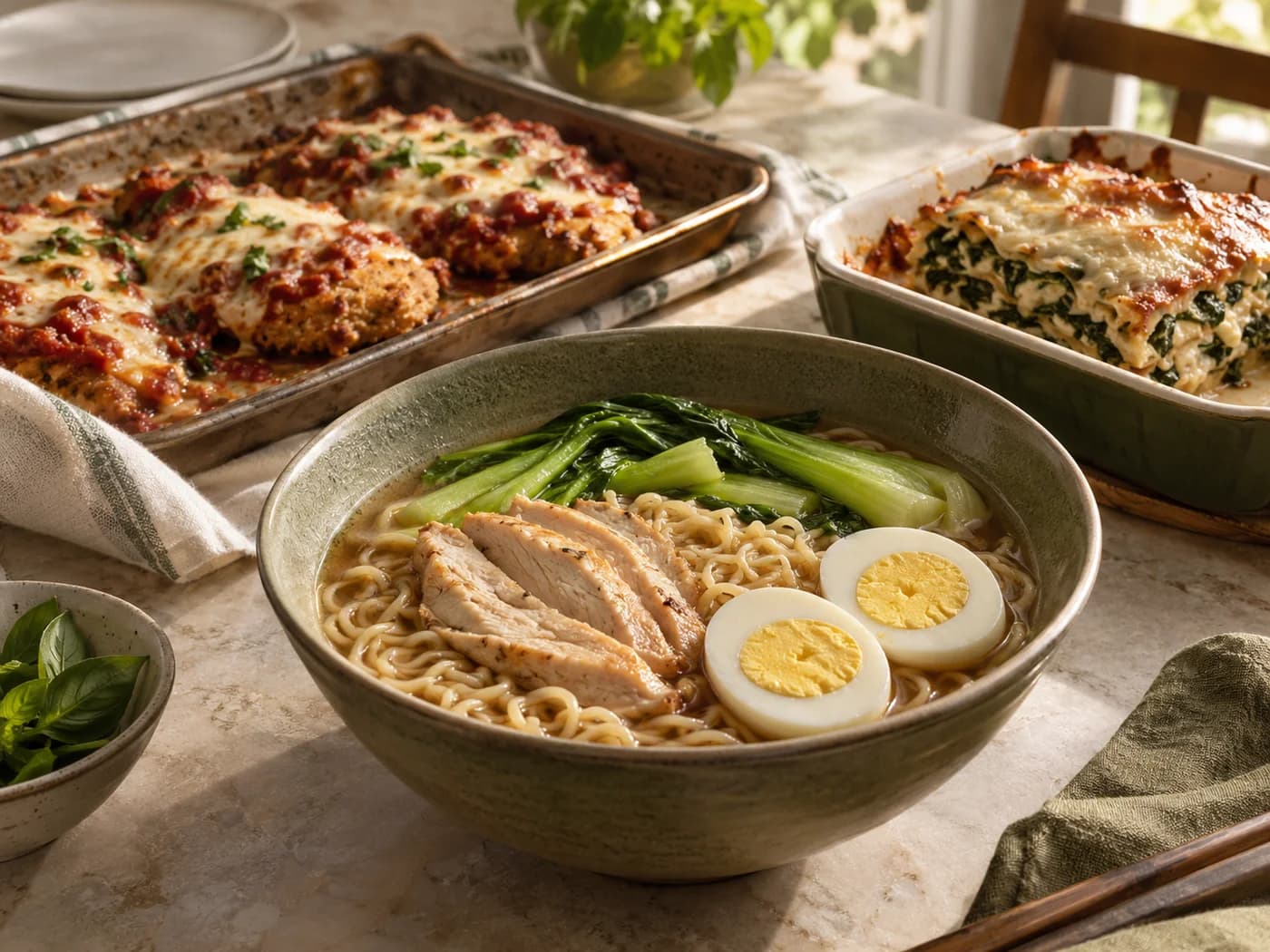
If you enjoy chicken but want a different texture, high-protein chicken Parmesan gives you an oven-baked crumb coating, tomato sauce and melted cheese. Chicken enchiladas offer a saucier tray of tender tortilla rolls, while a quesadilla brings a crisp skillet finish. These are separate recipes with their own ingredients, cooking times and serving definitions. Their numbers should not be compared as though every serving contains the same amount of food.
For another noodle or pasta evening, mac and cheese focuses on a creamy sauce, and lasagna layers turkey, spinach and dairy into a bake. Either can be a useful change from broth without requiring you to abandon familiar ingredients. Choose based on the time available and the meal you want to eat, then check how that recipe counts its protein, sides and portion size.
Keep a collection that suits real evenings
The broader recipe hub includes breakfasts, dinners and homemade bakes. A few reliable choices with different textures can make a recurring shopping list more enjoyable: chicken in ramen one night, a tortilla dinner another, and a pasta bake when you have time to assemble it. There is no need to invent a new meal every day or choose the highest protein number regardless of flavour.
Use the linked guides to compare effort, reheating and ingredients as well as nutrition. A bowl that tastes good fresh may need a component-based storage plan; a bake may be easier to portion later. Those practical differences matter when planning lunches or feeding people at different times. Save the options that fit your kitchen and let the recipes support your routine rather than make it unnecessarily complicated.